
PHYS-382 · Lesson 7 of 12 · 22 min
Electromagnetic waves in matter: reflection, refraction and the Fresnel equations
Light slows down in glass and water, bends as it enters them, and partly reflects from their surfaces. All three effects follow from Maxwell's equations in linear media combined with the boundary conditions of lesson 4. This lesson derives the speed of light in a medium and the index of refraction, obtains the laws of reflection and refraction from the requirement that the boundary conditions hold everywhere on a surface, and then derives the Fresnel equations, which give how much light is reflected and transmitted for each polarization at every angle. Brewster's angle, total internal reflection and the reflection from a window all drop out, and a program confirms that the reflected and transmitted powers always add up to the incident power.
Waves in linear media
In a linear, homogeneous medium with no free charge or current, Maxwell's equations read \(\nabla\cdot\mathbf{E} = 0\), \(\nabla\cdot\mathbf{B} = 0\), \(\nabla\times\mathbf{E} = -\partial\mathbf{B}/\partial t\) and \(\nabla\times\mathbf{B} = \mu\varepsilon\,\partial\mathbf{E}/\partial t\). They differ from the vacuum equations only by the replacement \(\mu_0\varepsilon_0 \to \mu\varepsilon\), so the waves travel at
where \(n\) is the index of refraction and the last step uses \(\mu_r \approx 1\) for nearly all transparent materials. Everything about plane waves carries over with \(c \to v\): the fields are transverse, \(B_0 = E_0/v = nE_0/c\), the intensity is \(I = \tfrac{1}{2}\varepsilon vE_0^2\), and the impedance of the medium is \(Z = \sqrt{\mu/\varepsilon} = Z_0/n\). A puzzle shows that \(\varepsilon_r\) here must be measured at the frequency of the light. For water the static relative permittivity is about 80, which would give \(n \approx 9\), yet the measured optical index is 1.33. The permanent dipoles of water molecules can follow a slowly varying field but not one oscillating \(5 \times 10^{14}\) times a second. At optical frequencies only the electrons respond, \(\varepsilon_r \approx 1.77\), and \(\sqrt{1.77} = 1.33\). Lesson 8 develops this frequency dependence.
The laws of reflection and refraction
Let a plane wave with wave vector \(\mathbf{k}_I\) strike the flat surface \(z = 0\) between medium 1, of index \(n_1\), and medium 2, of index \(n_2\). In general it produces a reflected wave \(\mathbf{k}_R\) in medium 1 and a transmitted wave \(\mathbf{k}_T\) in medium 2, all with the same frequency \(\omega\) because the boundary conditions must hold at every instant. They must also hold at every point of the surface. That is possible only if the three waves have the same phase dependence along the surface:
Three geometric laws follow from this one requirement. First, all three wave vectors lie in one plane, the plane of incidence, which also contains the normal. Second, the components of the wave vectors along the surface are equal; since \(k_I = k_R = n_1\omega/c\), this gives \(\theta_R = \theta_I\), the law of reflection. Third, \(k_I\sin\theta_I = k_T\sin\theta_T\) with \(k_T = n_2\omega/c\), which is Snell's law,
These laws are purely kinematic: they would hold for sound or for quantum matter waves too, because they follow from matching phases along a surface. How much light goes into each wave is a dynamical question, and its answer depends on the full boundary conditions and on the polarization.
The Fresnel equations
There are two independent polarizations. In s polarization, from the German senkrecht for perpendicular, the electric field is perpendicular to the plane of incidence and lies parallel to the surface; in p polarization the electric field lies in the plane of incidence. Write \(\tilde{E}_{0I}\), \(\tilde{E}_{0R}\) and \(\tilde{E}_{0T}\) for the complex amplitudes and assume \(\mu_1 = \mu_2 = \mu_0\). For s polarization, continuity of the parallel component of \(\mathbf{E}\) gives \(E_{0I} + E_{0R} = E_{0T}\), and continuity of the parallel component of \(\mathbf{H}\), whose magnitude is \(nE/Z_0\) and which now has a component along the surface proportional to \(\cos\theta\), gives \(n_1\cos\theta_I(E_{0I} - E_{0R}) = n_2\cos\theta_T E_{0T}\). Solving the two equations,
The same steps for p polarization, where the roles of \(\mathbf{E}\) and \(\mathbf{H}\) are exchanged, give
These are the Fresnel equations, found by Augustin-Jean Fresnel in 1821 and 1823 from his elastic-solid theory of light, decades before Maxwell. Sign conventions for \(r_p\) differ between textbooks, but the powers do not. The reflectance and transmittance, the fractions of incident power reflected and transmitted, are
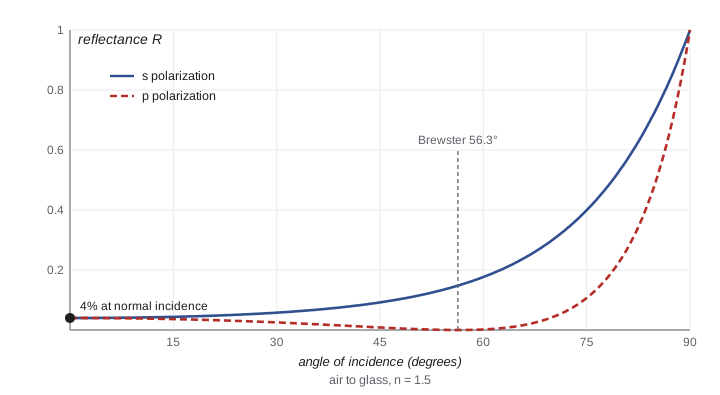
where the factor in \(T\) accounts for the different speed and impedance in medium 2 and for the change in beam width, since a beam of fixed width on the surface has cross-section proportional to \(\cos\theta\). At normal incidence both polarizations give \(R = \big(\frac{n_1 - n_2}{n_1 + n_2}\big)^2\), which is 4% for air and glass and 2% for air and water.
Brewster's angle and total internal reflection
The numerator of \(r_p\) vanishes when \(n_2\cos\theta_I = n_1\cos\theta_T\). Combined with Snell's law this happens when \(\theta_I + \theta_T = 90°\), that is, at Brewster's angle
At this angle p-polarized light is not reflected at all, so unpolarized light reflects as purely s-polarized. David Brewster found the effect experimentally in 1815. There is a physical picture: the transmitted light sets the electrons of medium 2 oscillating along its electric field, and an oscillating dipole radiates nothing along its own axis (lesson 11). At Brewster's angle the reflected direction lies exactly along that axis for p polarization. Glare from water and roads is largely s-polarized for the same reason, which is why polarizing sunglasses, whose transmission axis is vertical, cut it so effectively.
When light travels from a denser medium to a less dense one, \(n_1 > n_2\), Snell's law gives \(\sin\theta_T > 1\) for \(\theta_I\) beyond the critical angle \(\theta_c = \arcsin(n_2/n_1)\). Then \(\cos\theta_T\) becomes imaginary, the transmitted wave decays exponentially away from the surface instead of travelling, and \(|r_s| = |r_p| = 1\): total internal reflection. The decaying evanescent wave penetrates about a wavelength into the second medium and carries no average power across the surface. If a second dense medium is brought within that distance, some light tunnels through, frustrated total internal reflection, which is the optical analogue of quantum tunnelling. Optical fibres guide light by total internal reflection at the boundary between their core and cladding.
Computing the reflectances
The program implements the Fresnel equations with complex arithmetic, so that the same code works beyond the critical angle, where \(\cos\theta_T\) is imaginary. It tabulates \(R\) and \(T\) for both polarizations from air into glass, checks \(R + T = 1\), computes Brewster's angles and the glass–air critical angle, follows total internal reflection, and estimates the transmission of a window pane with reflections at both surfaces, adding the powers of the multiply reflected beams but ignoring interference between them.
import math, cmath
# Fresnel amplitude coefficients for light going from index n1 into index n2
def fresnel(n1, n2, th_i):
    ci = math.cos(th_i); si = math.sin(th_i)
    st = n1 * si / n2
    ct = cmath.sqrt(1 - st * st)                 # complex beyond the critical angle
    rs = (n1 * ci - n2 * ct) / (n1 * ci + n2 * ct)
    rp = (n2 * ci - n1 * ct) / (n2 * ci + n1 * ct)
    ts = 2 * n1 * ci / (n1 * ci + n2 * ct)
    tp = 2 * n1 * ci / (n2 * ci + n1 * ct)
    return rs, rp, ts, tp, ct

n1, n2 = 1.0, 1.5
print("air to glass (n = 1.5)")
print(" angle    Rs      Rp      Ts      Tp    Rs+Ts  Rp+Tp")
for deg in (0, 30, 45, 56.31, 70, 85):
    th = math.radians(deg)
    rs, rp, ts, tp, ct = fresnel(n1, n2, th)
    fac = (n2 * ct.real) / (n1 * math.cos(th))   # transmitted power uses the beam cross-section and speed
    Rs, Rp = abs(rs) ** 2, abs(rp) ** 2
    Ts, Tp = fac * abs(ts) ** 2, fac * abs(tp) ** 2
    print(f"{deg:6.2f}  {Rs:.4f}  {Rp:.4f}  {Ts:.4f}  {Tp:.4f}  {Rs + Ts:.4f} {Rp + Tp:.4f}")
print(f"Brewster angle air-glass = {math.degrees(math.atan(n2 / n1)):.2f} deg, air-water = {math.degrees(math.atan(1.333)):.2f} deg")

# Total internal reflection from glass into air
print(f"critical angle glass-air = {math.degrees(math.asin(1 / 1.5)):.2f} deg")
for deg in (30, 45, 60):
    rs, rp, ts, tp, ct = fresnel(1.5, 1.0, math.radians(deg))
    print(f"glass to air at {deg} deg: Rs = {abs(rs)**2:.4f}, Rp = {abs(rp)**2:.4f}, "
          f"phase of rs = {math.degrees(cmath.phase(rs)):.1f} deg")

# A window pane: two surfaces at normal incidence, ignoring interference
R1 = ((1.5 - 1) / (1.5 + 1)) ** 2
T_pane = (1 - R1) ** 2 / (1 - R1 ** 2)
print(f"one surface reflects {R1:.4f}; a pane with multiple reflections transmits {T_pane:.4f}")air to glass (n = 1.5) angle Rs Rp Ts Tp Rs+Ts Rp+Tp 0.00 0.0400 0.0400 0.9600 0.9600 1.0000 1.0000 30.00 0.0578 0.0252 0.9422 0.9748 1.0000 1.0000 45.00 0.0920 0.0085 0.9080 0.9915 1.0000 1.0000 56.31 0.1479 0.0000 0.8521 1.0000 1.0000 1.0000 70.00 0.2996 0.0425 0.7004 0.9575 1.0000 1.0000 85.00 0.7323 0.4933 0.2677 0.5067 1.0000 1.0000 Brewster angle air-glass = 56.31 deg, air-water = 53.12 deg critical angle glass-air = 41.81 deg glass to air at 30 deg: Rs = 0.1058, Rp = 0.0046, phase of rs = 0.0 deg glass to air at 45 deg: Rs = 1.0000, Rp = 1.0000, phase of rs = -36.9 deg glass to air at 60 deg: Rs = 1.0000, Rp = 1.0000, phase of rs = -95.7 deg one surface reflects 0.0400; a pane with multiple reflections transmits 0.9231
Every row satisfies \(R + T = 1\), the statement of energy conservation at the surface, which the Fresnel equations must obey because they were derived from Maxwell's equations. The p reflectance drops to zero at 56.31°, Brewster's angle for glass, while the s reflectance has grown to about 15%. Near grazing incidence both reflectances approach 1, which is why a lake mirrors the far shore so well. From inside the glass, light at 30° is partly transmitted, but at 45° and 60°, beyond the 41.81° critical angle, all of it is reflected, with a phase shift that depends on angle; Fresnel used those phase shifts to turn linearly polarized light into circularly polarized light with a glass rhomb. A window pane transmits about 92% at normal incidence, losing about 4% at each surface. Antireflection coatings, a quarter wavelength thick, use interference between the two surfaces of a coating to cancel the reflection for a chosen colour, as PHYS-230 showed.
Worked problem
Polarizing glare from a lake
At what angle above the horizon does sunlight reflected from a calm lake (\(n = 1.333\)) appear fully polarized? Which way is it polarized?
Show solution
- Brewster's angle from the normal: \(\theta_B = \arctan(1.333) = 53.1°\).
- The reflected ray makes \(90° - 53.1° = 36.9°\) with the water surface, so the Sun must be about 37° above the horizon.
- Only s polarization reflects at this angle, with \(\mathbf{E}\) perpendicular to the plane of incidence, which is horizontal for a horizontal surface.
- A polarizing filter with a vertical transmission axis therefore blocks the glare almost completely.
Answer: When the Sun is about 37° above the horizon, the glare is horizontally polarized and a vertical polarizer removes it.
Common mistakes
MistakeUsing the static permittivity to compute the optical index of water.
InsteadUse \(\varepsilon_r\) at the frequency of the light; it is about 1.77 for water, not 80.
MistakeForgetting the factor \(n_2\cos\theta_T/(n_1\cos\theta_I)\) in the transmittance.
InsteadWithout it, \(R + |t|^2 \neq 1\); the factor accounts for speed, impedance and beam width.
MistakeThinking Brewster's angle applies to s polarization.
InsteadOnly \(r_p\) vanishes; s light is always partly reflected (except at normal incidence with matched indices).
MistakeExpecting total internal reflection going from air into glass.
InsteadIt occurs only from the denser medium, \(n_1 > n_2\), beyond \(\theta_c = \arcsin(n_2/n_1)\).
MistakeAssuming no field exists beyond a totally reflecting surface.
InsteadAn evanescent field penetrates about a wavelength, though it carries no average power.
Summary and key terms
- In a linear medium waves travel at \(v = c/n\) with \(n = \sqrt{\mu_r\varepsilon_r} \approx \sqrt{\varepsilon_r}\), using \(\varepsilon_r\) at the wave's frequency.
- Matching phases along the surface gives the plane of incidence, the law of reflection and Snell's law.
- The Fresnel equations give \(r\) and \(t\) for s and p polarization; \(R = |r|^2\) and \(T = (n_2\cos\theta_T/n_1\cos\theta_I)|t|^2\), with \(R + T = 1\).
- At normal incidence \(R = [(n_1 - n_2)/(n_1 + n_2)]^2\): 4% for air and glass.
- \(r_p = 0\) at Brewster's angle \(\tan\theta_B = n_2/n_1\); beyond \(\theta_c = \arcsin(n_2/n_1)\) light is totally reflected.
- index of refraction
- The ratio c/v of the speed of light in vacuum to that in a medium.
- plane of incidence
- The plane containing the incident wave vector and the normal to the surface.
- Snell's law
- n1 sin(theta1) = n2 sin(theta2), relating the angles of incidence and refraction.
- Fresnel equations
- Formulas for the reflected and transmitted amplitudes at a boundary for each polarization.
- Brewster's angle
- The angle of incidence at which p-polarized light is not reflected, tan(theta) = n2/n1.
- total internal reflection
- Complete reflection of light striking a less dense medium beyond the critical angle.
Practice problems
Work each problem on paper first, then reveal the answer to check.
Find the reflectance at normal incidence from air into diamond (\(n = 2.42\)).
Show answer
\(R = (1.42/3.42)^2 = 0.172\), about 17%, one reason diamonds sparkle.
Light in water strikes the surface at 45°. Does it escape? What about 50°?
Show answer
\(\theta_c = \arcsin(1/1.333) = 48.6°\); at 45° it escapes, refracting to 70.5° in air; at 50° it is totally reflected.
Find Brewster's angle for light inside glass (\(n = 1.5\)) striking a glass–air surface.
Show answer
\(\tan\theta_B = 1/1.5\), so \(\theta_B = 33.7°\), below the critical angle as it must be.
Show that at Brewster's angle \(\theta_I + \theta_T = 90°\).
Show answer
With \(\tan\theta_I = n_2/n_1\), Snell's law gives \(\sin\theta_T = (n_1/n_2)\sin\theta_I = \cos\theta_I\), so \(\theta_T = 90° - \theta_I\).
How much light does a stack of 10 uncoated glass plates transmit at normal incidence, ignoring absorption and multiple reflections?
Show answer
Each surface transmits 0.96; 20 surfaces give \(0.96^{20} = 0.44\).
What is the speed of light in water, and what is the impedance of water at optical frequencies?
Show answer
\(v = c/1.333 = 2.25 \times 10^8\) m/s; \(Z = Z_0/n = 283\ \Omega\).
Lesson quiz · 5 questions
Score 60% or more to complete this lesson.
Create a free account to save your progress, take quizzes and earn a certificate.