
PHYS-382 · Lesson 3 of 12 · 23 min
Inductance, magnetic energy and Maxwell's displacement current
When the current in a circuit changes, the magnetic flux it produces changes too, and by Faraday's law that change induces an EMF, both in the circuit itself and in any circuit nearby. Inductance is the geometric constant that measures this coupling. This lesson derives the Neumann formula for mutual inductance, defines self-inductance, and shows that building up a current stores energy in the magnetic field, at a density \(B^2/2\mu_0\). It then completes Maxwell's equations by showing why Ampère's law must contain the displacement current, and checks numerically that the displacement current between the plates of a charging capacitor exactly matches the conduction current in the wires.
Mutual inductance and the Neumann formula
Suppose loop 1 carries current \(I_1\). By the Biot–Savart law its field is proportional to \(I_1\), so the flux it sends through a second loop is also proportional to \(I_1\): \(\Phi_2 = M_{21}I_1\). The constant \(M_{21}\) is the mutual inductance. To compute it, write the flux through loop 2 using the vector potential of PHYS-381, \(\Phi_2 = \int\mathbf{B}_1\cdot d\mathbf{a}_2 = \oint\mathbf{A}_1\cdot d\mathbf{l}_2\), by Stokes' theorem, and insert \(\mathbf{A}_1 = \frac{\mu_0 I_1}{4\pi}\oint d\mathbf{l}_1/\mathscr{r}\). The result is
the Neumann formula, published by Franz Neumann in 1845. It shows two things at once. The mutual inductance depends only on the geometry of the two loops, their sizes, shapes and relative positions. And the formula is symmetric under exchanging the loops, so \(M_{21} = M_{12} = M\): the flux through loop 2 when loop 1 carries a current \(I\) equals the flux through loop 1 when loop 2 carries the same current, however different their shapes. That symmetry is far from obvious from the flux picture and is a good example of the power of the vector potential.
If the current in loop 1 changes, the EMF induced in loop 2 is \(\mathcal{E}_2 = -M\,dI_1/dt\). This is how transformers, wireless chargers, and the pickups on electric guitars work. The program below evaluates the Neumann double integral numerically for two coaxial circular loops, a large one of radius 10 cm and a small one of radius 1 cm, and compares it with the simple estimate that treats the small loop as a magnetic dipole sitting in the on-axis field of the large one, \(M \approx \mu_0\pi b^2a^2/[2(a^2 + d^2)^{3/2}]\).
Self-inductance
A changing current also changes the flux through its own circuit. The flux is proportional to the current, \(\Phi = LI\), and the constant \(L\) is the self-inductance, or simply the inductance, measured in henries. The induced EMF opposes the change, \(\mathcal{E} = -L\,dI/dt\), and is called the back EMF. For a long solenoid of \(N\) turns, length \(l\) and cross-section \(A\), the field inside is \(B = \mu_0 NI/l\), the flux through all the turns is \(NBA\), and so
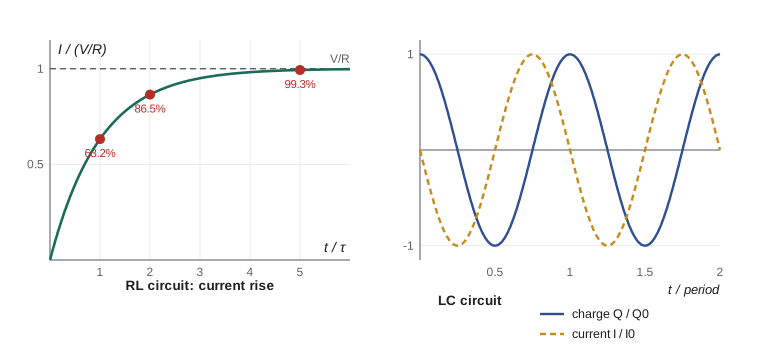
Inductance acts as electrical inertia. You cannot change the current in an inductor instantly, because that would require an infinite EMF. Connect a battery of EMF \(V\) to an inductor in series with a resistor \(R\), and Kirchhoff's loop rule gives \(V - L\,dI/dt = IR\), with solution \(I(t) = (V/R)(1 - e^{-t/\tau})\) and time constant \(\tau = L/R\). The current climbs to 63% of its final value after one time constant and to more than 99% after five. Interrupt the circuit suddenly and the collapsing field drives a large EMF across the gap: this is the spark in a car's ignition coil and the reason relay coils carry protective diodes. Combine an inductor with a capacitor and the energy sloshes back and forth between them at the angular frequency \(\omega_0 = 1/\sqrt{LC}\), the basis of every radio tuner.
Energy in the magnetic field
Building up the current in an inductor takes work, because the back EMF opposes it. At the moment the current is \(I\), the power that must be supplied against the back EMF is \(\mathcal{E}I = LI\,dI/dt\), so the total work to build up a current \(I\) from zero is
Where is this energy stored? Write \(LI = \Phi = \oint\mathbf{A}\cdot d\mathbf{l}\), so \(W = \tfrac{1}{2}I\oint\mathbf{A}\cdot d\mathbf{l}\). For a volume current this generalizes to \(W = \tfrac{1}{2}\int\mathbf{A}\cdot\mathbf{J}\,d\tau\). Replacing \(\mathbf{J}\) by \(\nabla\times\mathbf{B}/\mu_0\), integrating by parts with the identity \(\nabla\cdot(\mathbf{A}\times\mathbf{B}) = \mathbf{B}\cdot(\nabla\times\mathbf{A}) - \mathbf{A}\cdot(\nabla\times\mathbf{B})\), and letting the surface go to infinity where the fields vanish, gives
This mirrors the electrostatic result \(W = \tfrac{\varepsilon_0}{2}\int E^2\,d\tau\) from PHYS-381. The energy can be regarded as stored in the magnetic field, at an energy density \(B^2/2\mu_0\). A field of 1 T holds about 400 kJ per cubic metre; the 3 T magnet of a hospital MRI scanner stores megajoules, which is why a quench, the sudden loss of superconductivity, is a carefully engineered event. The program checks that \(\tfrac{1}{2}LI^2\) and the integral of \(B^2/2\mu_0\) over the solenoid's volume agree.
The displacement current
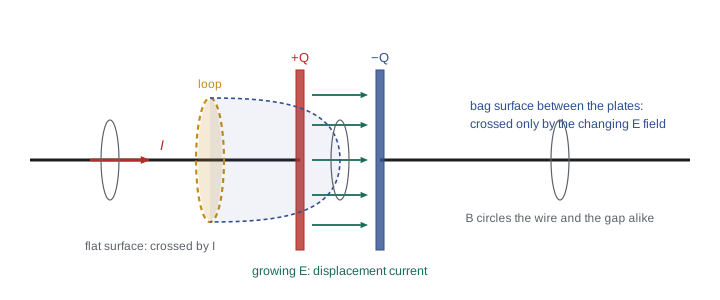
PHYS-381 derived \(\nabla\times\mathbf{B} = \mu_0\mathbf{J}\) for steady currents. Lesson 1 showed that it fails for changing currents, because taking its divergence forces \(\nabla\cdot\mathbf{J} = 0\). Here is a sharper way to see the failure. Apply Ampère's law in integral form to a circular loop around the wire leading into a charging capacitor. With a flat surface that the wire pierces, the enclosed current is \(I\). With a surface shaped like a bag that passes between the plates, where no charge flows, the enclosed current is zero. Both surfaces have the same boundary, so Ampère's law gives two different answers for the same line integral. Something must flow through the gap.
What is in the gap is a changing electric field. Gauss's law says \(\rho = \varepsilon_0\nabla\cdot\mathbf{E}\), so the continuity equation becomes
The combination \(\mathbf{J} + \varepsilon_0\,\partial\mathbf{E}/\partial t\) always has zero divergence, so it can be the curl of something. Maxwell's correction replaces \(\mathbf{J}\) by this combination:
Maxwell called \(\mathbf{J}_d = \varepsilon_0\,\partial\mathbf{E}/\partial t\) the displacement current. Between the capacitor plates \(E = Q/(\varepsilon_0 A)\), so \(\varepsilon_0\,dE/dt\) times the area is \(dQ/dt = I\): the displacement current through the bag surface equals the conduction current through the flat one, and Ampère's law gives the same answer for both. The magnetic field between the plates of a charging capacitor is therefore real and measurable, curling around the axis just as it does around the wire. The program confirms the equality numerically for an RC circuit charging through a 1 k\(\Omega\) resistor.
Historically, the displacement current is the term that turned two separate static theories into a theory of light. Without it, a changing electric field produces no magnetic field and electromagnetic waves are impossible. Its effects were invisible in Maxwell's time at laboratory frequencies, because \(\varepsilon_0\) is so small; it was confirmed only when Heinrich Hertz generated and detected electromagnetic waves in 1887 and 1888. The program now checks all four results of this lesson.
import math
mu0 = 4e-7 * math.pi; eps0 = 8.8541878188e-12

# 1. Neumann formula: mutual inductance of two coaxial circular loops,
#    M = (mu0/4pi) * double loop integral of dl1 . dl2 / distance
def mutual(a, b, d, n=400):
    tot = 0.0
    for i in range(n):
        p1 = 2 * math.pi * i / n
        for j in range(n):
            p2 = 2 * math.pi * j / n
            dist = math.sqrt(a * a + b * b - 2 * a * b * math.cos(p1 - p2) + d * d)
            tot += a * b * math.cos(p1 - p2) / dist
    return mu0 / (4 * math.pi) * tot * (2 * math.pi / n) ** 2
a, b = 0.10, 0.01
for d in (0.0, 0.05, 0.10):
    M = mutual(a, b, d)
    small = mu0 * math.pi * b * b * a * a / (2 * (a * a + d * d) ** 1.5)   # small inner loop
    print(f"loops a=10 cm, b=1 cm, spacing {d * 100:.0f} cm: Neumann M = {M * 1e9:.3f} nH, "
          f"small-loop formula {small * 1e9:.3f} nH")

# 2. A long solenoid: inductance and stored energy two ways
N, length, r, I = 1000, 0.50, 0.02, 2.0
area = math.pi * r * r
L = mu0 * N * N * area / length
Bsol = mu0 * N / length * I
print(f"solenoid L = {L * 1e3:.3f} mH, energy LI^2/2 = {0.5 * L * I * I * 1e3:.3f} mJ, "
      f"field energy B^2/2mu0 x volume = {Bsol**2 / (2 * mu0) * area * length * 1e3:.3f} mJ")

# 3. RL circuit: current rise toward V/R with time constant L/R
V, R = 12.0, 6.0
tau = L / R
for k in (1, 2, 5):
    print(f"t = {k} tau = {k * tau * 1e3:.3f} ms: I = {V / R * (1 - math.exp(-k)):.4f} A of {V / R:.1f} A")

# 4. Displacement current in a charging parallel-plate capacitor
Aplate, gap, Rc, V0 = 0.01, 1e-3, 1000.0, 10.0
C = eps0 * Aplate / gap
tc = Rc * C
for t in (0.0, tc, 3 * tc):
    Icond = V0 / Rc * math.exp(-t / tc)
    Q = C * V0 * (1 - math.exp(-t / tc))
    h = tc * 1e-6
    Q2 = C * V0 * (1 - math.exp(-(t + h) / tc))
    dEdt = (Q2 - Q) / h / (eps0 * Aplate)          # E = Q/(eps0 A) between the plates
    Idisp = eps0 * dEdt * Aplate
    print(f"t = {t / tc:.0f} RC: conduction current {Icond * 1e3:.4f} mA, displacement current {Idisp * 1e3:.4f} mA")
print(f"C = {C * 1e12:.2f} pF, RC = {tc * 1e9:.3f} ns")loops a=10 cm, b=1 cm, spacing 0 cm: Neumann M = 1.981 nH, small-loop formula 1.974 nH loops a=10 cm, b=1 cm, spacing 5 cm: Neumann M = 1.412 nH, small-loop formula 1.412 nH loops a=10 cm, b=1 cm, spacing 10 cm: Neumann M = 0.696 nH, small-loop formula 0.698 nH solenoid L = 3.158 mH, energy LI^2/2 = 6.317 mJ, field energy B^2/2mu0 x volume = 6.317 mJ t = 1 tau = 0.526 ms: I = 1.2642 A of 2.0 A t = 2 tau = 1.053 ms: I = 1.7293 A of 2.0 A t = 5 tau = 2.632 ms: I = 1.9865 A of 2.0 A t = 0 RC: conduction current 10.0000 mA, displacement current 10.0000 mA t = 1 RC: conduction current 3.6788 mA, displacement current 3.6788 mA t = 3 RC: conduction current 0.4979 mA, displacement current 0.4979 mA C = 88.54 pF, RC = 88.542 ns
The Neumann integral, computed on a 400 by 400 grid of points around the two loops, agrees with the dipole estimate to within about 0.3% at every spacing. The small remaining differences are real: the estimate treats the 1 cm loop as a point dipole, which is least accurate when the loops are coplanar or close. The solenoid's \(\tfrac{1}{2}LI^2\) and its field energy both come to 6.317 mJ. The RL current reaches 1.264 A, 63.2% of 2 A, after one time constant. In the capacitor, the conduction current in the wire and the displacement current between the plates agree to every printed digit at every moment, falling together as \(e^{-t/RC}\).
Worked problem
Mutual inductance of nested solenoids
A short coil of 50 turns and radius 1.0 cm sits inside a long solenoid of 1500 turns per metre. Find their mutual inductance and the EMF in the coil when the solenoid current changes at 200 A/s.
Show solution
- Use the easy direction: a current \(I\) in the solenoid gives \(B = \mu_0 nI\) inside, so the flux through the 50-turn coil is \(\Phi = 50\,\mu_0 nI\,\pi r^2\).
- \(M = 50\mu_0 n\pi r^2 = 50 \times 4\pi \times 10^{-7} \times 1500 \times \pi \times 10^{-4} = 2.96 \times 10^{-5}\) H \(= 29.6\ \mu\)H.
- By the symmetry of the Neumann formula this is also the flux through the solenoid per ampere in the small coil, which would be very hard to compute directly.
- \(\mathcal{E} = M\,dI/dt = 2.96 \times 10^{-5} \times 200 = 5.9\) mV.
Answer: \(M \approx 30\ \mu\)H, and the coil's EMF is about 5.9 mV.
Common mistakes
MistakeComputing \(M_{12}\) the hard way.
InsteadSince \(M_{12} = M_{21}\), choose whichever direction makes the flux easy to find.
MistakeExpecting the current in an inductor to jump when a switch closes.
InsteadInductance resists changes in current; it rises with time constant \(L/R\).
MistakeSaying the energy of an inductor is stored in the wire.
InsteadIt is stored in the magnetic field, at density \(B^2/2\mu_0\).
MistakeTreating the displacement current as a flow of charge across the gap.
InsteadNo charge crosses; it is the changing electric field that acts as a source of magnetic field.
MistakeUsing \(\nabla\times\mathbf{B} = \mu_0\mathbf{J}\) when fields change rapidly.
InsteadInclude \(\mu_0\varepsilon_0\,\partial\mathbf{E}/\partial t\) whenever charge densities change.
Summary and key terms
- Mutual inductance is given by the Neumann formula and depends only on geometry; it is symmetric, \(M_{12} = M_{21}\).
- Self-inductance \(L = \Phi/I\) gives a back EMF \(-L\,dI/dt\); for a solenoid \(L = \mu_0N^2A/l\).
- An RL circuit has time constant \(L/R\); an LC circuit oscillates at \(1/\sqrt{LC}\).
- The energy \(\tfrac{1}{2}LI^2\) equals \(\int B^2/2\mu_0\,d\tau\), the energy stored in the magnetic field.
- Charge conservation requires the displacement current, giving \(\nabla\times\mathbf{B} = \mu_0\mathbf{J} + \mu_0\varepsilon_0\,\partial\mathbf{E}/\partial t\).
- mutual inductance
- The flux through one circuit per unit current in another, in henries.
- Neumann formula
- The double line integral giving mutual inductance from the geometry of two loops.
- self-inductance
- The flux through a circuit per unit of its own current.
- back EMF
- The EMF -L dI/dt that opposes changes in a circuit's current.
- magnetic energy density
- The energy per unit volume B^2/2mu0 stored in a magnetic field.
- displacement current
- The term eps0 dE/dt that completes the Ampere-Maxwell law.
Practice problems
Work each problem on paper first, then reveal the answer to check.
Find the inductance of a solenoid 20 cm long, 2 cm in diameter, with 400 turns.
Show answer
\(L = \mu_0N^2A/l = 4\pi \times 10^{-7} \times 1.6 \times 10^5 \times 3.14 \times 10^{-4}/0.2 = 0.316\) mH.
How much energy is stored in a 1.5 T field filling 0.5 m\(^3\)?
Show answer
\(u = B^2/2\mu_0 = 2.25/(2.51 \times 10^{-6}) = 8.95 \times 10^5\) J/m\(^3\), so 448 kJ.
An RL circuit has \(L = 0.20\) H and \(R = 40\ \Omega\). How long does the current take to reach 90% of its final value?
Show answer
\(\tau = 5\) ms, and \(1 - e^{-t/\tau} = 0.9\) gives \(t = \tau\ln 10 = 11.5\) ms.
A parallel-plate capacitor with circular plates of radius 5 cm is charged by a current of 0.10 A. Find the magnetic field between the plates 3 cm from the axis.
Show answer
The displacement current within radius \(s\) is \(I s^2/R^2 = 0.036\) A, so \(B = \mu_0(0.036)/(2\pi \times 0.03) = 0.24\ \mu\)T.
Find the resonant frequency of an LC circuit with \(L = 10\ \mu\)H and \(C = 250\) pF.
Show answer
\(f = 1/(2\pi\sqrt{LC}) = 1/(2\pi\sqrt{2.5 \times 10^{-15}}) = 3.18\) MHz.
Show that the units of \(\varepsilon_0\,\partial\mathbf{E}/\partial t\) are amperes per square metre.
Show answer
\(\varepsilon_0\) has units C\(^2\)/(N m\(^2\)) and \(E\) has N/C, so \(\varepsilon_0 E\) is C/m\(^2\); dividing by seconds gives A/m\(^2\).
Lesson quiz · 5 questions
Score 60% or more to complete this lesson.
Create a free account to save your progress, take quizzes and earn a certificate.