
PHYS-382 · Lesson 2 of 12 · 24 min
Electromotive force, Ohm's law and Faraday's law of induction
Currents in circuits are pushed around by forces on charges, and the work done per unit charge around the circuit is called the electromotive force. This lesson starts with Ohm's law, which says how a material responds to a field, and with the electromotive force supplied by batteries and by motion through a magnetic field. It then states Faraday's law, the first of the two new pieces of Maxwell's equations: a changing magnetic flux through a loop produces an electromotive force around it, whether the change comes from moving the loop or from changing the field. That second case reveals something new, an electric field that is not produced by charges and whose field lines close on themselves.
Ohm's law
In most conductors the current density is proportional to the force per unit charge that drives it. When that force is electric,
where \(\sigma\) is the conductivity, measured in siemens per metre; its reciprocal \(\rho = 1/\sigma\) is the resistivity. Copper has \(\sigma \approx 6.0 \times 10^7\) S/m, sea water about 4 S/m, and glass less than \(10^{-12}\) S/m. The equation is local: it relates the current at a point to the field at that point. For a uniform wire of length \(L\) and cross-section \(A\) carrying current \(I\), integrating gives \(V = EL = (L/\sigma A)I\), which is the familiar \(V = IR\) with \(R = L/(\sigma A)\).
Ohm's law is not a fundamental law but a description of how electrons in a material scatter. Between collisions with lattice vibrations and impurities, a conduction electron accelerates in the field; each collision randomizes its direction. The average result is a slow drift velocity \(\mathbf{v}_d\) proportional to \(\mathbf{E}\), so \(\mathbf{J} = -ne\mathbf{v}_d\) is proportional to \(\mathbf{E}\). This picture is due to Paul Drude, in 1900. The drift is astonishingly slow: the program below finds a quarter of a millimetre per second for 10 A in a 2 mm copper wire. Signals nevertheless travel along the wire at a large fraction of the speed of light, because what propagates is the field, not the electrons. The electrons everywhere in the circuit start drifting almost at once, like water in a full hose.
Ohm's law has a striking consequence for a conductor carrying steady current: the electric field inside is not zero, unlike the electrostatic case. It is tiny, about 50 millivolts per metre in the example, because \(\sigma\) is so large, but it is what pushes the current. Inside a uniform ohmic conductor with steady current there is no charge density, because \(\nabla\cdot\mathbf{E} = \nabla\cdot\mathbf{J}/\sigma = 0\); the charges that shape the field sit on the surface of the wire. Power is dissipated as heat at the rate \(\mathbf{J}\cdot\mathbf{E} = \sigma E^2\) per unit volume, which integrates to \(I^2R\). This is Joule heating, which lesson 5 reinterprets as energy flowing into the wire from the surrounding field.
Electromotive force
A current circulating around a closed loop needs a force that does net work on the charges each time around. An electrostatic field cannot provide it, because its line integral around any closed loop is zero. Something else must push: chemical forces in a battery, a changing magnetic field, or the magnetic force on a moving wire. If \(\mathbf{f}\) is the total force per unit charge on the conduction charges, the electromotive force, or EMF, of the circuit is
The name is old and misleading, because the EMF is not a force but a work per unit charge, measured in volts. In a battery the chemical force acts only inside the cell. In an ideal battery with no internal resistance, the chemical force exactly balances the electrostatic field inside the cell, so the potential difference between the terminals equals the EMF. In the external circuit the electrostatic field alone drives the current. The battery is a pump that raises charges to a higher potential; the field then carries them around the rest of the loop.
Motional EMF
The simplest generator is a conducting rod of length \(L\) sliding with speed \(v\) along two rails in a uniform magnetic field \(\mathbf{B}\) perpendicular to the plane of the rails. The magnetic force on each charge carried along with the rod is \(q\mathbf{v}\times\mathbf{B}\), of magnitude \(qvB\) and directed along the rod. The EMF is therefore \(\mathcal{E} = vBL\). If the circuit has resistance \(R\), a current \(I = vBL/R\) flows, and the rod then feels a magnetic drag force \(ILB\) opposing its motion. To keep the rod moving at constant speed you must push with that force, delivering mechanical power \(ILBv = I^2R\), all of which appears as heat. The magnetic force does no work itself: it converts the work done by your push into electrical work, a point worth checking carefully in the program's output.
There is a useful way to describe the same result. The flux of \(\mathbf{B}\) through the circuit is \(\Phi = BLx\), where \(x\) is the distance from the end of the rails to the rod, and it grows at the rate \(d\Phi/dt = BLv\). So the motional EMF equals minus the rate of change of flux,
This flux rule holds for any loop moving or deforming in a static magnetic field; the proof considers the strip of new surface swept out by each element of the moving loop in a time \(dt\). The minus sign is a statement about direction: with the right-hand rule linking the loop direction and the surface normal, the induced current flows so that its own magnetic field opposes the change in flux. This is Lenz's law, stated by Heinrich Lenz in 1834.
Faraday's law
Faraday's experiments of 1831 showed that the flux rule works even when nothing moves. If the loop is fixed and the magnet is moved, or if the current in a second coil is changed, the EMF is still \(-d\Phi/dt\). Joseph Henry in the United States found the same effect independently at about the same time. For a stationary loop there is no motional force, so the EMF must come from an electric field: \(\oint\mathbf{E}\cdot d\mathbf{l} = -\frac{d}{dt}\int\mathbf{B}\cdot d\mathbf{a}\). Applying Stokes' theorem to the left side and noting that the loop is arbitrary gives the differential form
This is Faraday's law, one of Maxwell's equations. It says something remarkable: a changing magnetic field is surrounded by an electric field whose lines form closed loops, an induced electric field with no charge at either end. In the static case the curl of \(\mathbf{E}\) vanished and \(\mathbf{E}\) could be written as \(-\nabla V\); now that is no longer possible in general, and lesson 10 shows what replaces it. Einstein's 1905 relativity paper began from the observation that the motional and stationary cases, which classical physics explained in two quite different ways, give exactly the same EMF; to him this suggested that the distinction between them depends only on the observer.
When a magnetic field changes in a region with cylindrical symmetry, the induced field can be found from the integral form exactly as Ampère's law gives \(\mathbf{B}\) from a current. Inside a long solenoid whose current is increasing, \(\mathbf{B} = \mu_0 n I(t)\hat{\mathbf{z}}\), and a circular loop of radius \(s\) inside the solenoid gives \(E\,2\pi s = -\mu_0 n\,\dot{I}\,\pi s^2\), so \(E = -\tfrac{1}{2}\mu_0 n \dot{I} s\), circulating around the axis. This field accelerates electrons in a betatron, a circular accelerator in which the changing flux itself does the work.
Generators, eddy currents and induced fields
A coil of \(N\) turns and area \(a\) rotating at angular speed \(\omega\) in a uniform field has flux \(\Phi = NBa\cos\omega t\) and therefore produces \(\mathcal{E} = NBa\omega\sin\omega t\). That is the principle of every alternating current generator, from a hydroelectric turbine to a bicycle dynamo. The program checks the formula against a numerical derivative of the flux. Induced currents also flow in solid conductors whenever the flux through them changes. These eddy currents dissipate energy and produce drag; they brake trains and roller coasters smoothly without contact, make metal detectors work, heat pots on induction cooktops, and are kept small in transformer cores by building the cores from thin insulated laminations.
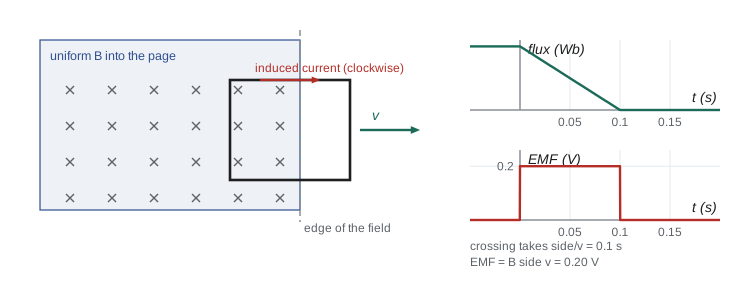
The program computes the drift speed and internal field of a copper wire, the EMF, current and power for the sliding rod, the EMF of a generator by numerical differentiation of the flux, and the current in a square loop pulled out of a field region at constant speed.
import math
# 1. Drift velocity of electrons in a copper wire carrying 10 A
n = 8.47e28            # free electrons per cubic meter in copper
e = 1.602176634e-19
A = math.pi * (1.0e-3) ** 2      # 2 mm diameter wire
I = 10.0
vd = I / (n * e * A)
print(f"drift speed in 2 mm copper wire at 10 A: {vd * 1e3:.3f} mm/s")
sigma = 5.96e7
print(f"field inside the wire: E = J/sigma = {I / A / sigma * 1e3:.3f} mV/m")

# 2. Motional EMF: a rod sliding on rails in a uniform field
B, L, v, R = 0.50, 0.40, 3.0, 2.0
emf = B * L * v; Ir = emf / R
print(f"rod: emf = {emf:.3f} V, current {Ir:.3f} A, magnetic drag {Ir * L * B:.4f} N, "
      f"power to push {Ir * L * B * v:.4f} W = I^2 R {Ir**2 * R:.4f} W")

# 3. Generator: N turns of area a rotating at angular speed w in field B.
#    Compare a numerical derivative of the flux with the formula N B a w sin(w t).
N, a, w = 200, 0.010, 2 * math.pi * 60
def flux(t): return N * B * a * math.cos(w * t)
for t in (0.001, 0.002, 0.004):
    h = 1e-7
    num = -(flux(t + h) - flux(t - h)) / (2 * h)
    exact = N * B * a * w * math.sin(w * t)
    print(f"t = {t * 1e3:.0f} ms: -dPhi/dt = {num:8.3f} V, formula {exact:8.3f} V")
print(f"peak emf = N B a w = {N * B * a * w:.1f} V, rms {N * B * a * w / math.sqrt(2):.1f} V")

# 4. A square loop (side 0.2 m, resistance 0.5 ohm) pulled at 2 m/s out of a field region
side, Rl, speed = 0.20, 0.5, 2.0
for x in (0.05, 0.10, 0.15, 0.25):     # distance of the leading edge past the boundary
    inside = max(0.0, side - min(x, side))
    emf_loop = B * side * speed if 0 < x < side else 0.0     # equals -dPhi/dt
    print(f"leading edge {x:.2f} m out: flux {B * side * inside:.4f} Wb, emf {emf_loop:.3f} V, "
f"current {emf_loop / Rl:.3f} A")drift speed in 2 mm copper wire at 10 A: 0.235 mm/s field inside the wire: E = J/sigma = 53.408 mV/m rod: emf = 0.600 V, current 0.300 A, magnetic drag 0.0600 N, power to push 0.1800 W = I^2 R 0.1800 W t = 1 ms: -dPhi/dt = 138.780 V, formula 138.780 V t = 2 ms: -dPhi/dt = 258.068 V, formula 258.068 V t = 4 ms: -dPhi/dt = 376.247 V, formula 376.247 V peak emf = N B a w = 377.0 V, rms 266.6 V leading edge 0.05 m out: flux 0.0150 Wb, emf 0.200 V, current 0.400 A leading edge 0.10 m out: flux 0.0100 Wb, emf 0.200 V, current 0.400 A leading edge 0.15 m out: flux 0.0050 Wb, emf 0.200 V, current 0.400 A leading edge 0.25 m out: flux 0.0000 Wb, emf 0.000 V, current 0.000 A
The rod's numbers show the energy bookkeeping explicitly: 0.18 W of mechanical power from the push becomes 0.18 W of Joule heating. The generator's numerical derivative matches \(NBa\omega\sin\omega t\) to all printed digits, and the peak EMF of 377 V shows how a modest coil turning at 60 revolutions per second produces mains-level voltage. The square loop gives a constant EMF of 0.20 V while its trailing part is still inside the field, because the flux falls at the steady rate \(B\,\text{side}\,v\); once the loop is entirely outside, the flux is zero and constant, and the current stops.
Worked problem
Induced electric field in a solenoid
A long solenoid of radius 3.0 cm has 2000 turns per metre. Its current rises at 50 A/s. Find the induced electric field 2.0 cm and 5.0 cm from the axis.
Show solution
- The field inside changes at \(\dot{B} = \mu_0 n\dot{I} = 4\pi \times 10^{-7} \times 2000 \times 50 = 0.126\) T/s; outside, \(B = 0\).
- Inside, at \(s = 0.02\) m: \(E\,2\pi s = \dot{B}\,\pi s^2\), so \(E = \tfrac{1}{2}\dot{B}s = 0.5 \times 0.126 \times 0.02 = 1.26\) mV/m.
- Outside, at \(s = 0.05\) m, the loop encloses the full flux \(\dot{B}\,\pi R^2\): \(E = \dot{B}R^2/(2s) = 0.126 \times 0.0009/0.10 = 1.13\) mV/m.
- Lenz's rule fixes the direction: the field circulates opposite to the solenoid current, so that a charge would be pushed to reduce the growing flux.
Answer: 1.26 mV/m inside at 2 cm and 1.13 mV/m outside at 5 cm, circulating against the solenoid current. The induced field exists outside even though \(\mathbf{B}\) is zero there.
Common mistakes
MistakeSaying the magnetic force does the work in a generator.
InsteadMagnetic forces are perpendicular to velocity and do no work; the work comes from whatever moves the conductor.
MistakeThinking an induced electric field can be written as minus the gradient of a potential.
InsteadIts curl is \(-\partial\mathbf{B}/\partial t\), which is not zero, so no such potential exists.
MistakeForgetting the sign in Faraday's law.
InsteadThe induced current always opposes the change in flux (Lenz's law); otherwise energy would not be conserved.
MistakeAssuming electrons carry signals at the drift speed.
InsteadDrift is a fraction of a millimetre per second; the field propagates at a large fraction of the speed of light.
MistakeAssuming the field inside a current-carrying wire is zero.
InsteadIt is small but nonzero; \(\mathbf{E} = \mathbf{J}/\sigma\) drives the current.
Summary and key terms
- Ohm's law \(\mathbf{J} = \sigma\mathbf{E}\) is a local, empirical relation; it gives \(R = L/\sigma A\) and power \(\sigma E^2\) per unit volume.
- The EMF is \(\oint\mathbf{f}\cdot d\mathbf{l}\), the work per unit charge done around a circuit by non-electrostatic forces.
- For a moving loop in a static field, \(\mathcal{E} = -d\Phi/dt\); the magnetic force redirects work but does none.
- Faraday's law \(\nabla\times\mathbf{E} = -\partial\mathbf{B}/\partial t\) makes the flux rule hold for stationary loops too.
- Induced electric fields form closed loops around changing magnetic flux, and Lenz's law fixes their direction.
- conductivity
- The ratio of current density to electric field in an ohmic material, in siemens per metre.
- electromotive force
- The line integral of the force per unit charge around a circuit; the work done per unit charge.
- motional EMF
- The EMF produced by the magnetic force on charges in a conductor moving through a magnetic field.
- magnetic flux
- The surface integral of B through a surface bounded by the circuit, in webers.
- Lenz's law
- The induced current flows so as to oppose the change in flux that produces it.
- eddy currents
- Induced currents circulating inside bulk conductors when the flux through them changes.
Practice problems
Work each problem on paper first, then reveal the answer to check.
A copper wire 100 m long with a 1.0 mm diameter carries 2.0 A. Find its resistance, the voltage across it and the power dissipated.
Show answer
\(R = L/(\sigma A) = 100/(5.96 \times 10^7 \times 7.85 \times 10^{-7}) = 2.14\ \Omega\); \(V = 4.3\) V; \(P = 8.6\) W.
A metal airplane with a 30 m wingspan flies at 250 m/s where the vertical component of Earth's field is 50 \(\mu\)T. Find the EMF between its wingtips.
Show answer
\(\mathcal{E} = vBL = 250 \times 5 \times 10^{-5} \times 30 = 0.375\) V; no current flows, because any wire run between the wingtips moves with the plane and picks up the same EMF, which cancels around the loop.
A circular loop of radius 5 cm lies in a field that falls uniformly from 0.40 T to zero in 0.10 s. Find the EMF.
Show answer
\(\Phi\) changes by \(0.40 \times \pi \times 0.0025 = 3.14 \times 10^{-3}\) Wb in 0.10 s, so \(\mathcal{E} = 31\) mV, driving current in the sense that tries to maintain the original field.
Show that the power needed to push the sliding rod equals \(\mathcal{E}^2/R\).
Show answer
Force \(F = ILB\) with \(I = vBL/R\), so \(Fv = v^2B^2L^2/R = \mathcal{E}^2/R\).
A 100-turn coil of area 0.02 m\(^2\) rotates at 50 revolutions per second in a 0.25 T field. Find the peak and rms EMF.
Show answer
\(\omega = 314\) rad/s; peak \(NBa\omega = 100 \times 0.25 \times 0.02 \times 314 = 157\) V; rms 111 V.
Why is a transformer core made of thin insulated laminations rather than solid iron?
Show answer
Laminations break the large eddy-current loops into thin ones; the EMF around each is smaller and its resistance larger, so the dissipated power falls roughly as the square of the lamination thickness.
Lesson quiz · 5 questions
Score 60% or more to complete this lesson.
Create a free account to save your progress, take quizzes and earn a certificate.