
PHYS-344 · Lesson 10 of 12 · 25 min
Phase space, Poisson brackets and Liouville's theorem
Hamilton's equations describe how a single state moves through phase space. This lesson studies the flow as a whole. Two results stand out. Liouville's theorem says that the flow preserves phase-space volume: a cloud of states may be stretched and folded into strange shapes, but its volume never changes. That fact is the foundation of statistical mechanics. The Poisson bracket gives an algebraic way to write the equations of motion, test for conserved quantities and recognize symmetries, and it is the structure that Paul Dirac carried over almost unchanged into quantum mechanics in 1925.
The Poisson bracket
For two functions \(f(q, p, t)\) and \(g(q, p, t)\) on phase space, the Poisson bracket, introduced by Siméon Denis Poisson in 1809, is
Its use comes from the time derivative of any function along a trajectory. By the chain rule and Hamilton's equations,
So the Hamiltonian generates the time evolution of every quantity through the bracket. Hamilton's equations themselves are the special cases \(\dot q_j = \{q_j, H\}\) and \(\dot p_j = \{p_j, H\}\). A quantity with no explicit time dependence is conserved exactly when its bracket with \(H\) vanishes: \(\{f, H\} = 0\). Testing conservation is reduced to computing derivatives, with no need to solve the motion.
Properties of the bracket
The bracket has a short list of algebraic properties that do all the work. It is antisymmetric, \(\{f, g\} = -\{g, f\}\), so \(\{f, f\} = 0\) and in particular \(\{H, H\} = 0\): energy is conserved if \(H\) has no explicit time dependence. It is linear in each argument. It obeys the product rule \(\{fg, h\} = f\{g, h\} + \{f, h\}g\). And it satisfies the Jacobi identity
For the coordinates and momenta themselves, the fundamental brackets are
A consequence of the Jacobi identity is Poisson's theorem: if \(f\) and \(g\) are both conserved, so is \(\{f, g\}\). Set \(h = H\) in the identity; if \(\{f, H\} = \{g, H\} = 0\), the first two terms vanish, leaving \(\{H, \{f, g\}\} = 0\). Sometimes this produces a genuinely new conserved quantity, sometimes zero or a combination of known ones.
Angular momentum
For a particle with \(\mathbf L = \mathbf r\times\mathbf p\), direct computation from the fundamental brackets gives
These relations encode the geometry of rotations: rotating about \(x\) and then \(y\) differs from rotating in the opposite order by a rotation about \(z\). For a central potential \(V(r)\), \(\{L_j, H\} = 0\) for each component. By Poisson's theorem, if \(L_x\) and \(L_y\) are conserved, so is \(L_z\), which we knew. Each component of \(\mathbf L\) can be fixed, but because their brackets with one another do not vanish, they cannot all be used as independent momenta at the same time; only \(L^2\) and one component can. In quantum mechanics this becomes the statement that \(L^2\) and \(L_z\) can have definite values together but \(L_x\) and \(L_z\) cannot.
Brackets and quantum mechanics
Dirac noticed in 1925 that Heisenberg's new quantum mechanics could be obtained from classical mechanics by a simple rule: replace each Poisson bracket by the commutator of the corresponding operators divided by \(i\hbar\),
The fundamental bracket \(\{x, p\} = 1\) becomes the canonical commutator \([\hat x, \hat p] = i\hbar\); the equation \(df/dt = \{f, H\}\) becomes Heisenberg's equation of motion \(d\hat f/dt = [\hat f, \hat H]/i\hbar\); and the angular momentum brackets become the commutation relations from which PHYS-372 derives the quantized values of angular momentum. The Poisson bracket is the classical shadow of the quantum commutator.
Liouville's theorem
Imagine not a single system but a great many copies, started from slightly different states, forming a cloud in phase space with density \(\rho(q, p, t)\). This is the situation in statistical mechanics, where we do not know the exact state of the \(10^{23}\) molecules of a gas, and in beam physics, where a bunch of particles in an accelerator occupies a small region of phase space. How does the cloud evolve?
Each state moves with the phase-space velocity \(\mathbf v = (\dot q_1, \dots, \dot q_n, \dot p_1, \dots, \dot p_n)\). The divergence of this velocity field is
The flow is divergence-free, like an incompressible fluid. A region of phase space carried along by the flow changes shape but keeps its volume. That is Liouville's theorem, proved by Joseph Liouville in 1838 in a mathematical setting and applied to mechanics by Boltzmann and Gibbs. Equivalently, the density is constant along each trajectory: \(d\rho/dt = \partial\rho/\partial t + \{\rho, H\} = 0\).
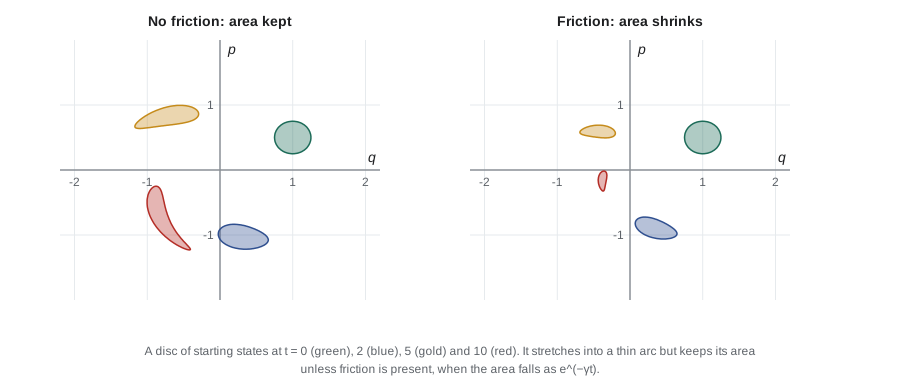
Friction is not Hamiltonian, and Liouville's theorem fails for it. For a damped pendulum, \(\dot p = -\sin q - \gamma p\), the divergence is \(-\gamma\), so phase-space areas shrink as \(e^{-\gamma t}\). The cloud of states collapses toward the equilibrium at the bottom, which is an attractor. Attractors, including the strange attractors of chaotic dissipative systems, exist only because dissipation shrinks phase-space volume. A Hamiltonian system cannot have an attractor.
import math

# 1. Liouville's theorem: follow a small circle of initial states for the pendulum H = p^2/2 - cos q
#    and measure the enclosed area with the shoelace formula. With damping the area must shrink.
def area(pts):
    return 0.5 * abs(sum(x1 * y2 - x2 * y1 for (x1, y1), (x2, y2) in zip(pts, pts[1:] + pts[:1])))
def step(q, p, dt, gamma):
    # damped pendulum, RK4: qdot = p, pdot = -sin q - gamma p
    f = lambda q, p: (p, -math.sin(q) - gamma * p)
    a1, b1 = f(q, p); a2, b2 = f(q + dt / 2 * a1, p + dt / 2 * b1)
    a3, b3 = f(q + dt / 2 * a2, p + dt / 2 * b2); a4, b4 = f(q + dt * a3, p + dt * b3)
    return q + dt / 6 * (a1 + 2 * a2 + 2 * a3 + a4), p + dt / 6 * (b1 + 2 * b2 + 2 * b3 + b4)
n = 400; r = 0.25
for gamma in (0.0, 0.2):
    pts = [(1.0 + r * math.cos(2 * math.pi * k / n), 0.5 + r * math.sin(2 * math.pi * k / n)) for k in range(n)]
    A0 = area(pts); t = 0.0; dt = 0.01; out = []
    for target in (2.0, 5.0, 10.0):
        while t < target - 1e-9:
            pts = [step(q, p, dt, gamma) for q, p in pts]; t += dt
        out.append(f"t = {target:4.1f}: area/area0 = {area(pts) / A0:.4f} (e^(-gamma t) = {math.exp(-gamma * t):.4f})")
    print(f"gamma = {gamma}:", "; ".join(out))

# 2. Poisson brackets computed numerically: {f, g} = sum_i (df/dq_i dg/dp_i - df/dp_i dg/dq_i)
def pb(f, g, z, h=1e-5):
    tot = 0.0
    for i in range(3):
        def d(F, k):
            zp = list(z); zm = list(z); zp[k] += h; zm[k] -= h
            return (F(zp) - F(zm)) / (2 * h)
        tot += d(f, i) * d(g, i + 3) - d(f, i + 3) * d(g, i)
    return tot
Lx = lambda z: z[1] * z[5] - z[2] * z[4]
Ly = lambda z: z[2] * z[3] - z[0] * z[5]
Lz = lambda z: z[0] * z[4] - z[1] * z[3]
H = lambda z: 0.5 * (z[3] ** 2 + z[4] ** 2 + z[5] ** 2) - 1 / math.sqrt(z[0] ** 2 + z[1] ** 2 + z[2] ** 2)
L2 = lambda z: Lx(z) ** 2 + Ly(z) ** 2 + Lz(z) ** 2
z = [0.7, -0.4, 1.1, 0.3, 0.9, -0.5]              # an arbitrary point (x, y, z, px, py, pz)
print(f"{{Lx, Ly}} = {pb(Lx, Ly, z):+.6f}   Lz = {Lz(z):+.6f}")
print(f"{{Lz, H}} = {pb(Lz, H, z):+.1e} (H is the Kepler Hamiltonian, so L is conserved)")
print(f"{{L^2, Lz}} = {pb(L2, Lz, z):+.1e} {{x, px}} = {pb(lambda s: s[0], lambda s: s[3], z):+.6f}")gamma = 0.0: t = 2.0: area/area0 = 1.0000 (e^(-gamma t) = 1.0000); t = 5.0: area/area0 = 1.0000 (e^(-gamma t) = 1.0000); t = 10.0: area/area0 = 1.0000 (e^(-gamma t) = 1.0000)
gamma = 0.2: t = 2.0: area/area0 = 0.6703 (e^(-gamma t) = 0.6703); t = 5.0: area/area0 = 0.3679 (e^(-gamma t) = 0.3679); t = 10.0: area/area0 = 0.1353 (e^(-gamma t) = 0.1353)
{Lx, Ly} = +0.750000 Lz = +0.750000
{Lz, H} = +6.7e-13 (H is the Kepler Hamiltonian, so L is conserved)
{L^2, Lz} = -9.5e-12 {x, px} = +1.000000The program follows 400 states on a circle of radius 0.25 in the pendulum's phase plane and measures the enclosed area with the shoelace formula. Without friction the area stays at 1.0000 times its initial value at \(t = 2\), 5 and 10, even though the circle has been stretched into a long thin arc, because pendulums started at larger amplitude have longer periods and fall behind. With \(\gamma = 0.2\) the area falls to 0.6703, 0.3679 and 0.1353 of its initial value, exactly \(e^{-\gamma t}\). The numerical brackets confirm \(\{L_x, L_y\} = L_z = 0.75\) at an arbitrary point, \(\{L_z, H\} = 0\) for the Kepler Hamiltonian, \(\{L^2, L_z\} = 0\) and \(\{x, p_x\} = 1\), all to the accuracy of the finite differences.
Consequences of Liouville's theorem
Statistical mechanics. In equilibrium the density cannot change with time, so \(\{\rho, H\} = 0\). Any function of the energy alone satisfies this, and the two most important ensembles, the microcanonical (all states of a given energy equally likely) and the canonical (\(\rho\propto e^{-H/kT}\)), are of this form. Liouville's theorem is what makes equal weighting of phase-space volume a consistent choice: a uniform density stays uniform. PHYS-361 builds on this.
Beam physics. The phase-space volume of a particle beam, called its emittance, cannot be reduced by any arrangement of magnets or electric fields, because these forces are Hamiltonian. A beam can be focused to a small spot only at the price of a larger spread in angles. To shrink emittance, accelerator designers must use non-Hamiltonian effects: stochastic cooling, invented by Simon van der Meer, sensed and corrected individual fluctuations in the antiproton beams at CERN and earned him a share of the 1984 Nobel Prize; electron cooling and radiation damping are other methods.
Optics. Light rays obey a Hamiltonian system in which the phase space is position and direction on a surface across the beam. Liouville's theorem becomes the conservation of étendue: no system of lenses and mirrors can concentrate sunlight to a brightness greater than that of the Sun's surface. That sets the maximum concentration of a solar furnace at about 46,000 times, and the maximum temperature it can reach at the Sun's surface temperature.
Recurrence. Henri Poincaré proved in 1890 that a Hamiltonian system confined to a bounded region of phase space returns arbitrarily close to its initial state, infinitely often. The proof uses only volume preservation: the region swept by a small ball over time cannot keep finding new volume forever. For a gas of many molecules the recurrence times are absurdly longer than the age of the universe, which is why we never see a gas spontaneously gather into one corner.
Worked problem
Is a quantity conserved?
For a particle in the potential \(V = k(x^2 + y^2) + \alpha z\), which of \(L_x\), \(L_y\), \(L_z\) and \(p_z\) are conserved? Use Poisson brackets.
Show solution
- \(\{p_z, H\} = -\partial H/\partial z = -\alpha \ne 0\): \(p_z\) is not conserved.
- \(\{L_z, H\}\): \(L_z = xp_y - yp_x\) generates rotations about \(z\), which leave \(x^2 + y^2\), \(z\) and the kinetic energy unchanged. So \(\{L_z, H\} = 0\).
- \(\{L_x, H\} = \{yp_z - zp_y, H\}\). The kinetic part commutes. For the potential, \(\{L_x, V\} = -y\,\partial V/\partial z + z\,\partial V/\partial y = -\alpha y + 2kzy\), which is not zero.
- Similarly \(\{L_y, H\} \ne 0\).
Answer: Only \(L_z\) is conserved (along with \(H\)). The bracket computation does the work of a symmetry argument and gives the rate of change of each non-conserved quantity as a bonus.
Worked problem
Area of a pendulum orbit
A cloud of pendulum states fills a small square of side 0.1 in phase space (in units with \(m = \ell = g = 1\)). After many periods the cloud is a long thin arc. If the arc has width 0.002, how long is it?
Show solution
- Liouville's theorem: the area is conserved at \(0.1^2 = 0.01\).
- For a thin arc of width \(w\) and length \(\ell_a\), area \(\approx w\,\ell_a\).
- \(\ell_a = 0.01/0.002 = 5\).
Answer: About 5 units long, wrapped around the origin several times. The stretching comes from the dependence of period on amplitude; the area is fixed by Liouville's theorem.
Common mistakes
MistakeWriting \(df/dt = \{H, f\}\).
InsteadThe order matters: \(df/dt = \{f, H\} + \partial f/\partial t\); reversing it flips the sign.
MistakeExpecting Liouville's theorem to mean the shape of a cloud of states is preserved.
InsteadOnly its volume is preserved; the shape can be stretched into long filaments.
MistakeApplying Liouville's theorem to damped motion.
InsteadFriction makes the phase-space flow compressible, and volumes shrink.
MistakeThinking that all three components of angular momentum can be used as independent momenta.
InsteadTheir brackets do not vanish; only \(L^2\) and one component are mutually compatible.
MistakeExpecting a lens system to concentrate light beyond the brightness of its source.
InsteadConservation of étendue, Liouville's theorem for rays, forbids it.
Summary and key terms
- The Poisson bracket \(\{f, g\} = \sum(\partial_q f\,\partial_p g - \partial_p f\,\partial_q g)\) gives \(df/dt = \{f, H\} + \partial f/\partial t\); a quantity is conserved if its bracket with \(H\) vanishes.
- The bracket is antisymmetric, linear, obeys a product rule and the Jacobi identity; \(\{q_j, p_k\} = \delta_{jk}\).
- Angular momentum components satisfy \(\{L_x, L_y\} = L_z\) and cyclic relations; Dirac's rule turns brackets into commutators over \(i\hbar\).
- Liouville's theorem: Hamiltonian flow is divergence-free and preserves phase-space volume; friction shrinks volume and allows attractors.
- Consequences include equilibrium ensembles, conserved beam emittance, the étendue limit in optics and Poincaré recurrence.
- Poisson bracket
- The bilinear operation {f, g} on phase-space functions that generates time evolution through H.
- Jacobi identity
- The cyclic sum {f, {g, h}} + {g, {h, f}} + {h, {f, g}} = 0.
- Liouville's theorem
- Hamiltonian flow preserves phase-space volume; the density of states is constant along trajectories.
- attractor
- A set toward which nearby trajectories converge; possible only in dissipative systems.
- emittance
- The phase-space area or volume occupied by a particle beam.
- étendue
- The phase-space volume of a bundle of light rays; it cannot be reduced by passive optics.
Practice problems
Work each problem on paper first, then reveal the answer to check.
Compute \(\{x, H\}\) and \(\{p, H\}\) for \(H = p^2/2m + \tfrac12 kx^2\).
Show answer
\(\{x, H\} = p/m\), \(\{p, H\} = -kx\): Hamilton's equations.
Show that \(\{x^2, p\} = 2x\).
Show answer
\(\partial(x^2)/\partial x\cdot\partial p/\partial p = 2x\).
Is \(xp\) conserved for a free particle with \(H = p^2/2m\)?
Show answer
\(\{xp, H\} = p\cdot p/m = 2H\), so it grows linearly: \(xp = 2Ht +\) constant.
A damped oscillator has \(\dot x = p\), \(\dot p = -x - 0.1p\). By what factor has a phase-space area shrunk after 20 time units?
Show answer
\(e^{-0.1\times20} = e^{-2} = 0.135\).
Use Poisson's theorem: if \(L_x\) and \(L_y\) are conserved, what else is?
Show answer
\(\{L_x, L_y\} = L_z\), so \(L_z\) is conserved.
Why can no arrangement of magnets reduce a beam's emittance?
Show answer
Magnetic forces derive from a Hamiltonian, so by Liouville's theorem phase-space volume is conserved.
Lesson quiz · 5 questions
Score 60% or more to complete this lesson.
Create a free account to save your progress, take quizzes and earn a certificate.