
PHYS-261 · Lesson 5 of 12 · 23 min
Heat capacity, phase changes and latent heat
How much heat does it take to warm something? The answer, the heat capacity, is one of the most informative quantities in thermal physics, because it reveals which kinds of microscopic motion a substance can store energy in. Classical physics predicts simple, temperature-independent heat capacities, and for gases near room temperature and solids at high temperature it is right. At low temperatures it fails, and the failure was one of the first clues to quantum mechanics. This lesson examines heat capacities of gases and solids, the Einstein and Debye models, and then turns to phase changes, in which heat flows without changing the temperature at all, and to the phase diagram of water, the substance that shapes the climate of the north.
Specific and molar heat capacity
The heat capacity of an object is \(C = \delta Q/dT\), measured in J/K. Dividing by mass gives the specific heat capacity \(c\), in J/(kg K); dividing by amount of substance gives the molar heat capacity, in J/(mol K). Water has an unusually large specific heat capacity, 4186 J/(kg K) at room temperature, about five times that of rock and four times that of air per kilogram. A kilogram of water cooling by one degree releases enough energy to warm about 3 m³ of air by one degree. That is why large lakes and oceans moderate the climate of nearby land, why coastal cities have milder winters than continental ones at the same latitude, and why hot water bottles work.
For solids and liquids the difference between \(C_P\) and \(C_V\) is small, because they expand little when heated; for gases it is \(nR\), as lesson 3 showed. Tables usually list \(c_P\) for condensed matter, while theory most naturally predicts \(C_V\).
Gases: degrees of freedom and freezing out
Equipartition, which lesson 11 proves, assigns an average energy \(\frac12 kT\) to each quadratic term in the energy of a molecule. A monatomic gas has three translational terms, so \(C_V = \frac32 R\) per mole. A diatomic molecule can also rotate about two axes perpendicular to its bond, adding two quadratic terms, so \(C_V = \frac52 R\); and it can vibrate along the bond, which adds two more terms, kinetic and potential, giving \(\frac72 R\). Measurements on nitrogen and oxygen at room temperature give very nearly \(\frac52 R\): the molecules rotate but do not vibrate. Why should vibration not count?
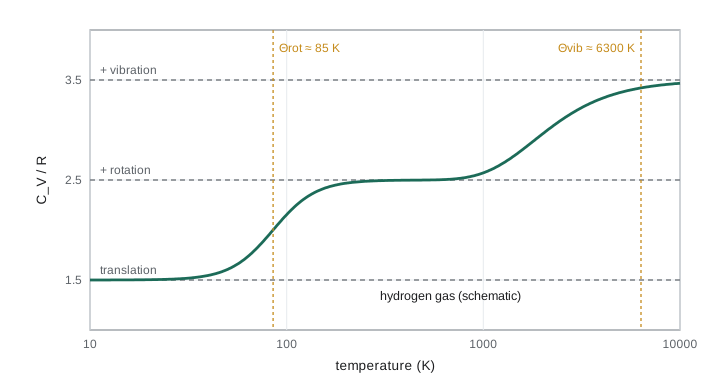
Quantum mechanics answers the question. A vibrating molecule can only take energies \(\big(j + \tfrac12\big)h\nu\) in steps of \(h\nu\), and if \(kT\) is much smaller than \(h\nu\) almost every molecule sits in its ground state; thermal collisions rarely deliver enough energy to excite the first level. The degree of freedom is said to be frozen out. The crossover is conveniently described by a characteristic temperature \(\Theta_{\text{vib}} = h\nu/k\). For nitrogen it is 3374 K, so vibration contributes almost nothing at room temperature and becomes important only in flames and shock waves. Rotation is quantized too, with characteristic temperature \(\Theta_{\text{rot}} = \hbar^2/(2Ik)\), where \(I\) is the moment of inertia; for nitrogen it is 2.88 K, far below the boiling point, so rotation is fully active in the gas. For hydrogen, the lightest molecule, \(\Theta_{\text{rot}} \approx 85\) K, and its heat capacity visibly drops from \(\frac52 R\) towards \(\frac32 R\) when it is cooled below about 100 K. The quantized energy of a single vibrating mode gives a heat capacity
which tends to \(R\) at high temperature and vanishes exponentially at low temperature. Lesson 11 derives it from the Boltzmann distribution.
Solids: Dulong–Petit, Einstein and Debye
In 1819 Pierre Louis Dulong and Alexis Thérèse Petit found that the molar heat capacities of many solid elements are close to 25 J/(mol K). Classical physics explains the rule: each atom oscillates about its lattice site in three dimensions, with three kinetic and three potential quadratic terms, so equipartition gives \(C_V = 3R = 24.9\) J/(mol K). But some solids, such as diamond, boron and silicon, have much smaller heat capacities at room temperature, and in the late nineteenth century measurements showed that every solid's heat capacity falls towards zero as the temperature falls. Classical physics had no explanation.
In 1907 Einstein proposed that each atom vibrates as three independent quantum oscillators of the same frequency \(\nu_E\). Multiplying the single-mode result above by three gives
which explains both the Dulong–Petit limit at high temperature and the fall at low temperature. Diamond, whose light, stiffly bonded atoms vibrate at high frequency, has \(\Theta_E \approx 1320\) K, and the model reproduces its room-temperature heat capacity of about 6.1 J/(mol K). This was the first application of quantum ideas outside radiation, and it persuaded many physicists that quantization was real.
Einstein's model falls off too quickly at the lowest temperatures, exponentially rather than as the observed \(T^3\). In 1912 Peter Debye fixed this by treating the vibrations as sound waves in the crystal, with a spread of frequencies up to a maximum set by the atomic spacing. Low-frequency waves remain excitable even at very low temperatures, and the Debye heat capacity is
which tends to \(3R\) at high temperature and to \(\frac{12\pi^4}{5}R(T/\Theta_D)^3\) at low temperature. The Debye temperature \(\Theta_D\) is 343 K for copper, 105 K for lead and about 2200 K for diamond. In metals, conduction electrons add a small contribution proportional to \(T\) that dominates below a few kelvins; its smallness, explained by Arnold Sommerfeld in 1927, was another triumph of quantum statistics.
import math
R = 8.314462618

def einstein(T, thE):
    x = thE / T
    return 3 * R * x * x * math.exp(x) / (math.exp(x) - 1)**2

def debye(T, thD, n=200):                 # Simpson's rule on the Debye integral
    xD = thD / T; h = xD / n
    f = lambda x: x**4 * math.exp(x) / (math.exp(x) - 1)**2 if x > 0 else 0.0
    s = f(0) + f(xD) + sum((4 if i % 2 else 2) * f(i * h) for i in range(1, n))
    return 9 * R * (T / thD)**3 * s * h / 3

def diatomic(T, th_rot, th_vib):
    """Molar C_V: translation + rotation (high-T limit above th_rot) + vibration (Einstein term)."""
    rot = R if T > 3 * th_rot else R * (T / (3 * th_rot))        # crude ramp for the rotational step
    x = th_vib / T
    vib = R * x * x * math.exp(x) / (math.exp(x) - 1)**2
    return 1.5 * R + rot + vib

print("diamond (Einstein 1320 K, Debye 2230 K) and copper (Debye 343 K), C_V in J/(mol K)")
print("  T (K)   diamond-Einstein  diamond-Debye   copper-Debye")
for T in (20, 50, 100, 200, 300, 600, 1000, 2000):
    print(f"{T:6d}   {einstein(T, 1320):14.4f}  {debye(T, 2230):13.4f}  {debye(T, 343):13.4f}")
print(f"Dulong-Petit 3R = {3 * R:.3f}")

print("\nnitrogen gas (rotation 2.88 K, vibration 3374 K): C_V / R")
for T in (100, 300, 1000, 2000, 3000, 5000):
    print(f"  T = {T:5d} K   C_V/R = {diatomic(T, 2.88, 3374) / R:.3f}")

# Latent heat: warming and melting a layer of lake ice in spring
c_ice, c_water, L_f = 2100.0, 4186.0, 3.34e5        # J/(kg K), J/(kg K), J/kg
area, thickness, rho = 1.0, 0.60, 917.0             # 1 m^2 of ice 60 cm thick
mass = area * thickness * rho
Q_warm = mass * c_ice * 10.0                        # from -10 C to 0 C
Q_melt = mass * L_f
print(f"\nice 0.60 m thick, per m^2: mass {mass:.0f} kg")
print(f"  warm from -10 C to 0 C: {Q_warm / 1e6:.2f} MJ;  melt: {Q_melt / 1e6:.1f} MJ")
print(f" days of 150 W/m^2 net sunshine needed: {(Q_warm + Q_melt) / (150 * 86400):.1f}")diamond (Einstein 1320 K, Debye 2230 K) and copper (Debye 343 K), C_V in J/(mol K)
T (K) diamond-Einstein diamond-Debye copper-Debye
20 0.0000 0.0014 0.3853
50 0.0000 0.0219 4.9847
100 0.0080 0.1753 14.7661
200 1.4821 1.3846 21.6283
300 6.0771 4.1332 23.3862
600 16.9183 13.6281 24.5405
1000 21.6166 19.6950 24.7973
2000 24.0573 23.4592 24.9067
Dulong-Petit 3R = 24.943
nitrogen gas (rotation 2.88 K, vibration 3374 K): C_V / R
T = 100 K C_V/R = 2.500
T = 300 K C_V/R = 2.502
T = 1000 K C_V/R = 2.918
T = 2000 K C_V/R = 3.293
T = 3000 K C_V/R = 3.401
T = 5000 K C_V/R = 3.463
ice 0.60 m thick, per m^2: mass 550 kg
warm from -10 C to 0 C: 11.55 MJ; melt: 183.8 MJ
days of 150 W/m^2 net sunshine needed: 15.1For copper the Debye heat capacity is within 7% of the Dulong–Petit value at room temperature, which is why the rule worked for most metals Dulong and Petit could study. For diamond both models give a heat capacity far below \(3R\) at 300 K, and the Einstein model with \(\Theta_E = 1320\) K gives 6.08 J/(mol K), very close to the measured value; diamond does not reach the classical limit until well over 1000 K. A single Debye temperature fitted to low-temperature data does not describe diamond equally well at all temperatures, a reminder that these are models, not exact theories. Nitrogen gas has \(C_V/R = 2.50\) at room temperature, as equipartition with rotation but no vibration predicts, and creeps towards 3.5 as vibration switches on above 1000 K.
Phase changes and latent heat
When ice at 0 °C is heated at atmospheric pressure, its temperature does not rise until all of it has melted. The heat absorbed, the latent heat of fusion, goes into breaking the hydrogen-bond network of the crystal rather than into molecular kinetic energy. For water it is \(L_f = 334\) kJ/kg; the latent heat of vaporization at 100 °C is much larger, \(L_v = 2257\) kJ/kg, because evaporation separates molecules completely. At room temperature evaporation needs about 2450 kJ/kg, which is why sweating cools us so effectively. Because these changes happen at constant pressure, latent heats are enthalpy changes, \(L = \Delta H\) per unit mass.
Latent heats are large compared with sensible heat. Melting a kilogram of ice takes as much energy as warming a kilogram of water by 80 °C, and boiling it away takes as much as warming it by 540 °C. The program's last calculation shows what this means for a Manitoba lake in spring: melting 60 cm of ice takes about 184 MJ per square metre, sixteen times the energy needed to warm the ice from \(-10\) °C to the melting point, and about two weeks of strong net sunshine. The latent heat also slows freezing in autumn and helps protect fish below: ice forms first at the surface, because water is densest at 4 °C, and the heat released as each layer freezes must be conducted up through the ice already formed.
The phase diagram of water
A phase diagram shows, as a function of pressure and temperature, which phase of a substance is stable. The boundaries are lines along which two phases coexist in equilibrium; along them the temperature of a phase change depends on pressure. The three lines meet at the triple point, which for water is at 273.16 K and 611.657 Pa. The liquid–vapour line ends at the critical point, 647.1 K and 22.06 MPa, beyond which there is no distinction between liquid and gas. Lesson 9 derives the slope of a coexistence line, the Clausius–Clapeyron equation
where \(\Delta v\) is the change in volume per unit mass on crossing the line. For most substances the solid is denser than the liquid, so \(\Delta v > 0\) on melting and the melting line slopes to the right: pressure raises the melting point. Water is anomalous: ice is less dense than liquid water, so its melting line slopes slightly to the left, and pressure lowers the melting point, by about 0.0074 K per atmosphere. The effect is far too small to explain ice skating, which depends mostly on a thin premelted surface layer and frictional heating. At high pressures water forms more than a dozen other crystalline phases of ice, numbered with Roman numerals.
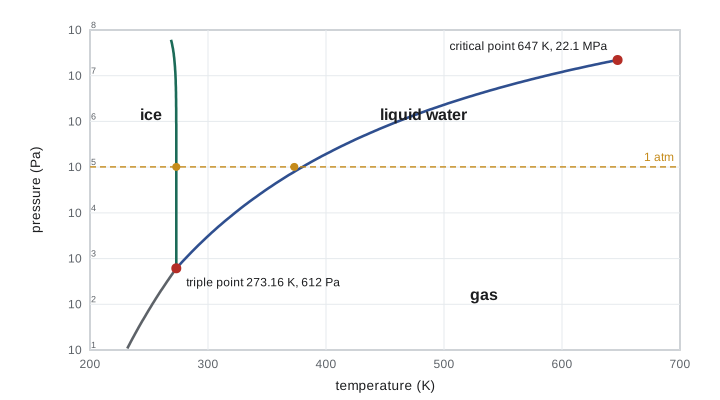
Boiling happens when the vapour pressure of the liquid reaches the surrounding pressure. At higher altitudes the air pressure is lower and water boils at a lower temperature: about 95 °C at 1500 m and about 71 °C on the summit of Everest. A pressure cooker does the reverse, raising the boiling point to about 120 °C. Below the triple-point pressure, liquid water cannot exist, and ice turns directly to vapour, sublimation, which is how snow banks shrink on cold, sunny, dry days and how freeze-drying works.
Worked problem
Ice in a drink
Ice cubes with a total mass of 50 g at \(-15\) °C are dropped into 300 g of water at 25 °C in an insulated cup. Find the final temperature, using \(c_{\text{ice}} = 2100\) J/(kg K), \(c_{\text{water}} = 4186\) J/(kg K) and \(L_f = 334\) kJ/kg.
Show solution
- Heat to warm the ice to 0 °C: \(0.050 \times 2100 \times 15 = 1575\) J. Heat to melt it: \(0.050 \times 334\,000 = 16\,700\) J.
- Heat available from the water cooling to 0 °C: \(0.300 \times 4186 \times 25 = 31\,395\) J, which is more than the 18 275 J needed, so all the ice melts.
- The remaining \(31\,395 - 18\,275 = 13\,120\) J warms all 350 g of water from 0 °C: \(\Delta T = 13\,120/(0.350 \times 4186) = 8.96\) K.
- Check: the original water cooled by \(25 - 8.96 = 16.04\) K, releasing \(0.300 \times 4186 \times 16.04 = 20\,140\) J, which equals \(1575 + 16\,700 + 0.050 \times 4186 \times 8.96 = 20\,150\) J, to rounding.
Answer: The drink ends at about 9.0 °C, with all the ice melted.
Common mistakes
MistakeForgetting the latent heat when a phase change occurs.
InsteadCheck whether the final state crosses a melting or boiling point; if it does, include \(mL\).
MistakeAssuming a substance's temperature rises while it melts.
InsteadAt a fixed pressure the temperature stays at the melting point until the phase change is complete.
MistakeUsing \(\frac72 R\) for the heat capacity of air at room temperature.
InsteadVibration is frozen out at room temperature; use \(C_V = \frac52 R\).
MistakeExpecting the Dulong–Petit rule to hold for all solids at room temperature.
InsteadIt holds only when \(T\) is well above the Debye temperature; diamond and silicon fall far short.
MistakeExplaining ice skating by pressure melting.
InsteadThe pressure effect is only about 0.0074 K per atmosphere; a premelted surface layer and frictional heating matter more.
Summary and key terms
- Heat capacity reveals the active degrees of freedom; equipartition predicts \(\frac12 R\) per quadratic term per mole.
- Quantized vibrations and rotations freeze out when \(kT\) is small compared with their level spacing.
- The Einstein model explains why solids' heat capacities fall at low temperature; the Debye model gives the observed \(T^3\) law.
- Latent heats are large: melting ice takes 334 kJ/kg and boiling water 2257 kJ/kg.
- A phase diagram shows coexistence lines meeting at the triple point; the liquid–vapour line ends at the critical point.
- The slope of a coexistence line is given by the Clausius–Clapeyron equation \(dP/dT = L/(T\Delta v)\).
- specific heat capacity
- Heat capacity per unit mass, in J/(kg K).
- Dulong–Petit law
- The molar heat capacity of many solids is close to 3R at high temperature.
- Debye temperature
- A characteristic temperature of a solid above which its heat capacity approaches 3R.
- freezing out
- The loss of a degree of freedom from the heat capacity when kT is small compared with its level spacing.
- latent heat
- Heat absorbed or released per unit mass in a phase change at constant temperature.
- critical point
- The end of a liquid–vapour coexistence line, beyond which the two phases are indistinguishable.
Practice problems
Work each problem on paper first, then reveal the answer to check.
How much heat is needed to warm 2.0 kg of aluminium (c = 900 J/(kg K)) from 20 °C to 220 °C?
Show answer
\(2.0 \times 900 \times 200 = 360\) kJ.
Using the Dulong–Petit law, estimate the specific heat capacity of lead (molar mass 207 g/mol).
Show answer
\(3R/M = 24.9/0.207 = 120\) J/(kg K); the measured value is about 128 J/(kg K).
How much energy is released when 10 kg of water vapour condenses at 100 °C?
Show answer
\(10 \times 2257 = 22\,570\) kJ, about 22.6 MJ.
Estimate the Einstein heat capacity of a solid with \(\Theta_E = 300\) K at \(T = 300\) K.
Show answer
\(x = 1\): \(3R \times e/(e - 1)^2 = 3R \times 2.718/2.952 = 0.920 \times 3R = 23.0\) J/(mol K).
By what factor does the Debye heat capacity of copper fall between 20 K and 5 K?
Show answer
In the \(T^3\) regime it falls by \(4^3 = 64\).
Why does water boil below 100 °C in a mountain village?
Show answer
The air pressure is lower, and water boils when its vapour pressure equals the surrounding pressure, which happens at a lower temperature.
Lesson quiz · 5 questions
Score 60% or more to complete this lesson.
Create a free account to save your progress, take quizzes and earn a certificate.