
PHYS-261 · Lesson 12 of 12 · 25 min
Capstone: thermal physics of the Earth, stars and life
The laws of this course were discovered by people trying to build better engines, but they reach much further. In this capstone we apply them to three systems far from the engine room. First the Earth: why it has the temperature it does, how a thin layer of gases warms its surface by more than 30 kelvins, and how sensitive that temperature is to added carbon dioxide. Then the stars: what sets the Sun's luminosity and spectrum, and why a star that loses energy gets hotter. Finally life and information: how living things maintain their intricate order without breaking the second law, and why erasing a bit of memory must release a minimum amount of heat. Each problem uses only tools from the earlier lessons: energy balance, the Stefan–Boltzmann and Wien laws, the Clausius–Clapeyron equation, entropy and the Boltzmann factor.
The Earth's energy balance
Sunlight arrives at the top of the atmosphere with a flux of about \(S_0 = 1361\) W/m², the total solar irradiance, measured by satellites since 1978. The Earth intercepts it over its cross-section \(\pi R^2\) but radiates over its whole surface \(4\pi R^2\), and it reflects a fraction \(\alpha \approx 0.30\), its albedo, mostly from clouds, ice and snow. In a steady state the absorbed power equals the power radiated as infrared:
This effective radiating temperature is 255 K, or \(-18\) °C. Yet the global mean surface temperature is about 288 K, or 15 °C. The difference of 33 K is the natural greenhouse effect. Joseph Fourier suggested in the 1820s that the atmosphere keeps the Earth warmer than it would otherwise be; John Tyndall showed in 1859 that water vapour and carbon dioxide absorb infrared radiation strongly while the main gases, nitrogen and oxygen, do not; and Svante Arrhenius made the first calculation of the warming from doubling carbon dioxide in 1896.
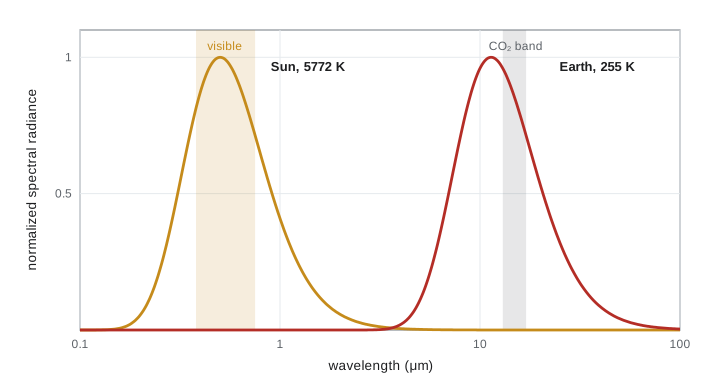
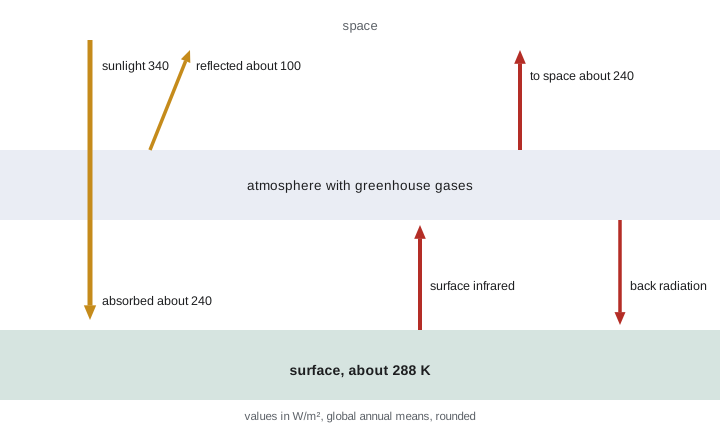
The key physical fact is visible in the figure. Wien's law places the peak of sunlight near 0.5 μm and the peak of the Earth's emission near 11 μm, so the two spectra barely overlap. The atmosphere is largely transparent to sunlight but absorbs much of the outgoing infrared, mainly through water vapour and carbon dioxide, whose bending vibration absorbs strongly near 15 μm, close to the peak of the Earth's emission. The absorbed infrared is re-emitted in all directions, half of it back down, so the surface receives more energy than sunlight alone provides and must warm until its own emission balances the books.
A one-layer greenhouse model
The simplest quantitative model treats the atmosphere as a single layer at temperature \(T_a\), transparent to sunlight and absorbing a fraction \(\varepsilon\) of the surface's infrared emission; by Kirchhoff's law it also emits with emissivity \(\varepsilon\), upward and downward. Balancing energy at the top of the atmosphere and at the surface gives
With \(\varepsilon = 0\) the surface is at \(T_e\); with a fully absorbing layer it is \(2^{1/4}T_e \approx 303\) K. The real atmosphere is not a single layer, and convection carries much of the heat upward, but choosing \(\varepsilon \approx 0.78\) reproduces the observed surface temperature. The model makes the essential point: adding absorbers raises the effective height from which infrared escapes to space, where the air is colder, so the planet must warm to restore the balance.
Climate sensitivity
How much would the surface warm if the concentration of carbon dioxide doubled? Doubling reduces the outgoing infrared by about \(\Delta F = 5.35\ln 2 \approx 3.7\) W/m², a radiative forcing computed from detailed spectroscopy; the logarithm reflects the fact that the centre of the 15 μm band is already saturated and further absorption happens in its wings. If nothing else changed, the planet would warm until its extra emission \(4\sigma T_e^3\,\Delta T\) cancelled the forcing, the Planck response, giving about 1 K. But other things do change. Warmer air holds more water vapour, about 7% more per kelvin by the Clausius–Clapeyron equation of lesson 9, and water vapour is itself a greenhouse gas, amplifying the warming. Melting snow and sea ice lower the albedo, another amplifier. Changes in clouds and in the vertical temperature profile add further feedbacks of both signs.
If feedbacks return a fraction \(f\) of any warming as further forcing, the total response is the Planck response divided by \(1 - f\). The Sixth Assessment Report of the Intergovernmental Panel on Climate Change, published in 2021, assessed the equilibrium climate sensitivity, the long-term warming for doubled carbon dioxide, as very likely between 2 and 5 °C, with a best estimate of 3 °C, corresponding to feedbacks that roughly triple the Planck response. Carbon dioxide has risen from about 280 parts per million before industrialization to more than 420 in the mid-2020s, and global mean surface temperatures have risen by about 1.3 °C, with high latitudes, including the Canadian North, warming two to four times faster than the global average.
The Sun and the stars
The Sun's spectrum is close to that of a blackbody at its effective temperature of 5772 K, a value adopted by the International Astronomical Union in 2015 as a nominal reference. With its radius of 695 700 km, the Stefan–Boltzmann law gives a luminosity \(L = 4\pi R_\odot^2\sigma T^4 = 3.83 \times 10^{26}\) W, and spreading that over a sphere of radius one astronomical unit returns the solar constant. Stars of different temperatures have different colours by Wien's law: red dwarfs near 3000 K, blue giants above 20 000 K.
A star is a ball of gas held together by its own gravity and supported by its internal pressure. For such a self-gravitating system in equilibrium, the virial theorem relates the total thermal kinetic energy \(K\) to the gravitational potential energy \(U_g\): \(2K + U_g = 0\). The total energy is then \(E = K + U_g = -K\). This has a startling consequence. When a star radiates energy, \(E\) decreases, so \(K\) increases: the star contracts and gets hotter. A star has a negative heat capacity. This is why contraction heats a young star until its core reaches the roughly \(10^7\) K needed for hydrogen fusion, and why, when the core runs out of hydrogen, it contracts and heats further until helium burns. Before nuclear energy was known, Kelvin and Helmholtz proposed that gravitational contraction powers the Sun, which would last only about 30 million years at its present luminosity; the conflict with the much longer ages required by geology and evolution was resolved only in the twentieth century, when Arthur Eddington in 1920 and Hans Bethe in 1939 showed that fusion is the true source.
The energy of the core does not escape directly. Photons produced near the centre are absorbed and re-emitted countless times in a random walk, and the energy takes tens of thousands to a few hundred thousand years to reach the surface, where the gas becomes transparent and the light escapes with the spectrum of a 5772 K blackbody.
Life and the export of entropy
Living things build and maintain intricate structures: proteins folded into precise shapes, cells with membranes and gradients, organisms with organs. Does this decrease in entropy contradict the second law? It does not, because organisms are not isolated systems. Erwin Schrödinger, in his 1944 book What Is Life?, put it memorably: an organism feeds on negative entropy, drawing order from its environment and exporting disorder. A person at rest converts the chemical energy of food into about 100 W of heat, released to the surroundings at a lower temperature than that of the chemical energy's source, and the entropy exported more than pays for the order maintained inside.
The ultimate source of that order for life on Earth is the Sun. The Earth receives energy as sunlight, which carries little entropy because it comes from a 5772 K source, and returns the same amount of energy to space as infrared from a 255 K planet, which carries far more. For radiation, the entropy flux is \(\frac43\) times the energy flux divided by temperature. The difference is the entropy that weather, ocean currents, chemistry and life produce on the way.
Information and Landauer's limit
In 1867 Maxwell imagined a tiny being that operated a trapdoor between two chambers of gas, letting fast molecules through one way and slow ones the other, so creating a temperature difference without doing work and seemingly violating the second law. Leo Szilard analysed a one-molecule version in 1929 and argued that the demon must pay for the information it gathers. The modern resolution came from Rolf Landauer, who showed in 1961 that erasing one bit of information, resetting a memory to a standard state regardless of its previous contents, must dissipate at least
of heat into the environment, because it reduces the number of possible states of the memory by a factor of two, lowering its entropy by \(k\ln 2\), and that entropy must go somewhere. Charles Bennett showed in 1982 that measurement itself can in principle be done without dissipation, so it is the demon's need to erase its memory to keep working that saves the second law. In 2012 Antoine Bérut and colleagues measured the heat released when a single colloidal bead in a double-well optical trap was reset, and found that it approached \(kT\ln 2\) as the erasure was made slower. Landauer's limit is about \(3 \times 10^{-21}\) J per bit at room temperature, far below what present computers dissipate per operation, but it sets a floor that no technology can go beneath.
import math
sigma, k, h, c = 5.670374419e-8, 1.380649e-23, 6.62607015e-34, 2.99792458e8
S0, albedo = 1361.0, 0.30

# 1. Planetary energy balance: absorbed sunlight = emitted infrared
absorbed = S0 * (1 - albedo) / 4
Te = (absorbed / sigma) ** 0.25
print(f"absorbed sunlight {absorbed:.1f} W/m^2, effective temperature {Te:.1f} K ({Te - 273.15:.1f} C)")

# 2. One-layer greenhouse model with infrared absorptivity eps of the atmosphere
for eps in (0.0, 0.5, 0.78, 1.0):
    Ts = Te * (2 / (2 - eps)) ** 0.25
    print(f"  atmosphere absorptivity {eps:.2f}: surface {Ts:.1f} K ({Ts - 273.15:+.1f} C)")

# 3. Climate sensitivity: CO2 forcing and the Planck response
F2x = 5.35 * math.log(2)
lam_planck = 4 * sigma * Te**3
print(f"\nforcing for doubled CO2: {F2x:.2f} W/m^2; Planck response {lam_planck:.2f} W/(m^2 K)")
print(f"warming with no feedbacks: {F2x / lam_planck:.2f} K")
for f in (0.5, 0.65, 0.75):
    print(f"  with feedback factor {f:.2f}: {F2x / lam_planck / (1 - f):.2f} K")

# 4. The Sun as a blackbody: luminosity, Wien peak and the solar constant
R_sun, T_sun, AU = 6.957e8, 5772.0, 1.495978707e11
L = 4 * math.pi * R_sun**2 * sigma * T_sun**4
b_wien = 2.897771955e-3
print(f"\nSun: luminosity {L:.3e} W, Wien peak {b_wien / T_sun * 1e9:.0f} nm, "
      f"flux at Earth {L / (4 * math.pi * AU**2):.0f} W/m^2")
print(f"Earth at {Te:.0f} K: Wien peak {b_wien / Te * 1e6:.1f} um, in the thermal infrared")

# 5. Entropy budget: sunlight arrives from a 5772 K source and leaves as 255 K infrared
Q = absorbed
s_in, s_out = (4 / 3) * Q / T_sun, (4 / 3) * Q / Te
print(f"\nradiation entropy flux in {s_in:.4f}, out {s_out:.4f} W/(m^2 K); "
      f"Earth exports {s_out - s_in:.3f} W/(m^2 K)")
P_body, T_body, T_room = 100.0, 310.15, 293.15
print(f"a resting person (100 W) produces entropy at {P_body / T_room - P_body / T_body:.4f} W/K "
      f"just by losing heat to a 20 C room")

# 6. Landauer's limit: minimum heat to erase one bit
for T in (300.0, 4.0):
    E = k * T * math.log(2)
    print(f"Landauer limit at {T:5.1f} K: {E:.3e} J per bit = {E / 1.602176634e-19 * 1000:.3f} meV")
bits = 1e21
print(f"erasing 1e21 bits per second at 300 K needs at least {bits * k * 300 * math.log(2):.2f} W")absorbed sunlight 238.2 W/m^2, effective temperature 254.6 K (-18.6 C) atmosphere absorptivity 0.00: surface 254.6 K (-18.6 C) atmosphere absorptivity 0.50: surface 273.6 K (+0.4 C) atmosphere absorptivity 0.78: surface 288.1 K (+14.9 C) atmosphere absorptivity 1.00: surface 302.7 K (+29.6 C) forcing for doubled CO2: 3.71 W/m^2; Planck response 3.74 W/(m^2 K) warming with no feedbacks: 0.99 K with feedback factor 0.50: 1.98 K with feedback factor 0.65: 2.83 K with feedback factor 0.75: 3.96 K Sun: luminosity 3.828e+26 W, Wien peak 502 nm, flux at Earth 1361 W/m^2 Earth at 255 K: Wien peak 11.4 um, in the thermal infrared radiation entropy flux in 0.0550, out 1.2474 W/(m^2 K); Earth exports 1.192 W/(m^2 K) a resting person (100 W) produces entropy at 0.0187 W/K just by losing heat to a 20 C room Landauer limit at 300.0 K: 2.871e-21 J per bit = 17.919 meV Landauer limit at 4.0 K: 3.828e-23 J per bit = 0.239 meV erasing 1e21 bits per second at 300 K needs at least 2.87 W
The energy balance gives an effective temperature of 254.6 K. The one-layer model raises the surface to 288 K with \(\varepsilon = 0.78\), and to 303 K if the atmosphere absorbed all outgoing infrared. Doubling carbon dioxide produces a forcing of 3.71 W/m², and the Planck response alone gives about 1.0 K of warming; feedback factors between 0.5 and 0.75 give 2 to 4 K, bracketing the assessed range. The Stefan–Boltzmann law with the Sun's radius and temperature reproduces its luminosity, \(3.83 \times 10^{26}\) W, and the solar constant of 1361 W/m², a satisfying closure. Each square metre of the Earth exports about 1.2 W/K of entropy to space, twenty times more than arrives with the sunlight; a resting person produces about 0.02 W/K just by losing heat to a room. Landauer's limit at room temperature is \(2.9 \times 10^{-21}\) J, or 18 meV, per bit; erasing \(10^{21}\) bits per second, far beyond any computer today, would need only 2.9 W at the limit.
Looking back
This course began with a simple model of balls moving between two urns and has ended with the climate of a planet, the interior of a star and the thermodynamics of computation. The same few ideas carried us all the way. Energy is conserved. Systems move from macrostates with few microstates to macrostates with many, so entropy increases. Temperature measures how the entropy of a system responds to energy, and the Boltzmann factor gives the probability of each state at a given temperature. The statistical mechanics course takes these ideas further, to the canonical and grand canonical ensembles, quantum gases of bosons and fermions, and phase transitions; the quantum mechanics courses supply the energy levels that the partition function needs.
Worked problem
A planet around another star
A planet orbits a star of luminosity \(0.50L_\odot\) at 0.70 astronomical units and has albedo 0.35. Estimate its effective temperature, and its surface temperature if its atmosphere is like the Earth's in the one-layer model.
Show solution
- Flux at the planet: \(S = 1361 \times 0.50/0.70^2 = 1389\) W/m².
- \(T_e = (1389 \times 0.65/(4 \times 5.670 \times 10^{-8}))^{1/4} = (3.98 \times 10^9)^{1/4} = 251\) K.
- With \(\varepsilon = 0.78\), \(T_s = 251 \times (2/1.22)^{1/4} = 251 \times 1.132 = 284\) K.
- That is about 11 °C, warm enough for liquid water at the surface, given an Earth-like atmosphere.
Answer: About 251 K effective and 284 K at the surface.
Common mistakes
MistakeUsing the Earth's surface area for absorbed sunlight.
InsteadSunlight is intercepted over the cross-section \(\pi R^2\); infrared is emitted over \(4\pi R^2\), hence the factor 4.
MistakeExplaining the greenhouse effect as trapped hot air, like a closed car.
InsteadIt works by infrared absorption and re-emission, which raises the altitude from which the planet radiates to space.
MistakeAssuming warming is proportional to carbon dioxide concentration.
InsteadThe forcing grows logarithmically, so each doubling adds about the same forcing.
MistakeThinking that living organisms violate the second law.
InsteadThey are open systems that export more entropy than they create internally.
MistakeBelieving that a star cools as it loses energy.
InsteadBy the virial theorem a self-gravitating star contracts and heats up as it radiates.
Summary and key terms
- Energy balance gives the Earth an effective temperature \(T_e = ((1 - \alpha)S_0/4\sigma)^{1/4} \approx 255\) K; the surface is 33 K warmer because of the greenhouse effect.
- Sunlight and earthlight occupy separate wavelength ranges, so the atmosphere can be transparent to one and partly opaque to the other.
- Doubling carbon dioxide gives a forcing of about 3.7 W/m²; the Planck response gives about 1 K, and feedbacks raise the sensitivity to about 3 K.
- The Sun's luminosity follows from \(4\pi R^2\sigma T^4\); self-gravitating stars have negative heat capacity.
- Life maintains order by exporting entropy; the Earth radiates about twenty times more entropy than it receives.
- Erasing a bit must dissipate at least \(kT\ln 2\), Landauer's limit, which resolves Maxwell's demon.
- albedo
- The fraction of incident sunlight that a planet reflects.
- effective temperature
- The temperature of a blackbody that would emit the same total power.
- radiative forcing
- The change in net energy flux at the top of the atmosphere caused by a perturbation.
- climate sensitivity
- The equilibrium global warming for a doubling of carbon dioxide.
- virial theorem
- For a self-gravitating system in equilibrium, twice the kinetic energy plus the potential energy is zero.
- Landauer's limit
- The minimum heat, kT ln 2, released in erasing one bit of information.
Practice problems
Work each problem on paper first, then reveal the answer to check.
Mars orbits at 1.52 astronomical units with albedo 0.25. Find its effective temperature.
Show answer
\(S = 1361/1.52^2 = 589\) W/m²; \(T_e = (589 \times 0.75/(4 \times 5.67 \times 10^{-8}))^{1/4} = 210\) K.
If the Earth's albedo fell from 0.30 to 0.29, by how much would its effective temperature rise?
Show answer
\(T_e \propto (1 - \alpha)^{1/4}\), so \(\Delta T/T = \frac14 \times 0.01/0.70 = 0.0036\), about 0.9 K.
Find the radiative forcing from raising carbon dioxide from 280 to 420 parts per million.
Show answer
\(5.35\ln(420/280) = 5.35 \times 0.405 = 2.17\) W/m².
A star has the Sun's radius but twice its surface temperature. How much more luminous is it?
Show answer
\(2^4 = 16\) times.
Find Landauer's limit at 77 K in joules.
Show answer
\(kT\ln 2 = 1.381 \times 10^{-23} \times 77 \times 0.693 = 7.4 \times 10^{-22}\) J.
Explain in one sentence why a star has negative heat capacity.
Show answer
By the virial theorem its total energy is minus its thermal kinetic energy, so losing energy raises its kinetic energy and hence its temperature.
Lesson quiz · 5 questions
Score 60% or more to complete this lesson.
Create a free account to save your progress, take quizzes and earn a certificate.