
PHYS-261 · Lesson 2 of 12 · 23 min
Temperature, thermometry and the zeroth law
Temperature is the most familiar quantity in thermal physics and one of the subtlest. We feel hot and cold directly, yet our senses are poor thermometers: a metal railing feels colder than a wooden bench at the same temperature because metal conducts heat away from the hand faster. This lesson gives temperature a precise meaning. We start from the zeroth law, which makes temperature a well-defined property of a system in equilibrium, then look at how practical thermometers work and how they are made to agree, and finally see how the absolute, or kelvin, scale is defined, first through ideal gases and, since 2019, by fixing the value of the Boltzmann constant.
Thermal equilibrium and the zeroth law
Bring two systems into thermal contact, meaning that they can exchange energy as heat through a wall that does not let matter through and does not move. Examples are a thermometer pressed against your tongue, or a sealed bottle of milk in a refrigerator. In general the systems change: the mercury rises, the milk cools. Eventually the changes stop, and the systems are said to be in thermal equilibrium with each other. The zeroth law of thermodynamics states:
Zeroth law: if system A is in thermal equilibrium with system C, and system B is in thermal equilibrium with C, then A and B are in thermal equilibrium with each other.
This sounds too obvious to need stating, but it is a genuine empirical fact, and it is exactly what makes thermometers work. Let C be a thermometer. If C reads the same when placed in contact with A as with B, the zeroth law guarantees that A and B would not exchange heat if brought together. The relation of being in thermal equilibrium is therefore transitive, and like any such relation it sorts all systems into classes. Temperature is a label for those classes: two systems have the same temperature if and only if they are in thermal equilibrium with each other. Ralph Fowler suggested the name zeroth law in the 1930s, because the first and second laws had already been numbered and this one logically comes before them.
The zeroth law gives temperature as a label but not yet as a number with a direction. That comes from heat flow: when two bodies at different temperatures are put in contact, energy flows from the one we call hotter to the one we call colder. A good temperature scale must assign higher numbers to hotter bodies. Beyond that, the choice of numerical scale is a matter of convention until the second law supplies a natural one in lesson 7.
Thermometers and empirical scales
A thermometer is any system with a property that changes smoothly and reproducibly with temperature. Common choices are the length of a column of liquid, the pressure of a gas at constant volume, the electrical resistance of a platinum wire, the voltage across a junction of two different metals, and the colour of light emitted by a hot body. Each defines an empirical temperature scale once we choose two fixed points and assume that the property varies linearly between them. The Celsius scale originally took the freezing and boiling points of water at standard atmospheric pressure as 0 and 100. Fahrenheit's scale, with water freezing at 32 and boiling at 212, is related by
so the two scales agree at \(-40\). A temperature difference of one Celsius degree equals 1.8 Fahrenheit degrees.
The trouble with empirical scales is that different thermometers, calibrated to agree at the two fixed points, disagree in between, because no real property is exactly linear in temperature. A mercury thermometer and an alcohol thermometer calibrated at 0 and 100 °C may differ by a few tenths of a degree at 50 °C. To settle on a single scale we need a thermometer whose behaviour does not depend on the details of the substance. Gases at low pressure come remarkably close.
The gas thermometer and absolute zero
Robert Boyle found in 1662 that at fixed temperature the pressure of a gas is inversely proportional to its volume. Later measurements by Jacques Charles and Joseph Louis Gay-Lussac, published by Gay-Lussac in 1802, showed that at fixed pressure the volume of a gas increases linearly with temperature, by about the same fraction for every gas. In a constant-volume gas thermometer, a bulb of gas is connected to a manometer that adjusts to keep the volume fixed, and the pressure is read. If the gas is dilute, the pressure is a linear function of Celsius temperature, and when the line is extrapolated to zero pressure it meets the axis at the same temperature for every gas, \(-273.15\) °C.
This universal point is absolute zero, and it suggests measuring temperature from it. Define the ideal-gas temperature by
where the limit removes the small deviations from ideal behaviour that real gases show at finite pressure. The kelvin scale is this scale, with the size of the unit chosen so that a kelvin equals a Celsius degree. So \(T/\text{K} = t/{}^\circ\text{C} + 273.15\). On the kelvin scale the pressure of a dilute gas at constant volume is simply proportional to \(T\), and the ratio of the pressures at the steam point and the ice point is \(373.15/273.15 = 1.3661\). Kelvin showed in 1848 that a scale with exactly these properties can be defined from Carnot's theorem without referring to any substance at all, which is why we call it the thermodynamic temperature; lesson 7 makes that argument.
Defining the kelvin
From 1954 until 2019 the kelvin was defined by assigning exactly 273.16 K to the triple point of water, the unique temperature and pressure at which ice, liquid water and water vapour coexist in equilibrium (0.01 °C and 611.657 Pa). The triple point is more reproducible than the ice point, because it does not depend on dissolved air or on the exact atmospheric pressure. In practice laboratories realized temperatures through the International Temperature Scale of 1990, ITS-90, which specifies fixed points such as the triple point of argon at 83.8058 K, the melting point of gallium at 302.9146 K and the freezing points of tin, zinc, aluminium and silver, together with interpolating instruments such as platinum resistance thermometers between them.
On 20 May 2019 the International System of Units was redefined so that all base units rest on fixed values of fundamental constants. The kelvin is now defined by fixing the Boltzmann constant at exactly
Temperature is thereby tied directly to energy: a kelvin is the temperature change that changes \(kT\) by \(1.380649 \times 10^{-23}\) J. The triple point of water is now a measured quantity, still 273.16 K to within about a tenth of a millikelvin. The redefinition was made possible by primary thermometers that measure \(kT\) directly, notably acoustic gas thermometry, which uses the speed of sound in argon, and Johnson noise thermometry, which measures the voltage fluctuations of a resistor; we will see why \(kT\) appears in both in lessons 4 and 11.
Practical thermometers
Liquid-in-glass thermometers are simple and need no power, but they are fragile and limited to a few hundred degrees. Platinum resistance thermometers exploit the nearly linear increase of resistance with temperature, about 0.385% per kelvin for industrial grades, and are the standard for precise measurement between about 14 K and 960 °C. Thermistors, made from semiconducting oxides whose resistance falls steeply with temperature, are cheap and sensitive and are used in household thermostats and medical thermometers. Infrared thermometers measure the thermal radiation emitted by a surface, which depends on its temperature through the Stefan–Boltzmann law of lesson 6, and need a correction for the surface's emissivity.
Thermocouples are the workhorses of industry. Two wires of different metals joined at a hot junction and a reference junction produce a voltage, the Seebeck effect discovered by Thomas Seebeck in 1821, that depends on the temperature difference. Type K, made of chromel and alumel, produces about 41 μV per kelvin near room temperature and works up to about 1250 °C. Its voltage is not exactly linear in temperature, so tables and polynomial fits are used to convert readings. The program below fits a simple quadratic to tabulated type K voltages and inverts it, and also shows the arithmetic of the gas thermometer extrapolation.
# Temperature scales and two thermometers

def c_to_k(c): return c + 273.15
def c_to_f(c): return 9 / 5 * c + 32
def f_to_c(f): return (f - 32) * 5 / 9

print("   deg C      K     deg F")
for c in (-273.15, -40.0, -30.0, 0.0, 20.0, 37.0, 100.0):
    print(f"{c:8.2f} {c_to_k(c):7.2f} {c_to_f(c):8.2f}")

# Constant-volume gas thermometer: extrapolate pressure to zero
P_ice, P_steam = 100.000, 136.610       # kPa, measured at 0 and 100 deg C
slope = (P_steam - P_ice) / 100.0
t_zero = -P_ice / slope
print(f"\ngas thermometer: pressure ratio {P_steam / P_ice:.4f}, zero pressure at {t_zero:.2f} deg C")

# Type K thermocouple: fit emf (mV) = a1 t + a2 t^2 by least squares, then invert
data = [(0, 0.000), (100, 4.096), (200, 8.138), (300, 12.209), (400, 16.397), (500, 20.644)]
S11 = sum(t**2 for t, e in data); S12 = sum(t**3 for t, e in data); S22 = sum(t**4 for t, e in data)
b1 = sum(t * e for t, e in data);  b2 = sum(t**2 * e for t, e in data)
det = S11 * S22 - S12 * S12
a1 = (b1 * S22 - b2 * S12) / det
a2 = (S11 * b2 - S12 * b1) / det
print(f"\nfit: emf = {a1 * 1000:.4f} uV/C * t + {a2 * 1e6:.4f} nV/C^2 * t^2")
for t, e in data:
    print(f"  t = {t:3d} C  table {e:6.3f} mV  fit {a1 * t + a2 * t * t:6.3f} mV")

def invert(emf):
    t = emf / a1
    for _ in range(20):                      # Newton iterations
        t -= (a1 * t + a2 * t * t - emf) / (a1 + 2 * a2 * t)
    return t
print(f"a reading of 10.000 mV means t = {invert(10.0):.1f} C") deg C K deg F
-273.15 0.00 -459.67
-40.00 233.15 -40.00
-30.00 243.15 -22.00
0.00 273.15 32.00
20.00 293.15 68.00
37.00 310.15 98.60
100.00 373.15 212.00
gas thermometer: pressure ratio 1.3661, zero pressure at -273.15 deg C
fit: emf = 40.1998 uV/C * t + 2.0925 nV/C^2 * t^2
t = 0 C table 0.000 mV fit 0.000 mV
t = 100 C table 4.096 mV fit 4.041 mV
t = 200 C table 8.138 mV fit 8.124 mV
t = 300 C table 12.209 mV fit 12.248 mV
t = 400 C table 16.397 mV fit 16.415 mV
t = 500 C table 20.644 mV fit 20.623 mV
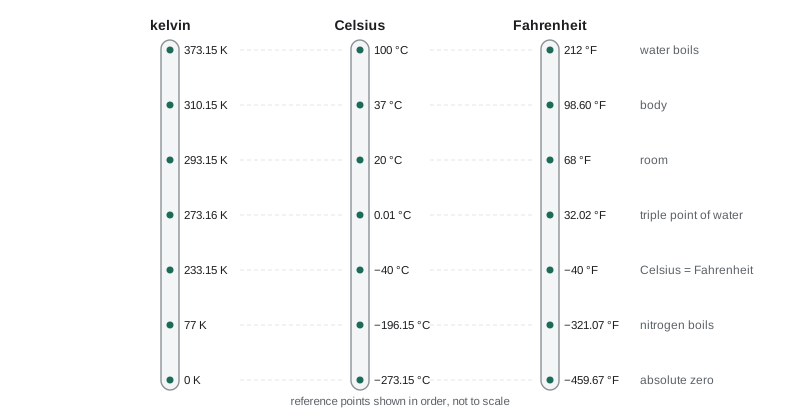
a reading of 10.000 mV means t = 245.6 CA gas thermometer whose pressure rises from 100.000 kPa to 136.610 kPa between the ice and steam points extrapolates to zero pressure at \(-273.15\) °C, as it must. The two-term fit to the thermocouple table reproduces the voltages to within about 0.05 mV, which is roughly 1 °C, and converts a reading of 10.000 mV to 245.6 °C, while the official table gives about 246.2 °C. That is good enough for a kitchen oven but not for a laboratory, which is why the international reference functions for thermocouples use polynomials of ninth or tenth degree. The conversion table also shows the two scales meeting at \(-40\) and a cold winter night of \(-30\) °C, which is \(-22\) °F and 243.15 K.
Temperature and energy
Why should temperature be connected to energy at all? The kinetic theory of lesson 4 shows that for a dilute gas the mean translational kinetic energy of a molecule is \(\frac{3}{2}kT\), and lesson 11 generalizes this: in equilibrium, each quadratic term in the energy of a classical system carries an average energy of \(\frac{1}{2}kT\). Temperature is therefore, roughly, a measure of the typical energy per degree of freedom. But that is only roughly true, and it fails badly for quantum systems at low temperature and for systems with a maximum energy. The deeper definition, in lesson 10, is that \(1/T\) measures how fast the entropy of a system grows as energy is added to it. Two systems in contact exchange energy until their entropies grow at the same rate, and that is why equal temperatures mean equilibrium.
Temperature is an intensive quantity: if you put two identical blocks at 300 K side by side, the combined system is still at 300 K, whereas its energy, volume and mass, which are extensive, double. Temperature is also a property of equilibrium. A system whose parts are not in equilibrium, such as a gas with a hot region and a cold region, or a plasma whose electrons and ions have different average energies, does not have a single temperature, although each part may have its own.
Worked problem
Reading a gas thermometer
A constant-volume gas thermometer, filled with helium at low pressure, reads 4.800 kPa at the triple point of water. When the bulb is placed in a bath of liquid nitrogen it reads 1.353 kPa. What is the temperature of the bath?
Show solution
- For a dilute gas at constant volume, \(P \propto T\).
- So \(T = 273.16\ \text{K} \times \frac{1.353}{4.800}\).
- \(T = 273.16 \times 0.28188 = 77.0\) K.
- In Celsius that is \(77.0 - 273.15 = -196.2\) °C, and in Fahrenheit \(-321.1\) °F.
Answer: The bath is at 77.0 K, the normal boiling point of liquid nitrogen.
Common mistakes
MistakeAdding 273 to a temperature difference to convert it to kelvins.
InsteadDifferences are the same in kelvins and Celsius degrees; only absolute temperatures shift by 273.15.
MistakeUsing Celsius temperatures in \(PV = nRT\) or in ratios such as \(T_2/T_1\).
InsteadAlways use kelvins in formulas that involve temperature multiplicatively.
MistakeWriting degrees kelvin.
InsteadThe unit is the kelvin, symbol K, with no degree sign.
MistakeAssuming that an object that feels colder is at a lower temperature.
InsteadTouch senses heat flow, which depends on conductivity; a metal and a wooden object at the same temperature feel different.
MistakeExpecting a two-point calibration to make any thermometer accurate everywhere in between.
InsteadReal properties are not exactly linear; precise work needs fits or standard reference functions.
Summary and key terms
- The zeroth law makes thermal equilibrium transitive, so temperature is a well-defined label for equilibrium classes.
- Empirical scales depend on the thermometer; dilute gases give a universal scale that extrapolates to absolute zero at \(-273.15\) °C.
- \(T/\text{K} = t/{}^\circ\text{C} + 273.15\) and \(t_F = \frac{9}{5}t_C + 32\).
- Since 2019 the kelvin is defined by fixing \(k = 1.380649 \times 10^{-23}\) J/K exactly.
- Platinum resistance thermometers, thermistors, thermocouples and infrared sensors cover different ranges and needs.
- Temperature is intensive and is defined only for systems in equilibrium.
- zeroth law
- Two systems each in equilibrium with a third are in equilibrium with each other.
- absolute zero
- The lowest possible temperature, 0 K, where an ideal gas would exert zero pressure.
- triple point of water
- The state where ice, liquid water and vapour coexist, at 273.16 K and 611.657 Pa.
- ITS-90
- The International Temperature Scale of 1990, defined by fixed points and interpolating instruments.
- Seebeck effect
- The voltage produced by a temperature difference across a junction of two conductors.
- intensive quantity
- A quantity, such as temperature or pressure, that does not scale with the size of the system.
Practice problems
Work each problem on paper first, then reveal the answer to check.
Convert body temperature, 37.0 °C, to kelvins and Fahrenheit.
Show answer
310.15 K and \(\frac95 \times 37 + 32 = 98.6\) °F.
At what temperature does the Fahrenheit reading equal twice the Celsius reading?
Show answer
\(2t = \frac95 t + 32\) gives \(0.2t = 32\), \(t = 160\) °C \(= 320\) °F.
A temperature drops by 25 °C overnight. What is the drop in kelvins and in Fahrenheit degrees?
Show answer
25 K and \(25 \times 1.8 = 45\) Fahrenheit degrees.
A platinum resistance thermometer has resistance 100.00 Ω at 0 °C and coefficient 0.00385 per kelvin. Estimate its resistance at 50 °C, assuming linearity.
Show answer
\(100.00 \times (1 + 0.00385 \times 50) = 119.25\) Ω.
A gas thermometer reads 52.0 kPa at the triple point of water. What does it read at 500 K?
Show answer
\(52.0 \times 500 / 273.16 = 95.2\) kPa.
Why does the zeroth law matter for the use of thermometers?
Show answer
It guarantees that two bodies that give the same thermometer reading are in equilibrium with each other, so the reading is a property of the bodies, not of the thermometer.
Lesson quiz · 5 questions
Score 60% or more to complete this lesson.
Create a free account to save your progress, take quizzes and earn a certificate.