
PHOT-340 · Lesson 4 of 12 · 29 min
Gear, backups and redundancy
At a studio shoot, a failed camera means a pause while a replacement arrives. At a wedding, a failed camera during the vows means a missed moment that can never be recovered, and a lost memory card can mean a missed wedding. Event photographers therefore think about gear differently: not only which camera and lenses make the best images, but what happens when each item fails. This lesson covers choosing cameras and lenses for events, the logic of redundancy, memory cards and dual slots, batteries and power, flash gear, carrying systems, backing up files during and after the event, and insuring equipment. Exposure and lighting fundamentals are in PHOT-201 and PHOT-220; this lesson focuses on reliability.
Cameras for events
Event cameras need reliable autofocus in dim light, clean high-ISO performance, fast and quiet shutters, long battery life and, ideally, two memory card slots. Mirrorless cameras now dominate event work because of eye-detection autofocus, silent electronic shutters for quiet ceremonies, and accurate exposure previews in the viewfinder; many photographers still use DSLRs successfully. Whatever the system, the essential rule is that a professional event photographer carries at least two camera bodies that can each do the whole job. Two bodies also allow two lenses to be ready at once, such as a wide zoom on one and a telephoto on the other, which reduces lens changes during fast-moving moments.
Electronic shutters allow silent shooting during vows, speeches and performances, but they can produce banding under some artificial lights and distortion with fast movement, as covered in PHOT-220. Test silent mode in similar lighting before relying on it.
Lenses for events
Most event photographers rely on a small set of lenses:
- A standard zoom, such as 24-70 mm f/2.8 on full frame, for getting ready, groups and general coverage.
- A telephoto zoom, such as 70-200 mm f/2.8, for ceremonies from the back or side, candid reactions, speeches and portraits with compressed backgrounds.
- Fast primes, such as 35 mm, 50 mm or 85 mm at f/1.4 to f/1.8, for low light, shallow depth of field and lighter carrying.
- A wide lens, such as 16-35 mm, for venues, dance floors and large groups in tight spaces.
- A macro lens, such as 90 to 105 mm, for rings and details, often doubling as a portrait lens.
The f/2.8 zooms are heavy but versatile; primes are lighter and brighter but require moving or changing lenses. Many photographers carry two zooms and two primes, and choose lenses for each part of the day based on the space and light they found when scouting.
| Lens | Main uses | Backup if it fails |
|---|---|---|
| 24-70 mm f/2.8 | Getting ready, groups, general coverage | 35 mm and 50 mm primes |
| 70-200 mm f/2.8 | Ceremony, speeches, candid moments | 85 mm prime and cropping |
| 35 mm f/1.4 | Low light documentary, dance floor | 24-70 mm at f/2.8 with higher ISO |
| 85 mm f/1.8 | Portraits, low-light speeches | 70-200 mm |
| 100 mm macro | Rings and details | Close focus on another lens and cropping |
The logic of redundancy
Redundancy means having a second way to do every critical job. For each item in the kit, ask: if this fails in the middle of the ceremony, what do I use instead, and how quickly? Critical items include camera bodies, a lens for each focal-length range, flash units, memory cards, batteries and chargers. Less obvious ones include the cable or card reader used to back up files, the car that carries the gear, and the photographer: a contract should say what happens if the photographer is ill, and many photographers have an agreement with trusted colleagues to cover each other in emergencies.
Memory cards and dual slots
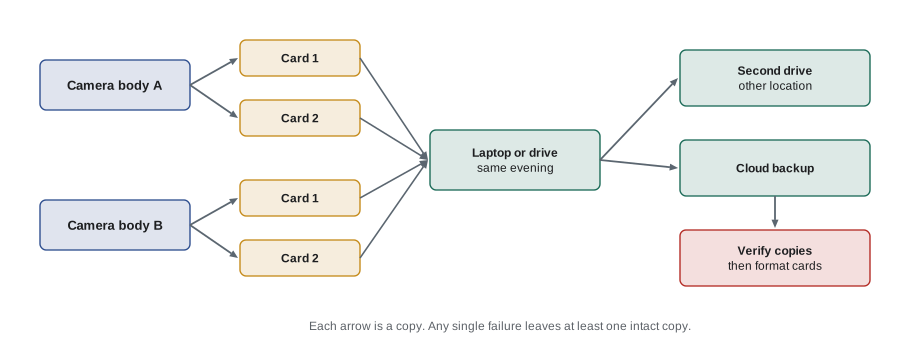
Memory cards fail rarely, but event photographers shoot thousands of frames a year, so rare failures still happen. Cameras with two card slots can write every image to both cards at once, called backup or mirror mode, so a single card failure loses nothing. This is the strongest single protection against loss during the event. Other good practices include:
- Use reputable cards from trusted suppliers, because counterfeit cards are common online.
- Format cards in the camera before each event, after confirming the previous event's files are backed up.
- Use several medium-capacity cards rather than one huge card, so a single failure or loss affects fewer images, and change cards at natural breaks.
- Store used cards in a labelled case on your person, never loose in a pocket or bag.
- Replace cards on a schedule and after any error message.
Worked problem
Shot count and card capacity
A photographer expects to shoot about 3,500 frames at a ten-hour wedding with a 45-megapixel camera. Each compressed raw file averages 50 MB. The camera writes to two cards in backup mode. How much card capacity is needed per slot, and how many 128 GB cards should the photographer bring if they change cards at two breaks?
Show solution
- Data: \( 3{,}500 \times 50 = 175{,}000 \) MB, about 175 GB per slot.
- Changing cards at two breaks splits the day into three periods of about 58 GB each.
- One 128 GB card per slot per period covers that with room to spare: 3 periods × 2 slots = 6 cards.
- Add spares: at least one extra pair, for 8 cards in total.
Answer: About 175 GB per slot; bring eight 128 GB cards for a three-period day with spares. If a second photographer shoots similar volumes, they need their own set. Large files make card and storage planning important, and lesson 11 continues with storage after the event.
Batteries and power
Mirrorless cameras use more battery power than DSLRs, and cold weather reduces battery capacity, as discussed in PHOT-330. Plan for at least three batteries per body for a full wedding, charged and labelled, plus chargers and a power bank or car charger for long days. Flashes use AA batteries or proprietary lithium-ion packs; bring enough to replace every set at least once. Rotate batteries in a consistent order, keep spent batteries separate from charged ones (for example, by turning the cover over), and charge everything the night before.
Worked problem
Battery planning
A mirrorless body is rated at about 500 shots per battery, but the photographer's own experience with continuous eye detection and long viewfinder use is about 350 shots. They expect to shoot 1,800 frames on this body. How many batteries should they carry?
Show solution
- Batteries needed: \( 1{,}800 / 350 ≈ 5.1 \).
- Round up to 6 and add one spare: 7 batteries.
- Alternatively, carry 4 and recharge 2 during dinner from a car or venue outlet.
Answer: Six or seven batteries, or fewer with planned recharging. Use real-world numbers from your own logs rather than published ratings, and add margin for cold days.
Flash and lighting gear
Lesson 7 covers flash technique. For reliability, carry at least two speedlights and preferably three, with wireless triggers and spares. Many photographers use one flash on camera for bounce and two off-camera flashes on light stands for receptions. Bring light stands, a small softbox or umbrella, gels for matching ambient light, and a small LED light for video-style fill or focusing assistance. Check that triggers and flashes share the same radio system and firmware.
Carrying systems and kit organization
Event photographers move constantly, so the way gear is carried affects both speed and health. Options include dual-camera harnesses or belt systems that hold two bodies at the hips, sling straps, belt pouches for lenses and batteries, and a rolling case or backpack left in a safe place as a base. Keep the base kit in sight or in a locked room, because theft at public venues does happen. A consistent layout, where every item always goes in the same pocket, makes it possible to change lenses or cards quickly in the dark without thinking.
Backup after the event
The event is not over until the files are safe. A common rule is 3-2-1: three copies of the data, on two different types of storage, with one copy off site. In practice:
- Back up cards to a laptop or portable drive the same evening, and keep the cards unformatted until at least two other copies exist.
- Copy to a second drive kept in a different place, and to a cloud backup service.
- Verify copies, for example by checking file counts or using software that verifies checksums.
- When travelling, keep one copy with you and another in a separate bag, so a single theft does not take everything.
Lesson 11 covers longer-term archiving and retention.
Maintenance and checks
A gear checklist before every event catches problems early: sensor and lens cleaning, firmware updates (installed and tested well before an event, not the night before), card formatting, battery charging, flash testing, and a test shoot to confirm that both slots are recording. After each event, check gear for damage, clean it and note any problems. Keep a written log of equipment purchases, serial numbers and repairs, which helps with insurance claims and resale.
Insuring equipment and liability
Professional photographers usually carry two kinds of insurance, as introduced in PHOT-302. Equipment insurance covers loss, theft and damage to gear, including at events and in vehicles; standard home insurance often excludes business equipment. Commercial general liability insurance covers injuries to others or damage to property caused by the photographer's business activities, such as a guest tripping over a light stand; many venues require proof of liability coverage, often a certificate naming the venue as an additional insured, before allowing a photographer to work. Some photographers also carry professional liability (errors and omissions) insurance for claims that they failed to deliver the promised service.
Worked problem
Gear and insurance budget
A new wedding photographer has one camera body, two lenses and one flash. To meet professional redundancy standards, they plan to buy a second body ($2,600), an 85 mm prime ($700), a second and third flash ($500 total), eight cards ($480), four extra batteries ($320), and a harness ($200). Annual equipment insurance costs about 2 percent of gear value, and liability insurance about $600 a year. The existing gear is worth $5,500. What is the redundancy upgrade cost and the yearly insurance cost?
Show solution
- Upgrade: \( 2{,}600 + 700 + 500 + 480 + 320 + 200 = 4{,}800 \) dollars.
- Total gear value after upgrade: \( 5{,}500 + 4{,}800 = 10{,}300 \).
- Equipment insurance: \( 0.02 \times 10{,}300 = 206 \) dollars a year.
- Total insurance: \( 206 + 600 = 806 \) dollars a year.
Answer: About $4,800 to become fully redundant and about $806 a year in insurance. Spread over 15 weddings a year for three years, the upgrade costs about $107 per wedding, a small price for protection against a missed wedding.
Travel and destination events
Destination weddings and out-of-town corporate events add risks to gear: airline baggage handling, theft from vehicles, customs inspections, humidity and extreme temperatures. Carry cameras, lenses and memory cards in cabin baggage, check airline rules on lithium batteries, which generally must travel in the cabin with terminals protected, and keep a list of serial numbers for customs and insurance. Confirm that equipment insurance covers travel outside the country.
Common mistakes
MistakeShooting a wedding with one camera body.
InsteadCarry at least two bodies that can each do the whole job.
MistakeWriting to one card when the camera has two slots.
InsteadUse backup mode to write every image to both cards.
MistakeFormatting cards before confirming backups.
InsteadKeep cards unformatted until at least two other verified copies exist.
MistakeInstalling new firmware the night before an event.
InsteadUpdate and test well in advance.
MistakeAssuming home insurance covers business gear and venues will not ask for proof.
InsteadCarry equipment and liability insurance and provide certificates when venues require them.
Summary and key terms
- Every critical item needs a backup, because event moments cannot be repeated.
- Carry at least two bodies and a lens kit with a fallback for each focal range.
- Dual card slots in backup mode are the strongest protection against card failure.
- Plan batteries, cards and storage from real shot counts and file sizes.
- Organize and carry gear for speed and safety, with a secure base kit.
- Follow the 3-2-1 rule after the event and verify copies before reusing cards.
- Insure equipment and carry liability coverage that venues may require.
Practice problems
Work each problem on paper first, then reveal the answer to check.
Why carry two camera bodies?
Show answer
So the whole job can continue if one fails, and two lenses are ready at once.
What does backup mode do?
Show answer
Writes every image to both card slots simultaneously.
3,000 frames at 40 MB each need how much card space per slot?
Show answer
120 GB.
A battery gives 400 shots; you expect 1,500. How many batteries, with one spare?
Show answer
1,500/400 = 3.75, round to 4, plus 1 = 5.
State the 3-2-1 rule.
Show answer
Three copies, two storage types, one off site.
When can you format the event cards?
Show answer
After at least two other verified copies exist.
Why use several medium cards instead of one huge card?
Show answer
A single failure or loss affects fewer images.
What does liability insurance cover?
Show answer
Injury or property damage caused by your business activities.
What might a venue ask for before you work there?
Show answer
A certificate of liability insurance naming it as an additional insured.
Give a backup for a 70-200 mm lens during a ceremony.
Show answer
An 85 mm prime and cropping.
Lesson quiz · 5 questions
Score 60% or more to complete this lesson.
Create a free account to save your progress, take quizzes and earn a certificate.