
PHOT-340 · Lesson 2 of 12 · 26 min
Clients, consultations and contracts
Most problems in event photography can be traced back to a misunderstanding before the event: a couple who expected every guest to be photographed when the package covered six hours, a company that assumed it could use conference images in national advertising, a family who thought the photographer would stay for the late-night party, or a client who cancelled and expected the deposit back. A good consultation and a clear written contract prevent most of these. This lesson covers how to run a consultation, what an event contract should contain, how deposits, cancellations and force majeure work, who owns the images and what clients may do with them, and when releases are needed. Business basics such as invoicing, taxes and liability insurance are covered in PHOT-302, and pricing is covered in lesson 12.
The consultation
A consultation, in person or by video call, is where the client decides whether to book and where the photographer learns what the event needs. It is also a chance to see whether the fit is right on both sides. A structured consultation covers:
- The event: date, venues, start and end times, number of guests, cultural or religious elements, and the planner or main contact.
- Priorities: the moments and people that matter most, the style the client likes, and images they have seen and loved or disliked.
- Constraints: venue rules on flash or movement, officiant rules, family dynamics such as divorced parents, and anyone who must not be photographed.
- Deliverables: number of hours, second photographer, number and type of images, delivery time, albums and prints.
- Budget and decision process: who is paying, who decides, and when they need an answer.
Listening matters more than presenting. Clients remember photographers who asked thoughtful questions and repeated their priorities back accurately. After the consultation, send a written summary and a proposal so the client can compare options; the summary becomes the basis for the contract.
Why a written contract
A written contract sets out what each side has promised. It protects the client, who knows exactly what they are buying, and the photographer, who can point to agreed terms if a dispute arises. Verbal agreements can be binding, but they are hard to prove and easy to remember differently. Electronic signatures are generally valid in both Canada and the United States, so most photographers send contracts through online client-management systems that also handle invoices and questionnaires.
A contract does not need legal jargon. Plain language that a client can understand is more likely to be read, accepted and enforced. Long contracts full of unreadable clauses can also run into consumer protection rules that require key terms to be clear.
Essential clauses
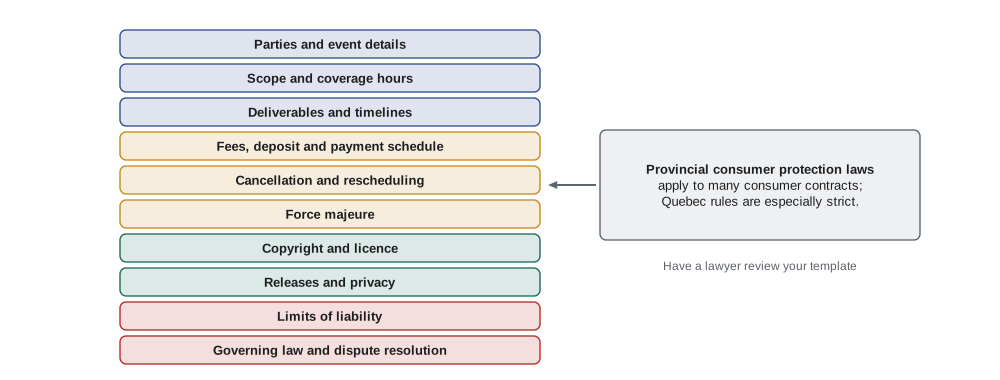
Event contracts vary, but most include these elements.
- Parties and event details. Names, contact details, date, venues and times. If someone other than the couple is paying, say who the client is.
- Scope of coverage. Hours of coverage, start and end points, number of photographers, travel, and what happens if the event runs late, usually overtime at a stated hourly rate.
- Deliverables. Approximate number of edited images, format (online gallery, downloads), resolution, delivery timeline, and products such as albums. Avoid promising exact image counts or specific shots you cannot guarantee; promise good-faith coverage of the moments listed.
- Fees and payment schedule. Total price, taxes, deposit or retainer, due dates for remaining payments, accepted methods, and late fees.
- Cancellation and rescheduling. What happens if the client cancels or changes the date, and what happens if the photographer cannot attend because of illness or emergency, including efforts to provide a qualified replacement and refunds if none can be found.
- Force majeure. Events beyond either party's control, such as natural disasters, public health orders or venue closures, and how payments and obligations are handled.
- Copyright and licence. Who owns the images and how the client may use them.
- Releases and portfolio use. Whether the photographer may use images for marketing, and any limits the client requests.
- Client responsibilities. Providing timelines and shot lists, ensuring the photographer can work in the venue, providing a meal on long days, and informing guests where needed.
- Limitation of liability. Capping the photographer's liability, often at the amount paid, for failures such as equipment malfunction or lost files, while committing to reasonable backup practices.
- Image editing and style. That the photographer selects and edits images in their professional style, and whether raw files are provided (usually not).
- Governing law and dispute resolution. Which jurisdiction's law applies and how disputes are handled, such as mediation before court.
Deposits, retainers and payment schedules
Wedding photographers usually require an advance payment to reserve the date, because accepting one booking means turning away others. Wording matters. A non-refundable retainer is described as payment for reserving the date and turning away other work, while a deposit may be treated as an advance on the total price that could be refundable in some circumstances. Courts and consumer protection laws look at substance as well as labels: an advance that is far larger than any realistic loss may be treated as a penalty, especially in consumer contracts.
In Canada, provincial consumer protection laws apply to many contracts between businesses and individuals. Ontario's Consumer Protection Act, 2002 includes rules on unfair practices, internet and remote agreements, and refunds when required disclosures are missing; Ontario passed a new Consumer Protection Act in 2023 that comes into force on a date set by regulation, so check which act applies when you sign a contract. Quebec's Consumer Protection Act is particularly strict: it limits what a merchant may keep when a consumer cancels certain contracts, regulates distance contracts made online, and voids some clauses that limit a merchant's liability. Other provinces have their own acts. A photographer working with consumers should have their contract reviewed for the province where they work and, if they travel, for the client's province.
Worked problem
A payment schedule
A wedding package costs $4,800 before tax. The photographer charges 13 percent HST in Ontario, asks for a 30 percent retainer at booking, 40 percent of the remaining balance 90 days before the wedding, and the rest 14 days before the wedding. How much is due at each stage?
Show solution
- Total with HST: \( 4{,}800 \times 1.13 = 5{,}424 \) dollars.
- Retainer: \( 0.30 \times 5{,}424 = 1{,}627.20 \).
- Remaining: \( 5{,}424 - 1{,}627.20 = 3{,}796.80 \).
- At 90 days: \( 0.40 \times 3{,}796.80 = 1{,}518.72 \).
- At 14 days: \( 3{,}796.80 - 1{,}518.72 = 2{,}278.08 \).
Answer: $1,627.20 at booking, $1,518.72 at 90 days and $2,278.08 at 14 days. Collecting the full balance before the wedding avoids chasing payment afterwards, and the contract should state how tax is shown on each invoice.
Cancellation, rescheduling and force majeure
Clear cancellation terms protect both sides. A common structure is a sliding scale: the retainer is kept if the client cancels at any time, and an increasing share of the total is owed as the date approaches, reflecting the photographer's shrinking chance of rebooking the date. Rescheduling terms often allow one change of date subject to availability, with payments transferred.
Force majeure clauses became much more important after 2020, when public health orders cancelled or postponed many weddings and events. Many photographers found their contracts did not say what happened when an event was legally prohibited, and disputes followed over whether deposits had to be returned. Lessons from that period include: define force majeure events clearly, including public health orders and venue closures; say whether payments are transferred to a new date, partly refunded or kept; set a time limit for rescheduling; and state what happens if the photographer, rather than the client, is prevented from attending. Event cancellation insurance, which some couples buy, can cover their losses and reduce pressure on vendors.
| When the client cancels | Share of total owed (example) | Reason |
|---|---|---|
| More than 12 months before | Retainer only | Date can usually be rebooked |
| 6 to 12 months before | Retainer plus 25 percent of balance | Rebooking is less likely |
| 1 to 6 months before | Retainer plus 50 percent of balance | Peak dates rarely rebook |
| Less than 1 month before | Full amount | Work turned away cannot be recovered |
Copyright and what clients may do with images
Under Canada's Copyright Act, since the Copyright Modernization Act of 2012, the photographer is generally the first owner of copyright in photographs they take, even when a client commissioned and paid for them, unless the photographer is an employee taking the photographs in the course of employment or the contract assigns copyright. Before 2012, the person who commissioned and paid for certain photographs owned the copyright. The 2012 change added a balancing provision: an individual who commissions photographs for personal or domestic purposes may use them for private or non-commercial purposes unless the contract says otherwise. That means a couple can share wedding photos with family and on personal social media, but they cannot sell them or license them to a magazine without the photographer's permission. Photographers also hold moral rights, including the right to be associated with the work and to object to distortions that harm their reputation; these rights can be waived but not assigned.
Contracts should say clearly what clients may do: print, share online with credit, give images to family; and what they may not do without further permission, such as use images in advertising, sell them or edit them heavily. Vendors such as venues, florists and planners often want images for their marketing; many photographers grant them a separate limited licence in exchange for credit and tagging, which also brings referrals. Corporate clients need commercial licences that match their intended use, as in PHOT-310.
Model releases at private events
A model release is a person's written permission to use their likeness for specified purposes. Whether you need one depends on how the image will be used and on the law where it is used, not on where it was taken. Using images in a portfolio or on a photographer's website to show their work is generally lower risk than using them in advertising that suggests a person endorses a product or service. For weddings, many contracts include a clause in which the couple consents to the photographer using images of them for portfolio and marketing purposes; guests have not signed that contract, so photographers should be cautious about featuring identifiable guests in advertising without consent, and should honour requests to remove images. Corporate clients that plan to use attendee images in marketing should handle consent at registration, as covered in lesson 9.
After the contract is signed
Signing is the start of the client relationship, not the end of sales. Send a welcome message that explains the next steps: the payment schedule, the planning questionnaire, an engagement session if included, and when to expect the final planning call. Keep a record of every change the client requests, such as extra hours or a new venue, and confirm changes in writing, either as a short amendment or an email the client replies to. Clear records protect both sides if memories differ months later. Many photographers also send a short guide that explains how to build a timeline, how to plan family groups and how to choose portrait light, which helps clients make good decisions and shows the photographer's expertise.
Common mistakes
MistakeRelying on emails and a verbal agreement for a wedding booking.
InsteadUse a clear written contract signed by the client before taking a retainer.
MistakePromising a specific number of images or every guest photographed.
InsteadPromise good-faith coverage of listed moments and an approximate image range.
MistakeCalling a large advance non-refundable and assuming it is always enforceable.
InsteadKeep advances reasonable and check the consumer protection law that applies.
MistakeLeaving force majeure undefined.
InsteadDefine events such as public health orders and state how payments and new dates are handled.
MistakeAssuming the couple owns the copyright because they paid.
InsteadState ownership and the licence clearly; clients receive the rights the law and contract give them.
Summary and key terms
- Most event disputes start with misunderstandings that a good consultation and contract prevent.
- Consultations cover the event, priorities, constraints, deliverables and budget, followed by a written summary.
- Contracts set out scope, deliverables, fees, cancellation, force majeure, copyright, releases, liability and governing law.
- Provincial consumer protection laws, especially Quebec's, affect deposits, cancellations and liability clauses.
- Force majeure clauses should name public health orders and closures and say what happens to payments.
- Since 2012 the photographer usually owns copyright; individuals who commission personal photos may use them non-commercially.
- Releases depend on use; be careful featuring guests in advertising.
Practice problems
Work each problem on paper first, then reveal the answer to check.
List five topics a consultation should cover.
Show answer
Event details, priorities, constraints, deliverables and budget.
Why avoid promising exact image counts?
Show answer
Events vary; promise good-faith coverage and an approximate range.
A $3,600 package plus 13 percent HST with a 25 percent retainer: what is the retainer?
Show answer
3,600 × 1.13 = 4,068; 25 percent is $1,017.
What lesson did 2020 teach about force majeure clauses?
Show answer
Define events such as public health orders and state how payments and new dates are handled.
Who usually owns copyright in wedding photos in Canada since 2012?
Show answer
The photographer.
What may a couple do with personal wedding photos under the 2012 rule?
Show answer
Use them for private or non-commercial purposes unless the contract says otherwise.
Why should vendors get a separate licence?
Show answer
Their marketing use is commercial and should be defined, often in exchange for credit.
What does a limitation of liability clause do?
Show answer
Caps the photographer's liability, often at the amount paid.
When are model releases most important?
Show answer
When images are used in advertising or to imply endorsement.
Why have a lawyer review your template?
Show answer
Contract and consumer law vary by province or state.
Lesson quiz · 5 questions
Score 60% or more to complete this lesson.
Create a free account to save your progress, take quizzes and earn a certificate.