
PHOT-340 · Lesson 12 of 12 · 27 min
The event photography business and capstone coverage plan
Talent and technique bring clients to an event photographer once; a sound business keeps the photographer working for years. Event photography has particular business challenges: seasonal income, long post-production hours hidden behind a single day of shooting, products such as albums with their own costs and margins, the need for insurance and backups, and a market where reviews and referrals drive most bookings. This lesson covers the cost of doing business, building packages and prices, deposits and cash flow, taxes on photography services, marketing and referrals, reviews and the law on fake or incentivized reviews, insurance, and finishes with a capstone: a complete coverage plan and package for a wedding. Business fundamentals such as registration, bookkeeping and income tax are covered in PHOT-302.
The cost of doing business
Pricing starts with costs, not with what competitors charge. The cost of doing business includes everything needed to operate for a year: equipment depreciation and replacement, insurance, software subscriptions, website and gallery services, storage and backups, marketing, vehicle and travel, professional fees, education, an office or studio, and the photographer's own salary, including taxes and retirement savings. Dividing this by the number of events a photographer can realistically shoot, given editing time and seasonality, gives the minimum average price per event needed to break even.
Worked problem
Break-even price per wedding
A full-time wedding photographer budgets $28,000 a year in business expenses (equipment replacement, insurance, software, marketing, vehicle, storage and fees) and wants a salary of $60,000 before personal income tax. They also expect to pay second shooters about $9,000 a year and album costs of about $6,500 a year. They can shoot about 25 weddings a year plus some smaller events that bring in $8,000. What average wedding price is needed to cover everything?
Show solution
- Total needed: \( 28{,}000 + 60{,}000 + 9{,}000 + 6{,}500 = 103{,}500 \) dollars.
- Less smaller-event income: \( 103{,}500 - 8{,}000 = 95{,}500 \).
- Per wedding: \( 95{,}500 / 25 = 3{,}820 \) dollars.
Answer: About $3,820 per wedding on average, before any sales tax. A photographer charging $2,500 per wedding while expecting this salary would fall short by more than $30,000 a year. Raising prices, reducing costs or booking more events are the only ways to close a gap.
Building packages
Packages make choices simple for clients and protect the photographer's margins. A common approach is three tiers:
| Package | Coverage | Team | Products | Purpose |
|---|---|---|---|---|
| Essential | 6 hours | One photographer | Online gallery | Smaller weddings and tighter budgets |
| Signature | 8 hours | Two photographers | Gallery and engagement session | Most popular middle tier |
| Complete | 10 hours | Two photographers | Gallery, engagement session and album | Full story and heirloom product |
Add-ons let clients customize: extra hours, a second photographer, albums, parent albums, prints, a rehearsal dinner, or a day-after session. Price add-ons at their full cost plus margin, remembering the editing time each brings (lesson 10 and lesson 11). Avoid offering unlimited options that make comparison hard, and avoid discounting so often that clients expect it.
For corporate events, prices are usually quoted per half-day or day plus usage licence, fast delivery and expenses, as in PHOT-310. For concerts, many photographers work on assignment fees or licensing to artists and publications.
Deposits, payments and cash flow
Weddings are booked months or years ahead, so income arrives long before and after the work. Retainers at booking, scheduled payments and final payment before the event (lesson 2) smooth cash flow. Keep enough reserves to cover the slow months; many photographers set aside a share of each payment in a separate account for taxes and for the off-season. Track bookings, payments due and tax collected in accounting software or a client-management system.
Taxes on photography services
In Canada, a business must register for GST/HST once its taxable revenue exceeds $30,000 in a single calendar quarter or over four consecutive calendar quarters, the small supplier threshold; it may register voluntarily earlier to claim input tax credits. Photography services and products are generally taxable. The rate depends on where the supply is made: 5 percent GST in provinces without HST, combined HST of 13 percent in Ontario, 14 percent in Nova Scotia (from April 2025) and 15 percent in the other Atlantic provinces, and in Quebec 5 percent GST plus 9.975 percent QST. British Columbia, Saskatchewan and Manitoba have separate provincial sales taxes with their own rules on services and goods. Show tax separately on invoices and remit it on time; it is not income. Weddings in another province may be taxed at that province's rate depending on the place-of-supply rules.
Marketing and referrals
Event photography depends heavily on word of mouth. Effective marketing usually includes:
- A portfolio and website that show full stories, not only highlights, so clients see consistency, and that state starting prices or a pricing guide to filter enquiries.
- Referrals from past clients, encouraged by excellent service and sometimes small thank-you gestures.
- Vendor relationships, sharing images with planners, venues and florists under a licence and crediting them, which leads to referrals and preferred-vendor listings.
- Social media and search, with clear location keywords and helpful content such as timelines and venue guides.
- Wedding directories and shows, which can work but cost money; measure enquiries and bookings from each source.
Respond to enquiries quickly and personally: many couples book the photographer who replies first with a thoughtful answer.
Reviews and the law
Online reviews strongly influence bookings. Encouraging happy clients to leave honest reviews is good practice; fabricating reviews, writing reviews of competitors, suppressing negative reviews, or offering incentives for positive reviews only is not.
In Canada, the Competition Act prohibits false or misleading representations, including fake reviews and testimonials, and the Competition Bureau has taken action against companies that posted fake reviews or used undisclosed incentives. Amendments in 2022 and 2024 increased penalties, which can reach millions of dollars or a share of revenue for corporations, and since June 2025 private parties can bring certain deceptive marketing cases to the Competition Tribunal. Ad Standards guidelines also require disclosure of material connections, such as free products or payments, when people post endorsements. Quebec's Consumer Protection Act prohibits false representations as well.
Insurance and risk management
Lesson 4 introduced equipment and liability insurance. Event photographers also consider professional liability (errors and omissions) insurance for claims of missed coverage or lost files, cyber insurance for data breaches, and vehicle insurance that covers business use. Risk management beyond insurance includes redundant gear, backups, clear contracts with liability limits, a network of replacement photographers, and good records. The cost is small compared with a single lawsuit or a lost wedding.
Capstone: a complete wedding coverage plan and package
The capstone brings the course together. Choose a real or realistic wedding and prepare a complete plan, as a professional would for a client:
- Consultation summary: couple, date, venues, guest count, cultural elements, priorities and constraints (lesson 2).
- Contract checklist: scope, deliverables, payments, cancellation, force majeure, copyright and licence, releases and liability (lesson 2).
- Timeline: built backwards from the ceremony, dinner and sunset, with buffers (lesson 3).
- Shot list and family formals list: specific items and ordered groups with helpers (lesson 3 and lesson 6).
- Gear and backup plan: two bodies, lenses with fallbacks, cards, batteries, flashes and the 3-2-1 plan (lesson 4).
- Ceremony plan: positions, lenses and settings, officiant rules and cultural notes (lesson 5).
- Lighting plan: portrait light, reception flash setup, gels and dance floor approach (lesson 6 to lesson 8).
- Team plan: division of coverage with a second shooter and a brief (lesson 10).
- Post-production plan: expected frames, delivered images, editing hours and delivery timeline (lesson 11).
- Package and price: costs, margin, taxes and payment schedule (this lesson).
Worked problem
Capstone package price
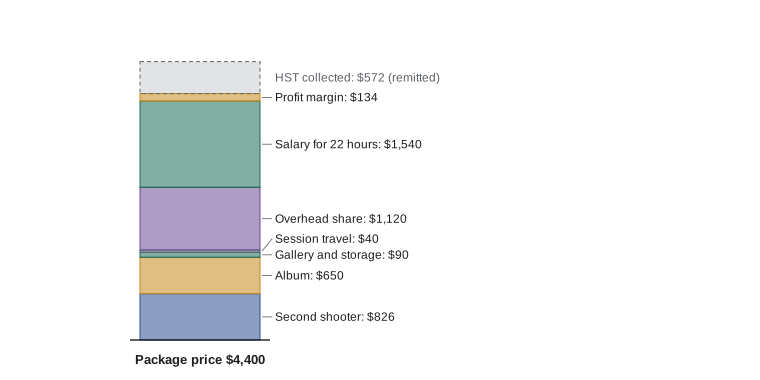
A couple in Ontario wants 8 hours of coverage with two photographers, an engagement session and a 30-page album. The photographer's costs for this wedding: second shooter $826 all-in (lesson 10), album $650, gallery and storage $90, engagement session travel $40, and a share of annual overheads of $1,120 per wedding. The photographer expects 22 hours of their own work (consultation, planning, shooting, editing, album design) and wants to earn $70 per hour. What package price covers costs and salary, and what is the price with HST and the payment schedule from lesson 2 (30 percent, 40 percent of the balance at 90 days, rest at 14 days)?
Show solution
- Direct costs: \( 826 + 650 + 90 + 40 = 1{,}606 \).
- Overhead share: 1,120, so costs total \( 2{,}726 \).
- Salary: \( 22 \times 70 = 1{,}540 \).
- Minimum price: \( 2{,}726 + 1{,}540 = 4{,}266 \); round to a package price of $4,400 for a small profit margin.
- With 13 percent HST: \( 4{,}400 \times 1.13 = 4{,}972 \).
- Retainer: \( 0.30 \times 4{,}972 = 1{,}491.60 \); at 90 days: \( 0.40 \times 3{,}480.40 = 1{,}392.16 \); at 14 days: \( 2{,}088.24 \).
Answer: A package of $4,400 before tax, $4,972 with HST, paid as $1,491.60, $1,392.16 and $2,088.24. The calculation shows how quickly costs and hours add up, and why packages priced much lower cannot sustain a professional business.
Present the plan as a short document with the timeline, lists and price, and reflect on the trade-offs: what you would do with one photographer instead of two, how you would adapt if it rained, and what you would change to make the business more sustainable.
Contracts, pricing and the client journey together
Pricing, contracts and delivery form one client journey. The pricing guide sets expectations before the first conversation; the consultation and proposal turn expectations into a choice; the contract records the promises; planning and the event deliver them; and the gallery, album and follow-up complete them. Photographers who look at the whole journey, asking where clients feel uncertain or where work is wasted, find ways to improve both service and profit: a clearer pricing guide reduces unsuitable enquiries, a better questionnaire shortens planning calls, and a standard album design process cuts revision rounds.
Growing and sustaining the business
Over time, many event photographers raise prices as demand grows, reduce the number of events to protect quality and health, and add income from teaching, albums, portraits or associate photographers. Track key numbers each year: enquiries, consultations, bookings, average sale, hours per event and profit per hour. These show whether marketing works, whether prices are right and whether the workload is sustainable. Burnout is common in wedding photography because of long days, weekend work and editing backlogs, so planning time off and setting realistic limits on bookings are business decisions, not luxuries.
Professional standards and continuing education
Associations such as the Professional Photographers of Canada and the Professional Photographers of America offer certification, competitions, insurance programs and education. Continuing education keeps skills current as cameras, editing software and client expectations change. Photographers who invest in learning, ethics and community tend to build longer careers.
Ethics in business
Honest business practice protects both clients and the profession. Describe packages accurately, disclose all fees before signing, deliver what was promised on time, respond to complaints fairly, and refund money when the contract or the law requires it. Treat vendors, second shooters and assistants as partners, pay them promptly and credit their work. When things go wrong, as they sometimes do, communicate early and propose a remedy, such as an additional portrait session; clients forgive problems handled openly far more readily than problems hidden.
Common mistakes
MistakeSetting prices by copying competitors.
InsteadStart from the cost of doing business, realistic event counts and desired salary.
MistakeTreating collected sales tax as income.
InsteadShow tax separately and set it aside for remittance.
MistakeOffering a discount for five-star reviews.
InsteadAsk all clients for honest reviews without conditions.
MistakePricing add-ons at their direct cost only.
InsteadInclude the time each add-on adds to editing and design, plus margin.
MistakeSpending all summer income before the slow months.
InsteadKeep reserves for taxes and off-season expenses.
Summary and key terms
- Price from the cost of doing business, realistic capacity and desired salary.
- Three-tier packages with add-ons simplify choice; design the middle tier carefully.
- Retainers and scheduled payments smooth seasonal cash flow; keep reserves.
- Register for GST/HST above the $30,000 small supplier threshold and charge the rate for the place of supply.
- Marketing relies on portfolios, referrals, vendor relationships and quick responses.
- The Competition Act prohibits fake reviews and undisclosed incentives.
- The capstone combines contract, timeline, lists, gear, lighting, team, post-production and pricing into one plan.
Practice problems
Work each problem on paper first, then reveal the answer to check.
Expenses $30,000, salary $55,000, 25 weddings: break-even per wedding?
Show answer
$3,400.
Why design the middle package carefully?
Show answer
Most clients choose it.
Why price add-ons above direct cost?
Show answer
They add editing and design time and should carry margin.
What is the GST/HST small supplier threshold?
Show answer
$30,000 in a quarter or over four consecutive quarters.
A $4,000 package in Ontario: price with HST?
Show answer
$4,520.
Name three marketing channels for event photographers.
Show answer
Website and portfolio, referrals, vendor relationships, social media or directories (any three).
Is it lawful to ask all clients for honest reviews?
Show answer
Yes; incentives only for positive reviews are not.
What does errors and omissions insurance cover?
Show answer
Claims that the photographer failed to provide the promised service.
Why keep cash reserves?
Show answer
For taxes and the slow off-season months.
List four parts of the capstone plan.
Show answer
Consultation summary, contract checklist, timeline, lists, gear, ceremony, lighting, team, post-production or price (any four).
Lesson quiz · 5 questions
Score 60% or more to complete this lesson.
Create a free account to save your progress, take quizzes and earn a certificate.