
PHOT-302 · Lesson 6 of 12 · 25 min
Pre-production: budgets, call sheets and logistics
The day of a fashion shoot is expensive: a team of specialists, models, studio or location, equipment and often a client, all on the clock. What happens that day depends on what was prepared beforehand. Pre-production turns a concept into a schedule, a budget, bookings and paperwork, so that the team can concentrate on making images. This lesson covers the pre-production timeline, estimates and budgets, shot lists and look orders, scheduling the day, call sheets, studios and locations, permits and insurance, equipment planning, travel, catering and logistics, weather and contingency plans, and pre-production for small editorials.
The pre-production timeline
Larger shoots follow a predictable sequence over several weeks:
- Brief, quote and approval: the client brief, the photographer's estimate and treatment, and confirmation of the job (Lesson 12).
- Concept development and mood boards (Lesson 3).
- Team and casting: booking stylist, hair and makeup, assistants, digital tech and models (Lessons 4 and 5).
- Location scouting or studio booking, permits and insurance.
- Styling: sample requests or product delivery, fittings and look planning.
- Production planning: schedule, shot list, call sheet, equipment, travel and catering.
- Pre-production meeting: a final review with the team and client.
- Shoot day or days, then post-production and delivery.
Small editorials compress this into days, with the photographer and stylist handling most tasks themselves, but the same steps apply.
Estimates and budgets
An estimate is the photographer's quote for a job, listing fees and expenses; a budget is the working plan for spending that money. Typical line items include:
- Creative fee or day rate, and usage or licensing fee.
- Pre-production and post-production days, including scouting, casting and editing.
- Crew: assistants, digital tech, producer, stylist, hair, makeup, set designer.
- Talent: model fees, usage, agency charges, overtime.
- Studio or location fees, permits and security.
- Equipment rental, digital capture station and lighting.
- Wardrobe, props, set construction and materials.
- Travel, accommodation, transport, parking and per diems.
- Catering and craft services.
- Insurance.
- Retouching, file preparation and delivery.
- A contingency, often 10 %, for unforeseen costs.
Editorial budgets may cover only a few of these lines; campaign budgets cover them all. Estimates should state what is included, what is billed at cost, the deposit and payment terms, and what happens if the scope changes.
Worked problem
Building a small campaign estimate
A photographer prepares an estimate for a one-day campaign: creative fee $2,500; usage $3,000; one assistant $400; digital tech $650 including station; stylist $900 plus $300 kit and shopping; hair and makeup $800; studio $1,200; lighting rental $600; catering for 10 people at $40 each; retouching 12 images at $75 each. Add a 10 % contingency on expenses (not fees). What is the total?
Show solution
- Fees: creative $2,500 + usage $3,000 = $5,500.
- Crew and talent services: $400 + $650 + $900 + $300 + $800 = $3,050.
- Studio and equipment: $1,200 + $600 = $1,800.
- Catering: 10 × $40 = $400. Retouching: 12 × $75 = $900.
- Expenses subtotal: $3,050 + $1,800 + $400 + $900 = $6,150; contingency 10 % = $615.
- Total: $5,500 + $6,150 + $615 = $12,265 before tax (models booked separately by the client).
Answer: About $12,265 before tax, with models budgeted separately.
Shot lists and look orders
A shot list describes each image needed: the look (outfit) number, the model, the location or set, the framing (full-length, three-quarter, close-up, detail), orientation (vertical or horizontal), and any specific requirements such as a product to feature or a layout to match. For editorials, the shot list may be an outline of the story's images (Lesson 11); for campaigns, it lists the deliverables agreed with the client; for e-commerce, it is a product list with required views. The look order arranges looks to minimize changes in hair, makeup, set and lighting, for example shooting all looks in one location or with one hairstyle together, and saving the most complex makeup changes for later in the day.
Scheduling the day
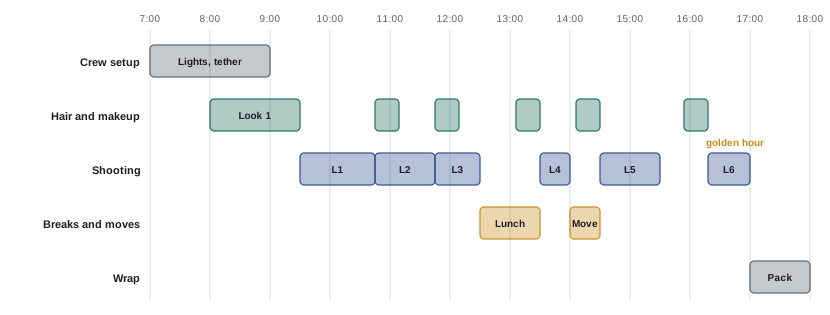
A fashion day typically runs eight to ten hours. A realistic schedule allows time for setting up lights and the capture station (often one to two hours before talent arrive), hair and makeup (60 to 120 minutes for the first look, 15 to 45 minutes for changes), dressing and styling each look (10 to 30 minutes), shooting each setup (20 to 60 minutes for editorial images; less for e-commerce), moves between locations, meals and breaks, and wrap and packing. Experienced producers schedule backwards from the light, such as golden hour on location, and from talent availability, and build in buffers. A common mistake is scheduling too many looks: an editorial of eight to ten images in a day is ambitious with location moves; three to five well-made campaign hero images may fill a day.
Call sheets
A call sheet is the one document that tells everyone where to be and when. It is sent the day before the shoot and typically includes the date and job name; the call times for each person or department; the address of the studio or location with parking, access instructions and a map; contact details for the producer and key team members; the schedule; the shot list or look order; weather forecast and sunrise or sunset times; nearest hospital and emergency information; catering details; and notes on dress code, security or special requirements. Call times are staggered: crew first, then hair and makeup, then models, then the client. Clear, accurate call sheets reduce confusion and late starts, and protect everyone's time.
| Call sheet element | Purpose |
|---|---|
| Call times by role | Stagger arrivals efficiently |
| Address, parking, access | Everyone arrives at the right place |
| Contacts | Who to call when something goes wrong |
| Schedule and look order | Shared plan for the day |
| Weather, sunrise and sunset | Prepare for conditions and light |
| Emergency information | Nearest hospital and procedures |
| Notes | Security, dress code, special requirements |
Studios, locations and permits
Rental studios offer cycloramas, daylight rooms, standing sets, equipment and support spaces such as hair and makeup stations and changing rooms; book them early, confirm what is included, and check load-in access for equipment. Locations offer character but add complexity: owners' permission, location fees, contracts, restrictions on hours, noise, crew size and parking, and protection of floors and furniture. Shooting in public spaces may require permits from municipalities, parks agencies or transit authorities, particularly for commercial work, tripods, crews, vehicles or closures; many cities have film offices that issue permits for photography as well as film. National, provincial, state and municipal parks often require commercial photography permits. Shooting on private property such as malls, galleries or restaurants requires the owner's permission. Allow lead time: some permits take weeks.
Insurance
Fashion shoots involve expensive samples, rented equipment, locations and people, so insurance matters. Photographers typically carry commercial general liability insurance, which covers injury or damage to third parties and is often required by studios, locations and permit offices, who may ask to be named as additional insured; equipment insurance for owned and rented gear; and professional liability coverage. Productions may buy short-term production insurance covering props, wardrobe, third-party property damage, weather days and talent illness. Clarify who is responsible for samples: stylists usually manage loans, but damage on set may fall on the production.
Equipment, travel and catering
Plan equipment from the concept: lighting for each setup, modifiers, stands and weights, power (including generators or batteries for locations), camera bodies and lenses, the tethering station, backups and weather protection. Make a checklist and test everything before the shoot. For travel, book transport, accommodation and per diems, check equipment and sample shipping or carnets for international work, and allow for travel time in the schedule. Catering keeps a team working well: plan meals and snacks for long days, ask about dietary needs and allergies, and keep food away from samples and hair and makeup stations.
Weather and contingency plans
Location shoots depend on weather. Monitor forecasts, agree weather-day policies and costs in advance (whether the team is paid if the shoot is postponed), and prepare plans B: an indoor alternative, a covered area, rain protection for equipment, warm spaces and clothing for models in cold weather, shade and water in heat. Other contingencies include backup models or crew contacts, spare equipment, extra time for delayed samples, and alternative locations. A shoot that has planned for problems can adapt calmly.
Pre-production for small editorials
Independent editorials and test shoots often have no producer and little money, but they benefit from the same discipline: a clear concept and mood board shared with the team; a simple shot list and look order; a realistic schedule with travel and light in mind; a short call sheet; permission or permits for locations; a weather plan; and agreements about credits and images. Small, well-organized shoots often produce better images than large, chaotic ones.
Sample logistics
Fashion shoots depend on samples, the garments and accessories borrowed from designers, showrooms and public relations agencies. Stylists request samples weeks ahead with a description of the story, the publication or client, the shoot date and the photographer, and many samples are in high demand, so requests may be refused or delayed. Samples arrive by courier or are picked up, are checked in against a list, and must be returned on time and in the condition received. Loan forms record each item, its value and the return date. Lost or damaged samples are expensive and can damage relationships with designers, so budgets should allow for courier costs, and productions should know whether their insurance covers samples.
The pre-production meeting
A pre-production meeting, often called a pre-pro, brings together the key people a few days before the shoot: the photographer, producer, stylist, hair and makeup lead, art director and client. The meeting walks through the concept and mood board, the casting, the looks and their order, the schedule, locations, lighting plans, deliverables, approvals and any open questions. It is the last chance to resolve disagreements before the expensive shoot day. Decisions are recorded in notes circulated afterwards, and the call sheet and shot list are updated. Even on small editorials, a short call or message thread serving the same purpose prevents surprises on the day.
Wrap and post-shoot tasks
Pre-production also plans what happens after the shoot. At wrap, the team packs equipment, returns the location to its original condition, checks that all samples are accounted for and repacked, and confirms that files have been backed up. Afterwards, the producer collects receipts, pays crew and suppliers, reconciles the budget against the estimate, and sends the final invoice. Samples are returned with their loan forms. Selects and retouching schedules are agreed with the client. Reconciling actual costs against the estimate after every job improves future quotes and shows where the budget was too tight or too generous.
Timing worked out for a call sheet
Call times are calculated backwards from the moment shooting should begin. If the first frame is planned for 9:30 and hair and makeup for the first look take 90 minutes, the first model's call time is 8:00, with perhaps 15 minutes for arrival and coffee, so 7:45. If lighting takes 90 minutes to set up, the photographer and assistants are called at 7:45 or earlier. The client might be called at 9:15 to see the first frames. Building in a small buffer for traffic and delays prevents a late start that would compress the rest of the day.
Experienced producers keep templates for estimates, call sheets and checklists, refining them after every job so that each production starts from a tested foundation.
Good pre-production is invisible on the day: when it works, the team simply arrives, knows the plan and spends its energy on making the images.
Common mistakes
MistakeScheduling too many looks in a day.
InsteadPlan realistic times for hair, styling and setups.
MistakeForgetting permits for public locations.
InsteadCheck municipal, park and property rules early.
MistakeEstimates without a contingency.
InsteadAdd about 10 % for unforeseen costs.
MistakeCall sheets missing access or emergency details.
InsteadInclude address, parking, contacts and hospital.
MistakeNo weather plan for location shoots.
InsteadPrepare indoor alternatives and weather-day terms.
Summary and key terms
- Pre-production turns a concept into bookings, schedules and paperwork.
- Estimates list fees, usage and expenses, with a contingency.
- Shot lists and look orders minimize changes and meet deliverables.
- Schedules allow realistic time for hair, makeup, styling and setups.
- Call sheets tell everyone where to be, when and how to get help.
- Studios, locations, permits and insurance need lead time.
- Plan equipment, travel, catering and weather contingencies.
- Estimate
- Photographer's quote of fees and expenses.
- Contingency
- Allowance for unforeseen costs.
- Shot list
- List of required images and their details.
- Look order
- Sequence of looks planned to minimize changes.
- Call sheet
- Document with call times, location and contacts.
- Call time
- Time a person must arrive.
- Cyclorama
- Curved studio wall creating a seamless background.
- Film office
- Municipal office issuing filming and photo permits.
- Additional insured
- Party added to an insurance policy for coverage.
- Weather day
- Day reserved or paid if weather prevents shooting.
Practice problems
Work each problem on paper first, then reveal the answer to check.
List four pre-production stages.
Show answer
Brief and quote, concept, team and casting, scouting, styling, planning, meeting.
Name six estimate line items.
Show answer
Fees, usage, crew, talent, studio, equipment, wardrobe, travel, catering, insurance, retouching.
What is a typical contingency?
Show answer
About 10 %.
Why arrange a look order?
Show answer
To minimize hair, makeup, set and lighting changes.
How long does first-look hair and makeup often take?
Show answer
60 to 120 minutes.
Why stagger call times?
Show answer
Crew sets up before talent and client arrive.
Name four call sheet elements.
Show answer
Call times, address, contacts, schedule, weather, emergency info.
When are public-location permits often needed?
Show answer
Commercial work, tripods, crews, vehicles, closures.
What does general liability insurance cover?
Show answer
Injury or damage to third parties.
Name two weather contingencies.
Show answer
Indoor alternative, rain protection, warm spaces, weather-day terms.
Lesson quiz · 5 questions
Score 60% or more to complete this lesson.
Create a free account to save your progress, take quizzes and earn a certificate.