
PHOT-302 · Lesson 3 of 12 · 25 min
Concepts, research and mood boards
Strong fashion images begin long before the shoot, with an idea. A concept gives a story its coherence, guides every decision about casting, styling, location, light and pose, and lets a team of creative people pull in the same direction. A mood board turns the concept into a shared visual language that the team, the client or the editor can discuss and approve. This lesson covers where fashion concepts come from, research and references, turning an idea into a concept, writing a treatment, building mood boards, colour palettes and visual themes, adapting concepts to briefs, originality and the line between inspiration and copying, and presenting concepts to editors and clients.
What a concept is
A concept is the central idea of a shoot, expressed simply enough that everyone on the team understands it. It can be a narrative ("a family reunion at a lakeside cottage that slowly becomes surreal"), a mood ("quiet solitude in winter light"), a visual device ("every image framed through a doorway or window"), a cultural reference ("1970s Montreal disco"), a social idea ("work clothes reimagined by the people who wear them"), or a formal exploration ("colour blocking against concrete architecture"). A good concept is specific enough to guide decisions, open enough to allow discovery on the day, appropriate to the clothes and the publication or brand, and achievable with the budget. Fashion concepts often combine several elements: a story, a setting, a light quality and a styling direction.
Where ideas come from
Fashion photographers draw ideas from many sources:
- The clothes themselves: the season's collections, their colours, fabrics, silhouettes and the designers' own inspirations.
- Art history: painting, sculpture, photography and film, from Vermeer's light to Bauhaus graphics.
- Cinema: the colour, framing and atmosphere of particular films or directors.
- Literature, music and subcultures: characters, eras, scenes and movements.
- Places: architecture, landscapes, cities and interiors.
- Everyday life and documentary observation: people, rituals, work and street culture.
- Personal experience and identity: memories, heritage and community.
- Social and cultural conversations: sustainability, gender, technology, ageing.
Keeping an idea journal, a folder of saved images, notes and sketches, lets ideas accumulate until the right shoot arrives. The best concepts often connect two unexpected sources, such as couture gowns in a curling rink or tailoring inspired by a fishing village.
Research and references
Research deepens a concept. If the story references a decade, research its photography, film, design, colour palettes and hairstyles so the references are accurate; if it uses a location or community, learn about it and, where relevant, involve people from it. Gather visual references for every element: light, location, styling, hair and makeup, poses, casting and colour grading. Note where each reference comes from. References are tools for communication and inspiration; they are not templates to copy, and the strongest work transforms its sources into something new. Be particularly careful with references drawn from cultures other than your own: respectful research, collaboration with people from that culture and fair credit help avoid appropriation and stereotyping.
From idea to concept: a worked process
Worked problem
Developing an editorial concept
A stylist invites a photographer to shoot an eight-page autumn editorial for an independent magazine. The clothes are oversized knits, wool coats and heavy boots in earth tones. How might the photographer develop a concept?
Show solution
- Start with the clothes: warmth, texture, weight, earth tones, autumn.
- Brainstorm associations: farms, harvest, fog, forests, cabins, walking, protection from weather.
- Choose a direction: "walking home through fog", a quiet narrative of a long walk through rural landscapes at dawn.
- Define the visual language: low, soft light; misty backgrounds; muted palette with one accent colour; long lenses compressing figures into landscape; models in motion.
- Check practicality: a location within two hours, early call time for fog and soft light, a weather backup in a barn.
- Summarize the concept in one sentence and build a mood board.
Answer: A concept such as "walking home through fog" connects the clothes, light, location and movement in a way the whole team can follow.
Writing a treatment
A treatment is a short written description of the concept, used to pitch editorials, campaigns and fashion films. A typical treatment of one to three pages includes a title; a one-sentence summary; the story or idea in a few paragraphs; the visual approach (light, colour, camera and framing); casting, styling, hair and makeup directions; locations; a shot list or image outline; and references. Treatments should be clear and evocative rather than long. For commercial work, they show the client how the photographer will interpret the brief; for editorials, they help editors commit to a story. Writing a treatment also forces the photographer to clarify the idea before spending money on production.
Building mood boards
A mood board is a collection of images, colours, textures and words that communicates the look and feel of a shoot. Effective mood boards:
- Are organized by topic: overall mood, light, location, styling, hair and makeup, casting, poses and colour grade, so each team member finds their part.
- Contain a focused selection: usually 15 to 40 images rather than hundreds, chosen so that together they point in one direction.
- Include notes explaining what each reference is for: "light quality, not the pose" or "colour palette only".
- Show a colour palette as swatches.
- Fit the medium: a slide deck or PDF for clients, a shared online board for teams, printed boards on a studio wall on the day.
Mood boards should not be a collage of other photographers' finished work that the team is asked to copy. Mixing references from film, painting, architecture, nature and your own tests produces more original results.
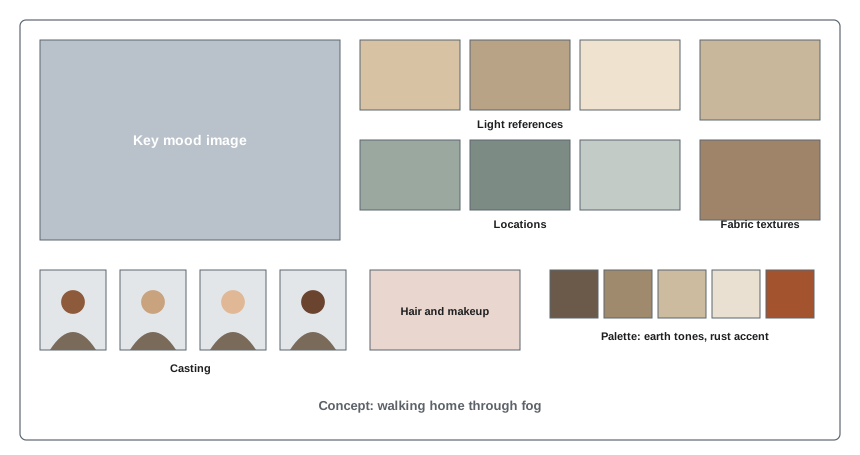
Colour palettes and visual themes
Colour is one of the most powerful unifying tools in a fashion story. Many editorials use a restricted palette: two or three dominant colours that recur in clothes, backgrounds, props and light, perhaps with one accent colour. Palettes can be derived from the clothes, from a reference painting or film still, from a location, or from colour theory: analogous palettes for harmony, complementary accents for energy, monochrome for elegance. Other recurring visual themes might be a particular frame shape, a recurring prop, a consistent camera height, a lighting direction or a texture such as fog, water or reflections. These elements help a story feel designed rather than random, and they guide stylists, set designers and retouchers.
| Palette approach | Effect | Example |
|---|---|---|
| Monochrome | Elegant, graphic, unified | All-white garments in a white space |
| Analogous | Harmonious, calm | Rust, ochre and brown in autumn fields |
| Complementary accent | Energy and focus | Blue set with one orange garment |
| Muted with one accent | Quiet with a focal point | Grey tones with a red scarf |
| Saturated pop | Bold, playful | Primary-coloured sets and clothes |
Working from a brief
In commercial work, the concept usually starts with the client's brief: the product, the campaign message, the audience, the brand guidelines, the deliverables and often layouts from the agency. The photographer's task is to interpret the brief, proposing how light, casting, location and mood will deliver it, sometimes with a treatment and mood board in a pitch against other photographers. Good practice includes reading the brief carefully, asking clarifying questions about must-haves and flexibility, identifying the deliverables and formats early, proposing ideas that solve the client's problem rather than only expressing personal style, and confirming changes in writing. For editorials, the brief may be looser: a theme from the editor, a set of clothes from the stylist, and freedom to propose.
Originality and influence
Every photographer is influenced by others, and references are a normal part of fashion practice. But there is a line between inspiration and copying. Recreating another photographer's distinctive image closely, with the same composition, light, styling and pose, can infringe copyright and damages reputations; the fashion industry has seen many public disputes over copied campaigns and editorials. Signs that a concept is too close include using one photographer's work as the main reference for every image, reproducing a recognizable composition, or matching a specific set design. Safer practice is to use many varied references, translate them through your own vision and circumstances, and develop a personal style through consistent experimentation. Homage is possible when it is clearly acknowledged and transformed, such as a story openly referencing a famous film.
Presenting concepts
Presenting concepts to editors, clients and collaborators is a skill. Keep presentations short and visual; lead with the one-sentence idea and the strongest mood image; show how the concept serves the clothes, brand or story; explain practical feasibility, including location, schedule and budget; and invite feedback. Prepare alternatives in case the first idea is rejected. After approval, share the final concept and mood board with the whole team, and keep it visible on set so that decisions stay aligned with the agreed direction.
Turning research into a concept statement
After research, a concept should be summarized in a short statement that anyone on the team can understand and remember. A useful formula combines the story, the mood and the visual approach: for example, "a quiet morning after a city festival, told in soft grey light, with crumpled evening wear and empty streets." The statement guides decisions throughout the project: if a location, garment or pose does not support it, it probably does not belong. Writing the concept in two or three sentences also tests whether the idea is clear. If it cannot be explained simply, it may need more development before the team is assembled.
Presenting mood boards to clients
When mood boards are presented to clients or editors, the presentation matters. Begin with the concept statement, then show the board in sections: light, setting, casting, styling, hair and makeup, and colour palette, with a short note on what each reference contributes. Avoid boards built entirely from the work of one well-known photographer, which suggests imitation, and explain how your interpretation will differ. Be ready for feedback: clients may ask for adjustments to fit the brand, the budget or the season. Keep versions of the board as it evolves, so that the agreed direction is documented. A clear, well-presented board builds confidence that the photographer understands the brief and can deliver it.
Keeping an inspiration archive
Concepts rarely arrive from nowhere. Many photographers keep an ongoing archive of inspiration: photographs, paintings, films, architecture, colour combinations, textures, overheard phrases and notes from travels. Organizing the archive by theme, mood or technique makes it useful when a brief arrives with little time. The archive should be broad, drawing on art history, cinema, music, nature and everyday life, rather than only on other fashion photographs, because the most original fashion images often borrow from outside fashion. Recording the source of each reference also makes it easier to credit influences and avoid unintentional copying.
Testing the concept before the shoot
Before committing a full team and budget, many photographers test elements of a concept on a small scale. A quick lighting test with a stand-in shows whether a colour gel, a hard shadow or a window effect works as imagined; a scouting visit at the right time of day confirms that the light and setting support the story; a makeup test reveals how a look reads on camera. These tests cost little but often change the plan for the better, and the images help explain the concept to collaborators and clients.
Finally, a concept should be practical as well as inspiring. Check that it can be achieved with the available budget, team, samples, locations and time, and simplify it where needed; a modest idea executed beautifully is more convincing than an ambitious idea that falls apart on the day.
Common mistakes
MistakeStarting a shoot without a clear concept.
InsteadSummarize the idea in one sentence first.
MistakeMood boards with hundreds of unrelated images.
InsteadCurate a focused, organized set with notes.
MistakeCopying one photographer's famous image.
InsteadUse varied references and transform them.
MistakeIgnoring the client's brief in favour of personal style.
InsteadSolve the brief and show how.
MistakeBorrowing cultural references carelessly.
InsteadResearch respectfully and collaborate.
Summary and key terms
- A concept is the central idea that guides every decision.
- Ideas come from clothes, art, cinema, places, culture and personal experience.
- Research makes references accurate and respectful.
- Treatments describe concepts in writing for pitches.
- Mood boards organize references by topic with notes and palettes.
- Restricted palettes and visual themes unify stories.
- Interpret briefs, avoid copying and present concepts clearly.
- Concept
- Central idea of a shoot.
- Brief
- Client's description of what the shoot must achieve.
- Treatment
- Short written description of a concept.
- Mood board
- Collection of references communicating look and feel.
- Colour palette
- Limited set of colours used across a story.
- Visual theme
- Recurring visual element that unifies images.
- Reference
- Image or source used for inspiration and communication.
- Homage
- Acknowledged, transformed reference to another work.
- Appropriation
- Taking from a culture without understanding, credit or consent.
- Pitch
- Proposal presented to win a job.
Practice problems
Work each problem on paper first, then reveal the answer to check.
What makes a good concept?
Show answer
Specific, open to discovery, appropriate, achievable.
Name four sources of fashion ideas.
Show answer
Clothes, art, cinema, music, places, everyday life, culture.
Why research a referenced decade?
Show answer
To make references accurate.
What does a treatment include?
Show answer
Title, summary, story, visual approach, casting, styling, locations, shot outline.
How many images suit a mood board?
Show answer
About 15 to 40.
Why add notes to references?
Show answer
To say what each reference is for.
What is an analogous palette?
Show answer
Neighbouring hues for harmony.
Name two steps in interpreting a brief.
Show answer
Read carefully, ask questions, identify deliverables, solve the problem.
Name a sign a concept is too close to another work.
Show answer
Reproducing a recognizable composition or set.
What should lead a concept presentation?
Show answer
The one-sentence idea and strongest mood image.
Lesson quiz · 5 questions
Score 60% or more to complete this lesson.
Create a free account to save your progress, take quizzes and earn a certificate.