
PHOT-302 · Lesson 12 of 12 · 25 min
Rights, pricing, pitching and the fashion capstone
Fashion photography is a business built on creativity. Photographers earn from commissions, licensing and, for some, sales of prints and books; they need to understand copyright and usage, price their work fairly, pitch ideas to publications and brands, protect themselves with contracts, manage taxes and build a career over time. This final lesson brings those topics together and sets out a capstone project: planning, shooting, editing and presenting an original fashion story.
Copyright and ownership
Copyright protects photographs as original works, giving the owner exclusive rights to reproduce, publish and adapt them. Who owns the copyright in commissioned fashion work depends on the law and the contract.
In Canada, since the Copyright Modernization Act came into force in November 2012, the photographer is generally the first owner of copyright in a photograph, even when it was commissioned and paid for, unless the photographer is an employee making the image in the course of employment or a written agreement assigns the copyright. Individuals who commission photographs for personal or domestic purposes may use them for those purposes without the photographer's consent unless agreed otherwise. Photographers also hold moral rights, including the right to be associated with the work and to its integrity, which can be waived but not assigned.
In fashion, brands often request copyright assignment or a work-for-hire agreement; many photographers prefer to keep copyright and grant a licence for the uses the client needs, which preserves the photographer's portfolio rights and future income. Whatever is agreed, write it down.
Licensing and usage
A licence grants the client permission to use images in defined ways. Usage terms specify the media (editorial print, web, social media, out-of-home advertising such as billboards and transit, point of sale, packaging, television or broadcast, internal use); the territory (a city, a country, North America, worldwide); the duration (for example, one year, two years or in perpetuity); exclusivity (whether the photographer can license the images to others); and the number of images. Usage fees reflect the value of the use: a worldwide, two-year, all-media campaign licence is worth many times a one-year regional social media licence. Model usage must match image usage (Lesson 5), so the photographer, producer and agency coordinate. Editorial commissions usually grant the publication first publication rights and limited online use, after which the photographer can use the images in portfolios and sometimes license them elsewhere.
Pricing: day rates, usage and expenses
Fashion photographers price commercial work by combining a creative fee (day rate) for the time and expertise on the shoot day, a usage fee for the licence, fees for pre-production and post-production days, and expenses billed at cost or with a markup. Editorial rates are set by publications and are often low, sometimes a few hundred dollars per day or per story, with expenses limited; photographers accept them for visibility and portfolio value. Commercial rates depend on the client, the market, the photographer's reputation and the usage. Understanding the market through industry pricing surveys, peers and agents helps photographers price confidently. Underpricing harms both the photographer and the profession.
Worked problem
Pricing a lookbook with usage
A designer asks for a lookbook shoot: one shoot day, 20 final images, used on the brand's website and social media in Canada and the United States for two years, plus print for buyers. The photographer charges a day rate of $2,000, one pre-production day at $500, editing at $400, a usage fee of 75 % of the day rate per year of web and social use, and $300 for print lookbook use. Expenses (assistant, digital tech, studio, retouching) total $3,200 with no markup. What is the quote before tax?
Show solution
- Day rate: $2,000. Pre-production: $500. Editing: $400.
- Usage for web and social: 75 % × $2,000 = $1,500 per year; two years = $3,000.
- Print lookbook usage: $300.
- Fees total: $2,000 + $500 + $400 + $3,000 + $300 = $6,200.
- Expenses: $3,200.
- Quote: $6,200 + $3,200 = $9,400 before tax.
Answer: $9,400 before tax, of which $3,300 is usage.
Estimates, contracts and terms
Every commercial job should have a written estimate and terms, and confirmation from the client before work begins. Typical terms include the scope of work and deliverables; usage granted and when the licence takes effect (often upon full payment); copyright ownership; payment terms (a deposit of 25 to 50 % for larger jobs, the balance within 30 days); cancellation and postponement fees; weather days; overtime; additional usage fees; approval and revision limits for retouching; credit lines; confidentiality; and liability limits. Model releases, location agreements and crew agreements accompany the main contract. Professional associations provide templates; a lawyer should review standard terms.
Taxes and business basics
Photographers are businesses and must keep records, invoice correctly and pay taxes. Sales taxes on photography services and licences differ by jurisdiction, and fashion photographers who work across provinces, states or borders should check where tax applies.
In Canada, businesses must register for the GST/HST once their taxable revenues exceed $30,000 in four consecutive calendar quarters or a single quarter, and then charge GST or HST on taxable supplies; Quebec also has the QST, and some provinces have a separate provincial sales tax with its own rules. Photographers report self-employment income on their income tax return, can deduct business expenses, and pay both portions of Canada Pension Plan contributions (or Quebec Pension Plan contributions in Quebec).
Keep records of income and expenses, separate business and personal accounts, set aside money for taxes, and consider professional advice. Insurance (Lesson 6) and retirement savings are part of a sustainable business.
Publications in Quebec and language rules
Fashion work for brands and publications in Quebec must consider language law.
In Quebec, the Charter of the French Language requires commercial advertising, catalogues, brochures and similar publications to be in French, and other languages may appear alongside French. Amendments made by Bill 96, with signage and product rules in force since June 1, 2025, strengthen French requirements for commercial signs, trademarks and packaging. When a fashion campaign or lookbook will be used in Quebec, the client is responsible for compliance, but photographers and designers should plan layouts with space for French text and be aware that French versions may be longer.
Pitching to publications and brands
Many editorials begin with a pitch: a short proposal to a magazine's photo or fashion editor describing a story idea, with a mood board, the proposed team, possible locations and timing, and links to relevant work. Good pitches are concise, tailored to the publication's style and readership, timely (aware of seasons and issue themes, often planned months ahead) and realistic. Pitching to brands is similar but focuses on the brand's goals: how your concept will reach their audience. Treatments for commercial jobs, often requested after the brief, describe the photographer's approach in detail, with references and production thoughts (Lesson 3). Follow up politely, keep track of contacts, and respect editors' time.
Building a fashion career
Fashion photography careers often follow a path from assisting established photographers (learning lighting, sets and the business), to test shoots, to independent editorials, to commissions from magazines and smaller brands, to larger campaigns. Representation by a photographers' agent can bring commercial work, negotiate fees and manage production, in exchange for a commission, often 20 to 30 % of creative fees. Portfolios should be edited ruthlessly, showing a clear point of view and current work, in print books and on websites and social media. Many photographers diversify into motion, beauty, portrait, celebrity, still life or teaching. Personal projects keep the work fresh. Above all, a career rests on relationships with stylists, editors, agencies and clients built over years.
| Career stage | Typical work | Goals |
|---|---|---|
| Assistant | Lighting, equipment, sets for others | Skills, contacts, industry knowledge |
| Testing | Collaborative test shoots | Portfolio, team, point of view |
| Emerging editorial | Independent and small magazine stories | Published credits, visibility |
| Commissioned | Magazines, lookbooks, e-commerce, small campaigns | Income, reputation |
| Established | Major editorials and campaigns, agent representation | Sustained career, creative freedom |
Capstone project: an original fashion story
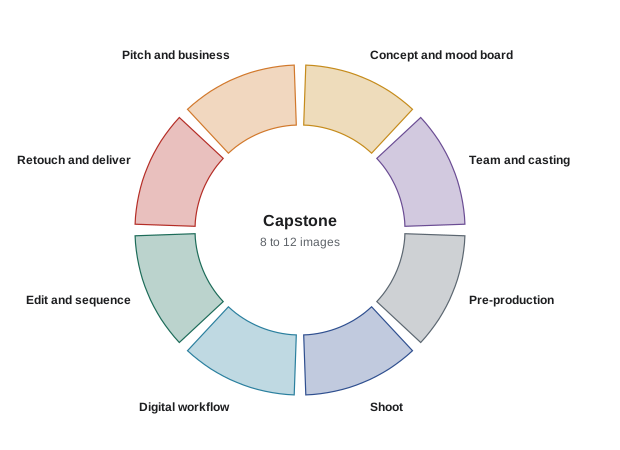
The capstone brings the course together in one complete project. Plan, shoot and present an original fashion story of 8 to 12 images, designed for a real or imagined publication or brand. The project includes:
- A written concept and mood board with references, palette and casting notes (Lesson 3).
- Team and casting plan, with releases and welfare measures (Lessons 4 and 5).
- A budget, schedule, shot list, look order and call sheet (Lesson 6).
- The shoot, in studio, on location or both, with lighting plans and movement (Lessons 7 to 9).
- A digital workflow record with backups and colour references (Lesson 10).
- An edited, sequenced story with layouts for print and social formats, and a retouching brief (Lesson 11).
- A one-page pitch or treatment and a quote with usage for a hypothetical commercial version (Lesson 12).
- A short reflection on what worked, what you would change and what you learned about collaboration.
Negotiating with clients
Negotiation is part of most commercial jobs. When a client's budget is lower than the estimate, explore options rather than simply cutting the fee: reduce usage (shorter duration, fewer media or a smaller territory), reduce the number of images or looks, shorten the shoot, simplify the production or move retouching to the client. Explain the value of each element so the client understands what changes. Be prepared to decline jobs that would require working at a loss or giving away rights cheaply, since accepting them sets expectations for future work and affects the market for other photographers. Confirm every agreed change in a revised estimate.
Handling additional usage requests
Clients often want to use images beyond the original licence: a lookbook image in an advertisement, a social media image on a billboard, or a one-year licence extended. These requests are an opportunity for additional income, and the original contract should state that further use requires a new licence and fee. Respond promptly with a quote, coordinate with model agencies, since models must also be paid for extended use, and issue a written licence before the new use begins. Monitor how images are used, and if unlicensed use occurs, contact the client politely first; most issues are misunderstandings that can be resolved with an invoice.
Protecting your work online
Fashion images are widely shared and sometimes copied without permission. Practical steps include embedding metadata, keeping records of creation and publication dates, registering important images where registration offers benefits, using reverse image search to find copies, and responding to infringement with takedown requests or licensing invoices. Platforms have procedures for removing infringing content. Watermarks can deter casual copying but may detract from portfolios. Balance protection with visibility, since sharing work is also how photographers find clients.
Sustainability and ethics as business values
Clients increasingly care about how images are made. Photographers who can show responsible practices, such as fair pay and conditions for crews and models, inclusive casting, ethical retouching, reduced travel and waste, and respect for communities and locations, may win work from brands with similar values. Writing these commitments into your business, and discussing them with clients, aligns your career with the changes the industry is making.
Planning for slow periods
Fashion work is seasonal and irregular. Some months bring several commissions, while others are quiet, especially between collection cycles. Sustainable photographers plan for this by building a financial cushion of several months of expenses, spreading income across different types of clients, and using quiet periods for personal projects, portfolio updates, pitching, testing new ideas, learning new skills and maintaining equipment. Tracking income by month over several years reveals patterns that help with planning. Diversifying into related work, such as portraits, products, motion or teaching, can smooth income without diluting a fashion portfolio, as long as each body of work is presented to the right clients.
Common mistakes
MistakeAssigning copyright without thinking.
InsteadPrefer a licence that meets the client's needs.
MistakeQuoting a single price with no usage terms.
InsteadSeparate creative fee, usage and expenses.
MistakeStarting work without written terms.
InsteadConfirm estimate, terms and deposit first.
MistakeIgnoring sales tax registration.
InsteadCheck GST/HST, QST or state rules.
MistakeGeneric pitches to every magazine.
InsteadTailor pitches to style, readership and timing.
Summary and key terms
- Copyright ownership depends on the law and the contract.
- Licences define media, territory, duration and exclusivity.
- Commercial prices combine day rate, usage, extra days and expenses.
- Written estimates and terms protect photographers and clients.
- Taxes and records are part of running a photography business.
- Quebec requires French in commercial publications.
- Pitches, portfolios and relationships build fashion careers.
- Copyright
- Exclusive rights to reproduce and publish a work.
- Licence
- Permission to use images in defined ways.
- Usage fee
- Payment for the licence.
- Day rate
- Creative fee for a shoot day.
- Work made for hire
- US category where the commissioner owns copyright.
- Moral rights
- Rights of attribution and integrity.
- Exclusivity
- Restriction on licensing images to others.
- Pitch
- Short proposal for a story or project.
- Photographers' agent
- Representative who finds work and negotiates.
- Capstone
- Final project combining course skills.
Practice problems
Work each problem on paper first, then reveal the answer to check.
Who usually owns copyright in commissioned photos in Canada since 2012?
Show answer
The photographer, unless agreed otherwise.
When is a US commissioned work a work made for hire?
Show answer
In listed categories with a signed written agreement.
Name four usage terms.
Show answer
Media, territory, duration, exclusivity, number of images.
Usage at 50 % of a $3,000 day rate for two years?
Show answer
$3,000.
Name four contract terms.
Show answer
Scope, usage, payment, cancellation, copyright, credit.
What is the GST/HST small supplier threshold?
Show answer
$30,000.
What US form reports freelance payments?
Show answer
Form 1099-NEC.
What does Quebec require for commercial catalogues?
Show answer
French text.
What goes in a pitch?
Show answer
Idea, mood board, team, locations, timing, links.
What is a typical agent commission?
Show answer
20 to 30 % of creative fees.
Lesson quiz · 5 questions
Score 60% or more to complete this lesson.
Create a free account to save your progress, take quizzes and earn a certificate.