
PHOT-230 · Lesson 7 of 12 · 25 min
Photographing in public in Canada
Street and documentary photographers in Canada need a working knowledge of the law: what they may photograph in public, when they need consent, what rules apply on private property, how to handle encounters with security guards and police, and how images may be used afterward. Canadian law in this area combines federal criminal law, the Charter of Rights and Freedoms, provincial privacy statutes, court decisions on privacy, Quebec's distinctive civil law protection of a person's image, and privacy legislation for organizations. This lesson summarizes the main principles for photographers in Canada.
The general principle
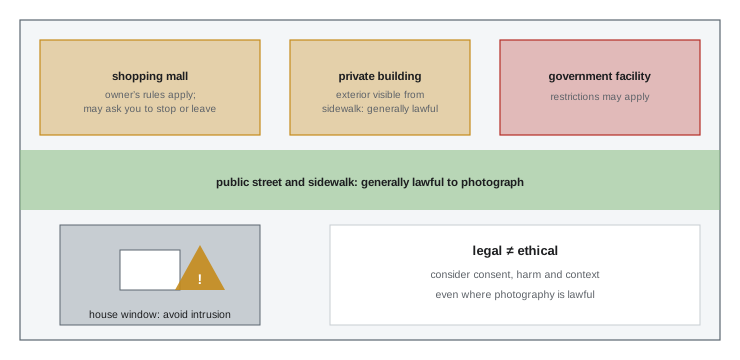
In most of Canada, there is no general law that prohibits photographing people, buildings or events that are visible from public places, such as streets, sidewalks and parks. Photography is a form of expression protected by section 2(b) of the Canadian Charter of Rights and Freedoms, subject to reasonable limits. People generally have a reduced expectation of privacy in public, though Canadian courts have recognized that privacy is not lost entirely in public spaces, particularly where recording is persistent, targeted or reveals intimate matters. The main exceptions concern Quebec's right to one's image, provincial privacy laws, voyeurism and intimate images, specific restrictions at certain sites, and the commercial use of images.
Privacy, image rights and publication
Quebec stands apart from the rest of Canada. The Civil Code of Québec (articles 3, 35 and 36) and the Quebec Charter of Human Rights and Freedoms (sections 4 and 5) protect a person's right to privacy and to their image. In Aubry v. Éditions Vice-Versa (1998), the Supreme Court of Canada held that a magazine infringed a young woman's rights by publishing, without her consent, a photograph taken of her sitting on a doorstep in Montreal, and awarded damages. The Court explained that the right to one's image is part of the right to privacy, but must be balanced against the public's right to information: publication without consent may be justified when the person is engaged in public activity or is newsworthy, or when they appear incidentally in a photograph of a public place or crowd, rather than as its main subject. In practice, street photographers in Quebec can usually photograph in public, but publishing images in which an identifiable person is the main subject, without consent and without a public interest justification, carries legal risk.
Outside Quebec, four provinces, British Columbia, Manitoba, Saskatchewan and Newfoundland and Labrador, have privacy statutes that make it a tort to violate another person's privacy wilfully and without a claim of right, and that specifically prohibit using a person's name or likeness for advertising or promotion without consent. In Ontario and some other provinces, courts have recognized common-law privacy torts, such as intrusion upon seclusion in Jones v. Tsige (Ontario Court of Appeal, 2012) and public disclosure of embarrassing private facts. These rarely affect ordinary street photography, but they matter for intrusive surveillance, publication of private matters and commercial use.
Voyeurism, intimate images and harassment
The Criminal Code makes voyeurism a crime (section 162): surreptitiously observing or recording a person in circumstances that give rise to a reasonable expectation of privacy, where the person is in a place where they might be nude or engaged in sexual activity, or where the recording is done for a sexual purpose. Publishing or distributing intimate images without consent is also a crime (section 162.1). Criminal harassment (section 264), including repeatedly following or watching someone so that they fear for their safety, can apply to persistent, targeted photography. These provisions do not affect ordinary street photography, but they draw clear lines around intrusive and sexualized image-making.
Recording sound
Video and audio recording raise an additional issue: the interception of private communications. Under Part VI of the Criminal Code, it is generally lawful to record a private conversation if at least one party to it consents, which includes the person recording if they are a participant. Recording a private conversation between other people without the consent of any participant can be an offence. Ordinary ambient sound on a street, and conversations held openly in public without an expectation of privacy, generally do not raise this problem.
Private property
Private property owners, including shopping malls, stores, restaurants, office buildings, stadiums and many transit stations, can set rules about photography on their premises and can ask photographers to stop or to leave; refusing to leave can lead to removal under provincial trespass legislation. Security guards may ask you to stop photographing or to leave, but they have no authority to take your camera, demand to see your images or force you to delete them; doing so could itself be unlawful. Photographing private property from a public place, such as a building's exterior from the sidewalk, is generally lawful. Some public property, such as government buildings, airports, ports and military sites, may have specific restrictions.
Encounters with police
Photographing and filming police officers carrying out their duties in public is lawful in Canada, and several police services have policies acknowledging the public's right to record. Officers may give lawful directions, for example to move back from an emergency scene, and obstructing an officer in the execution of their duty is an offence (Criminal Code section 129), so photographers should keep a safe distance and comply with reasonable instructions. Police generally cannot require you to delete images, and seizing a camera or searching its contents normally requires lawful authority such as a warrant, although police may sometimes seize evidence in urgent circumstances. The Supreme Court of Canada has recognized enhanced protection for journalistic sources and materials, and Parliament passed the Journalistic Sources Protection Act in 2017. If stopped, stay calm and polite, ask whether you are being detained, explain what you are doing, and do not physically resist.
Worked problem
A security guard at a plaza
A photographer is photographing commuters on a plaza in front of an office tower. A security guard says photography is not allowed and demands that the photographer delete the images. The plaza looks public but may belong to the building. What should the photographer do?
Show solution
- Stay calm and polite, and ask whether the plaza is private property.
- If it is private property, the owner can prohibit photography there; stop and, if asked, move to the public sidewalk.
- Explain that you will not delete the images; a guard has no authority to require deletion or take your camera.
- If the situation escalates, leave rather than argue, and note the time, location and guard's details if you want to follow up.
- From the public sidewalk, photography of the plaza and building is generally lawful.
Answer: Comply with a request to stop or leave private property, decline to delete images, stay calm and continue from public space if appropriate.
Commercial use and releases
How an image is used affects what permissions are needed. Editorial uses, such as news, documentary, books, exhibitions and educational publications, are generally the most protected, though in Quebec identifiable subjects may still have claims where there is no public interest. Commercial uses, such as advertising, promotion, merchandise or stock photography licensed for marketing, normally require model releases from identifiable people and property releases for some private property, both under the provincial privacy statutes that prohibit unauthorized use of likeness for advertising and as a matter of standard industry practice. Organizations collecting personal information in the course of commercial activity are subject to federal privacy law (PIPEDA) or provincial equivalents, but PIPEDA excludes information collected for journalistic, artistic or literary purposes.
| Use | Release generally needed? | Notes |
|---|---|---|
| News and documentary publication | No (public places) | Check sensitivities and context; captions must be accurate |
| Books, exhibitions, fine art prints | Usually no | Jurisdiction-specific risks for identifiable main subjects |
| Educational use | Usually no | Follow institutional policies, especially for minors |
| Advertising and promotion | Yes | Model releases from identifiable people |
| Commercial stock | Yes for commercial licences | Agencies require model and property releases |
Special situations
Several situations deserve particular attention. Drones are regulated by aviation authorities, with rules about where and how they may be flown and over people (PHOT-350). Schools, hospitals, courts and correctional facilities usually prohibit photography without permission, and courts in many jurisdictions restrict photographing inside courtrooms. Transit systems often permit personal photography but restrict tripods, lighting and commercial filming without permits. Events, concerts and festivals may restrict photography through ticket conditions. Protests and demonstrations are generally public, but photographers should consider the safety of participants (Lesson 2). Photography of critical infrastructure, such as power plants and bridges, is generally lawful from public places, but may attract questions from security personnel.
Practical advice
Knowing the law helps photographers work confidently and handle confrontations calmly. Useful practices include carrying a summary of your rights, staying polite in every encounter, never physically resisting police or guards, backing up images regularly so that a lost or seized device does not lose your work, and seeking legal advice through professional associations, press freedom organizations or a lawyer if you face legal action. Remember that what is legal is not always ethical, and what is ethical may sometimes require more restraint than the law demands (Lessons 2 and 6).
Photographing in other countries
Laws about photography in public vary widely around the world, and photographers travelling abroad should research the rules of each country before they go. Some European countries, such as France and Germany, give individuals stronger rights over their image than Canada or the United States, which can affect the publication of identifiable street photographs. Some countries restrict photography of government buildings, military sites, police, bridges, airports or religious sites, and penalties can be severe, including confiscation of equipment, detention or deportation. Drone use is restricted or banned in many places. Local advice from photographers, fixers or press organizations is invaluable, and travel advisories published by governments sometimes mention photography restrictions. When in doubt, ask permission and err on the side of caution.
Documenting your interactions
If a legal dispute or complaint arises, records of what happened can be important. Photographers who work in sensitive situations sometimes note the date, time and location of encounters with security guards or police, the names or badge numbers of officers, what was said, and any witnesses. Some record encounters with police on video, which is lawful in public in both Canada and the United States, though it can escalate tension. Keeping signed releases, consent notes and correspondence organized also protects photographers if subjects later raise concerns. Professional associations and press freedom organizations can advise members facing legal problems.
Releases in practice
A model release is a short document in which the person photographed, or a parent or guardian for a minor, grants permission for specified uses of their image. Releases typically identify the photographer and the subject, describe the images, specify the uses permitted, note any payment or consideration, and are signed and dated. Apps now allow releases to be signed on a phone, often with a photograph of the signer attached. For documentary projects, releases can also record agreements about anonymity or restrictions, which is useful for both parties. A release should be explained in plain language, and people should not feel pressured to sign; a signature obtained under pressure undermines both its ethical and legal value.
Keeping up to date
Laws and court decisions about photography change, and new technologies such as facial recognition, drones and generative AI continue to prompt new rules. Professional associations, press freedom groups and legal clinics publish updates and practical guides, and it is worth reviewing them periodically, especially before major projects or travel.
Common mistakes
MistakeAssuming the law is the same everywhere.
InsteadLearn the rules of each province, state and country.
MistakeIgnoring rules on private property.
InsteadStop or leave when asked by the owner or their agents.
MistakeDeleting images or handing over a camera under pressure from guards.
InsteadPolitely decline; guards have no such authority.
MistakeArguing physically with police.
InsteadStay calm, comply with lawful directions and seek advice later.
MistakeUsing street photographs in advertising without releases.
InsteadObtain model releases for commercial use.
Summary and key terms
- Photography in public is generally lawful in Canada and protected as expression.
- Quebec protects the right to one's image (Aubry); publication needs consent or public interest.
- Provincial privacy statutes and common-law torts address intrusion and commercial use of likeness.
- Voyeurism and intimate image laws draw firm lines.
- Private property owners can set rules but cannot seize cameras or force deletion.
- Stay calm with police; seizures and searches generally need lawful authority.
- Commercial use requires model releases; editorial uses are more protected.
- Expectation of privacy
- Whether a person can reasonably expect not to be observed or recorded.
- Right to one's image
- Quebec protection against unauthorized use of a person's image.
- Right of publicity
- Control over commercial use of one's name or likeness.
- Intrusion upon seclusion
- Privacy tort for intrusion into private affairs.
- Voyeurism
- Surreptitious recording where privacy is expected.
- One-party consent
- Rule allowing recording with one participant's consent.
- Trespass
- Remaining on property after being told to leave.
- Model release
- Written permission to use a person's likeness.
- Property release
- Permission to use images of private property commercially.
- Editorial use
- News, documentary, educational or artistic use.
Practice problems
Work each problem on paper first, then reveal the answer to check.
Which Charter section protects expression?
Show answer
Section 2(b).
What did Aubry v. Éditions Vice-Versa decide?
Show answer
Publishing an identifiable image without consent infringed Quebec image rights.
Name two provinces with privacy statutes.
Show answer
BC, Manitoba, Saskatchewan, Newfoundland and Labrador.
Which Criminal Code section covers voyeurism?
Show answer
Section 162.
Is one-party consent enough to record a private conversation in Canada?
Show answer
Generally yes, under Part VI of the Criminal Code.
Can a security guard force you to delete images?
Show answer
No.
What can a private property owner do?
Show answer
Prohibit photography and ask you to leave.
What should you do when police give a lawful direction?
Show answer
Comply calmly and keep a safe distance.
When is a model release needed?
Show answer
For advertising and commercial uses.
Is this lesson legal advice?
Show answer
No; consult a lawyer for specific questions.
Lesson quiz · 5 questions
Score 60% or more to complete this lesson.
Create a free account to save your progress, take quizzes and earn a certificate.