
PHOT-230 · Lesson 12 of 12 · 25 min
Publishing, exhibiting, books and capstone
Documentary and street photographs reach their audiences through many channels: magazines and newspapers, websites and social media, exhibitions, photobooks and zines, community presentations, archives and collections. Each channel shapes how work is seen and who sees it, and each has its own practices, opportunities and pitfalls. This final lesson covers editorial publication and pitching, online platforms and social media, photobooks and self-publishing, zines, exhibitions, community presentation and returning work, competitions and festivals, licensing and copyright, archiving for the future, and the capstone project.
Editorial publication and pitching
Magazines, newspapers and online publications commission and publish documentary stories, though staff positions and budgets have declined, and many publications rely on freelancers. Pitching a story involves researching the publication and its audience, contacting the appropriate photo editor with a concise pitch, and showing why the story matters now and why you are the right person to tell it. A typical pitch includes a short summary of the story, a few sentences on access and context, a selection of 5 to 15 images, and your contact details and relevant experience. Publications may buy first publication rights for completed work, or commission new photography with a fee and expenses. Agree terms in writing: rights granted, payment, credit, captions and whether the publication can edit captions or crop images.
Online platforms and social media
Online platforms allow photographers to publish work independently and build audiences. A personal website with clear project pages, statements and captions is the professional foundation. Social media platforms, especially Instagram, are widely used by documentary and street photographers to share work, connect with editors and audiences, and join communities; carousels allow short sequences with captions (Lesson 10). Social media also brings challenges: algorithms favour certain kinds of images; context can collapse as images are shared (Lesson 11); images of identifiable people reach large audiences quickly; and harassment can follow. Consider carefully which images to share publicly, especially of vulnerable people, and keep full projects, with context, on your own site.
Photobooks
The photobook is central to documentary and street photography culture. Books allow full control over editing, sequencing, pairing, pacing, scale, paper and design, and they endure in a way that online posts do not. Landmark books, from The Americans to The Decisive Moment, often define a photographer's career. Publishing routes include traditional publishers, who invest in production and distribution but may require subsidies from the photographer; specialist photobook publishers; self-publishing, where the photographer controls everything and bears the costs; and print-on-demand services for small runs. A photobook project involves editing and sequencing, design (often with a book designer), text, proofs and printing, distribution and promotion. Production costs depend heavily on page count, size, paper, binding, printing method and print run; offset printing is cheaper per copy for runs of several hundred or more, while print-on-demand suits very small quantities.
| Route | Photographer control | Cost to photographer | Distribution |
|---|---|---|---|
| Traditional or specialist publisher | Shared | Low to substantial subsidy | Bookstores, publisher networks |
| Self-published offset run | Full | High upfront | Own sales, fairs, selected stores |
| Print-on-demand | Full | Low upfront, high per copy | Online, small quantities |
| Zine or handmade edition | Full | Low | Fairs, direct sales, swaps |
Zines
Zines, small, inexpensive, self-published booklets, have long been part of street and documentary culture. They can be printed on office printers, risograph machines or through low-cost printers, in editions of a few dozen to a few hundred, and sold or traded at zine fairs, art book fairs and online. Zines are ideal for testing sequences, publishing work in progress, documenting local communities and reaching audiences outside the gallery and publishing world. Their informality encourages experimentation with layout, paper and format.
Worked problem
Budgeting a small zine
A photographer wants to print 150 copies of a 32-page zine documenting their neighbourhood. A local risograph printer quotes $3.20 per copy, plus $60 for setup. They plan to sell copies for $12 at a fair where a table costs $50. How many copies must they sell to cover costs?
Show solution
- Printing cost: 150 × $3.20 + $60 = $540.
- Total cost including the table: $540 + $50 = $590.
- Copies needed to break even: $590 ÷ $12 ≈ 49.2, so 50 copies.
- Remaining copies can be sold later, traded with other zine makers or given to the people photographed.
Answer: About 50 copies at $12 cover the $590 total cost.
Exhibitions
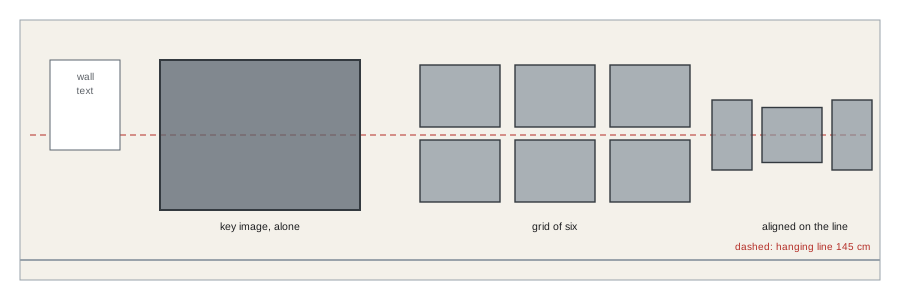
Exhibitions present photographs as physical objects in space, where size, framing, lighting and arrangement shape the experience. Venues range from major museums and commercial galleries to artist-run centres, libraries, community centres, cafés, festivals and outdoor public displays. Preparing an exhibition involves editing for the space, choosing print sizes and materials (PHOT-202, PHOT-301), framing or mounting, writing wall texts and captions, planning the layout, installation and lighting, publicity and an opening event. Exhibitions in the communities where the work was made can be especially meaningful, allowing participants and neighbours to see and respond to the work. Outdoor and public installations, such as large prints on fences or building walls, bring documentary work to people who might never visit a gallery.
Community presentation and returning work
Returning work to the people and communities photographed is one of the most important ethical practices in documentary photography (Lesson 2). It can take many forms: giving prints to participants; holding a slideshow or exhibition in the community; donating images to local archives, libraries or organizations; and creating publications in local languages. Returning work allows people to see how they have been represented and to respond, sometimes correcting errors or adding stories. It also builds trust for future work, by you and by other photographers.
Competitions, festivals and awards
Competitions and festivals, such as World Press Photo, the Sony World Photography Awards, the Contact Photography Festival in Toronto, Visa pour l'Image in Perpignan and many regional events, offer visibility, prizes, exhibitions and connections with editors and curators. Read entry rules carefully: many documentary competitions prohibit manipulation beyond basic adjustments and may request raw files (PHOT-202), require accurate captions and consent, and set conditions on rights granted to organizers. Entry fees vary, and some competitions exist mainly to collect fees; research reputable ones. Portfolio reviews at festivals let photographers show work to editors, curators and publishers for feedback.
Licensing and copyright
In both Canada and the United States, photographers generally own the copyright in their photographs from the moment they are made, unless they create them as employees within their employment or assign copyright in writing. Photographers earn income by licensing images, granting specific rights for specific uses, periods and territories, while keeping copyright. Documentary photographers license images to publications, books, documentaries, educational publishers and organizations, sometimes through agencies or archives. Licensing documentary images for advertising or commercial use may require model releases and may conflict with promises made to subjects (Lessons 2 and 7). Registration of copyright, available in the United States through the Copyright Office and in Canada through the Canadian Intellectual Property Office, can strengthen enforcement. PHOT-410 covers licensing and business in depth.
Archiving for the future
Documentary photographs often become more valuable over time, as historical records of places and people that have changed. Archiving well means keeping original files, edited masters and captions together; embedding metadata; backing up in multiple locations (PHOT-202); keeping project notes, consent records and correspondence; and, for film photographers, storing negatives in archival sleeves in cool, dry conditions. Many photographers eventually donate or sell their archives to museums, universities or community archives, which can preserve them and make them accessible. Consider in advance who will care for your archive, and document any restrictions agreed with subjects.
Capstone project
The capstone asks you to produce a short documentary or street photography project that demonstrates the skills and ethics of this course. Choose a subject close enough to allow repeated access, and work on it over several weeks. Your submission should include:
- A project statement of 250 to 400 words describing the subject, why it matters, your approach and your relationship to the people and place.
- A sequenced set of 12 to 20 photographs, with an opener and closer, varied image types and a clear structure or associative logic.
- Accurate captions for each image, following the guidance in Lesson 11, with names and details verified and identities protected where appropriate.
- An ethics and consent log: how you approached people, what consent you obtained, any restrictions agreed and how you will return the work to participants.
- A short reflection of about 500 words on what you learned about seeing, working with people, legal considerations and editing.
- A plan for sharing the work: a zine dummy, an exhibition layout, a web essay or a community presentation.
Present the project as you would to an editor, curator or grant panel.
Building an audience and a career
Documentary and street photographers build careers through a combination of persistence, community and visibility. Common paths include freelance editorial work, teaching, commissions from non-profit organizations, grants and fellowships, book projects, print sales, workshops, and combining photography with writing, filmmaking or research. Networking at festivals, portfolio reviews and photography communities, both in person and online, helps photographers meet editors, curators and collaborators. Building a career is usually slow, and many respected documentary photographers support their projects with other work for years. A clear body of work, a professional website and consistent engagement matter more than chasing every trend.
Responsible reuse of your work
Once work is published, photographers face requests to reuse it: from publications, documentaries, educational materials, advocacy campaigns and advertisers. Each request should be weighed against the agreements made with the people photographed and the original context. A photograph of a family made for a story about housing insecurity, for example, should not be licensed to illustrate an unrelated article in a way that misrepresents them, or for an advertisement. Keeping clear records of consent and restrictions with each image makes these decisions easier, and declining unsuitable uses protects both the subjects and the photographer's integrity.
Looking back and forward
Documentary and street photography connect the present with history. The photographs made today will become records of how people lived in the 2020s, just as the images of Atget, Hine and the FSA are records of their times. That long view is a reason to work carefully, caption accurately, archive thoroughly and treat people with respect, because the photographs will outlast the moment and the photographer. It is also a reason to begin: there is no shortage of important, unrecorded subjects in every community, waiting for someone to pay attention.
Editing for each outlet
The same project may appear as a magazine story of ten images, a web essay of twenty-five, a photobook of eighty and an exhibition of thirty prints. Each requires its own edit and sequence, suited to the format, audience and space, as Lesson 10 described. Keeping a master selection of the project's strongest images, with captions and notes, makes it easier to prepare each version. Track where each image has been published and under what terms, so that exclusive rights and agreements with subjects are respected.
Sharing the capstone
When the capstone is complete, consider how it might reach the people who appear in it and the community where it was made. A printed zine left at a community centre, a small exhibition at a library, or a slideshow evening can mean more to participants than a publication they never see. Their responses, corrections and stories are often the best guide to where the project should go next, and may become the starting point for a longer body of work.
Whatever form the finished work takes, keep the original files, captions and consent records together, so that the capstone can grow into a larger project or be revisited years from now.
Common mistakes
MistakePitching without researching the publication.
InsteadTailor pitches to the outlet and audience.
MistakePosting sensitive images publicly without thought.
InsteadConsider who could be harmed before sharing.
MistakeUnderestimating photobook costs.
InsteadBudget for design, printing, distribution and promotion.
MistakeEntering competitions without reading the rules.
InsteadCheck manipulation, caption and rights conditions.
MistakeNeglecting archives and consent records.
InsteadKeep files, captions, notes and agreements together.
Summary and key terms
- Pitch editorial stories with concise summaries and strong images.
- Use your own website for full context; share selectively on social media.
- Photobooks give full control over sequence and design; routes vary in cost and reach.
- Zines are inexpensive, flexible and community-oriented.
- Exhibitions and community presentations bring work to physical audiences.
- Competitions and festivals offer visibility; read the rules.
- License images while keeping copyright, archive carefully and return work to communities.
- Pitch
- Proposal of a story to an editor.
- First publication rights
- Right to publish work before anyone else.
- Photobook
- Book in which photographs are the primary content.
- Print-on-demand
- Printing copies as they are ordered.
- Offset printing
- High-volume commercial printing method.
- Zine
- Small self-published booklet.
- Wall text
- Text displayed in an exhibition.
- Portfolio review
- Meeting to show work for professional feedback.
- Licensing
- Granting rights to use images while keeping copyright.
- Archive
- Organized, preserved collection of work and records.
Practice problems
Work each problem on paper first, then reveal the answer to check.
What does a typical pitch include?
Show answer
Summary, access and context, 5–15 images, contact details.
What terms should be agreed with publications?
Show answer
Rights, payment, credit, captions, cropping.
Why keep full projects on your own website?
Show answer
To preserve context.
When is offset printing cheaper per copy?
Show answer
For runs of several hundred or more.
Zine break-even: costs $400, price $10?
Show answer
40 copies.
Name three steps in preparing an exhibition.
Show answer
Editing, printing, framing, texts, layout, installation, publicity.
Why return work to communities?
Show answer
Representation, response, trust and ethics.
What do documentary competitions often require?
Show answer
Limited manipulation, raw files, accurate captions.
Who owns copyright in a freelancer's photograph by default?
Show answer
The photographer.
Name three things to archive.
Show answer
Originals, masters, captions, notes, consent records, negatives.
Lesson quiz · 5 questions
Score 60% or more to complete this lesson.
Create a free account to save your progress, take quizzes and earn a certificate.