
PHOT-230 · Lesson 2 of 12 · 26 min
Ethics of representation
A documentary photograph does something to the people in it. It fixes a moment of their lives, gives it to strangers to look at, and attaches meanings that the subjects may never have intended. Done well, documentary work can dignify people, bring hidden realities into view and support real change. Done carelessly, it can humiliate, stereotype, endanger and exploit, even when the photographer means well. Before learning the techniques of documentary and street photography, it is worth thinking carefully about the ethics of representation: the relationships of power between photographer and subject, the stories images tell about groups of people, consent and collaboration, the representation of suffering, working with Indigenous and other communities, and the responsibilities that continue after the photograph is taken. This lesson offers frameworks and questions rather than rules, because ethical documentary practice depends on context and judgement.
Power and the camera
The photographer and the person photographed rarely meet as equals. The photographer usually decides what to photograph, how to frame it, which images to publish, what to write in the caption and who will see the result; they may also hold advantages of education, wealth, citizenship, race or institutional backing. The person photographed often has little control over how they appear, where the image goes or what it will be used to say. The writer Susan Sontag, in On Photography (1977), argued that photographing people can be a form of appropriation, turning them into objects that can be possessed, and in Regarding the Pain of Others (2003) she examined how images of suffering can both move and numb viewers. Critics have also described the colonial gaze, in which photographers from powerful societies portrayed colonized peoples as exotic, primitive or helpless, reinforcing the ideologies that justified domination. Recognizing these imbalances is the first step toward working more fairly.
Stereotypes and the single story
Images accumulate. When people from a particular group, place or community are repeatedly shown only in poverty, conflict, illness or need, audiences come to see them that way, a pattern the Nigerian novelist Chimamanda Ngozi Adichie described in a widely viewed 2009 talk as "the danger of a single story". Critics use the term "poverty porn" for imagery that dwells on suffering in order to provoke pity or donations, stripping subjects of agency and complexity. Similar concerns arise with images of people experiencing homelessness, addiction or mental illness, refugees, Indigenous communities, people with disabilities and residents of neighbourhoods labelled as dangerous. Ethical documentary work looks for complexity: showing people as individuals with names, relationships, work, humour, opinions and resilience; showing the causes of problems, not only their symptoms; and including moments of ordinary life alongside moments of crisis.
| Question | Why it matters |
|---|---|
| Whose story is this, and who is telling it? | Reveals whose perspective shapes the work |
| How would the people in the photographs describe this situation? | Tests the photographer's interpretation against theirs |
| Am I showing only the hardest moments? | Guards against a single story of suffering |
| Could this image harm the person if seen by family, employers, police or opponents? | Identifies risks to the subject |
| Would I photograph someone in my own community this way? | Checks for double standards |
| What do the people photographed gain from this work? | Considers reciprocity and benefit |
Consent and its limits
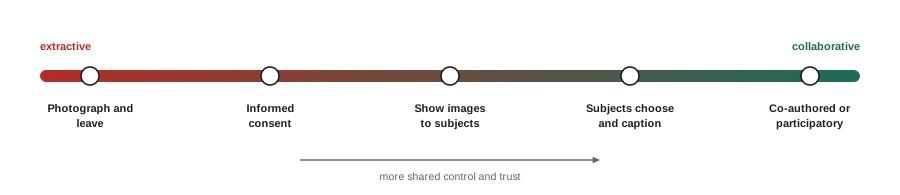
Consent is central to ethical documentary practice, but it is not simple. In street photography, candid images of strangers are usually made without asking, and the law in many places allows this in public (Lesson 7). In documentary projects that involve sustained access to people's homes, workplaces, treatment or private lives, informed consent is essential: the person should understand who you are, what the project is, where the images may appear, and that they can say no or change their mind. Meaningful consent requires that people are capable of giving it and are not under pressure; people who are in crisis, intoxicated, in pain, very young, detained or dependent on the organization that invited you may not be able to consent freely. Consent should be ongoing rather than a single signature, revisited as the project develops and when images are about to be published. Written releases are needed for commercial use and are often wise in documentary work, but a signature does not settle every ethical question.
Collaboration and shared authorship
Many contemporary documentary photographers work collaboratively, giving the people photographed more say in how they are represented. Approaches include showing images to subjects and inviting comments; involving people in choosing which images are published; recording their words and using them in captions; inviting participants to make their own photographs, an approach sometimes called participatory photography or photovoice, developed in public health research in the 1990s; co-authoring books and exhibitions; and sharing income or returning images and prints to communities. Collaboration does not remove the photographer's responsibility or point of view, and it can be time-consuming, but it often produces richer, more accurate and more trusted work. It also changes the relationship from one of extraction, in which the photographer takes images and leaves, to one of exchange.
Photographing suffering
Documentary photographers often witness pain: war, disaster, illness, violence, grief. Photographs of suffering can bear witness, preserve evidence, provoke compassion and change policy; they can also intrude on people at their most vulnerable, retraumatize survivors and families, and exploit pain for attention or awards. Many photographers work with principles such as these: be present and humane first, and a photographer second; ask permission whenever possible, especially of the injured and bereaved; avoid photographing people who are dying or in extreme distress without strong justification; respect requests to stop; consider whether the image adds understanding or merely shock; and consider how it will be seen by the people in it and their families. The 1993 photograph by Kevin Carter of a starving child in Sudan, which won a Pulitzer Prize, and the debates about his choices that followed, are often discussed in this context. Photographers also need to care for themselves, since repeated exposure to trauma can cause lasting harm (Lesson 9).
Indigenous communities and cultural protocols
Photography has a troubled history with Indigenous peoples in Canada, the United States and worldwide. Early photographers often staged images to fit romantic or colonial ideas, removed signs of modern life, photographed sacred ceremonies without permission and placed images in archives where communities could not control them. Today, many Indigenous communities have protocols for photography: ceremonies, sacred sites and objects may be off limits, and permission may be required from community leaders, Elders or knowledge keepers as well as from individuals. Principles developed in Canada, such as the First Nations principles of OCAP (ownership, control, access and possession) for research data, offer a model for thinking about who controls images and information about a community. In both countries, working respectfully means learning the specific protocols of each community, building relationships before photographing, recognizing that individual consent may not be enough, and supporting Indigenous photographers and storytellers, who are documenting their own communities in growing numbers.
Worked problem
An invitation to photograph a ceremony
A photographer meets a young man at a powwow who invites them to photograph his family. Later, the family takes part in a ceremony where cameras are not visible, and the photographer is unsure whether photography is allowed. What should they do?
Show solution
- Do not assume that the earlier invitation covers the ceremony.
- Put the camera away and ask the family, and if appropriate the organizers or an Elder, whether photography is permitted.
- Look for posted rules or announcements; many powwows indicate when photography must stop.
- If permission is given, follow any conditions, such as no flash or no publication, and offer to share the images with the family.
- If the answer is no or unclear, do not photograph.
Answer: Stop and ask the family and organizers; follow posted protocols, and photograph only with clear permission and conditions.
Children and vulnerable people
Images of children require particular care. Children cannot give fully informed consent, so permission should come from a parent or guardian as well as the child's own agreement, especially for sustained projects. Avoid images that could embarrass children as they grow up, reveal their locations or routines, or be misused. Schools, child welfare organizations and humanitarian agencies have strict policies about photographing children, often forbidding identifiable images of children in care or in sensitive situations. Similar care applies to people with cognitive disabilities, people in hospitals, prisons and shelters, survivors of violence, and people whose immigration status, sexuality or political activity could put them at risk if identified. Sometimes the ethical choice is to photograph in ways that protect identity, such as silhouettes, hands or details, or not to photograph at all.
Safety and harm to subjects
Photographs can put people in danger. Protesters identified in images may face arrest, dismissal or retaliation; witnesses and informants may be targeted; people living with undocumented status may be exposed; survivors may be found by abusers. With facial recognition technology and online searches, an image published today can identify someone years later. Documentary photographers working in sensitive contexts should consider whether faces need to be shown, remove location and other metadata, secure their files and devices, and think about how images could be used by authorities or opponents. Human rights organizations and press freedom groups publish guidance on these risks.
Responsibilities after the photograph
Ethical responsibility continues long after the shutter is pressed. Captions must be accurate and fair (Lesson 11). Images should be used in contexts consistent with what subjects agreed to; selling a documentary image for an advertisement, for example, may betray the people in it. Photographers should respond seriously when subjects ask for images to be removed. Archiving and licensing decisions affect how images will be used in the future, including by people with very different intentions. Giving prints back, sharing publications and staying in touch are small acts that recognize the relationship. Many documentary photographers keep notes of every agreement they make with subjects so that future uses can be checked against them.
Developing your own ethical framework
There is no checklist that resolves every ethical question in documentary work, and thoughtful photographers sometimes disagree. Developing your own framework means reflecting on your motives, learning from the communities you work with, reading critiques of documentary practice, discussing difficult cases with peers and mentors, and being willing to change your approach. A useful habit is to write a short ethical statement for each project: what you hope to achieve, what risks it poses and to whom, how you will seek consent and collaboration, and how you will handle publication and future uses. Revisit it as the project develops.
Who tells the story
Questions of representation are closely tied to who holds the camera. For much of photography's history, documentary images of working-class, colonized, racialized and marginalized communities were made mostly by outsiders, while members of those communities had little access to cameras, publications and galleries. That has changed substantially, as photographers from many communities document their own lives, and as organizations, collectives and publications work to diversify the field. Insider photographers bring knowledge, trust and perspectives that outsiders may lack; outsiders can sometimes see what insiders take for granted, and may have access to audiences and resources. Neither position guarantees good or ethical work. What matters is awareness of one's position, humility, collaboration, and a willingness to support and share space with photographers from the communities being represented, including by recommending them for assignments.
Ethics in street photography
Street photography raises its own ethical questions. Because most street images are made without consent, the photographer bears responsibility for considering how they might affect the people in them. Many street photographers follow informal principles: avoid photographing people at their most vulnerable or humiliating moments; avoid ridicule; avoid sexualized images of strangers; delete images when people object; and think twice before publishing images in which a person is identifiable and the context could embarrass or endanger them. Others argue that public life must remain photographable for the sake of history and art, and that excessive caution would make the genre impossible. Most thoughtful photographers hold both views at once, defending the right to photograph in public while exercising restraint and care.
Common mistakes
MistakeShowing communities only in crisis.
InsteadShow complexity, agency and ordinary life.
MistakeTreating a signed release as the end of ethical questions.
InsteadSeek ongoing, informed consent and consider harm.
MistakePhotographing ceremonies without permission.
InsteadLearn and follow community protocols.
MistakePublishing identifiable images that could endanger people.
InsteadAssess risks and protect identities where needed.
MistakeTaking images and never returning.
InsteadShare work and maintain relationships.
Summary and key terms
- Photography involves power imbalances between photographer and subject.
- Repeated images of suffering can create a single story and stereotypes.
- Consent should be informed, free and ongoing, especially in sustained projects.
- Collaboration and participatory methods share authorship and improve trust.
- Photographing suffering requires humanity, permission and restraint.
- Indigenous communities have protocols; individual consent may not be enough.
- Responsibilities continue after publication, in captions, uses and archives.
- Representation
- How people and groups are depicted.
- Colonial gaze
- Depiction of colonized peoples through the eyes of colonizers.
- Single story
- A narrow, repeated narrative about a group.
- Poverty porn
- Imagery exploiting suffering to provoke pity.
- Informed consent
- Agreement based on understanding of use and risks.
- Participatory photography
- Projects in which subjects make their own images.
- Photovoice
- Participatory method using photographs for community research.
- OCAP
- First Nations principles of ownership, control, access and possession.
- Reciprocity
- Mutual exchange and benefit in a relationship.
- Ethical statement
- Written reflection on a project's aims, risks and safeguards.
Practice problems
Work each problem on paper first, then reveal the answer to check.
Why is the photographer usually more powerful than the subject?
Show answer
They control framing, selection, captions and distribution.
What did Adichie warn against?
Show answer
The danger of a single story.
What is poverty porn?
Show answer
Imagery exploiting suffering to provoke pity.
Name two situations where consent may not be free.
Show answer
Crisis, intoxication, detention, dependence, youth.
What is photovoice?
Show answer
A participatory method where subjects make photographs.
Name two principles for photographing suffering.
Show answer
Be humane first, ask permission, respect requests to stop.
What does OCAP stand for?
Show answer
Ownership, control, access and possession.
How can identities be protected?
Show answer
Silhouettes, details, hands, not photographing faces.
How can images endanger protesters?
Show answer
Identification by authorities or opponents.
What does an ethical statement include?
Show answer
Aims, risks, consent approach, publication and future use.
Lesson quiz · 5 questions
Score 60% or more to complete this lesson.
Create a free account to save your progress, take quizzes and earn a certificate.