
PHOT-230 · Lesson 7 of 12 · 25 min
Photographing in public in the US
Street and documentary photographers in the United States need a working knowledge of the law: what they may photograph in public, when they need consent, what rules apply on private property, how to handle encounters with security guards and police, and how images may be used afterward. American law in this area combines the First Amendment, federal and state criminal law, state privacy torts and right of publicity laws, and court decisions on recording in public. This lesson summarizes the main principles for photographers in the United States.
The general principle
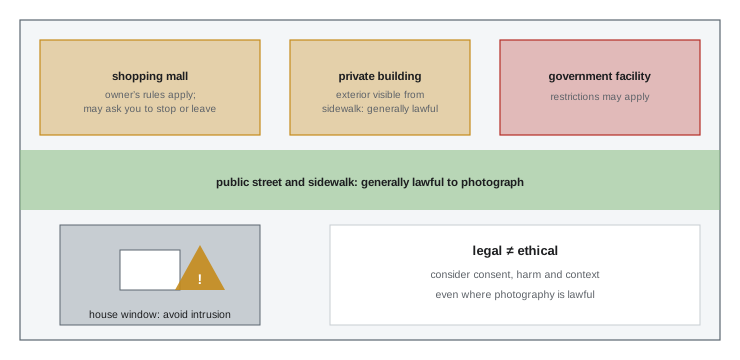
In the United States, photographing people, buildings and events that are plainly visible from public places, such as streets, sidewalks and parks, is generally lawful and is protected by the First Amendment as a form of expression and information gathering. People generally have no reasonable expectation of privacy in what they expose to public view. Federal appeals courts in several circuits have recognized a First Amendment right to photograph and record police officers performing their duties in public, including Glik v. Cunniffe (First Circuit, 2011), ACLU of Illinois v. Alvarez (Seventh Circuit, 2012), Fields v. City of Philadelphia (Third Circuit, 2017) and Turner v. Driver (Fifth Circuit, 2017). The main exceptions concern privacy torts, voyeurism and intimate images, audio recording laws, specific restricted sites, and the commercial use of images.
Privacy, image rights and publication
Privacy in the United States is protected mainly through state tort law, which recognizes four kinds of invasion of privacy: intrusion upon seclusion, for example photographing into a home through a window with a long lens; public disclosure of private facts that are highly offensive and not of legitimate public concern; false light, portraying someone in a misleading and offensive way, as with a misleading caption; and appropriation of name or likeness for commercial benefit. Photographs taken in public places rarely amount to intrusion, and publication of newsworthy or artistic images is strongly protected. In Nussenzweig v. diCorcia (2006 and 2007), New York courts dismissed a claim by a man whose candid street portrait, made by the photographer Philip-Lorca diCorcia in Times Square, was exhibited and sold as an edition of prints; the case was decided on the statute of limitations, but lower court reasoning treated art as protected expression rather than commercial use.
The right of publicity, governed by state statutes and common law, prohibits using a person's name or likeness for advertising or trade without consent. New York's Civil Rights Law sections 50 and 51 and California Civil Code section 3344 are among the most frequently cited. These laws generally do not prohibit news, documentary, editorial or artistic uses, which are protected expression, but they do mean that a street photograph used to advertise a product, or on merchandise, may require a model release. State laws differ significantly in scope and duration, including rights that continue after death.
Voyeurism, intimate images and harassment
Federal law (the Video Voyeurism Prevention Act of 2004) and the laws of every state criminalize capturing images of people's private areas or of people in places where they have a reasonable expectation of privacy, such as restrooms, changing rooms and bedrooms, without consent. Almost all states also criminalize the non-consensual distribution of intimate images, and the federal TAKE IT DOWN Act of 2025 requires platforms to remove such images when notified. Stalking and harassment laws can apply to persistent, targeted photography of an individual. These laws do not affect ordinary street photography, but they draw clear lines around intrusive and sexualized image-making.
Recording sound
Video and audio recording raise an additional issue: wiretapping and eavesdropping laws. Federal law and most states allow recording a conversation with the consent of one party, but around a dozen states, including California, Florida, Illinois, Maryland, Massachusetts, Montana, New Hampshire, Pennsylvania and Washington, generally require the consent of all parties to a confidential or private conversation. These laws usually do not apply to conversations held openly in public where there is no reasonable expectation of privacy, and courts have held that recording police in public is protected, but documentary filmmakers recording conversations should know the rules in each state.
Private property
Private property owners, including shopping malls, stores, restaurants, office buildings, stadiums and many transit facilities, can set rules about photography on their premises and can ask photographers to stop or to leave; refusing to leave can lead to trespass charges. Security guards may ask you to stop or leave, but they generally have no authority to take your camera, demand to see your images or force you to delete them. Photographing private property from a public place, such as a building's exterior from the sidewalk, is generally lawful. Some federal facilities, military installations and airports have specific restrictions, and federal regulations generally permit photography of building exteriors and public lobbies of federal buildings unless security officials restrict it.
Encounters with police
Recording police officers performing their duties in public is protected by the First Amendment, as several federal circuit courts have held. Officers may give lawful orders, such as to move back from an emergency scene, and interfering with officers can lead to arrest, so photographers should keep a safe distance and comply with reasonable instructions. Police generally cannot order you to delete images, and seizing a camera or searching its contents normally requires a warrant; the Supreme Court held in Riley v. California (2014) that police generally need a warrant to search a phone seized during an arrest, and the Privacy Protection Act of 1980 restricts searches and seizures of journalists' work materials. Some states have passed laws limiting how close people may approach police while recording, and some of these laws have been challenged or blocked in court. If stopped, stay calm and polite, ask whether you are free to go, explain what you are doing, and do not physically resist.
Worked problem
A security guard at a plaza
A photographer is photographing commuters on a plaza in front of an office tower. A security guard says photography is not allowed and demands that the photographer delete the images. The plaza looks public but may belong to the building. What should the photographer do?
Show solution
- Stay calm and polite, and ask whether the plaza is private property.
- If it is private property, the owner can prohibit photography there; stop and, if asked, move to the public sidewalk.
- Explain that you will not delete the images; a guard has no authority to require deletion or take your camera.
- If the situation escalates, leave rather than argue, and note the time, location and guard's details if you want to follow up.
- From the public sidewalk, photography of the plaza and building is generally lawful.
Answer: Comply with a request to stop or leave private property, decline to delete images, stay calm and continue from public space if appropriate.
Commercial use and releases
How an image is used affects what permissions are needed. Editorial uses, such as news, documentary, books, exhibitions and educational publications, are strongly protected and generally do not require releases from people photographed in public. Commercial uses, such as advertising, promotion, merchandise or stock photography licensed for marketing, normally require model releases from identifiable people under right of publicity laws, and property releases may be required by stock agencies for recognizable private property and some trademarks. Fine art sales of prints, as in the diCorcia case, have generally been treated as protected expression, but practices and outcomes vary by state.
| Use | Release generally needed? | Notes |
|---|---|---|
| News and documentary publication | No (public places) | Check sensitivities and context; captions must be accurate |
| Books, exhibitions, fine art prints | Usually no | Jurisdiction-specific risks for identifiable main subjects |
| Educational use | Usually no | Follow institutional policies, especially for minors |
| Advertising and promotion | Yes | Model releases from identifiable people |
| Commercial stock | Yes for commercial licenses | Agencies require model and property releases |
Special situations
Several situations deserve particular attention. Drones are regulated by aviation authorities, with rules about where and how they may be flown and over people (PHOT-350). Schools, hospitals, courts and correctional facilities usually prohibit photography without permission, and courts in many jurisdictions restrict photographing inside courtrooms. Transit systems often permit personal photography but restrict tripods, lighting and commercial filming without permits. Events, concerts and festivals may restrict photography through ticket conditions. Protests and demonstrations are generally public, but photographers should consider the safety of participants (Lesson 2). Photography of critical infrastructure, such as power plants and bridges, is generally lawful from public places, but may attract questions from security personnel.
Practical advice
Knowing the law helps photographers work confidently and handle confrontations calmly. Useful practices include carrying a summary of your rights, staying polite in every encounter, never physically resisting police or guards, backing up images regularly so that a lost or seized device does not lose your work, and seeking legal advice through professional associations, press freedom organizations or a lawyer if you face legal action. Remember that what is legal is not always ethical, and what is ethical may sometimes require more restraint than the law demands (Lessons 2 and 6).
Photographing in other countries
Laws about photography in public vary widely around the world, and photographers traveling abroad should research the rules of each country before they go. Some European countries, such as France and Germany, give individuals stronger rights over their image than Canada or the United States, which can affect the publication of identifiable street photographs. Some countries restrict photography of government buildings, military sites, police, bridges, airports or religious sites, and penalties can be severe, including confiscation of equipment, detention or deportation. Drone use is restricted or banned in many places. Local advice from photographers, fixers or press organizations is invaluable, and travel advisories published by governments sometimes mention photography restrictions. When in doubt, ask permission and err on the side of caution.
Documenting your interactions
If a legal dispute or complaint arises, records of what happened can be important. Photographers who work in sensitive situations sometimes note the date, time and location of encounters with security guards or police, the names or badge numbers of officers, what was said, and any witnesses. Some record encounters with police on video, which is lawful in public in both Canada and the United States, though it can escalate tension. Keeping signed releases, consent notes and correspondence organized also protects photographers if subjects later raise concerns. Professional associations and press freedom organizations can advise members facing legal problems.
Releases in practice
A model release is a short document in which the person photographed, or a parent or guardian for a minor, grants permission for specified uses of their image. Releases typically identify the photographer and the subject, describe the images, specify the uses permitted, note any payment or consideration, and are signed and dated. Apps now allow releases to be signed on a phone, often with a photograph of the signer attached. For documentary projects, releases can also record agreements about anonymity or restrictions, which is useful for both parties. A release should be explained in plain language, and people should not feel pressured to sign; a signature obtained under pressure undermines both its ethical and legal value.
Keeping up to date
Laws and court decisions about photography change, and new technologies such as facial recognition, drones and generative AI continue to prompt new rules. Professional associations, press freedom groups and legal clinics publish updates and practical guides, and it is worth reviewing them periodically, especially before major projects or travel.
Common mistakes
MistakeAssuming the law is the same everywhere.
InsteadLearn the rules of each province, state and country.
MistakeIgnoring rules on private property.
InsteadStop or leave when asked by the owner or their agents.
MistakeDeleting images or handing over a camera under pressure from guards.
InsteadPolitely decline; guards have no such authority.
MistakeArguing physically with police.
InsteadStay calm, comply with lawful directions and seek advice later.
MistakeUsing street photographs in advertising without releases.
InsteadObtain model releases for commercial use.
Summary and key terms
- Photography in public is generally lawful in the US and protected by the First Amendment.
- Privacy torts and right of publicity laws limit intrusive and commercial uses.
- Courts have recognized a right to record police in public.
- Voyeurism and intimate image laws draw firm lines.
- Private property owners can set rules but cannot seize cameras or force deletion.
- Stay calm with police; seizures and searches generally need lawful authority.
- Commercial use requires model releases; editorial uses are more protected.
- Expectation of privacy
- Whether a person can reasonably expect not to be observed or recorded.
- Right to one's image
- Quebec protection against unauthorized use of a person's image.
- Right of publicity
- Control over commercial use of one's name or likeness.
- Intrusion upon seclusion
- Privacy tort for intrusion into private affairs.
- Voyeurism
- Surreptitious recording where privacy is expected.
- One-party consent
- Rule allowing recording with one participant's consent.
- Trespass
- Remaining on property after being told to leave.
- Model release
- Written permission to use a person's likeness.
- Property release
- Permission to use images of private property commercially.
- Editorial use
- News, documentary, educational or artistic use.
Practice problems
Work each problem on paper first, then reveal the answer to check.
Which constitutional provision protects photography in public?
Show answer
The First Amendment.
Name the four privacy torts.
Show answer
Intrusion, disclosure of private facts, false light, appropriation.
Name a case recognizing a right to record police.
Show answer
Glik v. Cunniffe, Alvarez, Fields or Turner v. Driver.
Name two all-party consent states.
Show answer
California, Florida, Illinois, Pennsylvania, Washington and others.
What did Riley v. California require?
Show answer
A warrant to search a phone seized in an arrest.
Can a security guard force you to delete images?
Show answer
No.
What can a private property owner do?
Show answer
Prohibit photography and ask you to leave.
What should you do when police give a lawful direction?
Show answer
Comply calmly and keep a safe distance.
When is a model release needed?
Show answer
For advertising and commercial uses.
Is this lesson legal advice?
Show answer
No; consult a lawyer for specific questions.
Lesson quiz · 5 questions
Score 60% or more to complete this lesson.
Create a free account to save your progress, take quizzes and earn a certificate.