
PHOT-201 · Lesson 5 of 12 · 28 min
Lenses and optical quality
A lens is a carefully designed group of glass elements that bends light to form an image on the sensor. No real lens is perfect: every design balances sharpness, contrast, distortion, size, weight, speed and cost, and the result shapes the character of every photograph made with it. Understanding lens aberrations, how lenses are tested, how sharpness changes with aperture, and how software corrections work helps photographers choose lenses wisely, use them at their best and appreciate the characters of different designs. This lesson covers how lenses form images, the main optical aberrations, diffraction, reading MTF charts, the sharpness sweet spot, flare and coatings, bokeh, and in-camera and software corrections.
How a lens forms an image
A simple convex lens bends light rays from each point of a subject so that they converge to a point on the sensor. The focal length, the distance from the lens's optical centre to the sensor when focused at infinity, sets the magnification and field of view (PHOT-101). The aperture, an adjustable opening, controls how much light passes and the depth of field. A real camera lens contains many elements, often 10 to 20, made from glasses with different refractive indices and dispersions, some with aspherical surfaces, arranged so that the errors of one element cancel those of others. Lens designers use computer optimization to balance dozens of variables.
Aberrations
Aberrations are departures from perfect imaging. The main types are:
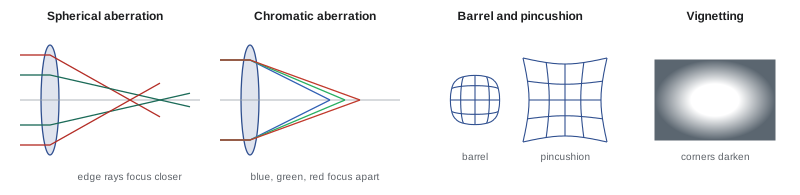
- Spherical aberration: rays through the edge of a spherical lens focus at a slightly different distance from rays through the centre, softening the image and lowering contrast, especially at wide apertures.
- Chromatic aberration: glass bends different wavelengths by different amounts. Longitudinal (axial) chromatic aberration focuses colours at different distances, causing coloured fringes in front of and behind the focus point, often purple and green. Lateral (transverse) chromatic aberration magnifies colours slightly differently, causing coloured fringes toward the edges of the frame.
- Coma: off-axis points of light spread into comet-shaped smears, especially visible in night skies and city lights near the corners.
- Astigmatism: off-axis lines in different orientations focus at different distances.
- Field curvature: the plane of sharpest focus is curved, so that the centre and edges of a flat subject cannot both be perfectly sharp.
- Distortion: straight lines are rendered curved, bowing outward (barrel distortion, common in wide-angle and zoom lenses at the wide end) or inward (pincushion distortion, common at the telephoto end).
- Vignetting: the corners of the image are darker than the centre, from both optical and mechanical causes.
Special glass types, such as extra-low dispersion (ED) and fluorite elements, reduce chromatic aberration; aspherical elements reduce spherical aberration and distortion while allowing smaller lenses. Stopping down reduces many aberrations, which is why lenses usually become sharper as the aperture closes from its widest setting.
Diffraction
When light passes through a small aperture, it spreads slightly, a wave effect called diffraction. A point of light becomes a small disc of blur, the Airy disc, whose diameter grows in proportion to the f-number: roughly 1.3 times the f-number in micrometres for green light. At f/4 the disc is about 5 µm across, comparable to the pixels of many sensors; at f/16 it is about 21 µm, covering several pixels of a high-resolution sensor and visibly softening fine detail. Diffraction affects every lens equally at a given f-number, regardless of quality. Higher-resolution sensors with smaller pixels show diffraction softening at wider apertures, though their images remain at least as detailed as lower-resolution sensors at the same aperture.
The sharpness sweet spot
Because aberrations decrease as a lens is stopped down while diffraction increases, most lenses reach their peak sharpness at an intermediate aperture, the sweet spot, typically about two to three stops below maximum aperture: around f/4 to f/8 on full frame. Corners often improve later than the centre. Modern high-quality lenses may be excellent even wide open, while older or inexpensive lenses may need more stopping down. The sweet spot is a guide, not a rule: landscape photographers often stop down to f/11 or f/16 for depth of field, accepting some diffraction, or use focus stacking (Lesson 7) to combine depth with sharpness.
Worked problem
Choosing an aperture for a landscape
A photographer with a 45-megapixel full-frame camera (4.4 µm pixels) wants maximum detail across a landscape from 3 m to infinity with a 24 mm lens. The lens is sharpest at f/5.6, but depth of field calculations suggest f/11 is needed. What are the options?
Show solution
- At f/11, the Airy disc is about 1.3 × 11 ≈ 14 µm, roughly three pixels across, causing slight softening at the pixel level.
- Option 1: shoot at f/11 and accept slight diffraction softness, partly recoverable with sharpening; prints at moderate sizes will look sharp.
- Option 2: shoot at f/5.6 and focus-stack several frames at different focus distances for maximum sharpness throughout.
- Option 3: use a tilt lens to align the plane of focus with the ground (Lesson 6).
Answer: f/11 is a reasonable compromise; focus stacking at f/5.6 or a tilt lens gives the best detail when the subject is static.
Reading MTF charts
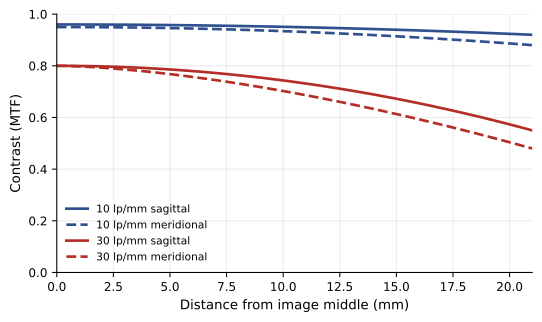
Manufacturers and testers describe lens sharpness with modulation transfer function (MTF) charts, which show how much of a pattern's contrast the lens preserves at a given fineness of detail, from the centre of the image to the corners. A typical chart plots contrast (0 to 1) on the vertical axis against distance from the centre in millimetres, with curves for coarse detail (often 10 line pairs per millimetre, indicating contrast) and fine detail (30 or more line pairs per millimetre, indicating resolution), and separate solid and dashed curves for sagittal and meridional orientations. Higher curves are better, flat curves indicate consistent performance across the frame, and close sagittal and meridional curves indicate smooth out-of-focus rendering and little astigmatism. Manufacturers' charts are usually calculated from the design, not measured, so independent measured MTF results are more reliable for comparisons.
Flare, ghosts and coatings
Light that reflects between lens surfaces rather than passing straight through causes flare, a veiling haze that lowers contrast, and ghosts, coloured shapes often mirroring the aperture. Each uncoated glass surface reflects about 4 % of light, so a lens with 20 surfaces would lose much of its contrast. Multi-layer anti-reflection coatings, and modern nano-structured coatings, cut reflections to a fraction of a percent per surface. Lens hoods block stray light from outside the frame and should be used routinely. Some photographers deliberately use vintage or uncoated lenses for their flare and lower contrast, a reminder that "optical quality" depends on the photographer's intentions.
Bokeh
Bokeh describes the quality of out-of-focus areas: whether backgrounds melt smoothly or appear busy and harsh, and whether out-of-focus points of light are smooth discs or have bright edges, onion-ring textures from aspherical elements, or cat's-eye shapes toward the edges of the frame from vignetting. Bokeh depends on the lens design, particularly its spherical aberration correction, the shape and number of aperture blades (rounded blades keep out-of-focus highlights circular when stopped down), and any special elements such as apodization filters, which soften the edges of out-of-focus discs. Bokeh is subjective; portrait photographers often prize smooth bokeh, while others enjoy the swirling character of certain vintage designs.
Corrections in camera and software
Modern systems correct many aberrations digitally. Lens profiles, stored in the camera or raw processor, describe each lens's distortion, vignetting and lateral chromatic aberration, which are then corrected automatically. Some recent lenses are designed with substantial uncorrected distortion, especially compact wide-angle lenses for mirrorless cameras, relying on software correction to produce straight lines, which slightly reduces corner resolution. Longitudinal chromatic aberration and coma cannot be fully corrected in software. Digital correction makes smaller, lighter and cheaper lenses possible, and for most photography the results are excellent; for critical work, test how much corner detail is lost after correction.
| Aberration | Visible effect | Reduced by |
|---|---|---|
| Spherical | Soft, low-contrast images wide open | Stopping down, aspherical elements |
| Longitudinal chromatic | Purple and green fringes near focus | Stopping down, ED glass |
| Lateral chromatic | Colour fringes toward corners | ED glass, software correction |
| Coma | Comet-shaped points in corners | Stopping down, lens design |
| Distortion | Curved straight lines | Lens design, software correction |
| Vignetting | Dark corners | Stopping down, software correction |
A practical lens test
Published MTF charts and reviews describe typical performance, but a simple test reveals how your own copy performs. Mount the camera on a sturdy tripod facing a flat, detailed subject such as a brick wall, a newspaper taped to a wall or a printed test chart, with the sensor exactly parallel to the subject. Use a remote release or self-timer, electronic or electronic first-curtain shutter, base ISO, and careful focus with magnified live view at the centre. Photograph the subject at every full stop from wide open to f/16 or f/22, then compare the centre, the edges and all four corners at 100 % magnification. Most lenses improve from wide open to about two stops down in the corners, then lose sharpness gradually from diffraction. Comparing the corners also reveals decentring: if one side is consistently softer at every aperture, the lens may need service. Repeat the test at several focal lengths for zooms and at distances similar to your real subjects, since some lenses are optimized for close or distant focus.
Worked problem
Finding the best aperture from a test
A photographer tests a 24–70 mm lens at 24 mm on a 45-megapixel full-frame camera. At f/2.8 the centre is sharp but the corners are soft; at f/5.6 corners are much better; at f/8 corners are at their best and the centre is unchanged; at f/16 the whole image is visibly softer. Which aperture should be used for a landscape where corner detail matters?
Show solution
- Corners improve as the lens is stopped down, reaching their best at f/8.
- Diffraction softens the whole frame by f/16 on this high-resolution sensor.
- If more depth of field is needed, f/11 is a reasonable compromise; beyond that, consider focus stacking.
Answer: f/8 for the best overall sharpness, f/11 if more depth of field is essential, and focus stacking rather than f/16 or smaller.
Field curvature and focus shift
Two aberrations deserve special attention because they can mislead tests and real photographs. Field curvature means that the plane of sharpest focus is curved rather than flat, so a flat subject cannot be sharp at the centre and edges simultaneously; the corners appear soft in a test chart but may be sharp when focused separately. For three-dimensional subjects such as landscapes, field curvature may matter less, or even help, depending on the scene. Focus shift occurs in some fast lenses when spherical aberration causes the plane of best focus to move as the lens is stopped down. If the camera focuses wide open and then stops down to take the picture, the sharpest plane may move slightly behind the focus point. Focusing at the working aperture, which mirrorless cameras can do, avoids the problem.
Lens rendering and character
Optical quality is not only about sharpness and the absence of aberrations. Lenses also differ in their rendering, the overall look created by contrast, micro-contrast, colour, the transition from focus to blur, and how they handle flare and highlights. Older lens designs, with fewer elements and simpler coatings, often produce lower contrast, warmer colour and more distinctive flare, and some photographers and filmmakers deliberately choose vintage lenses for their character, adapting them to modern mirrorless bodies. Modern lenses with aspherical and extra-low-dispersion elements produce very sharp, clean images that some find clinical. There is no single best rendering; the right choice depends on the subject and intended look, and testing lenses on real subjects reveals character in a way that charts cannot.
Filters and image quality
Filters placed in front of a lens become part of the optical system. A high-quality filter with good coatings has little effect on sharpness, but cheap filters can reduce contrast, add flare and ghosting, and soften the image, especially with high-resolution sensors and telephoto lenses. Protective clear filters guard the front element from scratches and spray but add two extra glass surfaces; many photographers use a lens hood for protection instead and fit a filter only in harsh conditions such as sea spray or sand. Polarizing, neutral density and graduated filters change the image in ways that cannot be fully reproduced in software and are covered in PHOT-330. Strong neutral density filters may introduce a colour cast and infrared contamination, which can be corrected in processing or with filters designed to block infrared.
Common mistakes
MistakeAlways shooting at the smallest aperture for maximum depth.
InsteadBalance depth of field against diffraction.
MistakeAssuming wide open is always softest and stopped down always sharper.
InsteadTest your lenses to find their sweet spots.
MistakeComparing manufacturers' calculated MTF charts directly.
InsteadPrefer independent measured results.
MistakeLeaving the lens hood off.
InsteadUse hoods to reduce flare and protect the lens.
MistakeIgnoring software corrections in lens reviews.
InsteadCheck corrected results, including corner detail.
Summary and key terms
- Lenses use many elements to balance aberrations, size and cost.
- Aberrations include spherical, chromatic, coma, astigmatism, field curvature, distortion and vignetting.
- Diffraction blur grows with f-number and limits sharpness at small apertures.
- Most lenses are sharpest two to three stops below maximum aperture.
- MTF charts show contrast across the frame at coarse and fine detail.
- Coatings and hoods reduce flare; bokeh depends on design and aperture blades.
- Software corrects distortion, vignetting and lateral CA, enabling smaller lenses.
- Aberration
- Departure from perfect imaging.
- Spherical aberration
- Edge and centre rays focusing differently.
- Chromatic aberration
- Colours focusing differently.
- Coma
- Comet-shaped off-axis blur.
- Field curvature
- Curved plane of sharpest focus.
- Distortion
- Curving of straight lines.
- Diffraction
- Spreading of light at an aperture.
- Sweet spot
- Aperture of maximum sharpness.
- MTF chart
- Graph of lens contrast across the frame.
- Bokeh
- Quality of out-of-focus areas.
Practice problems
Work each problem on paper first, then reveal the answer to check.
Why do lenses contain many elements?
Show answer
To cancel aberrations.
What causes purple and green fringes near focus?
Show answer
Longitudinal chromatic aberration.
Which distortion is common in wide-angle lenses?
Show answer
Barrel distortion.
Approximate Airy disc diameter at f/8?
Show answer
About 10 µm.
Where is the typical sharpness sweet spot?
Show answer
Two to three stops below maximum aperture.
What do the 10 lp/mm curves on an MTF chart indicate?
Show answer
Contrast.
What do close sagittal and meridional curves suggest?
Show answer
Little astigmatism and smooth rendering.
How much light does an uncoated surface reflect?
Show answer
About 4 %.
What keeps out-of-focus highlights round when stopped down?
Show answer
Rounded aperture blades.
Which aberrations are easily corrected in software?
Show answer
Distortion, vignetting and lateral chromatic aberration.
Lesson quiz · 5 questions
Score 60% or more to complete this lesson.
Create a free account to save your progress, take quizzes and earn a certificate.