
PHOT-201 · Lesson 3 of 12 · 31 min
Dynamic range, ISO and noise in practice
Two questions dominate discussions of sensor quality: how much contrast can the camera capture, and how clean are its images in low light? Both depend on the same underlying quantities, full-well capacity, read noise and the amount of light collected, and both are shaped by how the photographer exposes and sets ISO. This lesson explains dynamic range and how it is measured, what ISO really does on a digital camera, the idea of ISO invariance, how to expose for maximum image quality, how noise reduction works, and how to interpret published sensor measurements.
What dynamic range means
Dynamic range is the ratio between the brightest and darkest tones a system can record with useful quality. Photographers measure it in stops, each stop a doubling of light. A sunlit scene with deep shade can span 12 to 15 stops or more; a sunset with the sun in frame far more. When a scene's contrast exceeds the camera's dynamic range, the photographer must choose what to sacrifice: let highlights clip to white, let shadows sink into noise, or use techniques such as graduated filters, fill light or exposure blending (HDR) to compress the scene's range.
For a sensor, the engineering dynamic range is the ratio of the full-well capacity to the read noise, expressed in stops:
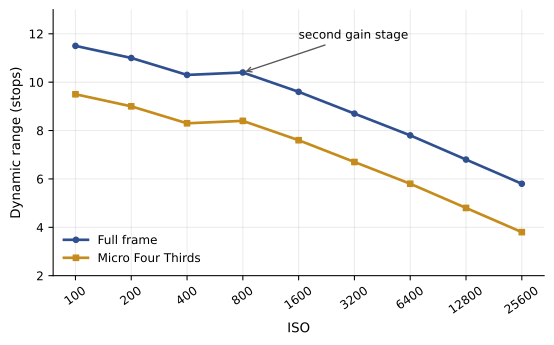
A sensor with a 50,000-electron full well and 3 electrons of read noise has an engineering dynamic range of \(\log_2(50{,}000/3) \approx 14\) stops. In practice, the darkest of those stops are too noisy to use, so measurements of usable dynamic range set a threshold for acceptable noise. A widely cited measure, photographic dynamic range, as published by the site Photons to Photos, uses a threshold based on what is acceptable in a print of a standard size, and typically reports about two to three stops less than the engineering figure: around 11 to 12 stops for good full-frame sensors at base ISO.
What ISO really does
On a digital camera, the sensor's ability to convert light into electrons does not change with ISO. What changes is the amplification applied to the signal before or after digitizing, and the brightness the camera assigns to the result. Raising ISO from 100 to 800 tells the camera to expect three stops less light and to amplify the signal eight times so that the image looks correctly bright. Since less light reaches the sensor, the image contains more shot noise relative to signal, regardless of the amplification. This is the crucial point: the noise in high-ISO images comes mainly from the reduced light, not from the ISO setting itself.
ISO does have effects of its own. Amplifying the signal early, before the ADC, can make the noise added by later electronics relatively smaller, improving shadows at high ISO in some cameras. Many sensors switch to a high conversion gain at a certain ISO, often called a second native ISO, which noticeably reduces read noise. And because amplification multiplies the signal, every doubling of ISO halves the maximum light the sensor can record before the output clips, reducing highlight headroom by one stop. This is why dynamic range falls as ISO rises.
ISO invariance
In many modern sensors, the electronics after the amplifier add very little noise. In such cameras, an image taken at ISO 100 and brightened by three stops in raw processing looks almost the same as one taken at ISO 800 with the same aperture and shutter speed; the camera is said to be ISO invariant over that range. The underexposed ISO 100 image even retains three extra stops of highlight detail, because it was not amplified to the point of clipping. Other cameras are less invariant: their shadows are noisier when brightened in software than when amplified in the camera. Testing your own camera tells you which approach gives the best results.
Worked problem
Testing ISO invariance
Design a simple test to find out whether your camera is ISO invariant between ISO 100 and ISO 1600.
Show solution
- Set the camera on a tripod and photograph a scene with deep shadows and some bright areas at a fixed aperture and shutter speed that is correctly exposed at ISO 1600.
- Take a second frame at ISO 100 with the same aperture and shutter speed, four stops underexposed.
- In raw processing, brighten the ISO 100 frame by +4 EV and compare shadows with the ISO 1600 frame at the same magnification.
- If they look nearly identical, the camera is invariant over this range, and the ISO 100 frame has kept four more stops of highlight detail.
Answer: Compare a correctly exposed high-ISO frame with an underexposed base-ISO frame brightened in software; similar shadows mean ISO invariance.
Exposing for image quality
For the cleanest images, give the sensor as much light as possible without clipping important highlights, then adjust brightness in processing. When shooting raw, this approach, often called exposing to the right because it pushes the histogram toward the right edge, maximizes signal-to-noise ratio in the shadows and midtones. It has limits. Camera histograms and highlight warnings are based on the processed JPEG preview, which typically clips before the raw data does, so a little more exposure may be safe than the camera suggests; testing your camera shows how much. Exposing to the right also requires a slower shutter speed or wider aperture, which may not be possible with moving subjects or when depth of field is needed. And it makes the camera's preview look too bright, which can mislead clients watching over your shoulder.
When light is limited and shutter speed and aperture are fixed by the subject, there is no way to collect more light; the choice is then between raising ISO in the camera or underexposing at a lower ISO and brightening later. With an ISO-invariant camera, the two give similar noise, and the lower ISO protects highlights. With a less invariant camera, raising ISO usually gives cleaner shadows. Either way, the image quality is ultimately limited by the light available.
| Situation | Priority | Practical approach |
|---|---|---|
| Landscape on a tripod | Maximum quality | Base ISO, expose to the right, bracket if contrast exceeds range |
| Sports indoors | Freeze motion | Fast shutter, widest practical aperture, raise ISO; accept noise |
| Concert with bright spotlights | Protect highlights | Expose for highlights; lift shadows in processing |
| Night street, handheld | Usable shutter speed | Stabilization, wide aperture, raise ISO as needed |
| High-contrast interior | Hold windows and shadows | Bracket and blend, or add light |
Kinds of noise
Noise appears in different forms. Luminance noise is a fine, grain-like variation in brightness, often acceptable and sometimes pleasing. Chroma noise is blotchy coloured speckling, usually objectionable and easily reduced in processing. Pattern noise, such as banding or a fixed texture, comes from the sensor's electronics and is very visible because the eye detects regular patterns easily; it appears most in deeply lifted shadows. Long exposures add thermal noise and hot pixels, which many cameras reduce with long-exposure noise reduction, taking a second dark frame of the same duration with the shutter closed and subtracting it.
Noise reduction
Noise reduction smooths random variation while trying to preserve detail. Traditional methods average neighbouring pixels in flat areas while protecting edges, trading noise for some loss of fine texture; heavy use gives a waxy, plastic look. Machine-learning noise reduction, now built into major raw processors, uses neural networks trained on pairs of noisy and clean images, and can remove much more noise while retaining detail, effectively gaining one or two stops of usable ISO. It works best on raw files, before other processing, and can occasionally invent texture, so check results at 100 %. Another approach, used in astrophotography and by smartphones, is stacking: averaging several frames of the same scene reduces random noise by the square root of the number of frames, so averaging 16 frames reduces noise by a factor of 4, equivalent to two stops.
Worked problem
Stacking to reduce noise
A night landscape photographer is limited to a 15-second exposure at ISO 3200 to avoid star trails. How many frames must be stacked to match the noise of a single frame at ISO 800?
Show solution
- ISO 800 versus 3200 is two stops: four times as much light per frame.
- Stacking \(n\) frames multiplies total light by \(n\) and reduces noise by \(\sqrt{n}\).
- To match four times the light, stack 4 frames, reducing noise by a factor of 2, equivalent to two stops.
Answer: Four frames aligned and averaged give noise similar to a single frame with four times the light.
Interpreting sensor measurements
Several independent sources publish sensor measurements, such as dynamic range and read noise curves across ISO settings. These are useful for comparing cameras on equal terms, but they should be read carefully. Differences of a third of a stop are rarely visible in practice. Results are usually normalized to a standard output size, which reflects real use better than per-pixel measurements. Raw processors and noise reduction affect real-world results. And sensor performance is only one factor: autofocus, lenses, handling and reliability may matter more to your photographs. A difference of a full stop or more in dynamic range, however, is significant for high-contrast landscape and architectural work.
Expose to the right, carefully
A long-standing technique for maximizing image quality in raw files is to expose to the right (ETTR): giving as much exposure as possible without clipping important highlights, so that the histogram sits toward its right edge, then reducing brightness in processing. Because shot noise grows only with the square root of the signal, more light always means a better signal-to-noise ratio, and shadows that received more light need less brightening later. ETTR works best in static scenes at base ISO, such as landscapes, where there is time to check the histogram and blinkies. It is less useful when the scene contains bright light sources that will clip anyway, when highlight detail matters more than shadow noise, or when shooting fast-moving subjects where a consistent exposure saves editing time. Because camera histograms are based on the JPEG preview, photographers who use ETTR test how much hidden highlight headroom their camera's raw files have.
Worked problem
Applying ETTR to a landscape
A photographer meters a landscape at 1/125 s, f/11, ISO 100. The histogram shows the brightest clouds about 1⅓ stops below clipping. From experience, the raw file holds about ½ stop beyond the camera's highlight warning. How much can exposure be increased?
Show solution
- Available room before the histogram edge: 1⅓ stops.
- Leave a margin and ignore hidden headroom for safety: increase by 1 stop.
- New exposure: 1/60 s, f/11, ISO 100.
- In processing, reduce exposure by about 1 stop to restore the intended brightness.
Answer: About 1 stop more exposure, to 1/60 s, then darken in processing for cleaner shadows.
Dual-gain and dual native ISO
Many recent sensors use dual conversion gain: each photosite can be read with two different gain circuits. At low ISO settings, a low-gain mode preserves the full capacity of the well and the maximum dynamic range. At higher ISO settings, the camera switches to a high-gain mode that reduces read noise substantially, improving shadow quality when little light is available. The switch usually happens at a specific ISO, such as 400, 640 or 800 depending on the camera, and measurements show a sudden drop in read noise at that point. Video-oriented cameras often describe this as dual native ISO. For photographers, the practical consequence is that the noise at, say, ISO 800 may be little worse than at ISO 500, so knowing where your camera switches helps you choose ISO in low light.
Comparing cameras fairly
Noise and dynamic range comparisons between cameras are only meaningful when the images are compared at the same output size. A 60-megapixel image viewed at 100 % on screen shows each pixel much larger than a 24-megapixel image viewed at 100 %, so it appears noisier even if the sensors collect the same total light. Reducing both to the same print or screen size averages the extra pixels and usually shows similar noise for sensors of the same size and generation. Independent tests that normalize results to a standard output size, such as measurements of photographic dynamic range or print-normalized signal-to-noise, give fairer comparisons than per-pixel viewing.
High ISO in practice
Modern full-frame cameras produce usable images at ISO 6400 and beyond, but practical limits depend on the subject, output size and audience. Noise is more acceptable in documentary, event and sports images, where moment and content dominate, than in commercial product images, where clean surfaces matter. Small images for social media hide noise that a large print would reveal. Underexposure makes noise much worse, so at high ISO it is better to expose correctly, accepting a slightly slower shutter speed if possible, than to underexpose and brighten. Modern AI-based noise reduction in raw processing software can recover remarkably clean images from high-ISO files, effectively gaining one to two stops of usable ISO, though it can also invent detail or smooth fine textures, so results should be inspected at full size before delivery.
Fixed pattern noise and banding
Besides random noise, some sensors show fixed pattern noise: horizontal or vertical lines, banding, or an uneven tint that remains in the same place in every image. It usually appears only when deep shadows are brightened strongly, in long exposures, or at high temperatures. Banding is a sign that the shadows have been pushed beyond what the sensor can deliver, and the remedy is more exposure rather than more processing. Flat-field and dark-frame corrections, used in astrophotography, can reduce fixed patterns because they are repeatable.
Common mistakes
MistakeBelieving ISO itself causes noise.
InsteadNoise mainly comes from less light reaching the sensor.
MistakeTrusting the JPEG histogram exactly when shooting raw.
InsteadTest how much raw headroom remains beyond the warning.
MistakeRaising ISO to protect highlights.
InsteadHigher ISO reduces highlight headroom.
MistakeOverusing noise reduction.
InsteadApply it moderately and check at 100 %.
MistakeChoosing cameras on tiny measured differences.
InsteadConsider differences of a stop or more meaningful.
Summary and key terms
- Dynamic range is the span from brightest to darkest usable tones, in stops.
- Engineering DR = log₂(full well / read noise); usable DR is lower.
- ISO changes amplification and brightness, not the sensor's sensitivity.
- Noise at high ISO comes mainly from reduced light.
- ISO-invariant cameras allow underexposure at low ISO with little penalty.
- Expose to the right for raw quality when the subject allows.
- Machine-learning noise reduction and stacking extend usable ISO.
- Dynamic range
- Ratio of brightest to darkest usable tones.
- Stop
- A doubling or halving of light.
- Photographic dynamic range
- Usable DR measured at a print-based noise threshold.
- Conversion gain
- Volts per electron in a photosite.
- Second native ISO
- ISO at which a sensor switches to high gain.
- ISO invariance
- Similar noise whether amplified in camera or software.
- Expose to the right
- Maximizing exposure without clipping highlights.
- Chroma noise
- Coloured speckle noise.
- Pattern noise
- Fixed or banded noise structure.
- Stacking
- Averaging multiple frames to reduce noise.
Practice problems
Work each problem on paper first, then reveal the answer to check.
Engineering DR for 40,000 e⁻ full well and 2.5 e⁻ read noise?
Show answer
log₂ 16,000 ≈ 14 stops.
Why is usable DR lower than engineering DR?
Show answer
The darkest stops are too noisy.
What does raising ISO do to highlight headroom?
Show answer
Reduces it by one stop per doubling.
Where does most high-ISO noise come from?
Show answer
Less light reaching the sensor.
What is a second native ISO?
Show answer
An ISO where the sensor switches to lower-noise high gain.
How do you test ISO invariance?
Show answer
Compare a high-ISO frame with a brightened underexposed base-ISO frame.
Why may raw headroom exceed the JPEG warning?
Show answer
The histogram is based on the processed JPEG.
Which noise type is most objectionable?
Show answer
Chroma or pattern noise.
Noise reduction from stacking 9 frames?
Show answer
Factor of 3 (about 1.6 stops).
What measured DR difference is meaningful?
Show answer
About a stop or more.
Lesson quiz · 5 questions
Score 60% or more to complete this lesson.
Create a free account to save your progress, take quizzes and earn a certificate.