
PHOT-201 · Lesson 1 of 12 · 26 min
Camera systems today
PHOT-101 treated the camera as a box with controls: aperture, shutter speed, ISO and focus. This course opens the box. It explains how sensors turn light into data, why some cameras handle shadows and highlights better than others, what makes a lens sharp or soft, how autofocus systems find and track subjects, how shutters and stabilization work, what happens inside the processor and raw file, and how to judge the specifications and reviews that surround every new camera. Understanding the technology makes you a better photographer: you can choose equipment that suits your work rather than marketing, predict how a camera will behave in difficult light, get the best from what you own, and explain your choices to clients and collaborators. This first lesson surveys the kinds of camera systems in use today and introduces the idea of choosing a system rather than a single camera.
What a camera system is
A camera body is only part of a photographic system. The lens mount ties the body to a family of lenses, from the manufacturer and from third-party makers, and lenses usually outlast several bodies. Around the mount grows an ecosystem of flashes and wireless triggers, batteries and grips, software for raw processing and tethering, repair services, rental availability and a used market. Once a photographer has invested in lenses for a mount, switching systems is expensive, so the most important decision is often the mount rather than the body. Many professionals think in terms of systems: a main body, a backup body that shares batteries and controls, a set of lenses covering their usual work, lighting that integrates with the bodies, and a workflow that handles the files.
Single-lens reflex cameras
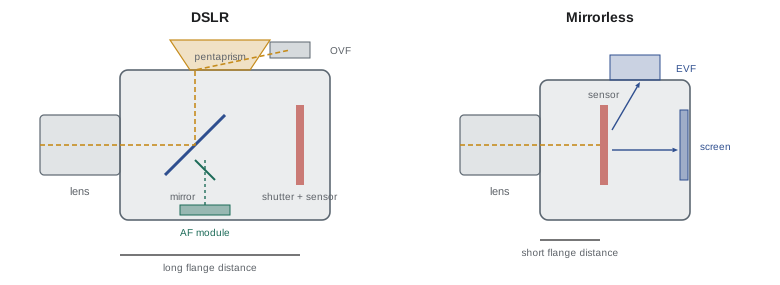
For about half a century, the single-lens reflex (SLR) design, and from the late 1990s its digital form, the DSLR, dominated serious photography. A mirror behind the lens reflects light up into a pentaprism and optical viewfinder, so the photographer sees exactly what the lens sees. When the shutter is pressed, the mirror flips up, the shutter opens, and light reaches the film or sensor. A separate phase-detection autofocus module below the mirror and a metering sensor in the viewfinder housing provide fast focus and exposure measurement. DSLRs offer optical viewfinders with no lag and long battery life, and huge lens catalogues remain usable. Their mechanical complexity, mirror vibration, limited autofocus coverage and the difficulty of using the viewfinder for video led manufacturers to shift to mirrorless designs, and Canon and Nikon have largely stopped developing new DSLRs.
Mirrorless cameras
Mirrorless interchangeable-lens cameras remove the mirror and optical viewfinder. The sensor is exposed to the lens continuously and feeds an electronic viewfinder (EVF) and rear screen, which show a live preview of exposure, white balance and depth of field. Autofocus happens on the sensor itself, covering almost the entire frame, and subject-recognition algorithms can find eyes, faces, animals and vehicles. Without a mirror box, the lens mount can sit closer to the sensor, giving lens designers more freedom and allowing lenses from other systems to be adapted. Since the late 2010s, mirrorless cameras from Sony, Canon, Nikon, Fujifilm, Panasonic, OM System, Leica and others have become the mainstream choice for both stills and video.
Medium format and large format
Medium format digital cameras use sensors larger than full frame, commonly about 44 × 33 mm in cameras such as Fujifilm's GFX and Hasselblad's X series, and larger still in high-end backs from Phase One. Larger sensors collect more light in total, can deliver very high resolution, often 100 megapixels or more, and render depth of field and perspective in a way many photographers value for landscape, fashion, product and fine art work. They are larger, slower and more expensive, with smaller lens ranges. Large-format film cameras, using sheets of 4 × 5 inches or larger, remain in use for fine art and architectural work, where their movements for controlling perspective and focus plane are valued (Lesson 6 covers tilt-shift lenses that provide similar control on smaller formats).
Compacts, specialist cameras and smartphones
Other categories serve specific needs. Premium compact cameras with large sensors and fixed lenses offer portability with high image quality. Bridge and travel-zoom cameras offer long zoom ranges with small sensors. Action cameras are rugged, waterproof and wide-angle. Drone cameras capture aerial images (PHOT-350). Rangefinder cameras, notably Leica's M system, use a separate optical viewfinder with a coupled rangefinder for manual focus, valued in street and documentary photography. Smartphones are now the most widely used cameras of all. Their tiny sensors and lenses would produce mediocre images on their own, but computational photography, combining many frames, recognizing scenes and processing aggressively, delivers remarkable results in many situations (Lesson 10 and PHOT-420).
| Category | Typical sensor | Strengths | Limitations |
|---|---|---|---|
| Smartphone | About 1/1.3 to 1 inch for main cameras | Always with you, computational processing, connectivity | Small sensor, limited lenses and control |
| Premium compact | 1 inch to APS-C, some full frame | Pocketable, high quality, quiet | Fixed lens, small batteries |
| Mirrorless, APS-C and MFT | About 23.5 × 15.6 mm or 17.3 × 13 mm | Compact systems, lower cost, long telephoto reach | Less light per frame than full frame at the same f-number |
| Mirrorless, full frame | 36 × 24 mm | Image quality, autofocus, lens choice | Size and cost of lenses |
| DSLR | APS-C or full frame | Optical viewfinder, battery life, used bargains | Limited development, older autofocus |
| Medium format | About 44 × 33 mm and larger | Resolution, tonality, rendering | Cost, size, slower handling |
The image chain
Whatever the category, every digital camera follows the same chain. The lens forms an image; filters in front of the sensor block infrared light and, in many cameras, slightly blur fine detail to prevent moiré; the sensor converts light into electrical charge in each pixel; analogue-to-digital converters turn charges into numbers; the processor interpolates colour, applies white balance, tone curves, noise reduction and sharpening, or leaves the data raw; and the file is written to a memory card. Each link can limit the final image, and much of this course is about understanding where those limits lie. A superb sensor behind a poor lens, or a superb lens with careless focusing, produces poor images.
Specifications and what they really mean
Camera marketing emphasizes numbers: megapixels, maximum ISO, frames per second, autofocus points, stops of stabilization and dynamic range. Each number is meaningful but incomplete. Megapixels describe resolution potential, which only matters if lenses, technique and output size can use it. Maximum ISO says little about how clean images are at useful settings. Frames per second may apply only with an electronic shutter or reduced autofocus. Stabilization ratings are measured under standard conditions that may not match your hands and lenses. Throughout the course, we will look at how to interpret these figures and where independent measurements, such as sensor data published by testing sites, and your own tests give a truer picture.
Worked problem
Reading a specification critically
A camera advertises "40 fps continuous shooting" and "ISO 100–102,400". What questions should a sports photographer ask before relying on these figures?
Show solution
- Is 40 fps available with the mechanical shutter, or only the electronic shutter, and does the electronic shutter cause rolling-shutter distortion of fast subjects (Lesson 8)?
- Does autofocus track continuously at 40 fps, or is focus fixed on the first frame?
- How many raw frames fit in the buffer before the camera slows, and how fast does the buffer clear to the card?
- Is the image usable at ISO 6400 to 12,800, the range sports photographers actually use indoors, regardless of the maximum?
Answer: Check shutter type and distortion, autofocus behaviour, buffer depth and real-world noise at working ISOs, not just the headline numbers.
Technology and photography
Technology serves photography, not the other way round. Many celebrated photographs were made with cameras that would seem primitive today, and every camera made in the last decade is capable of excellent work in skilled hands. The value of understanding technology lies in removing obstacles: knowing when a camera's limits are affecting your images, which upgrade would actually help, and how to work around constraints. A photographer who understands dynamic range exposes more confidently; one who understands autofocus sets up the camera to track subjects reliably; one who understands lenses chooses apertures for maximum sharpness or deliberate character. The goal of this course is that kind of informed control.
A short history of the digital camera
The first digital camera prototype was built at Eastman Kodak in 1975 by engineer Steven Sasson. It weighed about 3.6 kg, recorded 0.01-megapixel black-and-white images to a cassette tape, and took about 23 seconds to record each picture. Through the 1980s and early 1990s, electronic still cameras appeared in professional niches, and in 1991 Kodak fitted a 1.3-megapixel sensor to a Nikon F3 body to create the DCS 100, aimed at news photographers. Consumer digital cameras arrived in the mid-1990s, and by the early 2000s, affordable digital SLRs such as the Canon EOS D30 (2000), Nikon D100 (2002) and Canon EOS 300D (2003) had begun to replace film for enthusiasts and professionals. Full-frame sensors reached the market with the Contax N Digital (2002) and the Canon EOS-1Ds (2002), and live view, video recording and high-ISO performance improved rapidly through the 2000s.
Mirrorless interchangeable-lens cameras began with the Panasonic Lumix G1 in 2008, using the Micro Four Thirds system developed with Olympus. Sony's full-frame a7 series, launched in 2013, showed that mirrorless designs could match and surpass DSLRs in image quality, and Canon and Nikon introduced full-frame mirrorless systems in 2018. By the early 2020s, both companies had stopped developing new DSLR bodies, and almost all new interchangeable-lens cameras were mirrorless. At the same time, smartphones replaced compact cameras for most casual photography, and global camera shipments fell from over 120 million units in 2010 to under 10 million a decade later, with the remaining market concentrated in interchangeable-lens cameras and premium compacts.
The main manufacturers and mounts
Understanding the landscape helps when choosing a system, because the lens mount determines which lenses, adapters and accessories are available. In full-frame mirrorless, the major systems include Canon RF, Nikon Z, Sony E, the L-Mount shared by Leica, Panasonic and Sigma, and Fujifilm's medium-format G mount sits above them. APS-C systems include Fujifilm X, Sony E (which shares a mount across APS-C and full frame), Canon RF-S and Nikon Z DX bodies. Micro Four Thirds, used by OM System and Panasonic, offers smaller bodies and lenses with a 2× crop factor. Medium-format digital systems from Fujifilm and Hasselblad use sensors of about 44 × 33 mm, and Phase One makes larger sensors for high-end commercial and technical cameras. Each system has strengths in lens range, size, autofocus, video features or colour rendering, and third-party lens makers such as Sigma, Tamron, Samyang, Viltrox and Tokina extend the choice, depending on how openly each manufacturer licenses its mount protocols.
Hybrid cameras and the convergence of stills and video
Modern interchangeable-lens cameras are increasingly hybrid tools, designed for both stills and video. Features once limited to cinema cameras, such as 10-bit log recording, raw video, waveform monitors, timecode and full-size HDMI outputs, appear on many stills-oriented bodies, while some manufacturers offer video-first models with fans for cooling and no viewfinder. For photographers, this convergence means more capable cameras and opportunities to offer video to clients, but also more complex menus, more heat and power concerns, and decisions about whether a single body can serve both roles. PHOT-440 covers video work for photographers, and the cinematography courses cover cinema cameras in depth.
Why technology knowledge matters to photographers
A photographer who understands camera technology can make better decisions in the field and at purchase. Knowing why a sensor produces noise explains why exposing well at low ISO matters more than raising ISO in post; knowing how autofocus systems work explains why one setting tracks a bird while another loses it; knowing how a shutter reads out explains distorted propellers and banding under LED lights. This knowledge also guards against marketing: higher megapixel counts, faster burst rates and new model numbers do not always translate into better photographs for a particular kind of work. The rest of this course works through each part of the image chain, from light entering the lens to a finished file, and ends with a method for choosing a system that suits your photography.
Common mistakes
MistakeChoosing a body without considering the lens system.
InsteadChoose a mount and ecosystem; lenses outlast bodies.
MistakeEquating megapixels with image quality.
InsteadConsider sensor size, lenses, technique and output.
MistakeTaking headline specifications at face value.
InsteadCheck the conditions behind each figure.
MistakeAssuming smartphones cannot produce professional results.
InsteadUnderstand their computational strengths and limits.
MistakeUpgrading equipment to fix technique problems.
InsteadIdentify the real limiting factor first.
Summary and key terms
- A camera system includes the mount, lenses, accessories, software and support.
- DSLRs use a mirror and optical viewfinder; mirrorless cameras use the sensor and an EVF.
- Mirrorless designs dominate new development for stills and video.
- Medium format offers resolution and rendering at a cost in size and speed.
- Compacts, rangefinders, action cameras and smartphones serve specific needs.
- Every camera follows the same image chain from lens to file.
- Specifications are meaningful but incomplete; test and interpret them.
- Camera system
- Body, mount, lenses and supporting ecosystem.
- Lens mount
- Interface between lens and body.
- DSLR
- Digital single-lens reflex camera.
- Pentaprism
- Prism directing the image to an optical viewfinder.
- Mirrorless camera
- Interchangeable-lens camera without a reflex mirror.
- EVF
- Electronic viewfinder.
- Medium format
- Sensors larger than full frame.
- Rangefinder
- Camera focusing with a coupled optical rangefinder.
- Computational photography
- Combining and processing frames by algorithm.
- Image chain
- Sequence from lens to file.
Practice problems
Work each problem on paper first, then reveal the answer to check.
Why is the mount often the most important choice?
Show answer
Lenses outlast bodies and switching systems is costly.
What does the reflex mirror do in a DSLR?
Show answer
Sends light to the optical viewfinder until the shutter fires.
Name two advantages of mirrorless cameras.
Show answer
Live exposure preview, wide on-sensor AF coverage, subject recognition, adaptability.
Name one advantage DSLRs retain.
Show answer
Lag-free optical viewfinder or long battery life.
Typical medium format digital sensor size?
Show answer
About 44 × 33 mm.
Who uses rangefinders and why?
Show answer
Street and documentary photographers, for discreet manual focus.
How do smartphones overcome tiny sensors?
Show answer
Computational photography combining many frames.
List the stages of the image chain.
Show answer
Lens, filters, sensor, ADC, processor, file.
What should you ask about a "40 fps" claim?
Show answer
Shutter type, AF tracking, buffer depth.
What is the value of understanding camera technology?
Show answer
Removing obstacles and making informed choices.
Lesson quiz · 5 questions
Score 60% or more to complete this lesson.
Create a free account to save your progress, take quizzes and earn a certificate.