
PET-450 · Lesson 8 of 12 · 16 min
Royalties, taxes and Canadian fiscal regimes
The placeholder royalty in Lesson 7 was a single percentage. The real calculation is more involved, and the company's tax and finance analyst, Farid Haddad, joins Ethan for a week to build it properly. “Governments take their share in three ways,” he explains: “royalties as the owner of the minerals, taxes on profit, and a set of rules on what you can deduct and when. The rules change the value of a well as much as a change in the oil price, and they change more often than people expect.” This lesson covers mineral ownership and royalties in Alberta, the Modernized Royalty Framework, Canadian income tax and its pools, and how they combine into the after-tax cash flow that companies use for investment decisions.
Who owns the minerals
In Alberta about four fifths of the mineral rights belong to the Crown, that is, to the province; the rest are freehold rights held by individuals, companies and rail and land companies that received them before the province took ownership. Companies acquire Crown rights at regular public sales of petroleum and natural gas leases and licences, paying a bonus bid and annual rentals, and pay the Crown a royalty on production. Freehold rights are leased privately, with a royalty rate negotiated in the lease, and the province charges a freehold mineral tax on production from them. Most of the Cardium wells at Tamarack Lake field are on Crown land.
Other provinces have their own systems. Saskatchewan and British Columbia, for example, set Crown royalties through their own formulas and incentive programs, and federal frontier lands have a separate regime. The principle is the same everywhere: the owner of the resource receives a share of its value, and the design of the royalty determines how that share changes with price, productivity and cost.
The Alberta Modernized Royalty Framework
Since January 1, 2017, new Alberta wells have paid Crown royalties under the Modernized Royalty Framework (MRF). It is designed to resemble a revenue-minus-cost royalty while being calculated simply from each well's revenue. Before payout, the well pays a flat 5 percent royalty until its cumulative revenue equals a drilling and completion cost allowance, called C*. C* is calculated from a formula based on the well's true vertical depth and lateral length, using industry-average costs and indexed each year, so it does not depend on what the particular company actually spent: a company that drills more cheaply than average keeps the benefit. After payout the royalty rate depends on price, rising with the oil price to a maximum of 40 percent, and once production declines below a maturity threshold the rate is reduced to help keep older wells economic.
Wells drilled before 2017 kept the earlier royalty formulas for ten years, and a sunset provision brings them into the framework from 2027, so the year-end 2026 evaluation must apply the new rules to the company's older wells from the start of the forecast. Royalties are paid on the Crown's share of production, in cash, and allowances for gas processing and gathering costs reduce the royalty on gas and liquids.
Worked problem
Payout under the Modernized Royalty Framework
A Phase 2 well has C* = 4.6 million dollars and earns 5.84 million dollars of revenue in its first year. The post-payout rate at the current price is 20.1 percent. Find the first-year royalty and the average rate, assuming revenue arrives evenly.
Show solution
- Revenue up to payout is 4.6 million, which pays 0.05 × 4.6 = 0.23 million.
- The remaining 5.84 − 4.6 = 1.24 million pays 0.201 × 1.24 = 0.25 million.
- The first-year royalty is 0.23 + 0.25 = 0.48 million, an average of 0.48 / 5.84 = 8.2 percent.
Answer: The well pays out within its first year; after that it pays the post-payout rate until it reaches the maturity threshold.
Income tax
Companies pay federal and provincial income tax on taxable income. The general federal corporate rate is 15 percent and the Alberta rate is 8 percent, for a combined rate of 23 percent. Taxable income is revenue less royalties, operating costs and deductions for capital, but capital is not deducted when it is spent. Instead it is added to tax pools that are deducted at prescribed rates. Canadian exploration expense (CEE), mainly exploration drilling and geophysics, is deductible at 100 percent. Canadian development expense (CDE), which includes most development drilling and completion costs, is deductible at 30 percent of the remaining pool each year. Canadian oil and gas property expense (COGPE), the cost of acquiring rights, is deductible at 10 percent. Equipment and facilities go into capital cost allowance Class 41 at 25 percent declining balance, normally with a half-year rule in the first year, although federal budgets have at times added accelerated first-year allowances.
The pool system means the timing of deductions matters more than their total. A well's 5.2 million dollar cost is eventually deducted in full, but 30 percent declining balance spreads the CDE deduction over many years, while the well's revenue is concentrated in the first few. The company can use deductions against income from all its wells, so a growing company with large pools may pay little tax for years, while a mature company with depleted pools pays the full rate. For project evaluation, Prairie Crest assumes that the deductions from a new well are used as they arise against other income.
From before-tax to after-tax value
# Royalties and income tax for the Phase 2 well: from before-tax to after-tax cash flow (illustrative terms).
import math
SI = True      # True: Alberta-style Crown royalty and Canadian tax pools, False: North Dakota fee lease and US federal tax
V1 = 10710.0 if SI else 134144.0                       # first-year oil of the P50 type well, m3 or bbl
Di, b, Dt = 1.6, 1.1, -math.log(1 - 0.08)
capex = 5.2e6 if SI else 7.0e6
price = 505.0 if SI else 59.0                          # dollars per m3 or bbl
fixed, var = (120000.0, 40.0) if SI else (120000.0, 7.0)
aband = 0.15e6 if SI else 0.20e6
rate = 0.10
t_sw = (Di / Dt - 1) / (b * Di)
shape = lambda t: (1 + b * Di * t) ** (-1 / b) if t <= t_sw else (1 + b * Di * t_sw) ** (-1 / b) * math.exp(-Dt * (t - t_sw))
yearly = lambda y, qi: sum(qi * shape(y + (k + 0.5) / 48) for k in range(48)) * 365.25 / 48
qi = V1 / yearly(0, 1.0)
if SI:
    cstar = 4.6e6                                      # drilling and completion cost allowance C* for this well (illustrative)
    bbl_price = price / 6.2898                         # Canadian dollars per bbl, for the price-sensitive rate
    post = min(0.40, max(0.10, 0.10 + (bbl_price - 55.0) / (130.0 - 55.0) * 0.30))   # illustrative post-C* oil rate
    tax_rate = 0.23                                    # federal 15 percent + Alberta 8 percent
    cde, c41 = 0.85 * capex, 0.15 * capex              # Canadian development expense and Class 41 equipment pools
else:
    roy_frac, sev = 0.1875, 0.10                       # 3/16 lessor royalty; ND gross production tax 5 % + extraction tax 5 %
    tax_rate = 0.21 + 0.03 * (1 - 0.21)                # federal 21 percent plus a small state tax, net of its federal deduction
bt, at = [-capex], []
cum_rev = 0.0; tot_rev = tot_roy = 0.0; deds0 = 0.0
if SI:
    d_cde = 0.30 * cde; cde -= d_cde; d41 = 0.125 * c41; c41 -= d41; deds0 = d_cde + d41   # half-year rule on Class 41
else:
    deds0 = capex                                      # 80 % IDC expensed + 20 % equipment with 100 % bonus depreciation
at.append(-capex + tax_rate * deds0)                   # deductions used against the company's other income
y = 0
while True:
    v = yearly(y, qi); rev = v * price * 1.08
    if SI:
        below = max(0.0, min(rev, cstar - cum_rev))    # revenue still inside the pre-payout window
        roy = 0.05 * below + post * (rev - below); cum_rev += rev
    else:
        roy = rev * roy_frac + rev * (1 - roy_frac) * sev
    ncf = rev - roy - fixed - var * v
    if ncf <= 0: break
    if SI:
        d_cde = 0.30 * cde; cde -= d_cde; d41 = 0.25 * c41; c41 -= d41; ded = d_cde + d41
        taxable = ncf - ded
    else:
        taxable = ncf
        taxable -= min(0.15 * (rev - roy), max(taxable, 0.0))   # percentage depletion, capped at the property's net income
    bt.append(ncf); at.append(ncf - tax_rate * taxable)
    tot_rev += rev; tot_roy += roy; y += 1
    if SI and y == 1: first_roy = roy / rev
bt[-1] -= aband; at[-1] -= aband * (1 - tax_rate)
npv = lambda c: c[0] + sum(x / (1 + rate) ** (t + 0.5) for t, x in enumerate(c[1:]))
print(f"life {len(bt) - 1} years; royalties and production taxes take {100 * tot_roy / tot_rev:.1f} percent of revenue")
if SI:
    print(f"5 percent royalty until revenue reaches C* = {cstar / 1e6:.1f} million (in the first year: {100 * first_roy:.1f} percent average)")
    print(f"post-payout rate {100 * post:.1f} percent at {bbl_price:.1f} Canadian dollars per bbl")
else:
    print(f"royalty 18.75 percent + 10 percent severance on the working-interest share = {100 * (roy_frac + (1 - roy_frac) * sev):.2f} percent")
print(f"before-tax NPV10 {npv(bt) / 1e6:.2f} million, after-tax NPV10 {npv(at) / 1e6:.2f} million (ratio {npv(at) / npv(bt):.2f})")
print(f"income tax rate {tax_rate:.1%}; undiscounted after-tax cash flow {sum(at) / 1e6:.2f} vs before-tax {sum(bt) / 1e6:.2f} million")
gov = tot_roy + (sum(bt) - sum(at))
print(f"government take (royalty, severance and income tax) {100 * gov / (sum(bt) + tot_roy):.0f} percent of undiscounted pre-royalty net cash flow")life 27 years; royalties and production taxes take 17.3 percent of revenue 5 percent royalty until revenue reaches C* = 4.6 million (in the first year: 8.2 percent average) post-payout rate 20.1 percent at 80.3 Canadian dollars per bbl before-tax NPV10 5.55 million, after-tax NPV10 4.08 million (ratio 0.74) income tax rate 23.0%; undiscounted after-tax cash flow 7.63 vs before-tax 9.91 million government take (royalty, severance and income tax) 46 percent of undiscounted pre-royalty net cash flow
With the proper Crown royalty, the well pays 5 percent until its cumulative revenue reaches C* in its first year, and about 20 percent afterward. Over its 27-year life royalties average 17.3 percent of revenue, more than the 12 percent placeholder, but because the low pre-payout rate applies to the most heavily weighted early revenue the before-tax NPV10 falls only from 6.15 to 5.55 million dollars. Income tax at 23 percent, with CDE and Class 41 deductions, lowers the NPV10 to 4.08 million, 74 percent of the before-tax value. Royalties and income taxes together take about 46 percent of the well's undiscounted pre-royalty net cash flow.
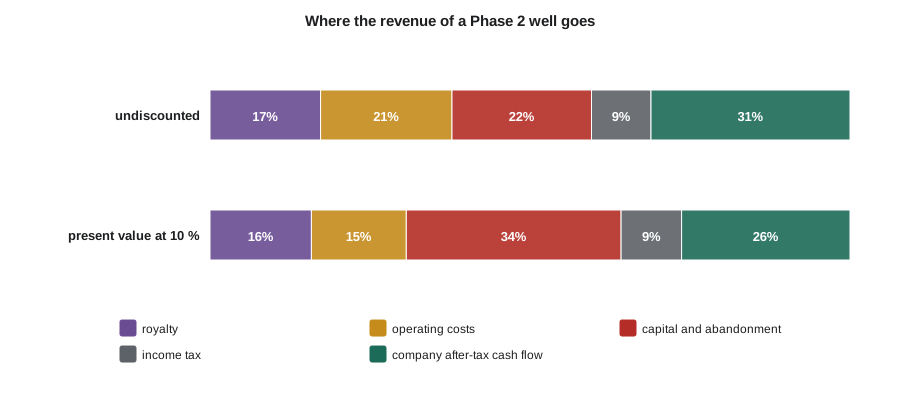
Government take and fiscal design
The share of a project's economic rent that goes to governments and mineral owners is called the government take. It is usually measured as the undiscounted sum of royalties, production taxes and income taxes divided by the project's pre-royalty net cash flow. Fiscal systems differ less in their average take than in how the take responds to price and profitability. A flat royalty on revenue, like a fee lease royalty or a severance tax, takes the same share whether the well is very profitable or marginal, so it can make marginal wells uneconomic and shortens their lives. A royalty that rises with price or profitability, like the post-payout MRF rate, takes more from the most profitable wells and less from marginal ones.
Investors compare fiscal systems by their effect on the value and the risk of projects, and governments adjust them to attract investment or capture more of a windfall. For the evaluator, the practical points are to apply the rules actually in force at the effective date, to read the lease and royalty records for each well rather than use averages, and to note in the report any changes that have been announced but not yet enacted. Royalty and tax rules have changed several times in both countries in the last decade, and a forecast that runs 30 years will see further changes that no one can predict.
Common mistakes
MistakeApplying the pre-payout or a flat royalty rate for the whole life of a well.
InsteadFollow the actual royalty formula, including payout, price sensitivity and maturity provisions.
MistakeTreating capital as deductible when spent in every jurisdiction.
InsteadUse the actual deduction rules: pools and declining balances in Canada, IDC, bonus depreciation and depletion in the United States.
MistakeUsing after-tax values for one project and before-tax values for another.
InsteadCompare projects on the same basis; companies normally decide on after-tax values.
MistakeAssuming royalty and tax rules stay fixed for decades.
InsteadUse the rules in force and test the sensitivity of value to plausible changes.
Summary and key terms
- In Alberta most mineral rights are Crown-owned; freehold rights carry negotiated royalties and a freehold mineral tax.
- The MRF charges 5 percent until revenue reaches the cost allowance C*, then a price-sensitive rate up to 40 percent, reduced for mature wells.
- Canadian income tax is about 23 percent in Alberta, with capital deducted through CEE, CDE, COGPE and Class 41 pools.
- The timing of deductions matters as much as their total.
- Government take measures the combined share of royalties and taxes in a project's economic rent.
- Progressive royalties take less from marginal wells than flat royalties do.
- Crown royalty
- The province's share of production from Crown mineral rights.
- C*
- The drilling and completion cost allowance that defines payout under the MRF.
- Canadian development expense
- The tax pool for development drilling and completion costs, deductible at 30 percent declining balance.
- Canadian exploration expense
- The tax pool for exploration costs, deductible at 100 percent.
- Class 41
- The capital cost allowance class for oil and gas equipment, at 25 percent declining balance.
- Freehold mineral tax
- A provincial tax on production from privately owned mineral rights.
- Government take
- The share of a project's pre-royalty net cash flow paid in royalties and taxes.
Practice problems
Work each problem on paper first, then reveal the answer to check.
A well's C* is 3.0 million and it earns 2.0 million per year in its first two years. When does it reach payout?
Show answer
After 1.5 years, when cumulative revenue reaches 3.0 million.
Why can a growing company pay little income tax even when profitable?
Show answer
Large tax pools from continuing capital spending provide deductions against current income.
What does a flat royalty on revenue do to marginal wells?
Show answer
It takes the same share regardless of profit, shortening their economic life.
Why do evaluators read lease and royalty records rather than use averages?
Show answer
Rates and terms vary by lease and well, and averages can misstate value and the economic limit.
Lesson quiz · 5 questions
Score 60% or more to complete this lesson.
Create a free account to save your progress, take quizzes and earn a certificate.