
PET-450 · Lesson 2 of 12 · 19 min
Reserves and resources classification
Graham Whitlock's first request to Ethan is not for a forecast but for a list. “Before anyone runs a decline curve, I want every project the company has, from the wells on production to the prospect on the geologists' wall, with a sentence on where each one stands. We classify projects, not barrels.” This lesson explains why. A volume of oil in the ground can be counted as reserves, as contingent resources or as prospective resources depending on how close the project that would produce it is to being carried out, and within each class the estimate is divided by uncertainty into low, best and high values. The system Graham uses is the Petroleum Resources Management System and the national rules built on it.
The resources framework
The Petroleum Resources Management System (PRMS) was first published in 2007 by the Society of Petroleum Engineers together with the World Petroleum Council, the American Association of Petroleum Geologists and the Society of Petroleum Evaluation Engineers, and was updated in 2018 with further co-sponsors. It is the most widely used framework worldwide, and the SPE's Oil and Gas Reserves Committee began a review of the 2018 edition in 2024. PRMS starts from the total petroleum initially in place and divides it along two axes: the chance that a project will be commercial, shown vertically, and the uncertainty in the recoverable quantity, shown horizontally.
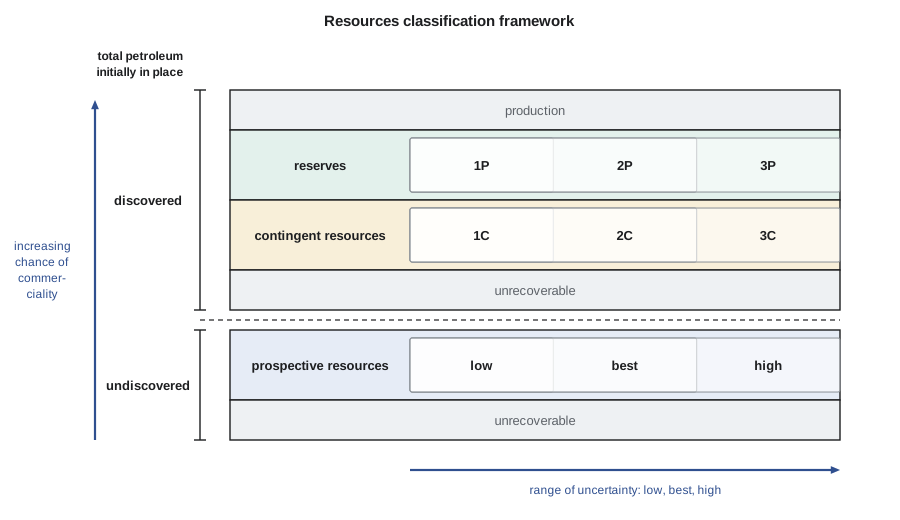
Discovered petroleum is that found by at least one well that has established the existence of a significant quantity of potentially movable hydrocarbons. Discovered quantities that are recoverable by a commercial project are reserves. Discovered quantities that are potentially recoverable but not yet commercial, because some contingency must be resolved first, are contingent resources. Undiscovered quantities that could be recovered by future projects are prospective resources. In each case some of the petroleum in place will never be recovered by any identified project; that portion is unrecoverable, although future technology may move part of it into one of the other classes.
What makes a quantity a reserve
PRMS defines reserves as quantities of petroleum anticipated to be commercially recoverable by application of development projects to known accumulations from a given date forward under defined conditions. Four tests follow from this definition. The quantities must be discovered, recoverable with an identified project and technology, commercial, and remaining as of the effective date, so past production is excluded.
Commerciality is the test that most often decides a project's class. A project is commercial when the entity has a firm intention to proceed, supported by a reasonable expectation that the economics are positive under the evaluation's price and cost assumptions, that the necessary regulatory approvals will be obtained, that markets and transport exist, that financing is available, and that development will begin within a reasonable time. PRMS uses five years from classification as a benchmark for that time; a longer period needs a specific justification, such as the schedule of a large offshore development. A project that is technically sound but lacks a sanction decision, a gas sales contract or a regulatory approval stays in contingent resources until the contingency is resolved.
Categories: how uncertainty is expressed
Within the reserves class, uncertainty is expressed by three cumulative categories. Proved reserves (1P) are those that, by analysis of geoscience and engineering data, can be estimated with reasonable certainty to be commercially recoverable. Proved plus probable reserves (2P) are the best estimate. Proved plus probable plus possible reserves (3P) are a high estimate. The incremental quantities are called probable (2P minus 1P) and possible (3P minus 2P). Contingent resources use the same scheme with labels 1C, 2C and 3C, and prospective resources use low, best and high estimates, sometimes written 1U, 2U and 3U.
When probabilistic methods are used, the categories have a statistical meaning: there should be at least a 90 percent probability that the quantities actually recovered will equal or exceed the 1P estimate, at least 50 percent for 2P, and at least 10 percent for 3P. These are the P90, P50 and P10 values of Lesson 3. When deterministic methods are used, as is common for individual wells, the evaluator chooses the inputs for each category so that the results represent the same levels of confidence. Either way, the categories describe the range of outcomes for the same project; they are not separate projects.
COGEH applies the same categories with explicit targets at the reported level. Proved reserves must be estimated so that there is at least a 90 percent probability that the quantities actually recovered will equal or exceed the estimate when the reserves of many properties are aggregated, which allows individual properties to vary more than that. Proved plus probable estimates should be equally likely to be too high or too low in aggregate, and proved plus probable plus possible estimates should have at least a 10 percent probability of being equalled or exceeded. NI 51-101 requires disclosure of proved and probable reserves, with possible reserves optional.
Project maturity and reserves status
PRMS adds subclasses that describe how far each project has advanced. They are useful for managing a portfolio because they show what has to happen next for each project to move up.
| Class | Subclass | Typical condition |
|---|---|---|
| Reserves | On production | The project is producing and selling petroleum. |
| Reserves | Approved for development | All approvals are obtained, capital is committed and work is under way or imminent. |
| Reserves | Justified for development | Development is commercially justified and the company intends to proceed, but approvals or sanction are pending. |
| Contingent resources | Development pending | Discovered; contingencies are being actively resolved, such as a pilot, supply contract or approval. |
| Contingent resources | Development on hold | A reasonable chance of commerciality but activity is deferred, for example by market conditions. |
| Contingent resources | Development unclarified | Under evaluation; data are insufficient to define a project clearly. |
| Contingent resources | Development not viable | No current plans to develop because of limited potential. |
| Prospective resources | Prospect, lead, play | Undrilled: a defined drillable target, a less defined lead, or a broad play concept. |
Reserves also carry a development status. Developed producing reserves are expected from existing wells and facilities that are producing at the effective date. Developed non-producing reserves are behind pipe or shut in, waiting for a recompletion, a tie-in or a market, at relatively small cost. Undeveloped reserves need significant new investment, such as new wells or a new facility. Proved developed producing reserves (PDP) are the most certain and the most valuable to a lender; proved undeveloped reserves (PUD) depend on capital that has not yet been spent.
Ethan's project list
Ethan's list for the year-end evaluation has nine projects, and the script below classifies them and adds up the reserves. The volumes are oil equivalent; Lessons 3 to 5 explain how each estimate was made.
# Classify the company's projects into PRMS-style categories and add up the totals.
SI = True      # True: Canadian case (thousand m3 of oil equivalent), False: US case (thousand boe)
f = 1.0 if SI else 6.2898
unit = "e3m3 OE" if SI else "Mboe"
# project, maturity, low, best, high (oil-equivalent volumes in thousand m3; converted for the US case)
projects = [
    ("producing horizontals",      "on production",             410, 541, 666),
    ("waterflood pilot area",      "on production",              70, 120, 170),
    ("Phase 2 wells 5-8",          "approved for development",  140, 171, 214),
    ("polymer conformance",        "approved for development",   40,  90, 140),
    ("waterflood expansion",       "justified for development",   0, 150, 240),
    ("north flank, 6 locations",   "justified for development",   0, 158, 250),
    ("CO2 WAG flood",              "development pending",         0,   0,   0),
    ("east flank appraisal",       "development unclarified",     0,   0,   0),
    ("Spruce Ridge prospect",      "prospect",                    0,   0,   0),
]
contingent = {"CO2 WAG flood": (330, 680, 1000), "east flank appraisal": (120, 260, 450)}
prospective = {"Spruce Ridge prospect": (150, 400, 900)}
klass = {"on production": "reserves", "approved for development": "reserves",
         "justified for development": "reserves", "development pending": "contingent resources",
         "development unclarified": "contingent resources", "prospect": "prospective resources"}
r = {"1P": 0.0, "2P": 0.0, "3P": 0.0}
print(f"{'project':28s} {'class':22s} low/best/high ({unit})")
for name, mat, lo, be, hi in projects:
    k = klass[mat]
    if k == "reserves":
        r["1P"] += lo; r["2P"] += be; r["3P"] += hi
    else:
        lo, be, hi = (contingent if k.startswith("contingent") else prospective)[name]
    print(f"{name:28s} {k:22s} {lo * f:6,.0f} / {be * f:6,.0f} / {hi * f:6,.0f}")
print(f"reserves 1P {r['1P'] * f:,.0f}, 2P {r['2P'] * f:,.0f}, 3P {r['3P'] * f:,.0f} {unit}")
print(f"probable = 2P - 1P = {(r['2P'] - r['1P']) * f:,.0f}; possible = 3P - 2P = {(r['3P'] - r['2P']) * f:,.0f}")project class low/best/high (e3m3 OE) producing horizontals reserves 410 / 541 / 666 waterflood pilot area reserves 70 / 120 / 170 Phase 2 wells 5-8 reserves 140 / 171 / 214 polymer conformance reserves 40 / 90 / 140 waterflood expansion reserves 0 / 150 / 240 north flank, 6 locations reserves 0 / 158 / 250 CO2 WAG flood contingent resources 330 / 680 / 1,000 east flank appraisal contingent resources 120 / 260 / 450 Spruce Ridge prospect prospective resources 150 / 400 / 900 reserves 1P 660, 2P 1,230, 3P 1,680 e3m3 OE probable = 2P - 1P = 570; possible = 3P - 2P = 450
The producing horizontals, including the four Phase 2 wells drilled this year, and the waterflood pilot area are on production. The last four Phase 2 wells and the polymer conformance work recommended in PET-430 are approved, with capital in the 2027 budget. The waterflood expansion and six locations on the north flank are justified for development but are booked as probable only: the expansion area has not yet responded to injection, and the north flank locations are more than one spacing unit from producing wells, beyond the distance at which Graham is reasonably certain of continuity. The CO2 flood is a contingent resource, development pending, because the company has neither a CO2 supply nor a sanction decision. The east flank, where one well found oil in a thin sand, is development unclarified. Spruce Ridge, undrilled, is a prospect.
The totals are 660 thousand m³ of oil equivalent proved, 1,230 proved plus probable and 1,680 proved plus probable plus possible. The probable volume of 570 thousand m³ is almost as large as the proved, which is typical of a company with a large undeveloped inventory. The contingent and prospective resources are reported separately and are never added to reserves, because they carry a much lower chance of being produced.
Worked problem
Incremental categories
For the waterflood pilot area, Graham's estimates are 1P = 70, 2P = 120 and 3P = 170 thousand m³. Find the probable and possible quantities and the ratio of 2P to 1P.
Show solution
- Probable = 2P − 1P = 120 − 70 = 50 thousand m³.
- Possible = 3P − 2P = 170 − 120 = 50 thousand m³.
- 2P / 1P = 120 / 70 = 1.71.
Answer: The ratio of about 1.7 reflects the uncertainty in waterflood response; a mature producing well would show a ratio much closer to 1.
Common classification problems
Several issues recur in evaluations. The first is booking quantities as reserves before the project is truly committed. A board resolution that approves a budget is good evidence of intent; a slide in an investor presentation is not. The second is the treatment of undeveloped locations far from control. Each standard limits how far proved undeveloped locations can be extended from producing wells, and moving beyond that needs evidence such as seismic, pressure data or a consistent statistical record of similar wells. The third is time: locations that have been booked as undeveloped reserves for many years without being drilled suggest that the company does not actually intend to drill them, and both PRMS and the SEC rules expect them to be removed.
A fourth problem is mixing classes. A contingent resource multiplied by a chance of development is still a contingent resource, not a risked reserve, and adding it to reserves misleads readers. The final problem is inconsistency between technical and economic assumptions: a volume can only be a reserve if it is produced before the economic limit under the price and cost assumptions of the same evaluation. Diane's rule is that every number in the reserves table must be traceable to a forecast, a cash flow and a classification decision that someone can explain.
Common mistakes
MistakeClassifying wells or barrels rather than projects.
InsteadClassify the project that would produce the quantities, using its maturity and commercial status.
MistakeAdding contingent or prospective resources to reserves.
InsteadReport each class separately; they have different chances of commerciality.
MistakeTreating 1P, 2P and 3P as separate projects or volumes to be added.
InsteadThey are cumulative estimates of the same project; probable and possible are the increments.
MistakeKeeping undeveloped locations booked indefinitely.
InsteadUndeveloped reserves need a firm plan to develop them within a reasonable time, normally five years.
Summary and key terms
- PRMS divides petroleum in place by chance of commerciality (classes) and range of uncertainty (categories).
- Reserves must be discovered, recoverable, commercial and remaining, with a committed development project.
- Proved, probable and possible reserves correspond to at least 90, 50 and 10 percent probability when probabilistic methods are used.
- Contingent resources are discovered but not yet commercial; prospective resources are undiscovered.
- Project maturity subclasses and reserves status show how far each project has progressed.
- COGEH applies the targets at the reported, aggregate level; NI 51-101 requires proved and probable disclosure.
- Reserves
- Discovered, recoverable, commercial and remaining quantities from a committed project.
- Contingent resources
- Discovered, potentially recoverable quantities not yet commercial because of one or more contingencies.
- Prospective resources
- Quantities estimated to be recoverable from undiscovered accumulations.
- Proved reserves (1P)
- Quantities recoverable with reasonable certainty, at least 90 percent probability.
- Probable reserves
- Additional quantities less likely than proved; 2P is the best estimate.
- Possible reserves
- Additional quantities less likely than probable; 3P is a high estimate.
- PDP
- Proved developed producing reserves from existing producing wells.
- PUD
- Proved undeveloped reserves that need significant new investment.
Practice problems
Work each problem on paper first, then reveal the answer to check.
A discovery needs a gas sales contract before it can be developed. How is it classified?
Show answer
Contingent resources, development pending, until the contract is secured.
1P is 300 and 2P is 450. What is the probable quantity?
Show answer
150.
Why are possible reserves not simply added to proved reserves in a lender's valuation?
Show answer
They have only about a 10 percent chance of being equalled or exceeded in total; lenders rely mainly on proved, especially developed producing.
What is the PRMS benchmark for the time to start development of reserves?
Show answer
Five years from classification, unless a longer period is specifically justified.
Lesson quiz · 5 questions
Score 60% or more to complete this lesson.
Create a free account to save your progress, take quizzes and earn a certificate.