
PET-450 · Lesson 1 of 12 · 21 min
Petroleum economics and the evaluator's role
In the first week of November, Ethan Cardinal, now registered as a professional engineer (P.Eng.), moves from the reservoir group to the Reserves and Planning group at Prairie Crest Energy Ltd. in Calgary. His new manager, Diane Mercer, hands him a calendar with one date circled: December 31, 2026, the effective date of the company's year-end reserves evaluation. Between now and mid-February the group must estimate how much oil and gas the company can still produce from the Tamarack Lake field, the Birch Coulee gas pool and its other properties, forecast how fast it will come out, and work out what it is worth. Graham Whitlock, the independent qualified reserves evaluator at Kestrel Petroleum Consultants, will review every number before the report goes to the board's reserves committee and then into the company's annual filings under NI 51-101 and COGEH.
Diane's first piece of advice is about attitude. “Everything you have learned so far tells you how the reservoir works. In this job you also have to say how sure you are, and what it is worth to someone who has to pay for it. A reserves number is a promise to investors and lenders. It has to be defensible years from now, by someone who was not in the room.” This course follows Ethan through that evaluation cycle and the capital decisions that come out of it. This first lesson sets out why reserves and economic evaluation matter, who does the work, and the basic vocabulary and calculation that everything else builds on.
Why reserves and value matter
Oil and gas companies own an unusual asset: a wasting resource buried kilometres underground that no one can see or count directly. The company's value, its ability to borrow, and the way it accounts for its costs all depend on estimates of that resource. Reserves estimates are used in at least six ways.
First, they underpin the company's market value. Investors compare companies on reserves per share, reserve life and the net present value of future net revenue. Second, they set borrowing capacity. Most small and mid-sized producers borrow under a reserves-based credit facility, in which the banks set a borrowing base, usually twice a year, from their own valuation of the company's reserves, with most weight on proved developed producing volumes. A lower reserves value can force a company to repay debt at the worst possible time. Third, they drive accounting. Depletion of capitalized costs is calculated on a unit-of-production basis using reserves, and impairment tests compare the carrying value of the properties with the value of their future cash flows.
Fourth, they are the basis of capital allocation. A company decides where to spend next year's budget by comparing the value each project adds per dollar invested, and those values come from the same forecasts and cash flow models as the reserves report. Fifth, they set prices in acquisitions and divestitures, where buyer and seller each run their own evaluation and negotiate over the differences. Sixth, they are a regulatory requirement for public companies, which must disclose reserves and their value each year in a prescribed form, with penalties for misleading disclosure.
In Canada, the disclosure rules are National Instrument 51-101, Standards of Disclosure for Oil and Gas Activities, adopted by the Canadian Securities Administrators, and the Canadian Oil and Gas Evaluation Handbook (COGEH), which NI 51-101 requires evaluators to follow. Both are aligned with the international Petroleum Resources Management System (PRMS) published by the Society of Petroleum Engineers and its co-sponsors. Lesson 2 covers the classification system and Lesson 12 the disclosure rules in detail.
Who does the work
A reserves evaluation involves several groups with different responsibilities. The company's own reserves engineers, like Ethan, gather the data and prepare most of the forecasts, because they know the wells and the field best. Geologists and geophysicists supply maps and volumes, and the finance group supplies operating costs, ownership and tax information. Engineers in drilling, completions and facilities supply cost estimates for future work.
Under NI 51-101 the reserves must be evaluated or audited by an independent qualified reserves evaluator or auditor, a professional engineer or geoscientist with relevant experience who is independent of the company. Graham's firm either prepares the estimates itself or audits the company's estimates and states whether they are reasonable in aggregate. The board of directors, usually through a reserves committee, appoints the evaluator, meets with them without management present, and approves the disclosure. Management and two directors sign a report on the process, Form 51-101F3, and the evaluator signs Form 51-101F2.
Professional obligations apply throughout. The engineers who sign or rely on the estimates are bound by their licensing body's code of ethics and by the standards of the evaluation profession, such as those of the Society of Petroleum Evaluation Engineers. The core obligations are competence, objectivity and independence: an evaluator must not let a client's preference, a pending financing or a bonus scheme push an estimate up or down. Diane is blunt about this. “Our job is not to make the numbers big. It is to make them right, and to be able to show how we got them.”
The evaluation workflow
Ethan's first task is to understand the sequence of the evaluation. It starts with data: monthly production and injection by well, pressure surveys, well tests, logs and core, the latest geological maps, lease operating statements with actual costs, authorizations for expenditure for planned wells, and the land records that define the company's ownership in each well and lease. The technical work follows: volumetric estimates for undeveloped and newly discovered areas, decline curve analysis and type curves for producing wells and future locations, material balance for gas pools, and simulation results for the waterflood. These produce forecasts of production by well or project.
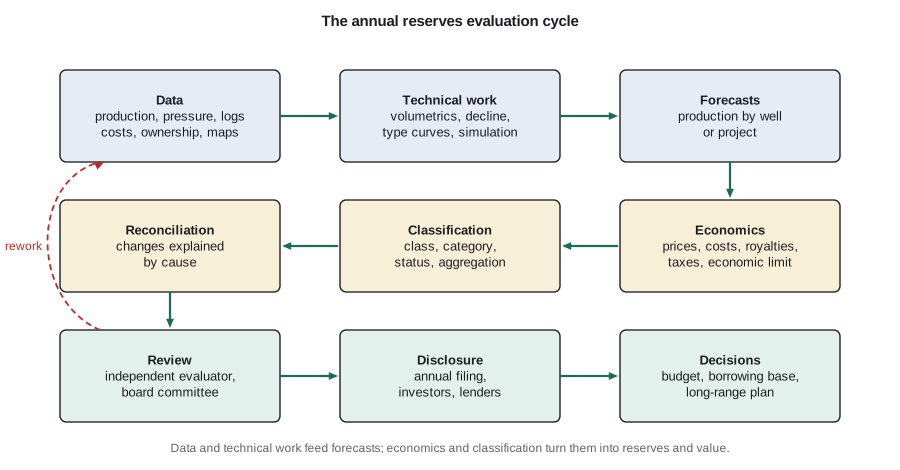
The economic work then turns forecasts into value. Each forecast is combined with a price forecast, the company's ownership, royalties, operating costs, future capital, abandonment costs and taxes to give a cash flow by year. The cash flow sets the economic limit, the point at which the well or project no longer pays its operating costs, and only production before that limit counts as reserves. Each project is then classified by its maturity and uncertainty, the results are aggregated, and the totals are reconciled with last year's numbers so that every change is explained. Finally the results are reviewed, approved and disclosed, and the same models feed the budget and long-range plan.
Basic vocabulary
The language of evaluation distinguishes carefully between volumes and interests. A few terms appear in every lesson.
| Term | Meaning |
|---|---|
| Working interest (WI) | The share of the costs a company pays in a well or lease, which gives it the same share of production before royalties. |
| Royalty interest | A share of production or revenue, free of costs, held by the mineral owner or another party. |
| Net revenue interest (NRI) | The share of revenue the working-interest owner keeps after royalties: WI multiplied by one minus the royalty fraction. |
| Gross and net reserves | Company gross reserves are the working-interest share before royalties; net reserves are after deducting royalties. NI 51-101 requires both. |
| Oil equivalent | Gas converted to oil at an energy-based ratio, conventionally 6 Mcf of gas per barrel, used to add products together. |
| Operating netback | Revenue per unit of production after royalties, operating costs and transportation. |
| Economic limit | The production rate at which revenue after royalties just covers operating costs. |
| Effective date | The date at which the reserves and their value are estimated; production after this date is in the forecast. |
The oil-equivalent convention needs care. Using 6 Mcf per barrel, which in metric units is roughly 1.07 thousand m³ of gas per m³ of oil, is an energy equivalence, not a value equivalence. At recent prices a barrel of oil sells for many times as much as 6 Mcf of gas, so an oil-equivalent total can hide very different values. NI 51-101 requires a cautionary statement whenever oil equivalents are disclosed for this reason.
The time value of money
The central idea of petroleum economics is that a dollar received today is worth more than a dollar received in ten years, because today's dollar can be invested or used to repay debt. The net present value (NPV) of a project discounts each year's net cash flow back to the effective date at a chosen rate and adds the results:
where CF_t is the net cash flow in year t and i is the discount rate. Reserves reports usually present values at several rates, such as 0, 5, 10, 15 and 20 percent, so that readers can apply their own view of risk and cost of capital; 10 percent is the most quoted. Oil production is front-loaded, especially from horizontal wells, so most of a well's value arrives in its first few years and discounting has less effect than it would on a long, flat profile. Lesson 6 develops discounting further, including mid-year conventions and inflation.
The script below values one of the producing Cardium horizontals for the year-end report. The well has declined to about 10 m³/d and is modelled with a simple exponential decline of 22 percent per year, a net price of 520 Canadian dollars per m³, a 10 percent royalty, and operating costs of 60,000 dollars per year plus 60 dollars per m³.
# What is a well worth? Undiscounted and discounted cash flow for one producing horizontal well.
SI = True      # True: Canadian case (m3, Canadian dollars), False: US case (bbl, US dollars)
BBL = 6.2898                                   # barrels per cubic metre
q0 = 3650.0 if SI else 26000.0                 # first-year oil, m3 or bbl
decline = 0.22                                 # simple annual exponential decline fraction (illustrative)
price = 520.0 if SI else 62.0                  # net oil price, dollars per m3 or per bbl
roy = 0.10 if SI else 0.28                     # royalty and production taxes as a fraction of revenue
fixed = 60000.0 if SI else 72000.0             # fixed operating cost, dollars per year
var = 60.0 if SI else 9.0                      # variable operating cost, dollars per m3 or bbl
rate = 0.10                                    # discount rate
unit = "m3" if SI else "bbl"

cum = 0.0; undisc = 0.0; disc = 0.0; year = 0; q = q0
print(f"year  oil ({unit})   net cash flow   discounted")
while True:
    year += 1
    cf = q * (price * (1 - roy) - var) - fixed
    if cf <= 0: break                          # economic limit: stop when a year loses money
    df = 1 / (1 + rate) ** (year - 0.5)        # mid-year discounting
    cum += q; undisc += cf; disc += cf * df
    if year <= 3 or year % 5 == 0:
        print(f"{year:4d}  {q:11,.0f}  {cf:14,.0f}  {cf * df:11,.0f}")
    q *= 1 - decline
print(f"economic limit reached after {year - 1} years")
print(f"remaining reserves {cum:,.0f} {unit}" + (f" ({cum * BBL:,.0f} bbl)" if SI else ""))
print(f"undiscounted value {undisc / 1e6:.2f} million, NPV10 {disc / 1e6:.2f} million")
print(f"discounting removes {100 * (1 - disc / undisc):.0f} percent of the undiscounted value")year oil (m3) net cash flow discounted 1 3,650 1,429,200 1,362,689 2 2,847 1,101,576 954,829 3 2,221 846,029 666,659 5 1,351 491,228 319,901 10 390 99,149 40,092 economic limit reached after 13 years remaining reserves 15,935 m3 (100,226 bbl) undiscounted value 5.72 million, NPV10 4.38 million discounting removes 23 percent of the undiscounted value
The well reaches its economic limit after 13 years. Its remaining reserves are about 15,900 m³, or 100,000 barrels, and the undiscounted future net revenue is 5.72 million dollars, of which discounting at 10 percent removes about a quarter, leaving an NPV10 of 4.38 million. Two features are general. The reserves are not a property of the rock alone: a higher price or lower operating cost would push the economic limit later and add reserves. And because the cash flow falls each year, the first three years provide most of the value.
Worked problem
Net revenue interest and net reserves
Prairie Crest has an 80 percent working interest in a well; its partner has 20 percent. The Crown royalty averages 15 percent. The well's remaining reserves at 100 percent are 20,000 m³. Find the company gross reserves, net revenue interest and net reserves.
Show solution
- Company gross reserves are 0.80 × 20,000 = 16,000 m³.
- The net revenue interest is 0.80 × (1 − 0.15) = 0.68.
- Net reserves are 0.68 × 20,000 = 13,600 m³.
Answer: The company reports 16,000 m³ gross and 13,600 m³ net. Revenue and value follow the net revenue interest; costs follow the working interest.
Estimates, judgement and uncertainty
Every input to an evaluation is uncertain: the volume of rock, its properties, the decline of a well that has produced for only a year, the price of oil in 2035, the cost of drilling next year's wells. The evaluator's job is not to remove that uncertainty, which is impossible, but to describe it honestly. The reserves categories of Lesson 2, the probabilistic methods of Lesson 3 and the risk analysis of Lessons 10 and 11 are all ways of doing this. A good estimate is one whose range brackets what actually happens, and whose central value turns out too high about as often as too low over many properties and many years.
Reserves also change. Each year's evaluation adds new information from another year of production, new wells and new prices, and the estimates are revised. Revisions are normal; what matters is that they are explained and not systematically in one direction. Large repeated downward revisions damage a company's credibility with investors and lenders far more than a cautious initial estimate would have.
How this course is organized
The course follows the year-end cycle. Lesson 2 sets out how reserves and resources are classified. Lessons 3 to 5 cover the three main families of estimation methods: volumetric estimates with probabilistic ranges, decline curve analysis for producing wells, and type curves for unconventional development. Lessons 6 to 9 turn forecasts into value: price forecasts and discounting, cash flow models, royalties and taxes, and the indicators used to rank capital projects. Lessons 10 and 11 deal with risk and decisions, from expected monetary value to decision trees, Monte Carlo simulation and the value of information. Lesson 12 brings the evaluation together into the year-end reconciliation and disclosure.
Common mistakes
MistakeTreating reserves as a fixed property of the reservoir.
InsteadReserves depend on prices, costs, technology and the development plan as well as the rock; they change when any of these change.
MistakeValuing a well on gross rather than net revenue.
InsteadApply the net revenue interest to revenue and the working interest to costs.
MistakeAdding oil and gas by energy equivalence and treating the total as a value measure.
InsteadReport the product mix and values; an oil equivalent is an energy convention, not a price ratio.
MistakeLetting the purpose of an estimate influence its value.
InsteadEstimates must be objective and documented whether they support a financing, a sale or the annual report.
Summary and key terms
- Reserves estimates underpin market value, borrowing capacity, accounting, capital allocation, transactions and regulatory disclosure.
- In Canada, NI 51-101 and COGEH govern disclosure, with an independent qualified reserves evaluator or auditor and oversight by the board.
- The workflow runs from data through technical forecasts and economics to classification, reconciliation, review and disclosure.
- Working interest sets the share of costs; net revenue interest sets the share of revenue after royalties.
- NPV discounts each year's net cash flow to the effective date; reports show values at several discount rates.
- The economic limit, and therefore the reserves, depend on price and cost as well as on the reservoir.
- Reserves
- Quantities of petroleum anticipated to be commercially recoverable from known accumulations from a given date forward under defined conditions.
- Effective date
- The date at which reserves and their value are estimated.
- Working interest
- A share of the costs of a property, carrying the same share of production before royalties.
- Net revenue interest
- The share of revenue retained after royalties.
- Borrowing base
- The maximum loan a bank will make under a reserves-based facility, set from the bank's valuation of the reserves.
- Economic limit
- The rate at which revenue after royalties equals operating cost.
- Net present value
- The sum of future net cash flows discounted to the effective date.
Practice problems
Work each problem on paper first, then reveal the answer to check.
Name four uses of a company's reserves estimates.
Show answer
Market valuation, borrowing base, depletion and impairment accounting, capital allocation, acquisitions and regulatory disclosure (any four).
A company has a 60 percent working interest and the royalty is 20 percent. What is its net revenue interest?
Show answer
0.60 × 0.80 = 0.48.
Why does a higher oil price usually increase reserves as well as value?
Show answer
It moves the economic limit later, so more production is economic.
What is the discount factor for a cash flow at the end of year 5 at 10 percent?
Show answer
1 / 1.10^5 = 0.621.
Lesson quiz · 5 questions
Score 60% or more to complete this lesson.
Create a free account to save your progress, take quizzes and earn a certificate.