
PET-450 · Lesson 12 of 12 · 19 min
Reserves reporting and disclosure
By the second week of February the forecasts, cash flows and classifications are complete, and Graham's firm has finished its evaluation. What remains is to explain the year in numbers: how the reserves changed from last year, why, at what cost, and what they are worth. Then the reserves committee of the board will meet Graham without management present, the board will approve the disclosure, and the company will file its reserves data with its annual financial statements. Diane tells Ethan that the reconciliation is the part of the report that investors read most closely. “Anyone can publish a big number. The reconciliation shows whether last year's number was honest.” This lesson covers the reconciliation, the performance measures that come from it, and the disclosure required under NI 51-101.
The reserves reconciliation
A reconciliation, or roll-forward, explains the change in each reserves category between the start and end of the year. Each change is assigned to one cause. Production reduces reserves by the volume produced. Extensions and improved recovery add reserves from new drilling locations, from the extension of a pool's boundaries, and from improved recovery projects such as waterfloods. Discoveries add reserves in new pools. Technical revisions reflect new information about existing reserves, such as better or worse well performance. Economic factors reflect changes in price and cost forecasts. Acquisitions and dispositions record reserves bought and sold.
The categories matter because they say different things about the company. Additions from drilling show that capital is replacing production; technical revisions show whether earlier estimates were sound; economic revisions show sensitivity to price. NI 51-101 requires a reconciliation of company gross reserves by product type for proved and for proved plus probable, using these categories.
# Year-end reserves reconciliation, reserve life, finding and development cost and the recycle ratio.
SI = True      # True: COGEH / NI 51-101 style, thousand m3 OE and Canadian dollars; False: SEC style, Mboe and US dollars
f = 1.0 if SI else 6.2898
u = "e3m3 OE" if SI else "Mboe"
# changes to proved (1P) and proved plus probable (2P), thousand m3 OE
items = [("opening (1 January)",         630,  960),
         ("extensions and improved recovery", 230, 420),
         ("technical revisions",          -45,   12),
         ("discoveries",                    0,    0),
         ("acquisitions",                  42,   58),
         ("dispositions",                   0,    0),
         ("economic factors",             -29,  -52),
         ("production",                  -168, -168)]
p1 = p2 = 0.0
print(f"{'':34s} {'1P':>8s} {'2P':>8s}  ({u})")
for name, a, b in items:
    p1 += a; p2 += b
    print(f"{name:34s} {a * f:8,.0f} {b * f:8,.0f}")
print(f"{'closing (31 December)':34s} {p1 * f:8,.0f} {p2 * f:8,.0f}")
prod = 168
print(f"reserve life index: 1P {p1 / prod:.1f} years, 2P {p2 / prod:.1f} years")
capital = 60.0 if SI else 67.0                  # exploration and development capital, millions
fdc_change = 12.0 if SI else 10.0               # change in future development capital, millions
adds_2p = 420 + 12 + 0 - 52                    # 2P additions excluding acquisitions, thousand m3 OE
unit_vol = 1e3 * (1 if SI else 6.2898)
fd = (capital + fdc_change) * 1e6 / (adds_2p * unit_vol)
netback = 255.0 if SI else 36.0                 # operating netback, dollars per m3 OE or per boe
print(f"2P F&D cost {fd:.1f} dollars per {'m3 OE' if SI else 'boe'}; netback {netback:.1f}; recycle ratio {netback / fd:.2f}")
print(f"production replacement (2P additions incl. acquisitions / production) {100 * (adds_2p + 58) / prod:.0f} percent")
if not SI:
    fdom = [63.1, 64.8, 66.2, 61.9, 60.4, 63.7, 65.0, 66.8, 64.1, 61.2, 59.8, 62.5]   # first-day-of-month WTI, illustrative
    print(f"SEC price: average of 12 first-day-of-month prices = {sum(fdom) / 12:.2f} US dollars per bbl (WTI, before differentials)")
    puds = [("location A", 2024), ("location B", 2025), ("location C", 2021), ("location D", 2026)]
    for n, yr in puds:
        ok = 2026 - yr < 5
print(f"PUD {n} first booked {yr}: {'within' if ok else 'beyond'} the five-year development window at year-end 2026")1P 2P (e3m3 OE) opening (1 January) 630 960 extensions and improved recovery 230 420 technical revisions -45 12 discoveries 0 0 acquisitions 42 58 dispositions 0 0 economic factors -29 -52 production -168 -168 closing (31 December) 660 1,230 reserve life index: 1P 3.9 years, 2P 7.3 years 2P F&D cost 189.5 dollars per m3 OE; netback 255.0; recycle ratio 1.35 production replacement (2P additions incl. acquisitions / production) 261 percent
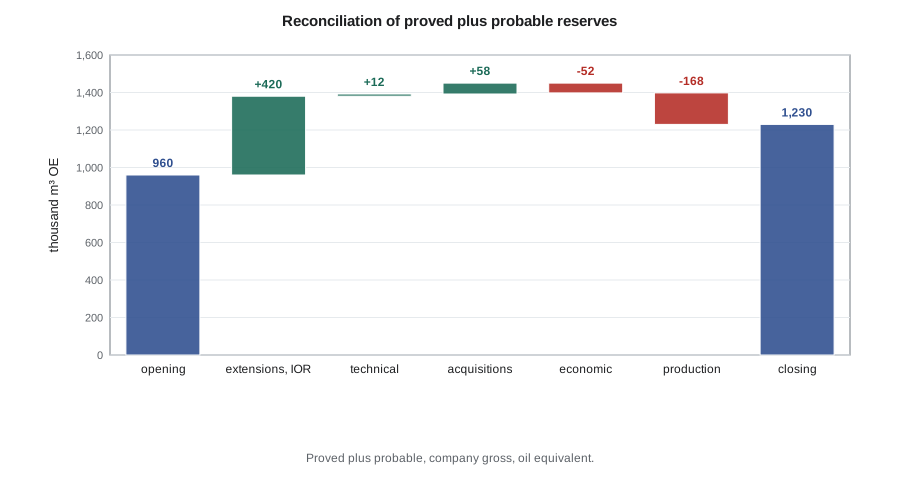
Prairie Crest's proved reserves rose from 630 to 660 thousand m³ of oil equivalent, and proved plus probable from 960 to 1,230. Production of 168 thousand m³ was more than replaced: extensions and improved recovery, mainly the Phase 2 wells, the polymer conformance project and the north flank locations, added 230 thousand m³ of proved and 420 of proved plus probable. Technical revisions were −45 thousand m³ in proved, because two older horizontals declined faster than forecast, but slightly positive in proved plus probable. A small acquisition of a partner's interest added 42 and 58, and a lower long-term price forecast removed 29 and 52. Proved plus probable additions, including the acquisition, replaced production 2.6 times.
Performance measures
Several measures derived from the reconciliation are watched by investors. The reserve life index is reserves divided by annual production: about 3.9 years for proved and 7.3 years for proved plus probable here, short because the Cardium horizontals decline quickly and the company replaces reserves mainly by drilling. Production replacement is the ratio of reserves added to reserves produced. Finding and development (F&D) cost is the capital spent in the year, plus the change in estimated future development capital, divided by the reserves added, excluding acquisitions. Including acquisitions gives finding, development and acquisition (FD&A) cost.
The recycle ratio is the operating netback divided by the F&D cost. It measures how many dollars of netback each dollar of capital generates, and a value above about 2 is generally considered healthy. Prairie Crest's proved plus probable F&D cost is about 190 dollars per m³ of oil equivalent, about 30 dollars per barrel of oil equivalent, against a netback of 255 dollars per m³, a recycle ratio of 1.35. That is acceptable but not strong, and it reflects the year's spending on the waterflood and conformance projects, whose reserves additions will grow as they respond.
Worked problem
Finding and development cost
Capital spent in the year was 60 million dollars and future development capital increased by 12 million. Proved plus probable additions excluding acquisitions were 420 + 12 − 52 = 380 thousand m³ of oil equivalent. Find the F&D cost and the recycle ratio for a netback of 255 dollars per m³.
Show solution
- Total capital: 60 + 12 = 72 million dollars.
- F&D cost: 72,000,000 / 380,000 = 189.5 dollars per m³ of oil equivalent.
- Recycle ratio: 255 / 189.5 = 1.35.
Answer: Including the change in future development capital is essential: without it, a company could book large undeveloped reserves cheaply and appear far more efficient than it is.
Disclosure under NI 51-101
NI 51-101 requires each reporting issuer with oil and gas activities to file three forms each year, no later than the deadline for its audited annual financial statements. Form 51-101F1, the statement of reserves data and other oil and gas information, sets out reserves by product type and category, gross and net, and the net present value of future net revenue before and after income tax at discount rates of 0, 5, 10, 15 and 20 percent, using forecast prices and costs. It also gives the prices used, future development costs, the reconciliation, the timing of undeveloped reserves development, abandonment costs and other information. Form 51-101F2 is the independent evaluator's or auditor's report, and Form 51-101F3 is the report of management and directors confirming the process.
The rules also govern how reserves information may be presented elsewhere. Product types defined in the instrument, such as light and medium crude oil, tight oil, conventional natural gas and shale gas, must be used. Oil equivalents must carry a cautionary statement about the 6 Mcf to 1 barrel ratio. Contingent and prospective resources may be disclosed, but only if estimated under COGEH by a qualified evaluator, with their category, the risks and the chance of development or discovery, and never added to reserves. Analogous information, such as results from wells on neighbouring land, must be identified as such. The evaluator's independence and the board's oversight are what give the disclosure its credibility.
Ethan's last check before the report goes to the board is a set of consistency tests. Every reserves number must trace to a forecast in the evaluation database; the production in the reconciliation must equal the volume sold; the undeveloped locations must match the approved development plan; and the future development capital must be in the long-range plan that the board has seen. He also checks the location schedule against the time rules.
COGEH expects proved undeveloped reserves to be developed in a reasonable time and requires the evaluator to consider the company's history of converting them. Graham reviews the company's record: of the locations booked as undeveloped three years ago, all but one were drilled on schedule, and the remaining one was removed this year. That record supports the 2027 drilling schedule behind this year's undeveloped bookings.
Closing the cycle
At the reserves committee meeting, Graham presents his findings without management present: the estimates are reasonable in aggregate, the process is sound, and he notes the north flank as an area of uncertainty where the probable bookings depend on continuity that has not yet been proven. The committee asks about the downward technical revision on the older horizontals, and Ethan explains how the type curves have been adjusted. The board approves the disclosure, and the company files it in March.
The work does not end with the filing. The same models are now the basis of the 2027 budget approved in Lesson 9, the borrowing base review with the banks in April, and the long-range plan. The Spruce Ridge survey will be shot in the summer, the CO2 supply study continues, and the actual results of the Phase 2 wells will test the type curve. Next year's evaluation will start from this year's forecasts, and the reconciliation will show how well they held up. Diane's last comment to Ethan sums up the discipline. “Every number in that report is a forecast about the future. We will not get them all right. What we owe the people who rely on them is that they are honest, documented, and as likely to be too low as too high.”
Reviewing the year as a whole
Before the meeting, Diane asks Ethan to step back from the detail and write one page on what the year's numbers say about the company. He makes four points. First, the reserves base is growing, but it is short-lived: at 3.9 years of proved reserve life the company must keep drilling simply to hold production flat, which makes it sensitive to any interruption in capital. Second, the probable reserves are large relative to the proved, so a great deal of value depends on the waterflood expansion and the north flank performing as expected; the pilot results and the first north flank wells are the most important information the company can obtain next year. Third, the downward technical revision on the older horizontals is a warning that the type curves may be slightly optimistic in the long-term tail, and the terminal decline assumptions should be watched. Fourth, the recycle ratio shows that the company is creating value, but not by a wide margin, so cost control and the choice of projects in the capital budget matter.
Graham reads the page and tells Diane it is the most useful thing in the package. The board receives it with the reserves report. It is the kind of document that turns a compliance exercise into a management tool: the reserves evaluation is not only a number for the annual filing but the company's best statement of what it owns, what it is worth and what it must do next.
Common mistakes
MistakeAssigning all changes in reserves to a single category.
InsteadSeparate production, additions, technical revisions, economic factors and transactions.
MistakeCalculating F&D cost without the change in future development capital.
InsteadInclude it, so that undeveloped bookings carry their full cost.
MistakeKeeping undeveloped locations that have repeatedly been deferred.
InsteadApply the time rules and remove or reclassify locations the company is not developing.
MistakePresenting resources other than reserves without their category, risk and chance.
InsteadDisclose them only as the rules allow, clearly separated from reserves.
Summary and key terms
- The reconciliation explains each change in reserves by production, additions, revisions, economic factors and transactions.
- Reserve life, production replacement, F&D cost and recycle ratio are the main performance measures.
- F&D cost must include the change in future development capital.
- NI 51-101 requires Forms 51-101F1, F2 and F3, with reserves and their value at forecast prices and several discount rates.
- COGEH expects undeveloped reserves to be developed in a reasonable time, supported by the company's history.
- Honest, documented estimates that are as likely to be low as high are the evaluator's obligation.
- Reconciliation
- A statement explaining the change in reserves between two dates by cause.
- Technical revision
- A change in reserves due to new technical information about existing properties.
- Reserve life index
- Reserves divided by annual production.
- Production replacement
- Reserves added divided by reserves produced in a period.
- F&D cost
- Capital spent plus the change in future development capital, divided by reserves added.
- Recycle ratio
- Operating netback divided by F&D cost.
- Future development capital
- Estimated capital still required to develop booked undeveloped reserves.
Practice problems
Work each problem on paper first, then reveal the answer to check.
Opening reserves are 500, production 80, additions 120 and revisions −10. What are the closing reserves?
Show answer
500 − 80 + 120 − 10 = 530.
Reserves are 600 and annual production is 100. What is the reserve life index?
Show answer
6.0 years.
A company spends 40 million, future development capital rises by 10 million, and it adds 2 million boe. What is the F&D cost?
Show answer
50 / 2 = 25 dollars per boe.
Why is the recycle ratio a useful single measure?
Show answer
It compares the cash generated per barrel with the cost of adding a barrel, so it shows whether reinvestment creates value.
Lesson quiz · 5 questions
Score 60% or more to complete this lesson.
Create a free account to save your progress, take quizzes and earn a certificate.