
MSBA-290 · Lesson 12 of 12 · 22 min
Case study: onboarding a large engineering department
▶ Video coming soon A video version of this lesson is on the way.
The last session of the series was not planned. On the Monday before it, Skerry announced that it had bought Driftline Labs, a 240-developer company in Vancouver that builds the route-planning and offline-maps app many Skerry customers already use. Marisol rewrote the agenda overnight: the platform team, with Priya observing, would plan Driftline's move into the Skerry enterprise from start to finish, using everything from the previous eleven sessions. This lesson follows that plan. It is a fictional case, but every decision in it rests on the features and rules covered in the course.
The brief
Driftline's CTO, Saoirse Kamakau-Lund, sent a one-page summary of what Driftline had.
| Area | Driftline today |
|---|---|
| GitHub plan | Two organizations on the GitHub Team plan, driftline and driftline-labs, with personal accounts |
| People | 240 developers, 18 contractors from two agencies, 6 organization owners |
| Identity | Okta for all company applications; no SAML on GitHub |
| Repositories | 412 repositories, 31 public (open source map tools), the rest private |
| Automation | 3 machine accounts with personal access tokens used by the deployment system |
| Actions | About 180,000 minutes a month, mostly macOS runners for the iOS app |
| Security | Dependabot alerts on; no secret scanning on private repositories |
| Constraints | The iOS and Android release trains ship every two weeks and cannot slip |
Skerry's requirements were short. Driftline developers must be in the managed users enterprise within one quarter. Contractors must keep only the access their contracts allow. The public map tools must stay public. No release may slip. And the integration must be visible to auditors from day one.
Step 1: identity
The first problem was the identity provider. Skerry's managed users enterprise authenticates and provisions with Entra ID over OIDC, and GitHub explicitly does not support mixing Okta and Entra ID for single sign-on and provisioning. Driftline's people therefore had to exist in Entra ID before they could have managed accounts. Amadou's team planned the identity merge first: Driftline staff would be created in Skerry's Entra ID from the HR feed, added to new groups such as Driftline-iOS-Developers, and covered by Skerry's Conditional Access policies. Okta would remain for Driftline's other applications until the company-wide identity project caught up.
Worked problem
Checking usernames before provisioning
Driftline's email format is first.last@driftline.example; Skerry's Entra ID user principal names are first.last@skerry.example, and the managed usernames are built from the part before the at sign. Three Driftline developers share a name with existing Skerry staff. What happens if nothing is done, and what is the fix?
Show solution
- Both domains produce the same local part, for example sam.lee, so both normalize to sam-lee_skr.
- GitHub provisions the first and rejects the second with a conflict.
- Amadou's pre-provisioning script, from lesson 4, finds the three collisions.
- The fix agreed in lesson 4 applies: map the SCIM userName from the unique employee identifier attribute, or give the three people distinct principal names.
Answer: Three provisioning conflicts; prevent them by using a unique identifier in the SCIM userName mapping before provisioning starts.
Contractors were handled the same way as Skerry's own agencies: an Entra ID group per agency, mapped to the guest collaborator role, with access granted only to the repositories in each contract. Driftline's 18 contractors had previously been organization members with access to everything, which Freya noted as the largest single risk reduction in the plan.
Step 2: where things go
Next came the organization design. Driftline's two organizations would not survive as organizations; under the "few organizations" principle from lesson 2, their private repositories would move into the main skerry organization under a set of teams, with custom properties owning-team set to driftline-ios, driftline-android or driftline-platform. The 31 public repositories could not move into the managed users enterprise at all, because managed users cannot create public content, so they would join skerry-oss, the separate organization with personal accounts that already held Skerry's own open source libraries.
Step 3: access, roles and policies
With teams in place, access followed the standards from lessons 6 to 8. Teams were connected to Entra ID groups, so membership would come from the identity team's access reviews. Driftline's six organization owners lost their owner roles when their organizations were retired, because the skerry organization already had its owners. Instead, Driftline's release engineers got the Release coordinator custom repository role on their repositories, and their platform engineers got a custom organization role for runners and secrets. Enterprise policies applied automatically on arrival: no visibility changes by repository administrators, forks only within the organization, selected actions only, and the restricted-repository ruleset for anything labelled as handling payment data.
Driftline's workflows used eight third-party actions that were not on Skerry's allow list. Rather than relax the policy, the platform team reviewed the eight, pinned six to full commit SHAs and added them, and replaced two with GitHub-created equivalents. A policy that bends for every acquisition stops being a policy.
Worked problem
Replacing machine accounts
Driftline's deployment system uses three machine accounts with classic personal access tokens. Managed users come only from Entra ID, and Skerry's standard is that automation uses GitHub Apps. What should happen to the machine accounts, and why does it matter for cost and rate limits?
Show solution
- Create a GitHub App owned by the enterprise, registered by an app manager, with only the repository permissions the deployment system needs.
- Install it on the Driftline repositories and switch the deployment system to app authentication.
- Delete the machine accounts' tokens; the accounts are not recreated in the managed users enterprise.
- Apps do not consume licences and get higher rate limits on Enterprise Cloud than tokens.
Answer: Replace them with one narrowly scoped GitHub App, which saves three licences, raises rate limits and removes long-lived tokens.
Step 4: migration waves
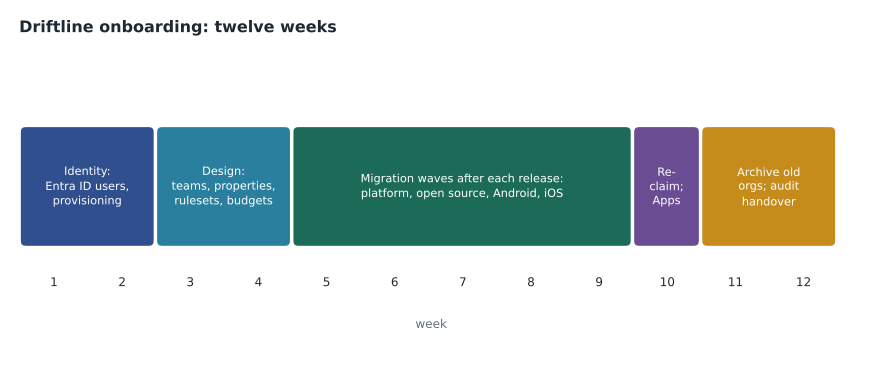
The migration itself, which MSBA-291 covers in detail, was scheduled around Driftline's two-week release trains. Each wave started the day after a release shipped and finished well before the next code freeze, so a problem could be fixed without endangering a release. Repositories moved with GitHub Enterprise Importer, which carries history, issues and pull requests. Because Driftline's authors were personal accounts that do not exist in the managed users enterprise, their past activity arrived attributed to mannequins, and each developer's mannequin was reclaimed to their new managed account in week 10.
| Wave | Repositories | Timing | Special handling |
|---|---|---|---|
| 1: platform | 96 internal libraries and services | Week 5 | Shared workflows converted to Skerry's reusable workflows |
| 2: Android | 118 repositories | Week 7, after an Android release | Signing keys moved to environment secrets with required reviewers |
| 3: iOS | 167 repositories | Week 9, after an iOS release | macOS runner usage moved to a separate cost centre and budget |
| Open source | 31 public repositories | Week 6 | Transferred to skerry-oss; maintainers keep personal accounts |
Step 5: security, audit and support
From the day the first Driftline managed account existed, its activity appeared in the enterprise audit log and therefore in the streamed copy in the SIEM, which met the auditors' visibility requirement without extra work. Freya applied Skerry's standard security configuration to the migrated repositories, which turned on secret scanning and push protection. On the first scan it found 23 live credentials in Driftline's history, all of which were revoked and rotated in week 6 under the security response plan.
For support, Priya's developer guide gained a Driftline page, two Driftline engineers became champions, and the platform team ran daily office hours during each wave. The first-week question rate for Driftline developers was 0.41 per developer, slightly higher than the commerce group's but far below the original pilot, which the team put down to the change of identity provider.
Step 6: cost
Lorcan asked for the bill before the plan was approved. The licence count was straightforward: 240 developers plus 18 contractors as guest collaborators, while the three machine accounts became an app. The Actions picture was different. Driftline's 180,000 monthly minutes were mostly macOS minutes, which are charged at a higher rate than Linux minutes, so the iOS repositories got their own cost centre, a budget with alerts, and a review of the test matrix, which ran every test on four iOS versions for every push.
Worked problem
Estimating licences
Driftline adds 240 developers and 18 contractors. Seven Driftline developers already have Skerry managed accounts because they worked on the store app integration, and the three machine accounts are replaced by a GitHub App. How many new licences does the enterprise need?
Show solution
- Start with 240 developers and 18 contractors: 258 people.
- Seven developers already hold licences, and licences are per unique user: 258 - 7 = 251.
- The GitHub App does not consume a licence, so the machine accounts add nothing.
Answer: 251 new licences.
Risk register
| Risk | Likelihood | Mitigation |
|---|---|---|
| A release slips because of migration work | Medium | Waves start the day after a release; rollback plan keeps old repositories read-only but intact |
| Username conflicts block provisioning | High without action | Pre-provisioning collision script and unique identifier mapping |
| Live secrets in migrated history | High | Push protection on arrival, secret scanning, revoke and rotate under the response plan |
| Contractors keep broader access than contracts allow | Medium | Guest collaborator role and per-agency groups with repository-level access |
| Developers resist two accounts | Medium | Guide, champions, clear rule: personal account for public work |
| macOS Actions costs exceed forecast | Medium | Separate cost centre, budget alerts, test matrix review |
What Priya took back to Tidewater
At the end of the session Marisol asked Priya what she would take back to a company of eighteen people on the Team plan. Priya's answer filled the last page of her notebook. Tidewater did not need an enterprise, but it did need three habits from Skerry: roles assigned to teams rather than people, automation on GitHub Apps rather than personal tokens, and every setting written down with a reason. She also had an exam to sit. The study guide's five domains, identities and access, the enterprise environment, secure development and compliance, Actions, and monitoring and optimization, now each had a Skerry story attached, and MSBA-291 and MSBA-299 would cover the rest.
A day-one checklist
At the end of the planning session the team distilled the plan into a checklist that any future acquisition could reuse. Priya copied it into her notes as the clearest summary of the whole course.
| Area | Check before the first account is provisioned |
|---|---|
| Identity | People exist in the enterprise IdP; usernames tested for collisions; contractors grouped by agency |
| Design | Target organizations, teams, custom properties and cost centres agreed |
| Access | Teams connected to IdP groups; custom roles available; owners limited |
| Policy | Third-party actions reviewed; exceptions recorded in the baseline |
| Automation | GitHub Apps registered to replace machine accounts and tokens |
| Security | Security configuration ready to apply; secret rotation owners named |
| Audit | Streaming confirmed; standing reports cover the new repositories |
| Support | Guide page, champions and office hours scheduled |
Reviewing the outcome
Three months after the plan was approved, the platform team reviewed it against its goals. All 240 developers and 18 contractors were working with managed accounts; no release had slipped; the 31 public repositories were live in skerry-oss; and 23 exposed credentials had been rotated. Two things had gone worse than planned. The iOS migration wave took four days instead of two because a handful of very large repositories with long histories migrated slowly, and the macOS Actions bill for the first month came in above forecast until the test matrix review cut it. Both went into the checklist for next time: measure repository size before scheduling waves, and review expensive workflows before they arrive, not after.
What the case shows about the exam domains
Read against the GH-100 study guide, the Driftline plan touched every domain. Identity and access: Entra ID provisioning, guest collaborators, connected teams and custom roles. The enterprise environment: the deployment model, licensing and support for developers. Secure development and compliance: policies, rulesets, security configurations, app access and audit logging. Actions: allowed actions, runners and secrets for the mobile pipelines. Monitoring and optimization: licence counts, the macOS cost centre and usage reviews. That is why case studies are a good way to prepare for the exam: questions are often small scenarios in which several features interact, and practising with a whole scenario builds the habit of asking which feature answers which part.
Common mistakes
MistakeProvisioning acquired staff from their old identity provider.
InsteadUse the enterprise's IdP; mixing Okta and Entra ID for SSO and provisioning is not supported.
MistakeRecreating an acquired company's organizations in the enterprise.
InsteadFold repositories into the existing design with teams and custom properties.
MistakeRelaxing enterprise policy to fit an acquisition's habits.
InsteadReview the exceptions and bring the newcomer up to the standard.
MistakeScheduling migration without regard to release trains.
InsteadPlan waves around release dates with a rollback path.
Summary and key terms
- Start with identity: people must exist in the enterprise IdP before they can be managed users.
- Resolve username collisions before provisioning, and give contractors the guest collaborator role.
- Fold repositories into the existing organizations; public repositories go to a separate personal-account organization.
- Apply roles, custom roles and enterprise policies on arrival, and replace machine accounts with GitHub Apps.
- Migrate in waves around release dates, then reclaim mannequins.
- Make security, audit visibility, support and cost part of the plan from day one.
- Migration wave
- A batch of repositories moved together in a planned window.
- Release train
- A fixed, regular schedule for shipping software releases.
- Risk register
- A list of risks with their likelihood and planned mitigations.
- Pre-provisioning check
- A script that finds identity problems, such as username collisions, before provisioning starts.
- Cost centre budget
- A spending limit with alerts for a cost centre's metered usage.
Practice problems
Work each problem on paper first, then reveal the answer to check.
Why could Driftline not keep Okta for its developers' GitHub sign-in?
Show answer
The enterprise uses Entra ID, and combining Okta and Entra ID for SSO and provisioning is not supported.
Where did Driftline's public repositories go, and why?
Show answer
To skerry-oss, because managed users cannot create or maintain public content.
What did the platform team do with Driftline's machine accounts?
Show answer
Replaced them with a narrowly scoped GitHub App and removed their tokens.
Lesson quiz · 5 questions
Score 60% or more to complete this lesson.
Create a free account to save your progress, take quizzes and earn a certificate.