
MSAZ-309 · Lesson 2 of 12 · 21 min
Question types and case studies
▶ Video coming soon A video version of this lesson is on the way.
Hana's first reaction to the diagnostic was about the questions, not the answers. Several of them were long. One gave her a table definition, a paragraph of requirements and four T-SQL statements, and asked which statement met every requirement. Another listed three settings and asked her to put four configuration steps in order. She had studied the features but not the formats, and she lost time working out what each question wanted before she could start on it. Elena says this is normal and fixable. The formats are a small, fixed set, and each one rewards a particular way of reading.
This lesson goes through the formats Microsoft uses on role-based exams, the case study layout, and the review rules that decide when a candidate can go back to a question. It ends with how to tell whether an answer is a complete solution or one part of one, which is a distinction that trips up many first-time candidates.
Why the formats matter
A format tells a candidate what kind of thinking is required. A single-answer question wants the best option, even if two would work. A multiple-answer question says how many choices to select and gives credit only when the selection is right. An ordering question tests whether the candidate knows the sequence of a task, not only its parts. Recognizing the format in the first five seconds saves the half minute that Hana spent on several diagnostic questions working out what was being asked.
Microsoft's exam sandbox shows every format with sample content, including the case study layout and the review screen. Hana will work through it once in March and once in May, so that the interface itself is familiar by exam day.
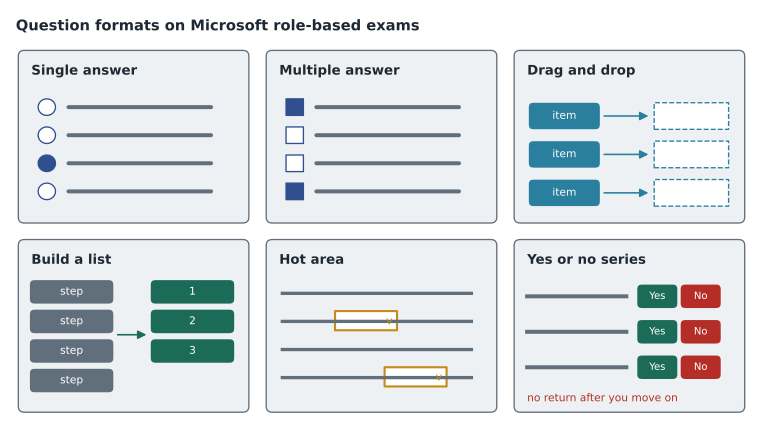
Multiple choice, single answer
The most common format gives a short scenario and four or more options, with one correct answer. On DP-800 the scenario is often a few lines about a table or a service, followed by a requirement such as 'You need to ensure that...'. The trap is that several options are partly right. If a question asks for the method that refreshes embeddings within a minute of a change without adding load to the insert path, a table trigger refreshes immediately but adds work to every insert, and a nightly job adds no load but takes a day. Only an option that is both quick and asynchronous meets both halves.
Elena's method for single-answer questions is to read the requirement sentence first, underline each constraint mentally, then read the options. For each option, ask whether it breaks any one constraint. Usually two options fall out at once, and the remaining two differ on one detail that the scenario has already settled.
Multiple choice, more than one answer
These questions say how many answers to choose, for example 'Each correct answer presents part of the solution. Choose two.' The question may be scored as a whole or give partial credit for each correct selection; the instruction on the screen says what applies. Selecting more than the stated number is not allowed by the interface.
There are two kinds of wording to watch for. 'Each correct answer presents part of the solution' means the selected options must work together, like the two permissions an application needs. 'Each correct answer presents a complete solution' means each selected option works alone, like two different ways to stop a data engineer from seeing card numbers. Mixing up the two is one of the most common errors on these exams. Hana saw two such questions in the diagnostic and got one wrong for exactly this reason.
Drag and drop and build a list
Drag-and-drop questions give a set of items and a set of targets. A candidate might drag T-SQL keywords into the blanks of a statement, or match change-handling methods to scenarios. Some items are distractors and are not used; some may be used more than once, and the instructions say which. Build-a-list questions ask the candidate to move steps into an answer area and put them in the right order, for example the steps to create an external model with a managed identity: create the database master key if needed, create the database scoped credential, create the external model, then grant EXECUTE on the model to the application's user.
Ordering questions reward people who have done the task. Hana's habit, from the design sessions, of writing a short plan before each change will help. When she cannot recall the order, she asks what each step depends on. A credential must exist before a model can name it. A user must exist before it can be granted anything. Dependencies usually reveal the sequence.
Hot area
A hot area question shows a diagram, a screen, a code listing or a table and asks the candidate to select a region of it, or to pick values from drop-down lists placed within it. A common DP-800 version shows a T-SQL statement with two or three drop-down boxes in place of a keyword, a function name or a number, such as a choice between VECTOR_DISTANCE and VECTOR_SEARCH, or between the metrics cosine, euclidean and dot. Each drop-down is usually scored separately.
Code-completion questions are covered in more depth in lesson 8. The key habit is to read the whole statement before choosing anything. The right value for the first box often depends on a clause near the end, such as an ORDER BY that only makes sense with a distance column.
Yes or no series
A yes or no series gives one scenario and then a set of proposed solutions, usually three, each on its own screen. For each, the candidate decides whether it meets the goal. These series are often marked so that once a candidate answers one and moves on, they cannot return to it. Because the solutions are judged separately, more than one can be right, or none.
The trap is the temptation to compare. Each proposal must be tested against the goal on its own. If the goal is to stop support staff from reading members' full email addresses while still letting them search by email, Dynamic Data Masking on the column meets the 'cannot read' half for non-privileged users, but the candidate must still check whether searches by exact value would work and whether the support role has the UNMASK permission. The fact that a later proposal might be better does not make an earlier one wrong.
Case studies
A case study is a longer scenario followed by several questions about it. On screen, the scenario is split into tabs or sections, such as Overview, Existing environment, Requirements and Technical constraints. Some questions refer to an exhibit, such as a table definition or a JSON configuration file. Within the case study a candidate can move back and forth between the questions and the scenario. When the case study ends, it locks, and the candidate cannot return to it.
Elena's advice for case studies is to read the first question before reading the scenario. That tells Hana what to look for. Then she reads the Requirements section carefully and skims the rest, coming back to it when a question points there. Requirements in case studies are often numbered or bulleted, and each question usually turns on one or two of them. A candidate who reads the whole scenario slowly before looking at any question can spend ten minutes reading details that no question uses.
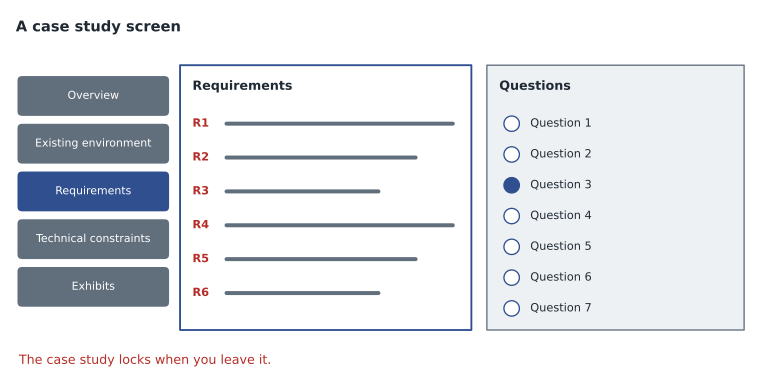
Case studies on DP-800 are likely to combine skill groups. A single company might need a JSON column, an RLS policy, a SQL database project in GitHub and a hybrid search over product descriptions. That is realistic and it is also why case studies are good practice: they force a candidate to keep several constraints in mind at once. Lesson 10 works through a full practice case study.
Review screens and sections
Most of the exam allows a candidate to mark a question for review and come back to it from a review screen before ending the section. Some parts do not: yes or no series and case studies usually lock once left, and the screen says so before the candidate moves on. The review screen lists questions by number and shows which are marked and which are unanswered.
Marking is useful but should be limited. Hana's rule will be to answer every question when she first sees it, even if she is unsure, and to mark only those where she thinks a minute more would help. A long list of marked questions at the end of a timed exam is a list of minutes she does not have. The pacing plan in lesson 11 includes a short block of time for review.
Interactive components
The certification page says the exam may include interactive components. Microsoft has used labs, in which candidates perform tasks in a live or simulated environment, on some exams in the past, and the format used on any exam can change. Rather than guess, Hana will rely on two sources: the exam sandbox, which shows the current formats, and the instructions on screen at the start of the exam, which list the sections and their rules. If a task-based item appears, the same rule applies as for every other question: read the goal, check each requirement, and do only what is asked.
Can candidates look things up?
In 2023 Microsoft announced that candidates in role-based exams could open Microsoft Learn documentation during the exam, in a restricted window within the exam interface. The clock keeps running while it is open. The rules can vary by exam and by delivery method, so Hana will read the current rules on the exam page and in the Pearson VUE instructions when she books, and will treat any such access as a fallback for a single fact. Searching documentation is slow. A candidate who needs to look up a third of the answers will run out of time, and DP-800's long T-SQL questions leave little slack.
Worked problem
Complete solution or part of a solution?
A question reads: 'An API reads member records through the view rewards.vMemberCard. The API must not be able to read the base table rewards.Member directly. Each correct answer presents part of the solution. Choose two.' The options are: A) GRANT SELECT ON rewards.vMemberCard to the API user; B) GRANT SELECT ON rewards.Member to the API user; C) make sure the view and the base table have the same owner; D) enable Row-Level Security on rewards.Member. Which two should be chosen?
Show solution
- The wording says 'part of the solution', so the two choices must work together.
- The API needs permission on the view: option A.
- It must not read the table, so option B is ruled out.
- With an unbroken ownership chain, SQL Server does not check permissions on the base table when it is reached through the view, so the API can read through the view without any grant on the table: option C.
- Row-Level Security filters rows; it does not decide whether a principal can query the table at all, so option D does not meet this requirement.
Answer: Choose A and C. Granting SELECT on the view and keeping the same owner for the view and the table lets the API read through the view while it has no permission on the base table itself.
Common mistakes
MistakeEvery multiple-answer question needs options that each work alone.
InsteadRead the instruction: 'part of the solution' means the options work together; 'a complete solution' means each works alone.
MistakeWithin a yes or no series, only one proposal can be correct.
InsteadEach proposal is judged on its own; several or none may meet the goal.
MistakeRead the whole case study scenario carefully before looking at any question.
InsteadRead the first question, then the requirements, and return to the rest of the scenario when a question points there.
MistakeMark every uncertain question and come back to all of them at the end.
InsteadAnswer every question the first time and mark only the few where extra time would really help.
MistakeA case study can be revisited after moving on to the next section.
InsteadCase studies lock when the candidate leaves them.
Summary and key terms
- Microsoft role-based exams use a fixed set of formats: single and multiple answer, drag and drop, build a list, hot area, yes or no series and case studies.
- In multiple-answer questions, 'part of the solution' and 'a complete solution' mean different things.
- Yes or no series and case studies usually lock once the candidate moves on.
- In a case study, read the first question and the requirements first; most questions turn on one or two requirements.
- Answer every question when first seen and mark only a few for review.
- Use the exam sandbox to see the current formats, and read the on-screen rules at the start of the exam.
- Case study
- A longer scenario split into sections, followed by several questions; it locks when the candidate leaves it.
- Yes or no series
- A set of proposed solutions to one goal, each judged separately as meeting the goal or not.
- Hot area
- A question in which the candidate selects a region of an exhibit or picks values from drop-down lists placed in it.
- Build a list
- A question in which the candidate moves steps into an answer area and puts them in order.
- Ownership chain
- The rule that permissions on a referenced object are not checked when the referencing object has the same owner.
Practice problems
Work each problem on paper first, then reveal the answer to check.
What is the difference between 'part of the solution' and 'a complete solution'?
Show answer
Part-of-the-solution options must work together; complete-solution options each meet the goal alone.
Which question types usually cannot be revisited once left?
Show answer
Yes or no series and case studies.
What should a candidate read first in a case study?
Show answer
The first question, and then the Requirements section.
Why are ordering questions easier for people who have done the task?
Show answer
They know the dependencies between steps, such as needing a credential before an external model can use it.
What should Hana use to see the current question formats before exam day?
Show answer
Microsoft's exam sandbox.
Lesson quiz · 5 questions
Score 60% or more to complete this lesson.
Create a free account to save your progress, take quizzes and earn a certificate.