
MSAZ-190 · Lesson 4 of 12 · 23 min
Reading a skills outline and building a study plan
▶ Video coming soon A video version of this lesson is on the way.
Keiko prints the DP-900 study guide and spreads it across the boardroom table: four skill areas, a dozen subskills, and under each subskill a list of bullet points beginning with verbs such as describe, identify and compare. "This is the whole exam?" she asks. "This is the whole scope of the exam," Renata says. "The questions can come at it from any direction, but they should not go outside it." This lesson shows how to read a skills outline closely, how to turn its weights into a study budget, and how to build a study plan that uses what research says about learning: spacing, retrieval practice and mixing topics. Theo's AZ-900 plan is the worked example, and the same method works for the other three exams.
The anatomy of a study guide
Each Microsoft study guide follows the same layout. At the top is the exam's audience profile, which describes who the exam is for and what they are expected to know already. AI-901's audience profile, for example, says candidates are at the beginning of their AI solution development careers and should be familiar with Python syntax and Azure resources; that single sentence tells Hana she will meet code on the exam. Next comes the skills measured section, dated with an "as of" date, listing the skill areas with their weight ranges. Each skill area breaks into subskills, and each subskill into specific bullet points. Finally, a change log compares the current version with the previous one, marking each item as unchanged, minor or major.
Read the change log every time you open a study guide. If you are using a book or a video course recorded before the current version, the change log tells you exactly which sections might be out of date. SC-900's guide, for instance, shows a version effective October 21, 2026, with minor changes in two areas: Microsoft Entra function and identity types, and threat protection with Microsoft Defender XDR. Ama's video course was recorded in spring 2026, so she knows to check those two areas against Microsoft Learn.
Reading the verbs
Fundamentals outlines are written almost entirely with the verbs describe and identify, with occasional compare, recognize or select. That tells you the level of the exam. A describe objective asks whether you understand what something is, what it is for and how it differs from similar things. It does not ask you to configure it step by step, write a script or troubleshoot a failure. So for an objective such as "describe the purpose of tags", you should be able to say what a tag is, why organizations use tags, which kinds of resources accept them and what tags do not do, such as automatically pass down from a resource group to its resources. You do not need to memorize command syntax.
The exception is AI-901, whose second skill area uses implement: "Implement generative AI apps and agents by using Foundry", and so on. The audience profile's mention of Python, REST APIs, SDKs and command-line tools confirms that AI-901 asks more practical questions than the other three. Hana plans more hands-on time than her colleagues as a result.
Weights are a budget, not a forecast
The weight ranges show what proportion of the exam each area represents. AZ-900's three areas are weighted 25 to 30, 35 to 40 and 30 to 35. Because they are ranges, they do not tell you exactly how many questions you will see on each topic, and the number of questions per area can differ between candidates. But they are the best guide you have to dividing study time. A simple method is to take the midpoint of each range, add them up, and give each area its share of your total study hours.
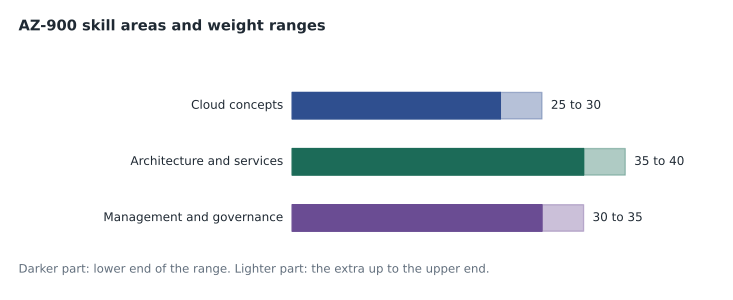
Theo has about 32 hours available before his January exam: roughly four hours a week for eight weeks. The midpoints of AZ-900's ranges are 27.5, 37.5 and 32.5, which add up to 97.5. Dividing each midpoint by the total and multiplying by 32 gives his budget. The code below does the arithmetic and rounds to the nearest half hour.
areas = {
    "Cloud concepts": (25, 30),
    "Architecture and services": (35, 40),
    "Management and governance": (30, 35),
}
hours = 32
mids = {name: (lo + hi) / 2 for name, (lo, hi) in areas.items()}
total = sum(mids.values())
for name, mid in mids.items():
    share = mid / total * hours
print(f"{name:28} {round(share * 2) / 2:5} hours")Cloud concepts 9.0 hours Architecture and services 12.5 hours Management and governance 10.5 hours
What this code does
Splits 32 hours of study time across the three AZ-900 skill areas in proportion to their weight on the exam, using the middle of each published weight range. The output gives the hours to spend on each area. Spending time where the exam puts its weight makes revision more efficient.
The result, about 9 hours, 12.5 hours and 10.5 hours, is a starting point. Theo then adjusts for what he already knows. He has run servers for six years, so the cloud concepts area, with its comparisons of capital and operating expenditure and of IaaS, PaaS and SaaS, will move quickly. Governance tools such as Azure Policy and resource locks are newer to him, so he moves two hours from cloud concepts to management and governance. A plan that ignores your starting point wastes time on what you know and starves what you do not.
Start with a diagnostic
The best way to find your starting point is to test it. In the first week, before studying anything new, take the free Microsoft practice assessment for your exam, which Lesson 5 describes, or work through a set of original practice questions covering every area. Do it untimed and without notes. The score matters less than the pattern: which areas are strong, which are weak, and which questions you got right by luck. Mark each question with a confidence level as you answer it: sure, unsure or guessed. A correct answer you guessed is a gap, not a strength.
Keiko's diagnostic for DP-900 shows strong results in relational data, which she uses every day, and weak results in non-relational data and real-time analytics, which she has never touched. Her plan gives those areas more than their weight alone would suggest.
Three study methods that work
Decades of learning research point to a few methods that reliably improve long-term recall. The first is spacing: study a topic, then return to it after a gap, rather than studying it once for a long time. Reviewing cloud concepts briefly in weeks 3, 5 and 7 helps more than an extra session in week 1. The second is retrieval practice: actively recalling information, for example by answering questions, explaining a concept aloud or writing a summary from memory, rather than rereading notes. Rereading feels productive but produces weaker memories. The third is interleaving: mixing topics within a session once you have learned the basics, so that you practise choosing which idea applies, which is exactly what the exam asks you to do.
A fourth habit makes the other three work: a mistakes log. Every time you get a practice question wrong or guess it, write down the question's topic, why the right answer is right, why your answer was wrong and what you will remember next time. Review the log at the start of each study session. By exam week, the log is your most valuable revision document, because it contains exactly your weak points and nothing else.
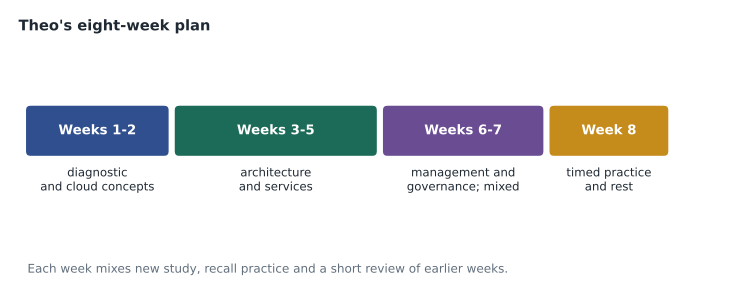
Theo's plan, week by week
| Weeks | Main focus | Every week also includes |
|---|---|---|
| 1-2 | Diagnostic; cloud concepts (MSAZ-101 lessons 1-4) | Mistakes log started; short recall quizzes |
| 3-5 | Architecture and services: regions, compute, networking, storage, identity | Ten-minute review of cloud concepts; one hands-on sandbox module |
| 6-7 | Management and governance: cost, Policy, locks, tools, monitoring | Mixed practice sets across all three areas |
| 8 | Practice assessment under exam timing; mistakes log review; rest the day before | No new topics |
The plan has three features worth copying. Every week revisits earlier material, which is spacing. Every session includes questions or explanations from memory, which is retrieval. From week 6 the practice sets mix all areas, which is interleaving. And the last week adds nothing new. The temptation in the final week is to cram one more topic; the better use of the time is to consolidate what you know, practise under exam conditions, and sleep.
Turning each bullet into a question
One of the most useful things you can do with a skills outline is rewrite every bullet point as a question you can answer from memory. "Describe the benefits of high availability and scalability in the cloud" becomes "What is the difference between high availability and scalability, and how does the cloud help with each?" "Identify options for data storage" becomes "Which Azure storage options suit files, objects, tables and relational data, and why?" Theo turns the AZ-900 outline into 41 questions on index cards, with the answer on the back in his own words. Each study session starts with ten cards drawn at random from those already covered. Cards he answers easily go to the back of the pile; cards he struggles with go into the mistakes log.
Writing the questions has a second benefit: it shows you which bullets you do not understand well enough to ask about. If you cannot turn an objective into a clear question, that objective is a gap, and it goes to the top of the next session. By the end of the plan, the cards are a complete, personal revision set that matches the official scope exactly, without borrowing a single word from any real exam.
Studying with other people
The Harrow & Finch group meets for half an hour every Friday lunch. Each person brings two questions they wrote that week from their own outline, and the others try to answer them. Explaining a concept to someone preparing for a different exam is a strong form of retrieval practice, because you cannot rely on shared jargon. When Ama explains Conditional Access to Keiko, she has to say what it does in plain words, and in doing so she discovers that she had been confusing it with multifactor authentication itself. A study partner, a group or even a willing friend with no technical background can serve the same purpose.
Adjusting the plan as you go
A plan is a hypothesis about what you need. Test it every two weeks with a short mixed practice set and compare the results with your diagnostic. If an area is still weak, move time to it. If an area is consistently strong, reduce it to brief reviews. If you fall behind, cut breadth before depth: it is better to understand the main services in each area well than to skim every bullet point. And if, two weeks before the exam, your practice results are well below where you want them, consider rescheduling while you still can; Lesson 2 explained why that is usually cheaper than failing.
Worked problem
Budgeting study time for DP-900
Keiko has 24 hours before her February exam. DP-900's four skill areas are weighted 25 to 30, 20 to 25, 15 to 20 and 25 to 30. Using midpoints, how many hours does each area get before adjustment? Her diagnostic shows non-relational data is her weakest area. How might she adjust?
Show solution
- Midpoints: 27.5, 22.5, 17.5 and 27.5. Their total is 95.
- Core data concepts: 27.5 / 95 x 24 is about 6.9 hours. Relational data: 22.5 / 95 x 24 is about 5.7 hours.
- Non-relational data: 17.5 / 95 x 24 is about 4.4 hours. Analytics: 27.5 / 95 x 24 is about 6.9 hours.
- Because relational data is her strength and non-relational her weakness, she might move two hours from relational to non-relational, giving about 3.7 and 6.4 hours.
Answer: About 7, 5.5, 4.5 and 7 hours before adjustment; then shift time from her strongest area to her weakest.
Keiko pins her budget to the wall beside her monitor. Under it she writes the three methods in large letters: space it, recall it, mix it. "Rereading is not studying," she says to Theo, who has just admitted to reading the same module three times.
Common mistakes
MistakeStudying from a book without checking the study guide's change log.
InsteadCompare your material with the current version and fill any gaps.
MistakeDividing study time equally across areas.
InsteadUse the weight ranges as a budget, then adjust for your diagnostic.
MistakeCounting a lucky guess as knowledge.
InsteadMark confidence on practice questions; guessed answers are gaps.
MistakeRereading notes as the main study method.
InsteadUse retrieval practice: questions, explanations and summaries from memory.
MistakeLearning a new topic the day before the exam.
InsteadUse the last week to consolidate, practise under time and rest.
Summary and key terms
- A study guide gives the audience profile, dated skills measured with weight ranges, subskills and a change log.
- Fundamentals objectives mostly use describe and identify; AI-901 also uses implement and expects some Python.
- Use the midpoints of the weight ranges to budget study hours, then adjust for your starting point.
- Begin with a diagnostic and mark confidence on every answer.
- Spacing, retrieval practice and interleaving improve long-term recall; keep a mistakes log.
- Revisit the plan every two weeks and cut breadth before depth if you fall behind.
- Audience profile
- The study guide's description of who the exam is for and what they should already know.
- Change log
- The study guide's comparison of the current and previous versions of the outline.
- Diagnostic
- A first practice test used to find strengths and gaps before studying.
- Spacing
- Returning to a topic after a gap rather than studying it all at once.
- Retrieval practice
- Recalling information from memory, for example by answering questions.
- Interleaving
- Mixing different topics within a study session.
Practice problems
Work each problem on paper first, then reveal the answer to check.
What does the change log show?
Show answer
Which parts of the outline changed since the previous version, and how much.
What do the verbs describe and identify tell you?
Show answer
The exam tests understanding and recognition, not step-by-step configuration.
Which fundamentals exam expects familiarity with Python?
Show answer
AI-901, according to its audience profile.
What are the midpoints of AZ-900's weight ranges?
Show answer
27.5, 37.5 and 32.5.
Why mark confidence on diagnostic answers?
Show answer
So that lucky guesses are treated as gaps.
What is interleaving?
Show answer
Mixing topics in a study session so you practise choosing which idea applies.
What should the last week before the exam contain?
Show answer
Consolidation, timed practice and rest, not new topics.
Lesson quiz · 5 questions
Score 60% or more to complete this lesson.
Create a free account to save your progress, take quizzes and earn a certificate.