
MSAZ-190 · Lesson 1 of 12 · 22 min
How Microsoft certification exams work
▶ Video coming soon A video version of this lesson is on the way.
On the first Friday of November 2026, Renata Kowal books the small boardroom at Harrow & Finch Home Supply in Winnipeg for a lunch hour and writes four exam codes on the whiteboard: AZ-900, AI-901, DP-900 and SC-900. Project Skylight is two months old, the first landing zone is running, and Dana Whitcombe, the chief financial officer, has agreed that the company will pay for one fundamentals exam for each of four people who want one. Theo Marchand, the systems administrator who has been Renata's shadow since September, wants AZ-900. Keiko Tanabe, who owns the nightly sales reports, wants DP-900. Hana Sato, the developer rebuilding the loyalty app, wants AI-901. Ama Boateng, an analyst on Sunil Rao's security team, wants SC-900. "Before anyone opens a study guide," Renata says, "you need to know how the exams themselves work. Most people who fail a fundamentals exam do not fail on the content. They fail on surprises."
This course is the readiness and review course shared by the four Microsoft fundamentals programs on this site. If you are preparing for AZ-900, you will have taken MSAZ-101 and MSAZ-102. The other three programs each have their own pair of courses. The lessons here explain how the exams are built and scored, how to book one, what the questions look like, how to plan and practise, and how to manage your time. Four lessons then review each exam's published skills outline with original practice items, and the last two cover common traps and what happens on exam day and after. Everything here was checked against Microsoft's own pages in November 2026, and anything that could not be confirmed is marked as such. The scenes in later lessons follow the four candidates through the weeks Renata has planned for them, from mid-November 2026 to their exams in early 2027; they show the plan as it is meant to unfold, and every exam date in them is still to come.
The levels of Microsoft certification
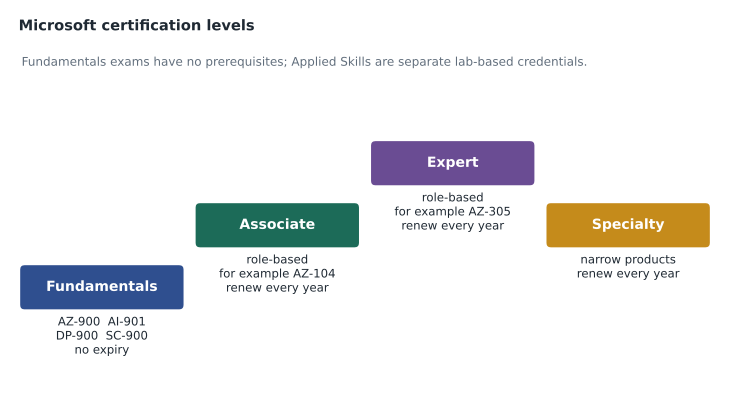
Microsoft groups its certifications into levels. Fundamentals certifications sit at the entry level and prove that you understand the concepts and the main services in an area, without needing to have built or run them in production. Role-based certifications come next, at the associate level and then the expert level. They are named after jobs, such as administrator, developer, engineer, analyst or architect, and they test whether you can do the work. Specialty certifications cover narrower products or scenarios. Separately from all of these, Microsoft offers Applied Skills credentials, which are earned by completing a hands-on lab assessment rather than a traditional exam. You will also see Microsoft Office Specialist exams for desktop applications, which have their own rules and are delivered differently.
Each fundamentals certification is earned by passing a single exam. AZ-900 earns Microsoft Certified: Azure Fundamentals. AI-901 earns Microsoft Certified: Azure AI Fundamentals, which until 2026 was earned with an older exam numbered AI-900. DP-900 earns Azure Data Fundamentals, and SC-900 earns Security, Compliance, and Identity Fundamentals. None of them has a prerequisite. You can take them in any order, and you do not need a fundamentals certification before attempting an associate exam. Many people take one anyway, because it is shorter, cheaper and narrower, and it proves that their study habits work before they tackle a longer exam.
What the letters mean
Exam codes begin with letters that hint at the subject. AZ exams are about Azure infrastructure, administration, development and architecture. AI exams cover artificial intelligence on Azure. DP exams are about data platforms, analytics and databases. SC exams cover security, compliance and identity. Others you may meet include PL for the Power Platform, MS for Microsoft 365 and MB for Dynamics 365 business applications. The number after the letters is a rough guide to the level: the 900 series are fundamentals, while lower numbers are usually associate or expert exams. Microsoft retires and replaces exams regularly, sometimes keeping the certification name and changing the exam code, as it did when AI-901 replaced AI-900. Always check the certification page to see which exam currently earns it.
| Certification | Exam | Skills outline dated | Courses on this site |
|---|---|---|---|
| Azure Fundamentals | AZ-900 | July 20, 2026 | MSAZ-101, MSAZ-102, MSAZ-190 |
| Azure AI Fundamentals | AI-901 | April 15, 2026 | MSAZ-110, MSAZ-111, MSAZ-190 |
| Azure Data Fundamentals | DP-900 | July 21, 2026 | MSAZ-120, MSAZ-121, MSAZ-190 |
| Security, Compliance, and Identity Fundamentals | SC-900 | October 21, 2026 | MSAZ-130, MSAZ-131, MSAZ-190 |
How long fundamentals exams last
Microsoft's exam duration page, checked for this course in November 2026, lists fundamentals exams at 45 minutes of exam time and 65 minutes of seat time. Seat time is the whole appointment: reading the instructions, accepting the candidate agreement, answering the questions and, if you wish, leaving comments at the end. The same page says that most Microsoft exams have between 40 and 60 questions, but that the number varies by exam. Microsoft does not publish an exact count for each exam, and the count can change between versions, so treat any precise number you read elsewhere as an estimate. Lesson 6 shows how to plan your pace without knowing the count in advance.
Associate and expert exams are longer. Role-based exams without labs are listed at 100 minutes of exam time, and exams that may include labs at 120 minutes. Some role-based exams also let candidates open Microsoft Learn documentation during the exam. That feature is not available on fundamentals exams, so you cannot look anything up on AZ-900, AI-901, DP-900 or SC-900. Everything has to be in your head.
How scores work
Microsoft reports technical exam scores on a scale from 1 to 1,000, and the passing score for each of the four fundamentals exams is 700 or greater. That number appears on every one of the four study guides. The most important thing to understand about it is that it is a scaled score. Microsoft's scoring page says plainly that 700 may not equal 70 of every 100 points, because the passing standard reflects the knowledge needed to show competence and the difficulty of the particular questions you receive. Two candidates may see different but equivalent sets of questions; scaling puts their results on the same line. So the question "how many do I need to get right?" has no precise answer, and anyone who gives one is guessing.
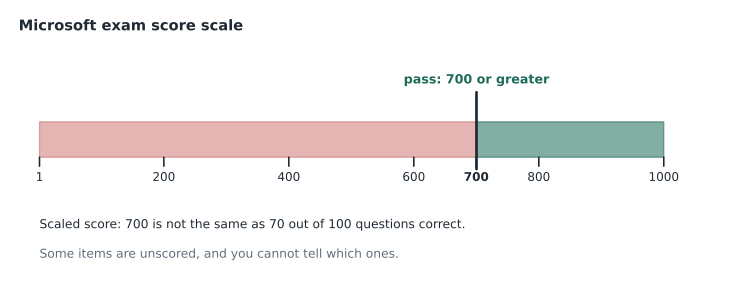
Three other scoring rules shape your strategy. First, there is no penalty for guessing: a wrong answer simply earns no points, so you should never leave a question blank. Second, most multi-part questions give one point for each part you get right, so you can earn some of the points on a question even if you miss one part. A question worth more than one point says so, and any other scoring method is noted in the question. Third, some questions are unscored. Microsoft uses them to try out new material, and you cannot tell which ones they are, so you should treat every question as if it counts. Lesson 3 returns to these rules when it looks at each question format.
Skills outlines and study guides
Every Microsoft exam has a study guide page with a skills outline: the list of what the exam measures, grouped into skill areas, each with a weight range. For AZ-900, for example, "Describe cloud concepts" is weighted 25 to 30, "Describe Azure architecture and services" 35 to 40, and "Describe Azure management and governance" 30 to 35. The ranges tell you roughly how much of the exam each area represents, and they are the best guide you have for dividing your study time. Each study guide also shows the date of the current version, a change log comparing it with the previous version, and a note that the English version is updated first, with other languages usually following about eight weeks later. If an exam is not offered in your preferred language, the study guide says you can request an extra 30 minutes.
The outline is a promise about scope, not a list of questions. A question can approach a listed skill from any angle, and the exam can include features in preview if they are commonly used. What the outline does guarantee is that a skill not on it should not be tested. That makes the outline your most useful study tool, and Lesson 4 shows how to turn it into a plan.
How long a certification lasts
Microsoft's credential expiration policy states that fundamentals certifications do not expire. Once Theo passes AZ-900, he holds Azure Fundamentals for good, even if the exam is later updated or replaced. Role-based and specialty certifications work differently. They are valid for one year from the date you earn them, and you keep them by passing a free online renewal assessment on Microsoft Learn before the expiry date. If a role-based certification lapses, you have to earn it again by passing the exam. Renata, who holds two role-based certifications, renews both every year and says the renewal assessments take about an evening each. That difference is one reason fundamentals exams are popular as a first step: there is nothing to maintain.
The candidate agreement
Before every exam, you accept Microsoft's candidate agreement. Among other things, it commits you to keep the exam content confidential, not to copy or record questions, and not to receive help from anyone or any tool during the exam, including artificial intelligence tools. Microsoft can revoke certifications and ban candidates who break it. That has a practical consequence for studying: any website or file that claims to contain real exam questions is offering you material that was obtained by breaking the agreement. Using it puts your certification at risk, and it rarely helps anyway, because Microsoft updates its question pools. Lesson 5 shows where to find legitimate practice material.
Worked problem
Choosing a first fundamentals exam
Renata asks each of the four candidates why they picked their exam. (a) Theo manages servers and is moving them to Azure. (b) Keiko builds sales reports and is about to move them to a new data platform. (c) Hana writes code and has been asked to prototype a customer-service assistant. (d) Ama triages security alerts and is joining the identity team's review of sign-in policies. Is each choice sensible, and what might each do next?
Show solution
- (a) AZ-900 covers Azure's core architecture, services, cost and governance, which matches Theo's work. An administrator associate exam would be a natural next step.
- (b) DP-900 covers data concepts, relational and non-relational data on Azure and analytics, which matches Keiko's reporting move. A data analyst or analytics certification could follow.
- (c) AI-901 covers AI concepts and building AI solutions with Microsoft Foundry, and it expects some Python, which suits Hana as a developer.
- (d) SC-900 covers security, compliance and identity concepts and Microsoft's products for each, which matches Ama's role and the identity review.
- Each choice follows the work the person does now or will do soon, which is the best reason to choose an exam.
Answer: All four choices are sensible. Match the first exam to the work, then build toward a role-based certification.
Renata finishes the lunch by drawing a line under the four codes and writing a month beside each: January for Theo, February for Keiko and Ama, March for Hana. "Those are targets, not bookings," she says. "By the end of this course you will know exactly what booking involves." Theo takes a photo of the whiteboard for the shared study notebook the group sets up that afternoon.
Common mistakes
MistakeThinking 700 means 70 of every 100 questions correct.
InsteadIt is a scaled score; how many you need depends on the questions you get.
MistakeLeaving hard questions blank.
InsteadThere is no penalty for guessing, so answer every question.
MistakeAssuming a fundamentals exam is a prerequisite for an associate exam.
InsteadFundamentals certifications have no prerequisites and are not required for later exams.
MistakePlanning to renew a fundamentals certification.
InsteadFundamentals certifications do not expire.
MistakeTreating a third-party question count as official.
InsteadMicrosoft says most exams have 40 to 60 questions; the count varies.
Summary and key terms
- Microsoft certifications are grouped into fundamentals, role-based associate and expert, and specialty levels; Applied Skills are separate lab-based credentials.
- Each fundamentals certification is earned with one exam and has no prerequisites.
- Fundamentals exams are listed at 45 minutes of exam time and 65 minutes of seat time; most Microsoft exams have 40 to 60 questions.
- Scores run from 1 to 1,000; a pass is 700 or greater, and it is a scaled score, not a simple count.
- There is no guessing penalty, most multi-part questions give partial credit, and some questions are unscored.
- Fundamentals certifications do not expire; role-based and specialty certifications are renewed each year with a free online assessment.
- The candidate agreement forbids sharing or using real exam content.
- Fundamentals certification
- An entry-level Microsoft certification earned with a single exam, with no expiry.
- Role-based certification
- An associate or expert certification named after a job role and renewed every year.
- Scaled score
- A score adjusted for the difficulty of the questions a candidate received, reported from 1 to 1,000.
- Skills outline
- The published list of skill areas and weights an exam measures.
- Seat time
- The full appointment length, including instructions, agreement and comments.
- Unscored item
- A question used to try out new material that does not count toward the score.
Practice problems
Work each problem on paper first, then reveal the answer to check.
What score is needed to pass AZ-900?
Show answer
700 or greater on a scale from 1 to 1,000.
Does 700 mean 70 of every 100 questions correct?
Show answer
No. It is a scaled score that reflects the difficulty of the questions received.
How long is the exam time on a fundamentals exam?
Show answer
45 minutes, within 65 minutes of seat time.
Which exam now earns Azure AI Fundamentals?
Show answer
AI-901.
Do fundamentals certifications expire?
Show answer
No. Microsoft's policy says they do not expire.
How is a role-based certification kept current?
Show answer
By passing a free online renewal assessment before it expires each year.
Can you look up documentation during a fundamentals exam?
Show answer
No. Learn access is not available on fundamentals exams.
Lesson quiz · 5 questions
Score 60% or more to complete this lesson.
Create a free account to save your progress, take quizzes and earn a certificate.