
MEC-250 · Lesson 5 of 12 · 28 min
Dislocations and strengthening mechanisms
Kestrel buys steel in several forms. Shaft blanks arrive as hot-rolled bar and are forged at about 1200 °C. Hitch pins are machined from cold-drawn bar, which is stronger than the same steel hot rolled. Brackets are cut and bent from microalloyed plate, a low-carbon steel with tiny additions of niobium and vanadium that gives a high yield strength without heat treatment. Last month a batch of brackets cracked on the outside of a bend in the press brake. Amira was asked to find out why, and the answer lay in how dislocations move and how they can be stopped. This lesson explains plastic deformation at the scale of dislocations and the four main ways of making a metal stronger.
Why metals are weaker than their bonds
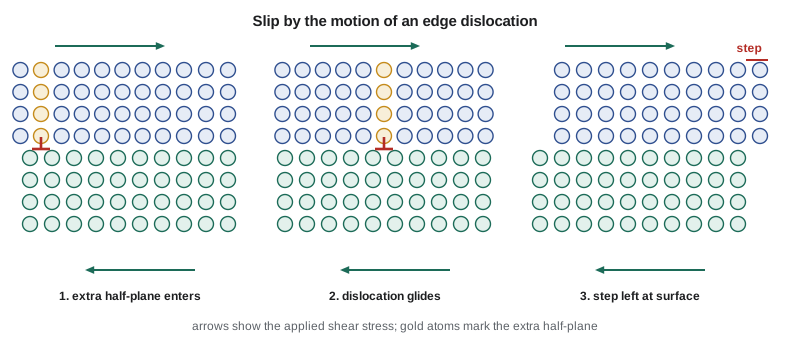
If a perfect crystal deformed by sliding one whole plane of atoms over another at once, every bond across the plane would have to break simultaneously. A simple estimate of the shear stress needed is about \(G/10\) to \(G/30\), several gigapascals for iron with \(G = 80\ \text{GPa}\). Real annealed iron yields at a few tens of megapascals, a hundred times less. The explanation, proposed in the 1930s and confirmed when dislocations were seen in the electron microscope, is that plastic deformation happens by the movement of dislocations. As a dislocation glides, only the bonds along its line break and reform at any moment, so the stress needed is far smaller. The familiar analogy is moving a large rug by pushing a ruck along it rather than dragging the whole rug at once.
When a dislocation passes completely through a crystal, the part above its slip plane has moved relative to the part below by one Burgers vector, creating a small step on the surface. Millions of dislocations moving on many planes produce visible slip bands and the large plastic strains of metal forming. Dislocations also multiply as they move, through mechanisms such as the Frank–Read source, so a metal's dislocation density increases dramatically as it is deformed.
Slip systems
Dislocations move most easily on the most densely packed planes and in the most densely packed directions, where the Burgers vector is shortest and the lattice distortion smallest. A slip plane together with a slip direction in it forms a slip system. FCC metals slip on the four \(\{111\}\) planes, each containing three \(\langle 110 \rangle\) directions, giving 12 slip systems. BCC metals have no truly close-packed plane; they slip in \(\langle 111 \rangle\) directions on \(\{110\}\), \(\{211\}\) and \(\{321\}\) planes, giving up to 48 systems, although many need higher stresses. HCP metals slip easily only on the basal plane, which has three slip directions, so they have few easy slip systems.
The number of available slip systems explains much about ductility. FCC metals such as aluminium, copper and austenitic stainless steel stay ductile even at cryogenic temperatures. HCP metals such as magnesium and zinc are less ductile at room temperature because a polycrystal needs at least five independent slip systems for every grain to change shape to match its neighbours, and basal slip alone does not provide them. BCC metals, including ordinary steels, have plenty of slip systems, but dislocation motion in BCC becomes much harder at low temperatures, which causes the ductile-to-brittle transition discussed in Lesson 6.
Resolved shear stress and Schmid's law
Dislocations respond only to shear stress acting on their slip plane in their slip direction. When a single crystal is pulled with tensile stress \(\sigma\), the resolved shear stress on a particular slip system depends on the angle \(\phi\) between the load axis and the slip plane normal, and the angle \(\lambda\) between the load axis and the slip direction:
The product \(\cos\phi\cos\lambda\) is the Schmid factor, with a maximum possible value of 0.5 when both angles are 45°. Slip begins on the system with the largest Schmid factor when the resolved shear stress reaches the critical resolved shear stress \(\tau_{\text{crss}}\), a property of the material. The tensile yield strength of the single crystal is therefore \(\sigma_y = \tau_{\text{crss}}/(\cos\phi\cos\lambda)_{\max}\). Because the Schmid factor depends on orientation, single crystals of the same metal can yield at very different stresses depending on how they are cut.
Worked problem
Yield of a copper single crystal
A copper single crystal is pulled along a direction that makes \(\phi = 48^\circ\) with the normal of the most favourable slip plane and \(\lambda = 44^\circ\) with its slip direction. The critical resolved shear stress is 0.70 MPa. At what tensile stress does it yield?
Show solution
- Schmid factor: \(\cos 48^\circ \cos 44^\circ = 0.669 \times 0.719 = 0.481\).
- \[\sigma_y = \frac{\tau_{\text{crss}}}{\cos\phi\cos\lambda} = \frac{0.70}{0.481} = 1.45\ \text{MPa}\]
Answer: High-purity annealed copper single crystals really are this soft, which shows how easily dislocations glide when nothing obstructs them. Commercial copper is far stronger because grain boundaries, solute atoms and other dislocations get in the way.
The program below finds all 12 FCC slip systems and computes their Schmid factors for any loading direction. Along \([001]\), eight systems share the largest factor, 0.408; along \([123]\), a single system has a factor of 0.467 and slips first. In a polycrystal, each grain has a different orientation, and the grains must deform compatibly. The average effect is captured by the Taylor factor, about 3.1 for FCC metals: the polycrystal's tensile yield strength is about 3.1 times the critical resolved shear stress.
# Schmid factors for FCC slip, Hall-Petch strengthening and cold work
import math, itertools

def unit(v):
    m = math.sqrt(sum(c * c for c in v)); return [c / m for c in v]
def dot(a, b): return sum(x * y for x, y in zip(a, b))

normals = [(1, 1, 1), (-1, 1, 1), (1, -1, 1), (1, 1, -1)]
dirs = [d for d in itertools.product((-1, 0, 1), repeat=3) if sorted(map(abs, d)) == [0, 1, 1]]
systems = []
for nrm in normals:
    for d in dirs:
        if dot(nrm, d) == 0 and (-d[0], -d[1], -d[2]) not in [s[1] for s in systems if s[0] == nrm]:
            systems.append((nrm, d))
print(f"FCC slip systems found: {len(systems)}")

def schmid_table(load):
    L = unit(load); out = []
    for nrm, d in systems:
        m = abs(dot(L, unit(nrm))) * abs(dot(L, unit(d)))   # cos(phi) * cos(lambda)
        out.append((m, nrm, d))
    return sorted(out, reverse=True)

tau_crss = 0.70   # MPa, typical order for annealed high-purity copper
for load in ((0, 0, 1), (1, 1, 1), (1, 2, 3)):
    t = schmid_table(load)
    m, nrm, d = t[0]
    active = sum(1 for x in t if abs(x[0] - m) < 1e-9)
    ix = lambda v: ' '.join(f"{c:d}" for c in v)
    print(f"load along [{ix(load)}]: max Schmid factor {m:.3f} on ({ix(nrm)})[{ix(d)}],"
          f" shared by {active} system(s); single-crystal yield = {tau_crss / m:.2f} MPa")

# Hall-Petch: sigma_y = sigma_0 + k / sqrt(d), typical constants for a low-carbon ferritic steel
s0, k = 70.0, 0.74          # MPa, MPa*m^0.5
print("\nmean intercept (um)  ASTM G (approx)  yield (MPa)")
for d_um in (100, 50, 20, 10, 5, 2):
    d = d_um * 1e-6
    G = -6.6457 * math.log10(d_um / 1000) - 3.298     # mean intercept (mm) to ASTM number, approximate
    print(f"   {d_um:5.0f}            {G:4.1f}          {s0 + k / math.sqrt(d):6.0f}")

# Cold work: percent reduction in area for drawn wire
d0 = 10.0
print("\ndrawn diameter (mm)  % cold work")
for dd in (9.0, 8.0, 7.0, 6.0, 5.0):
print(f" {dd:4.1f} {100 * (1 - (dd / d0) ** 2):5.1f}")FCC slip systems found: 12
load along [0 0 1]: max Schmid factor 0.408 on (1 1 1)[0 -1 1], shared by 8 system(s); single-crystal yield = 1.71 MPa
load along [1 1 1]: max Schmid factor 0.272 on (1 1 -1)[0 -1 -1], shared by 6 system(s); single-crystal yield = 2.57 MPa
load along [1 2 3]: max Schmid factor 0.467 on (-1 1 1)[-1 0 -1], shared by 1 system(s); single-crystal yield = 1.50 MPa
mean intercept (um) ASTM G (approx) yield (MPa)
100 3.3 144
50 5.3 175
20 8.0 235
10 10.0 304
5 12.0 401
2 14.6 593
drawn diameter (mm) % cold work
9.0 19.0
8.0 36.0
7.0 51.0
6.0 64.0
5.0 75.0Strengthening: making dislocations work harder
Since plastic deformation means dislocation motion, every strengthening mechanism works by making that motion harder. There are four main mechanisms in metals, and most engineering alloys use several at once.
1. Grain size reduction
A dislocation gliding through one grain cannot simply continue into the next, because the slip planes and directions change orientation at the boundary. Dislocations pile up against boundaries, and the stress concentration at the head of the pile-up must activate slip in the neighbouring grain. Smaller grains mean shorter pile-ups and smaller stress concentrations, so a higher applied stress is needed. The result is the Hall–Petch relation:
Here \(d\) is the average grain diameter, \(\sigma_0\) the friction stress and \(k_y\) a constant. For low-carbon ferritic steel, typical values are \(\sigma_0 \approx 70\ \text{MPa}\) and \(k_y \approx 0.74\ \text{MPa·m}^{1/2}\). Grain refinement is unique among the strengthening mechanisms because it also improves toughness and lowers the ductile-to-brittle transition temperature. That is why controlled rolling of microalloyed steels, where small niobium, titanium and vanadium carbonitride particles pin grain boundaries and prevent grain growth, is the basis of modern pipeline, ship and structural plate.
Worked problem
Grain refinement in a bracket steel
Using \(\sigma_0 = 70\ \text{MPa}\) and \(k_y = 0.74\ \text{MPa·m}^{1/2}\), compare the yield strength of a ferritic steel with grains of 50 µm and 10 µm.
Show solution
- For 50 µm: \(d^{-1/2} = (50 \times 10^{-6})^{-1/2} = 141.4\ \text{m}^{-1/2}\), so \(\sigma_y = 70 + 0.74(141.4) = 175\ \text{MPa}\).
- For 10 µm: \(d^{-1/2} = 316.2\ \text{m}^{-1/2}\), so \(\sigma_y = 70 + 0.74(316.2) = 304\ \text{MPa}\).
Answer: Refining the grains five times increases the yield strength by about 75 percent with no change in composition. Microalloyed plate gets most of its strength this way, with precipitation adding the rest, which is how Kestrel's bracket steel reaches a minimum yield strength of 350 to 420 MPa without quenching.
2. Solid solution strengthening
Solute atoms distort the lattice around them. A substitutional atom larger than the host compresses its neighbours; a smaller one stretches them; an interstitial atom distorts the lattice strongly. These strain fields interact with the strain fields of dislocations, pinning them or making their motion harder. Strength rises with solute concentration. Brass, a copper–zinc solid solution, is much stronger than pure copper; nickel strengthens copper in cupronickel; manganese and silicon strengthen ferrite in plain steels. Carbon and nitrogen in ferrite are especially potent because they collect around dislocations, forming atmospheres that anchor them. Breaking dislocations away from these atmospheres causes the sharp upper yield point of low-carbon steels.
3. Strain hardening (cold work)
As a metal is plastically deformed at room temperature, its dislocation density rises enormously, and dislocations increasingly tangle with and obstruct each other. The metal becomes harder and stronger but less ductile. This is strain hardening, also called work hardening or cold working. The amount of cold work is expressed as the percent reduction in cross-sectional area:
Cold-drawn bar, cold-rolled sheet, spring wire and drawn copper wire all rely on strain hardening. The price is ductility: a steel that elongates 30 percent when annealed may elongate only a few percent after 50 percent cold work. This was the cause of Kestrel's cracked brackets. The supplier had shipped plate that had been cold levelled heavily to flatten it, and the extra cold work, added to the bending strain on the outside of a tight bend, used up the remaining ductility. The fix was to specify a larger inside bend radius and to return the plate.
Worked problem
Cold work in drawn wire
Steel wire is drawn from 10.0 mm to 7.0 mm in diameter. What is the percent cold work?
Show solution
- \[\%\text{CW} = \Big[1 - \Big(\frac{d_d}{d_0}\Big)^2\Big] \times 100 = \Big[1 - \Big(\frac{7.0}{10.0}\Big)^2\Big] \times 100 = 51\,\%\]
Answer: Half the cross-section has been squeezed out into extra length. For a typical low-carbon steel, 50 percent cold work roughly doubles the yield strength and cuts elongation to a few percent. If more reduction is needed, the wire is annealed between drawing passes to restore ductility.
4. Second-phase particles
Fine, hard particles of a second phase obstruct dislocations very effectively. If the particles are small and closely spaced, dislocations must either cut through them or bow around them, leaving loops behind. Precipitation hardening produces such particles by a controlled heat treatment and is the main strengthening method in high-strength aluminium alloys and many nickel superalloys; Lesson 9 covers it. Dispersion strengthening uses particles that do not dissolve, such as oxides. In steels, carbide particles in tempered martensite, and the hard martensite itself, are the most powerful strengtheners of all; Lesson 8 covers those.
| Mechanism | What blocks dislocations | Effect on ductility and toughness | Example at Kestrel |
|---|---|---|---|
| Grain refinement | Grain boundaries | Improves both | Microalloyed bracket plate |
| Solid solution | Lattice strain around solute atoms | Slight reduction | Manganese in plain carbon steel |
| Strain hardening | Other dislocations | Large reduction | Cold-drawn hitch pin bar |
| Precipitation and dispersion | Fine second-phase particles | Moderate reduction | Heat-treated aluminium housings |
| Martensite and tempering | Supersaturated carbon and fine carbides | Depends on tempering | Quenched and tempered shafts |
Recovery, recrystallization and grain growth
Cold-worked metal stores energy in its dislocations, and heating it releases that energy in three stages. During recovery, at moderate temperatures, dislocations rearrange into lower-energy arrays and internal stresses are relieved, with little change in strength; stress-relief anneals use this stage. During recrystallization, new strain-free grains nucleate and grow, consuming the deformed structure, and the strength and ductility return to near their annealed values. The recrystallization temperature is typically 0.3 to 0.5 of the absolute melting temperature, and it falls as the amount of prior cold work increases. Finally, if heating continues, grain growth occurs: larger grains consume smaller ones to reduce the total boundary area, and strength and toughness fall.
The distinction between hot and cold working follows from recrystallization. Hot working, such as forging Kestrel's shaft blanks at 1200 °C, is done above the recrystallization temperature, so the metal recrystallizes continuously and does not strain harden; large deformations are possible with modest forces, but surfaces oxidize and dimensions are less precise. Cold working is done below the recrystallization temperature, giving strength, good surface finish and close tolerances, at the cost of higher forces and lower ductility. Lead and tin recrystallize below room temperature, so bending them at room temperature is technically hot working.
Common mistakes
MistakeThinking slip happens by whole planes sliding at once.
InsteadSlip happens by dislocation motion, which needs far less stress.
MistakeUsing the tensile stress directly as the stress driving slip.
InsteadOnly the resolved shear stress, σ cos φ cos λ, on the slip system matters.
MistakeAssuming any strengthening is good for a part that must be bent or formed.
InsteadMost mechanisms reduce ductility; only grain refinement improves toughness.
MistakeCalculating percent cold work from diameters without squaring.
InsteadCold work uses areas: 1 − (d_d/d₀)².
MistakeTreating recrystallization temperature as a fixed property.
InsteadIt falls with more prior cold work and depends on time and purity.
Summary and key terms
- Plastic deformation occurs by dislocation glide at stresses far below the theoretical shear strength.
- FCC metals have 12 {111}⟨110⟩ slip systems; BCC slip in ⟨111⟩ directions; HCP has few easy systems.
- Slip starts when the resolved shear stress σ cos φ cos λ reaches the critical resolved shear stress.
- Hall–Petch: σ_y = σ₀ + k_y d^(−1/2); grain refinement raises both strength and toughness.
- Solute atoms, other dislocations and fine particles also obstruct dislocations.
- Cold work, %CW = (A₀ − A_d)/A₀ × 100, raises strength and lowers ductility.
- Annealing proceeds by recovery, recrystallization and grain growth; hot working occurs above the recrystallization temperature.
- Slip system
- A combination of slip plane and slip direction on which dislocations move.
- Resolved shear stress
- The component of applied stress acting along a slip direction on a slip plane.
- Schmid factor
- The product cos φ cos λ relating tensile stress to resolved shear stress.
- Critical resolved shear stress
- The resolved shear stress needed to start slip in a single crystal.
- Hall–Petch relation
- The increase of yield strength with the inverse square root of grain size.
- Strain hardening
- Strengthening by plastic deformation that increases dislocation density.
- Recrystallization
- Formation of new strain-free grains in a cold-worked metal on heating.
- Hot working
- Deformation above the recrystallization temperature.
Practice problems
Work each problem on paper first, then reveal the answer to check.
Find the tensile stress to start slip in a crystal with φ = 60°, λ = 35° and τ_crss = 1.0 MPa.
Show answer
Schmid factor 0.410; σ = 2.44 MPa.
Why is the maximum possible Schmid factor 0.5?
Show answer
cos φ cos λ is largest when φ = λ = 45°, giving 0.707 × 0.707.
Using the Hall–Petch constants in the lesson, what grain size gives a yield strength of 250 MPa?
Show answer
d^(−1/2) = 243 m^(−1/2), so d ≈ 17 µm.
A copper rod is drawn from 20 mm to 16 mm diameter. What is the percent cold work?
Show answer
36 %.
Which strengthening mechanism would you choose for a part that must be strong and tough at −40 °C, and why?
Show answer
Grain refinement, because it raises yield strength and lowers the ductile-to-brittle transition temperature.
Use the program to find the maximum Schmid factor for loading along [1 1 0].
Show answer
0.408, shared by four systems.
Lesson quiz · 5 questions
Score 60% or more to complete this lesson.
Create a free account to save your progress, take quizzes and earn a certificate.