
MEC-250 · Lesson 11 of 12 · 29 min
Ceramics and composites
Two projects landed on Amira's desk in her last month at Kestrel. The first was a warranty question from the hydraulic pump line: the pump's shaft seal uses a pair of silicon carbide faces, lapped flat and pressed together, and one customer had returned a pump with a chipped seal face. The second was a design study for a lighter, longer drive shaft for a self-propelled sprayer, where a steel tube would have to spin uncomfortably close to its whirling speed. The answers lay in two classes of material that behave very differently from metals: ceramics, which are hard, stiff and heat resistant but brittle, and composites, which combine materials to get properties none of them has alone.
What makes a ceramic
Ceramics are inorganic, non-metallic compounds, most often of metals with oxygen, carbon or nitrogen: alumina (\(\text{Al}_2\text{O}_3\)), zirconia (\(\text{ZrO}_2\)), silicon carbide (SiC), silicon nitride (\(\text{Si}_3\text{N}_4\)) and many others, along with glasses, clay products, cements and refractories. Their bonds are ionic, covalent or a mixture, as Lesson 1 showed. These strong, directional or charge-constrained bonds give ceramics high melting points, high hardness, high stiffness, low density compared with metals of similar stiffness, chemical stability and, usually, low thermal and electrical conductivity. They also leave no easy way for dislocations to move at room temperature, so ceramics do not yield. They break.
In ionic ceramics, the crystal structure is governed by two requirements: the crystal must be electrically neutral, and each cation should touch as many anions as possible without the anions touching each other. The ratio of cation to anion radius sets the coordination number. Sodium chloride and magnesium oxide have the rock-salt structure, with each ion surrounded by six of the other kind. Zinc blende and many covalent compounds such as SiC have tetrahedral coordination. Zirconia and uranium dioxide adopt the fluorite structure. Silicates, the basis of clays, cements and glasses, are built from \(\text{SiO}_4\) tetrahedra linked in chains, sheets or networks. When the network is disordered, the result is glass.
Brittle fracture and the role of flaws
Ceramics fail in tension by the rapid growth of a crack from a pre-existing flaw: a pore, an inclusion, a grain-boundary crack or a surface scratch. With fracture toughness values of only 3 to 6 MPa·m\(^{1/2}\) for most engineering ceramics, the critical flaw size at useful stresses is a few tens of micrometres. Strength therefore depends on the largest flaw in the stressed volume, not on an intrinsic material property, and it varies widely from piece to piece. Compressive strength is much higher, often ten times the tensile strength, because compressive stresses close cracks rather than opening them.
Because ceramics are hard to grip and machine into tensile specimens, their strength is usually measured in bending. A rectangular bar is supported near its ends and loaded at the centre (three-point bending) or at two points (four-point bending). The flexural strength, or modulus of rupture, is the maximum tensile stress at fracture, which for a three-point test on a rectangular bar is
where \(F_f\) is the fracture load, \(L\) the span between supports, \(b\) the width and \(d\) the depth. Flexural strengths are higher than true tensile strengths of the same material, because only a small volume near the bottom surface is under peak stress, and the chance of finding a large flaw there is lower.
Worked problem
Flexural strength of an alumina bar
An alumina bar 4 mm wide and 3 mm deep is broken in three-point bending over a 40 mm span at a load of 300 N. Find its flexural strength.
Show solution
- \[\sigma_{fs} = \frac{3(300)(40)}{2(4)(3)^2} = \frac{36\,000}{72} = 500\ \text{MPa}\]
Answer: A strength of 500 MPa is typical of a good dense alumina. A batch of nominally identical bars might give values from 350 to 600 MPa, which is why ceramic strength is reported statistically.
Weibull statistics
The scatter in ceramic strength is described by the Weibull distribution. The probability that a specimen of volume \(V\) survives a stress \(\sigma\) is
where \(\sigma_0\) is a characteristic strength (at which about 63 percent of specimens of volume \(V_0\) fail) and \(m\) is the Weibull modulus. A large \(m\) means little scatter: metals behave as if \(m\) were around 100, while traditional ceramics have \(m\) of 5 to 10 and good engineering ceramics 10 to 20 or more. Two consequences matter in design. First, an allowable stress with a very low failure probability is far below the average strength. Second, larger parts are weaker, because they contain more flaws: for the same failure probability, strength scales as \(V^{-1/m}\).
Worked problem
Failure probability of a seal face
A silicon carbide grade has \(\sigma_0 = 400\ \text{MPa}\) and \(m = 10\) for a component of the seal face's size. What fraction of faces would fail at a peak tensile stress of 300 MPa? At 250 MPa?
Show solution
- At 300 MPa: \(P_f = 1 - \exp[-(300/400)^{10}] = 1 - \exp(-0.0563) = 0.055\), about 5.5 percent.
- At 250 MPa: \(P_f = 1 - \exp[-(0.625)^{10}] = 1 - \exp(-0.00909) = 0.009\), about 0.9 percent.
Answer: A one-in-twenty failure rate is unacceptable, and even one in a hundred is high for a pump seal. Designers keep ceramic stresses low, improve the grade (a higher \(m\) narrows the scatter dramatically, as the program shows), and proof-test parts to remove weak ones. The returned seal face had been chipped at its edge, where a mishandled installation tool had loaded a small volume very highly, a classic ceramic failure that better assembly instructions fixed.
# Ceramics and composites: flexural strength, Weibull statistics, rule of mixtures
import math

# 1. Three-point bend test of an alumina bar: sigma = 3 F L / (2 b d^2)
F, L, b, d = 300.0, 40.0, 4.0, 3.0                 # N, mm (span, width, depth)
print(f"flexural strength = {3 * F * L / (2 * b * d * d):.0f} MPa")

# 2. Weibull: probability of survival P_s = exp(-(V/V0) (sigma/sigma0)^m)
sigma0, m = 400.0, 10.0
print("\nstress (MPa)  failure probability, m = 10   m = 20")
for s in (200, 250, 300, 350, 400):
    pf10 = 1 - math.exp(-(s / sigma0) ** 10)
    pf20 = 1 - math.exp(-(s / sigma0) ** 20)
    print(f"   {s:4d}           {100 * pf10:7.3f} %          {100 * pf20:7.3f} %")
# Size effect: same failure probability, volume 10 times larger
print(f"strength ratio for 10x the volume (m = 10): {(1 / 10) ** (1 / m):.3f}")

# 3. Rule of mixtures for continuous filament composites, Vf = 0.60, epoxy matrix
Em, rho_m, Vf = 3.5, 1.20, 0.60
reinf = {'E-glass': (72, 2.58), 'carbon (standard modulus)': (230, 1.80), 'aramid': (125, 1.44)}
print("\nreinforcement              E_long   E_trans  density  E_long/rho")
for name, (Ef, rho_f) in reinf.items():
    El = Ef * Vf + Em * (1 - Vf)
    Et = 1 / (Vf / Ef + (1 - Vf) / Em)
    rho = rho_f * Vf + rho_m * (1 - Vf)
    print(f"{name:26s} {El:6.1f}   {Et:6.2f}   {rho:6.2f}   {El / rho:7.1f}")

# 4. Critical filament length: l_c = sigma_f d / (2 tau_c)
sf, df, tau = 3500.0, 7e-3, 50.0                   # MPa, mm, MPa
print(f"\ncritical length for carbon filaments: {sf * df / (2 * tau):.3f} mm")

# 5. Drive shaft whirl: first critical speed scales with sqrt(E/rho) for the same geometry
steel = (205, 7.85)
for name, (E, rho) in (('steel tube', steel), ('Al alloy tube', (70, 2.70)),
                       ('carbon/epoxy tube (axial E)', (139.4, 1.56))):
print(f"{name:30s} relative critical speed {math.sqrt(E / rho) / math.sqrt(steel[0] / steel[1]):.2f}")flexural strength = 500 MPa
stress (MPa) failure probability, m = 10 m = 20
200 0.098 % 0.000 %
250 0.905 % 0.008 %
300 5.476 % 0.317 %
350 23.132 % 6.687 %
400 63.212 % 63.212 %
strength ratio for 10x the volume (m = 10): 0.794
reinforcement E_long E_trans density E_long/rho
E-glass 44.6 8.16 2.03 22.0
carbon (standard modulus) 139.4 8.55 1.56 89.4
aramid 76.4 8.40 1.34 56.8
critical length for carbon filaments: 0.245 mm
steel tube relative critical speed 1.00
Al alloy tube relative critical speed 1.00
carbon/epoxy tube (axial E) relative critical speed 1.85Thermal shock and other properties
Ceramics are often chosen for high temperatures, but sudden temperature changes are dangerous. When a hot ceramic is quenched, its surface contracts while the interior is still hot, putting the surface in tension. Resistance to thermal shock improves with high strength and thermal conductivity and with low thermal expansion and modulus. Silicon nitride and silicon carbide have good thermal shock resistance; alumina is poorer; fused silica, with almost zero expansion, is excellent. Tempered glass uses the same physics in reverse: the surfaces of hot glass are cooled quickly with air jets so that they solidify first, and when the interior later contracts, it pulls the surfaces into compression. Cracks cannot grow until the applied tension exceeds that built-in compression, so tempered glass is several times stronger than annealed glass, and when it does break, it shatters into small, relatively harmless pieces.
Engineering ceramics and how they are made
Most technical ceramics are made from fine powders. The powder is mixed with binders, shaped by pressing, slip casting, extrusion or injection moulding, dried, and then sintered at high temperature, often 1400 to 1900 °C. During sintering, diffusion moves material to the necks between particles, the pores shrink, and the part densifies, shrinking by 15 to 20 percent in each dimension. Final machining, if needed, is done by diamond grinding and lapping, which is slow and costly, so designers aim for near-net shapes.
| Ceramic | Key properties | Typical uses |
|---|---|---|
| Alumina | Hard, wear resistant, electrical insulator, inexpensive | Insulators, wear liners, seal faces, substrates |
| Silicon carbide | Very hard, high thermal conductivity, chemically inert | Mechanical seal faces, abrasives, kiln furniture, armour |
| Silicon nitride | Tough for a ceramic, light, good thermal shock resistance | Bearing balls, cutting tools, turbocharger rotors |
| Zirconia (stabilized) | Transformation toughened, low thermal conductivity | Thermal barrier coatings, cutting blades, oxygen sensors |
| Cemented carbide (WC–Co) | Very hard carbide in a tough cobalt binder | Cutting tools, dies, mining bits |
Engineers have found ways to make ceramics less brittle. Transformation toughening in partially stabilized zirconia uses small grains of the tetragonal phase that transform to the larger monoclinic phase in the high-stress zone at a crack tip; the expansion squeezes the crack shut. Silicon nitride grains grown as elongated rods bridge cracks behind the tip. Ceramic matrix composites, with ceramic fibres in a ceramic matrix, deflect and bridge cracks so effectively that they fail gradually; they now appear in the hot sections of jet engines. Hybrid bearings with silicon nitride balls running in steel races are common in electric motors and machine tool spindles, because the balls are lighter, stiffer, run cooler and do not conduct the stray electric currents that pit steel bearings in inverter-driven motors.
Composites: combining materials
A composite combines two or more materials with distinct phases to obtain properties that none has alone. It usually has a continuous matrix and a dispersed reinforcement. Particle-reinforced composites include concrete, cemented carbides and filled polymers. Fibre-reinforced composites, the most important structurally, use strong, stiff fibres to carry load and a matrix to hold them in place, transfer load between them, protect them and resist crack growth. Structural composites, such as laminates and sandwich panels, arrange layers of material to suit the loads. Wood, bone and many other natural materials are composites too.
The fibres used most are E-glass, cheap and strong but with a modulus of only about 72 GPa; carbon, available in grades from about 230 GPa to over 500 GPa, light, stiff, strong and fatigue resistant but expensive; and aramid, very tough and impact resistant but weak in compression. Matrices are usually thermosetting polymers such as epoxy, polyester and vinyl ester, though thermoplastic matrices such as nylon and PEEK are growing in use, and metal and ceramic matrices exist for special purposes.
Rule of mixtures
For continuous, aligned fibres loaded along their length, the fibres and matrix must stretch together (an isostrain condition). The composite modulus is then the volume-weighted average:
Loaded across the fibres, the fibres and matrix carry the same stress (isostress), and the modulus is much lower:
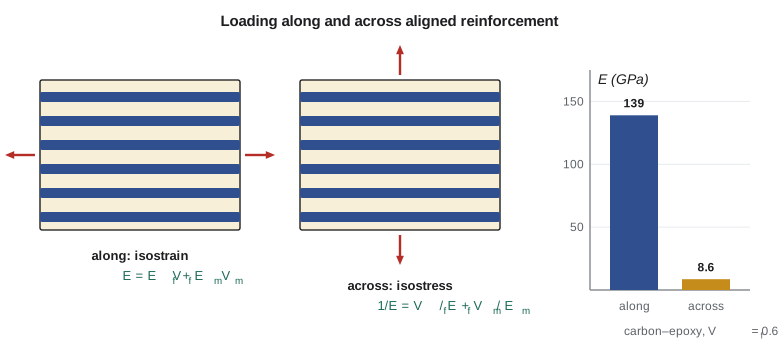
Here \(V_f\) and \(V_m = 1 - V_f\) are the volume fractions. Real transverse moduli are somewhat higher than this simple isostress estimate, but the conclusion holds: a unidirectional composite is extremely anisotropic. Density follows the simple rule of mixtures in all directions, \(\rho_c = \rho_f V_f + \rho_m V_m\).
Worked problem
Stiffness of a carbon fibre shaft laminate
Standard-modulus carbon fibres (\(E_f = 230\ \text{GPa}\), \(\rho = 1.80\ \text{Mg/m}^3\)) are aligned in epoxy (\(E_m = 3.5\ \text{GPa}\), \(\rho = 1.20\ \text{Mg/m}^3\)) at \(V_f = 0.60\). Find the longitudinal and transverse moduli and the density.
Show solution
- \(E_{c,\ell} = 230(0.60) + 3.5(0.40) = 138 + 1.4 = 139\ \text{GPa}\).
- \(1/E_{c,t} = 0.60/230 + 0.40/3.5 = 0.00261 + 0.1143 = 0.1169\), so \(E_{c,t} = 8.6\ \text{GPa}\).
- \(\rho_c = 1.80(0.60) + 1.20(0.40) = 1.56\ \text{Mg/m}^3\).
Answer: Along the fibres, the composite is about two-thirds as stiff as steel at one-fifth of its density, so its specific stiffness is more than three times steel's. Across the fibres it is barely stiffer than the epoxy. A drive shaft tube is therefore wound with most fibres at shallow angles for bending stiffness and some at ±45° for torsion.
For the sprayer drive shaft, the result was decisive. A shaft's first whirling (critical) speed, for the same geometry and supports, scales with \(\sqrt{E/\rho}\). The carbon–epoxy tube's axial specific stiffness gives a critical speed about 1.85 times that of a steel tube of the same dimensions, so a single long carbon shaft could replace a two-piece steel shaft with a centre bearing. Aluminium offers no advantage here, because its \(E/\rho\) is the same as steel's. Kestrel built a prototype with steel end fittings bonded to a filament-wound tube; bonding the metal to the composite, and protecting it from stone impacts, turned out to be the hard part.
Short fibres and strength
The rule of mixtures for strength along aligned continuous fibres is \(\sigma_{c} \approx \sigma_f V_f + \sigma_m' V_m\), where \(\sigma_m'\) is the matrix stress when the fibres fail. With short fibres, load must be transferred into each fibre by shear at the fibre–matrix interface, and a fibre can only be loaded to its full strength if it is longer than a critical length, \(l_c = \sigma_f d/(2\tau_c)\), where \(d\) is the fibre diameter and \(\tau_c\) the interface shear strength. For carbon fibres 7 µm across with a strength of 3500 MPa in a matrix with 50 MPa interface strength, \(l_c\) is about a quarter of a millimetre. Fibres several times longer than \(l_c\) behave almost like continuous ones. Injection-moulded short-glass-filled nylon, with fibres a fraction of a millimetre long, gets less than the full benefit but is cheap and easy to mould.
Laminates, manufacturing and failure
Because single plies are so directional, composite parts are built up as laminates of plies at different angles. A quasi-isotropic layup, such as 0°, +45°, −45° and 90° plies stacked symmetrically, has similar in-plane stiffness in all directions, at about a third of the unidirectional stiffness. Parts are made by hand lay-up and spray-up for boats and large covers; by laying pre-impregnated plies (prepreg) and curing them under pressure in an autoclave for aerospace parts; by resin transfer moulding, injecting resin into dry fibre in a closed mould; by filament winding for tubes and pressure vessels; by pultrusion for constant profiles such as ladder rails; and by compression moulding of sheet moulding compound for vehicle panels.
Composites fail in ways metals do not. Plies can separate (delamination), especially after an impact that leaves little visible surface damage but crushes the interior; the matrix can crack between fibres; fibres can buckle in compression; and moisture and heat degrade the matrix. They do not corrode like metals, and they resist fatigue well, but they are difficult to inspect and repair, and recycling thermoset composites remains a challenge. Carbon fibre in contact with aluminium or steel in a wet environment also forms a galvanic couple, with carbon as the noble member, so metal fittings must be isolated, often with a glass-fibre layer.
Common mistakes
MistakeDesigning a ceramic part from its average strength.
InsteadUse Weibull statistics; allowable stresses for low failure probability are well below average.
MistakeAssuming a larger ceramic part has the same strength as a test bar.
InsteadLarger volumes contain larger flaws; strength scales as V^(−1/m).
MistakeUsing the longitudinal rule of mixtures in every direction.
InsteadTransverse stiffness is matrix dominated and far lower.
MistakeExpecting short fibres shorter than the critical length to carry their full strength.
InsteadFibres need to be several times l_c to be loaded effectively.
MistakeJudging impact damage on a composite by its surface appearance.
InsteadInternal delamination can be extensive under a barely visible dent.
Summary and key terms
- Ceramics have ionic or covalent bonds and are hard, stiff, heat resistant and brittle.
- Ceramic strength depends on the largest flaw; flexural strength is σ = 3FL/(2bd²).
- Weibull statistics describe strength scatter; a high modulus m means less scatter.
- Thermal shock depends on expansion, conductivity, modulus and strength; tempered glass uses surface compression.
- Transformation toughening and fibre reinforcement make ceramics less brittle.
- Fibre composites follow E_ℓ = E_fV_f + E_mV_m along the fibres and an isostress rule across them.
- Short fibres need lengths well above l_c = σ_f d/2τ_c; laminates and manufacturing set composite performance.
- Flexural strength
- The maximum tensile stress at fracture in a bend test.
- Weibull modulus
- A measure of the scatter of strength; large values mean little scatter.
- Sintering
- Densification of a powder compact by diffusion at high temperature.
- Thermal shock
- Fracture caused by stresses from rapid temperature change.
- Transformation toughening
- Toughening by a stress-induced phase change near a crack tip.
- Matrix
- The continuous phase of a composite that binds and protects the reinforcement.
- Rule of mixtures
- Estimating a composite property as a volume-weighted combination of constituent properties.
- Critical fibre length
- The minimum fibre length that allows a fibre to be loaded to its full strength.
- Delamination
- Separation of plies in a laminated composite.
Practice problems
Work each problem on paper first, then reveal the answer to check.
A silicon nitride bar 3 mm deep and 4 mm wide breaks at 450 N over a 30 mm span in three-point bending. Find its flexural strength.
Show answer
σ = 3(450)(30)/(2 × 4 × 9) = 563 MPa.
With σ₀ = 400 MPa and m = 20, what fraction of parts fail at 300 MPa?
Show answer
About 0.3 %.
By what factor does strength fall when the stressed volume increases 10 times, for m = 10?
Show answer
10^(−1/10) = 0.79, a 21 % reduction.
Find the longitudinal and transverse moduli of E-glass/epoxy with V_f = 0.60 (E_f = 72 GPa, E_m = 3.5 GPa).
Show answer
About 44.6 GPa and 8.2 GPa.
Why does tempered glass shatter into small pieces?
Show answer
The stored compressive and tensile stresses release suddenly and drive many cracks.
Using the program, how much higher is the critical speed of an aramid/epoxy tube than steel, for the same geometry? (Use E = 76.4 GPa, ρ = 1.34.)
Show answer
√(76.4/1.34)/√(205/7.85) ≈ 1.48.
Lesson quiz · 5 questions
Score 60% or more to complete this lesson.
Create a free account to save your progress, take quizzes and earn a certificate.