
MEC-250 · Lesson 12 of 12 · 24 min
Material selection, sustainability and the capstone
On her last Friday, Amira presented two things to Kestrel's engineering group. The first was her report on the broken PTO shaft, which by now ran from atomic bonding to fracture surfaces and ended with a radius gauge on the lathe. The second was a recommendation for the housing of a new compact gearbox, where the design team had asked whether the aluminium housing used on the current model was still the right choice, or whether ductile iron, magnesium or a glass-filled polymer would be better. Answering that question well requires everything in this course plus a method for choosing among thousands of materials. This lesson provides the method, adds environmental impact to the usual criteria of performance and cost, and works through the housing decision as a capstone.
The selection problem
There are more than 100 000 engineering materials. Choosing among them by intuition leads to the materials you already know, which may not be the best. A systematic method, developed largely by Michael Ashby and colleagues, has four steps. First, translate the design requirements into four lists: the function of the part, the constraints it must meet (non-negotiable requirements such as a minimum stiffness or a maximum service temperature), the objective to be minimized or maximized (mass, cost, carbon footprint), and the free variables the designer can change (often a dimension such as wall thickness). Second, screen out materials that fail any constraint. Third, rank the survivors using a material index that captures the objective. Fourth, look for supporting information, such as corrosion behaviour, manufacturability, supplier experience and failure history, before making a final choice.
Material indices
A material index is a combination of properties that, when maximized or minimized, gives the best performance for a given function, constraint and objective. It is derived by writing the objective in terms of the free variable, using the constraint to eliminate that variable, and collecting the material properties into one group.
Consider a tie rod of fixed length \(L\) that must carry a load \(F\) without stretching more than a set amount, so its stiffness \(S = EA/L\) is fixed, and whose mass \(m = \rho AL\) should be minimum. The free variable is the area \(A\). From the stiffness constraint, \(A = SL/E\). Substituting, \(m = SL^2(\rho/E)\). The geometry and loads are fixed, so the lightest tie has the lowest \(\rho/E\), or equivalently the highest \(E/\rho\), the specific stiffness.
The same steps for other shapes and loads give other indices. For a beam of square cross-section in bending, stiffness depends on the fourth power of the section dimension, and the index for minimum mass at fixed stiffness becomes \(E^{1/2}/\rho\). For a flat panel of fixed width and length loaded in bending, with thickness free, stiffness depends on thickness cubed, and the index is \(E^{1/3}/\rho\). Strength-limited designs give analogous indices with yield strength in place of modulus: \(\sigma_y/\rho\) for a tie, \(\sigma_y^{2/3}/\rho\) for a beam and \(\sigma_y^{1/2}/\rho\) for a panel. To minimize cost instead of mass, replace \(\rho\) with \(C_m\rho\), where \(C_m\) is the cost per kilogram; to minimize embodied carbon, replace it with the carbon footprint per kilogram times \(\rho\).
| Component and load | Constraint | Minimize mass: maximize |
|---|---|---|
| Tie in tension | Stiffness | E/ρ |
| Tie in tension | Strength | σ_y/ρ |
| Beam in bending (square section) | Stiffness | E^1/2/ρ |
| Beam in bending (square section) | Strength | σ_y^2/3/ρ |
| Panel in bending (thickness free) | Stiffness | E^1/3/ρ |
| Panel in bending (thickness free) | Strength | σ_y^1/2/ρ |
These indices explain observations from earlier lessons. Aluminium and steel have nearly equal \(E/\rho\), so aluminium saves no weight in a stiffness-limited tie. But aluminium's \(E^{1/3}/\rho\) is about twice steel's, so in a stiff panel it saves about half the weight. Wood, with a very low density, is an excellent panel and beam material, which is why trees and floors are made of it. Carbon fibre composite excels in every stiffness index, at a price.
Property charts
Ashby's material property charts plot one property against another on logarithmic axes, with each material class occupying a bubble. On a chart of modulus against density, all materials with the same value of an index such as \(E/\rho\) lie on a straight line of slope 1; for \(E^{1/2}/\rho\) the slope is 2 and for \(E^{1/3}/\rho\) it is 3. Sliding such a guideline across the chart separates the materials above it, which perform better, from those below. Charts make the whole range of materials visible at once and often suggest options the designer had not considered.
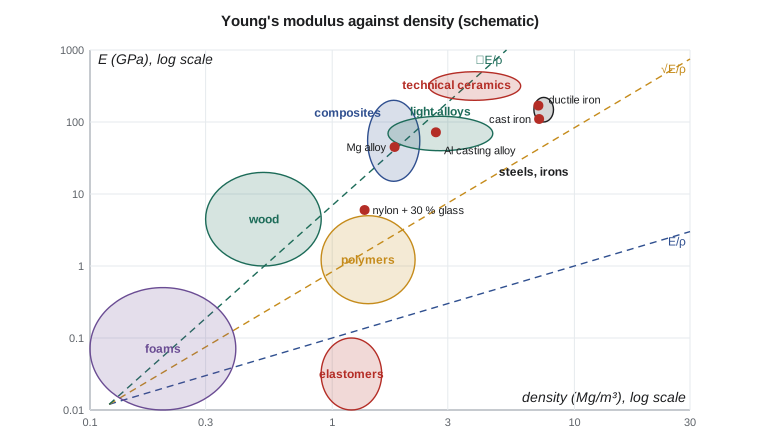
Sustainability and the material life cycle
A material's environmental impact accumulates over its life cycle: extracting and refining raw materials, making the material, manufacturing the part, using the product, and dealing with it at end of life. Life-cycle assessment (LCA) quantifies these stages, often reporting energy and greenhouse gas emissions, along with water use and other impacts. For many products, one stage dominates. For a gearbox in a diesel-powered self-propelled machine operating for ten thousand hours, the use phase, burning fuel, dominates; reducing mass reduces fuel use, so a lighter material can repay a higher production footprint. For a stationary product, such as a housing for a pump that never moves, production dominates, and the lowest-impact material at equal function wins.
Production footprints differ widely. As rough orders of magnitude, steel and cast iron made largely from scrap in electric furnaces or cupolas emit around one to two kilograms of carbon dioxide equivalent per kilogram; steel from iron ore in blast furnaces roughly two; primary aluminium, made by electrolysis, ten or more, depending heavily on the electricity source, while recycled aluminium needs only a small fraction of that energy; magnesium and titanium are higher still; and carbon fibre composites are among the highest per kilogram. Published values vary by source, region and year, so for real decisions engineers use current, well-documented databases or supplier environmental product declarations rather than single numbers.
Designing for the end of life matters too. Metals are recycled at high rates and with little loss of quality, especially when alloys are kept separate. Thermoplastics can be remelted, but mixed and filled grades are hard to separate and degrade with each cycle. Thermoset composites are difficult to recycle at all. Practical steps include using fewer materials in a product, making them easy to identify and separate, avoiding unnecessary coatings and inserts, and choosing alloys compatible with existing scrap streams. Durability is also a sustainability measure: a part that lasts twice as long halves its impact per year of service.
Capstone: choosing the compact gearbox housing
Amira set up the housing problem in the four lists. The function is to hold the gear shafts in alignment, contain the oil and support the gearbox's mounting loads. The main constraint is stiffness: the housing walls must not deflect enough under gear loads to misalign the bearings. Others are a continuous oil temperature of up to 120 °C, with a margin, corrosion resistance outdoors, and the ability to be cast in volumes of a few thousand a year. The objectives are minimum mass, minimum cost and minimum embodied carbon, which pull in different directions. The free variable is wall thickness. Because the walls behave like panels in bending, the index for minimum mass at fixed stiffness is \(E^{1/3}/\rho\), and the relative mass of each candidate housing scales with \(\rho/E^{1/3}\).
| Candidate | ρ (Mg/m³) | E (GPa) | Relative cost per kg | CO₂ per kg (illustrative) | Max. service temp. (°C) |
|---|---|---|---|---|---|
| Grey cast iron | 7.15 | 110 | 1.0 | 1.5 | 350 |
| Ductile iron | 7.10 | 169 | 1.2 | 1.7 | 350 |
| Aluminium A356-T6 | 2.68 | 72 | 3.0 | 6.5 | 150 |
| Magnesium AZ91 | 1.81 | 45 | 5.0 | 25 | 120 |
| Nylon 66, 30 % glass (conditioned) | 1.36 | 6 | 4.0 | 7 | 120 |
Worked problem
Relative mass, cost and carbon of the housing
For a housing of equal wall stiffness, compare aluminium A356-T6 with grey cast iron in mass, material cost and embodied carbon, using the table.
Show solution
- Relative mass \(= \dfrac{\rho_{\text{Al}}/E_{\text{Al}}^{1/3}}{\rho_{\text{Fe}}/E_{\text{Fe}}^{1/3}} = \dfrac{2.68/72^{1/3}}{7.15/110^{1/3}} = \dfrac{2.68/4.160}{7.15/4.791} = \dfrac{0.644}{1.492} = 0.43\).
- Relative material cost \(= 0.43 \times 3.0/1.0 = 1.30\). Relative carbon \(= 0.43 \times 6.5/1.5 = 1.87\).
Answer: The aluminium housing weighs 57 percent less than an equally stiff iron one but costs about 30 percent more in material and carries nearly twice the production carbon under these assumptions. Whether that trade is worth making depends on how much the mass matters in service, which is a question about the product, not the material.
# Material selection for a gearbox housing: stiffness-limited panel index, cost and CO2
import math

# name: density (Mg/m3), E (GPa), relative cost per kg (flake cast iron = 1),
#       cradle-to-gate CO2 (kg per kg, illustrative), max continuous service temp (C)
cands = {
    'flake cast iron':       (7.15, 110, 1.0, 1.5, 350),
    'ductile iron':          (7.10, 169, 1.2, 1.7, 350),
    'Al A356-T6 (cast)':     (2.68,  72, 3.0, 6.5, 150),
    'Mg AZ91 (cast)':        (1.81,  45, 5.0, 25.0, 120),
    'PA66, 30 % glass':      (1.36,   6, 4.0, 7.0, 120),   # E for conditioned (moist) material
}
T_service = 120          # oil temperature, C; require a margin of at least 20 C
ref = cands['flake cast iron']
idx = lambda rho, E: rho / E ** (1 / 3)        # mass of a stiffness-limited panel (lower is better)

print(f"{'material':20s} {'mass':>6s} {'cost':>6s} {'CO2':>6s}  temperature check")
rows = []
for name, (rho, E, c, co2, Tmax) in cands.items():
    m = idx(rho, E) / idx(*ref[:2])
    cost = m * c / ref[2]
    carbon = m * co2 / ref[3]
    ok = Tmax >= T_service + 20
    rows.append((name, m, cost, carbon, ok))
    print(f"{name:20s} {m:6.2f} {cost:6.2f} {carbon:6.2f}  {'pass' if ok else 'FAIL (margin)'}")
print("(all values relative to a flake cast iron housing of equal stiffness)")

# Weighted property method among candidates that pass the screen
weights = {'mass': 0.40, 'cost': 0.35, 'CO2': 0.25}
passing = [r for r in rows if r[4]]
best = {k: min(r[i] for r in passing) for k, i in (('mass', 1), ('cost', 2), ('CO2', 3))}
print("\nweighted score (higher is better) for candidates that pass the screen:")
for name, m, cost, carbon, ok in passing:
    score = (weights['mass'] * best['mass'] / m + weights['cost'] * best['cost'] / cost
             + weights['CO2'] * best['CO2'] / carbon)
    print(f"  {name:20s} {score:.3f}")

# Sensitivity: how does the ranking change if mass is weighted more heavily?
for wm in (0.2, 0.4, 0.6):
    wc = (1 - wm) * 0.35 / 0.60; wg = (1 - wm) * 0.25 / 0.60
    scores = {r[0]: wm * best['mass'] / r[1] + wc * best['cost'] / r[2] + wg * best['CO2'] / r[3] for r in passing}
    top = max(scores, key=scores.get)
print(f"mass weight {wm:.1f}: best is {top} ({scores[top]:.3f})")material mass cost CO2 temperature check flake cast iron 1.00 1.00 1.00 pass ductile iron 0.86 1.03 0.98 pass Al A356-T6 (cast) 0.43 1.30 1.87 pass Mg AZ91 (cast) 0.34 1.71 5.68 FAIL (margin) PA66, 30 % glass 0.50 2.01 2.34 FAIL (margin) (all values relative to a flake cast iron housing of equal stiffness) weighted score (higher is better) for candidates that pass the screen: flake cast iron 0.767 ductile iron 0.790 Al A356-T6 (cast) 0.801 mass weight 0.2: best is ductile iron (0.886) mass weight 0.4: best is Al A356-T6 (cast) (0.801) mass weight 0.6: best is Al A356-T6 (cast) (0.867)
The screening step removed two candidates immediately. AZ91 magnesium has no temperature margin at 120 °C, where it creeps under bolt loads, a well-known problem that led to special creep-resistant magnesium alloys for automotive transmission cases. Glass-filled nylon also lacks margin, and its conditioned modulus is so low that the walls would need to be very thick; it creeps, too, and would need metal inserts for the bearing seats. Both remain useful for covers and lightly loaded parts, which is where Kestrel already uses them.
Among the survivors, the weighted ranking depended on how much the team valued mass. With mass weighted at 40 percent, aluminium came out slightly ahead of ductile iron; with mass at only 20 percent, ductile iron won, because it is cheaper and lower in carbon per housing. Amira's recommendation followed the product: keep aluminium for the compact gearbox, which goes on self-propelled sprayers where every kilogram costs fuel and payload, and specify a mix with a high recycled content to cut its carbon; use ductile iron for a heavy-duty variant on tractor-mounted equipment, where mass hardly matters and the iron's higher stiffness and damping are welcome. She listed the supporting checks still to do: castability of the thinner iron walls, galvanic isolation of steel bearing carriers in the aluminium, and fatigue testing of the mounting bosses.
Looking back: the course in one part
Amira closed her shaft report with a single page linking each stage of the investigation to the course. The steel was ductile because its atoms are held by metallic bonds (Lesson 1). It is BCC at room temperature and FCC when hot, which made its heat treatment possible (Lessons 2 and 8). Its carbon atoms sit in interstitial sites and diffuse quickly, which is how the gears were carburized (Lesson 3). Tensile and hardness tests confirmed the shaft had its specified strength (Lesson 4), achieved by martensite and fine carbides obstructing dislocations (Lessons 5 and 8). It failed by fatigue from a fillet machined too sharp, a stress concentration that raised the local stress above the endurance limit (Lesson 6). The housings, bushings, seals and guards around it were chosen using phase diagrams, precipitation hardening, polymer behaviour and composite design (Lessons 7, 9, 10 and 11), and the choice between them is a structured trade among performance, cost and sustainability (Lesson 12). Processing created structure, structure set properties, and properties met loads to decide performance. That chain is materials engineering.
Common mistakes
MistakeChoosing a material by its strength or stiffness alone, ignoring density, cost and the load path.
InsteadUse the material index for the actual function, constraint and objective.
MistakeApplying the tension index E/ρ to a panel or beam.
InsteadBending-dominated parts use E^1/2/ρ or E^1/3/ρ, which favour low-density materials.
MistakeRanking materials before screening on hard constraints.
InsteadScreen first: a material that fails a constraint cannot be rescued by a good index.
MistakeComparing carbon footprints per kilogram instead of per part.
InsteadCompare the footprint of equally functional parts, which accounts for different masses.
MistakeTreating a weighted score as the final answer.
InsteadCheck sensitivity to the weights and confirm with supporting information.
Summary and key terms
- Selection translates requirements into function, constraints, objective and free variables, then screens, ranks and checks.
- Material indices combine properties for a given design: E/ρ for stiff ties, E^1/2/ρ for beams, E^1/3/ρ for panels.
- Replacing ρ with C_mρ or carbon × ρ ranks materials by cost or embodied carbon.
- Property charts with index guidelines show the best candidates across all material families.
- Life-cycle thinking asks which stage dominates impact; for moving products, use-phase mass often matters most.
- Recycling, separability and durability are part of sustainable material choice.
- The capstone: aluminium for mass-critical housings, ductile iron where cost and carbon dominate, after screening out creep-prone options.
- Constraint
- A requirement that must be met, such as a minimum stiffness or maximum temperature.
- Objective
- The quantity to be minimized or maximized, such as mass, cost or carbon.
- Free variable
- A design parameter the designer may change, such as a wall thickness.
- Material index
- A combination of material properties that measures performance for a given design.
- Screening
- Eliminating materials that fail a constraint.
- Property chart
- A log-log plot of one material property against another, grouped by material family.
- Life-cycle assessment
- Quantifying the environmental impact of a product over all stages of its life.
- Embodied carbon
- The greenhouse gas emissions associated with producing a material or part.
Practice problems
Work each problem on paper first, then reveal the answer to check.
Derive the material index for a minimum-mass tie that must carry a load F without yielding.
Show answer
A = F/σ_y, m = ρAL = FL(ρ/σ_y); maximize σ_y/ρ.
Compare steel (ρ = 7.85, E = 205) and aluminium (ρ = 2.70, E = 70) using E^1/3/ρ. Which gives the lighter stiff panel, and by how much?
Show answer
Steel 0.75, aluminium 1.53; aluminium panel about 49 % of the steel mass.
Why might aluminium be the lower-carbon choice for a housing on a self-propelled machine even though its production carbon per part is higher?
Show answer
Lower mass reduces fuel use over the machine's life, and the use phase can dominate the total.
Using the table, compare ductile iron with grey iron for mass and cost at equal panel stiffness.
Show answer
Mass 0.86, cost about 1.03.
What is the purpose of the screening step, and why must it come before ranking?
Show answer
It removes materials that fail hard constraints; ranking them would be meaningless.
In the program, raise the aluminium cost factor from 3.0 to 4.0. Does aluminium still win with a mass weight of 0.4?
Show answer
No: its relative cost rises to about 1.73 and ductile iron scores higher; run the code to confirm.
Lesson quiz · 5 questions
Score 60% or more to complete this lesson.
Create a free account to save your progress, take quizzes and earn a certificate.