
MCAT-112 · Lesson 8 of 12 · 22 min
The renal system and fluid balance
▶ Video coming soon A video version of this lesson is on the way.
Ezequiel arrived at the eighth session tired from a double shift of evening classes and admitted that the kidney was the topic he dreaded most. 'In my EMT course they told us the kidney filters blood,' he said. 'Then my physiology professor drew a nephron with nine labelled parts and I never recovered.' Thandiwe laughed. 'Here is the whole kidney in one sentence: it filters almost everything out, then takes back almost everything it wants. If you hold onto that, every part of the nephron is just a step in the taking back.'
This lesson covers the excretory system in content category 3B: the structure of the kidney and nephron, filtration, reabsorption and secretion, the concentration of urine, the hormones that control water and salt balance, and the kidney's roles in blood pressure, acid-base balance and red blood cell production.
Structure of the urinary system
The urinary system consists of two kidneys, two ureters that carry urine to the bladder, the bladder itself, which stores urine, and the urethra, which carries it out. Each kidney has an outer cortex and an inner medulla, which is arranged into cone-shaped pyramids that drain into the renal pelvis and then the ureter. The kidneys receive about 20 to 25 percent of the cardiac output at rest, far more than their size would suggest, because their job is to process the blood, not just to supply themselves.
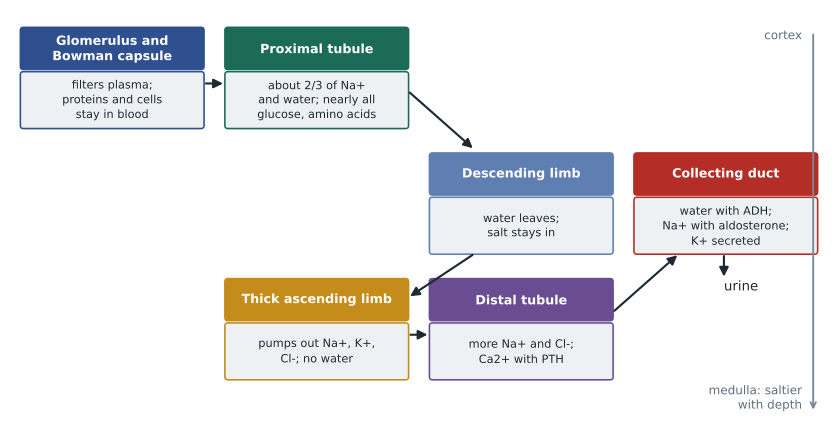
The functional unit is the nephron, and each kidney has about a million of them. A nephron has two parts. The renal corpuscle consists of a tuft of capillaries, the glomerulus, surrounded by a cup-shaped Bowman's capsule. The renal tubule leads from the capsule and has several segments: the proximal convoluted tubule, the loop of Henle with its descending and ascending limbs, the distal convoluted tubule and the collecting duct, which many nephrons share.
The blood supply of the nephron is unusual. Blood enters the glomerulus through the afferent arteriole and leaves through the efferent arteriole, so the glomerulus is a capillary bed between two arterioles. The efferent arteriole then gives rise to a second capillary network, the peritubular capillaries, which wrap around the tubule and take up what it reabsorbs. In nephrons with long loops of Henle that dip deep into the medulla, straight vessels called the vasa recta run alongside the loop.
The three processes
Urine is formed by three processes. Filtration moves fluid from the blood into Bowman's capsule. Reabsorption moves substances from the tubule back into the blood. Secretion moves substances from the blood into the tubule. The amount of a substance excreted equals the amount filtered, minus the amount reabsorbed, plus the amount secreted.
Filtration
In the glomerulus, blood pressure pushes plasma through a filtration barrier made of three layers: the fenestrated endothelium of the capillaries, a basement membrane, and the slit-like spaces between the foot processes of cells called podocytes. Water and small solutes such as glucose, amino acids, sodium, urea and small drugs pass freely. Blood cells and most plasma proteins, including albumin, are too large and too negatively charged to pass, so the filtrate resembles plasma without its proteins. Protein in the urine is therefore a sign that the barrier is damaged.
The same Starling forces that act in other capillaries determine filtration, but the balance strongly favours filtration. Glomerular hydrostatic pressure is unusually high, because the efferent arteriole adds resistance downstream; it is opposed by the oncotic pressure of plasma proteins and by the pressure of fluid already in Bowman's capsule. The glomerular filtration rate, the volume of filtrate formed per minute by both kidneys, is about 125 millilitres per minute, or about 180 litres per day. Since the plasma volume is only about 3 litres, the kidneys filter the whole plasma volume about 60 times a day, yet the body produces only about 1.5 litres of urine. More than 99 percent of the filtered water is reabsorbed.
Changes in the two arterioles adjust the filtration rate. Constricting the afferent arteriole lowers glomerular pressure and reduces filtration, while constricting the efferent arteriole raises glomerular pressure and increases filtration, at least at first. The kidney keeps its filtration rate fairly steady across a wide range of blood pressures through autoregulation, in which the afferent arteriole constricts when stretched and the tubule signals back to the arterioles when the flow of salt reaching the distal tubule changes.
Reabsorption and secretion along the tubule
| Segment | What is reabsorbed or secreted | Notes |
|---|---|---|
| Proximal convoluted tubule | About 65 percent of filtered sodium, chloride and water; nearly all glucose and amino acids; most bicarbonate; secretes hydrogen ions, organic acids and many drugs | Reabsorption is isosmotic: water follows solutes, so the fluid leaving is still about as concentrated as plasma; many transporters are driven by the sodium gradient set by the sodium-potassium pump |
| Descending limb of the loop of Henle | Water | Permeable to water, not to salt; fluid becomes more concentrated as it descends into the salty medulla |
| Thick ascending limb of the loop of Henle | Sodium, potassium and chloride | Impermeable to water; active transport of salt makes the medulla salty and the tubular fluid dilute; target of loop diuretics |
| Distal convoluted tubule | Sodium and chloride; calcium under the control of parathyroid hormone | Impermeable to water; target of thiazide diuretics |
| Collecting duct | Sodium (aldosterone); water (antidiuretic hormone); secretes potassium and hydrogen ions | Final adjustment of urine volume and composition; the duct runs down through the salty medulla |
Glucose shows how reabsorption can be saturated. In the proximal tubule, glucose is taken up by sodium-glucose cotransporters, which have a maximum rate. Normally all filtered glucose is reabsorbed, so urine contains none. When blood glucose rises above about 10 to 11 millimolar, as in uncontrolled diabetes, the amount filtered exceeds the transporters' capacity, and glucose appears in the urine, carrying water with it by osmosis. That is why frequent urination and thirst are classic signs of diabetes. A class of diabetes drugs works by blocking these transporters on purpose, so excess glucose is excreted.
Concentrating the urine
The kidney can make urine more dilute or much more concentrated than plasma, from about 50 to about 1,200 milliosmoles per litre, compared with about 290 for plasma. This depends on the loop of Henle and the collecting duct working together.
The thick ascending limb pumps salt out into the surrounding tissue but does not let water follow. That makes the tissue of the medulla salty, and the deeper parts of the medulla saltier, because the loop is arranged so that fluid flowing in opposite directions in the two limbs multiplies the effect, a system called countercurrent multiplication. Urea, which is reabsorbed from the deepest part of the collecting duct, adds to the concentration of the inner medulla. The vasa recta, which also loop down and back, carry away reabsorbed water without washing out the salt, because their own countercurrent arrangement lets them exchange solutes with the tissue.
The collecting duct then runs down through this salty medulla. When antidiuretic hormone is present, it causes collecting duct cells to insert water channels called aquaporins into their membranes, so water flows out of the duct by osmosis into the salty tissue and back into the blood. The urine becomes concentrated and small in volume. When antidiuretic hormone is absent, the collecting duct stays impermeable to water, and the dilute fluid that left the ascending limb is excreted as large volumes of dilute urine. Alcohol inhibits antidiuretic hormone release, which is why it causes frequent urination.
Hormonal control of water and salt
Four hormone systems regulate the volume and concentration of body fluids. A key distinction runs through all of them: water balance controls the concentration of body fluids (osmolarity), while sodium balance controls their volume, because water follows sodium.
| Hormone | Stimulus | Action on the kidney | Overall effect |
|---|---|---|---|
| Antidiuretic hormone (ADH, vasopressin) | High plasma osmolarity sensed by hypothalamic osmoreceptors; large falls in blood volume or pressure | Inserts aquaporins in the collecting duct | Retains water; urine concentrated; plasma osmolarity falls |
| Aldosterone | Angiotensin II; high blood potassium | Increases sodium reabsorption and potassium secretion in the collecting duct | Retains sodium and, with it, water; blood volume and pressure rise; potassium falls |
| Angiotensin II | Made in response to renin release when blood pressure or kidney perfusion falls | Constricts efferent arterioles; increases proximal sodium reabsorption; stimulates aldosterone and ADH | Raises blood pressure; constricts arterioles throughout the body; stimulates thirst |
| Atrial natriuretic peptide | Stretch of the atria from high blood volume | Increases filtration and decreases sodium reabsorption | Excretes sodium and water; lowers blood volume and pressure |
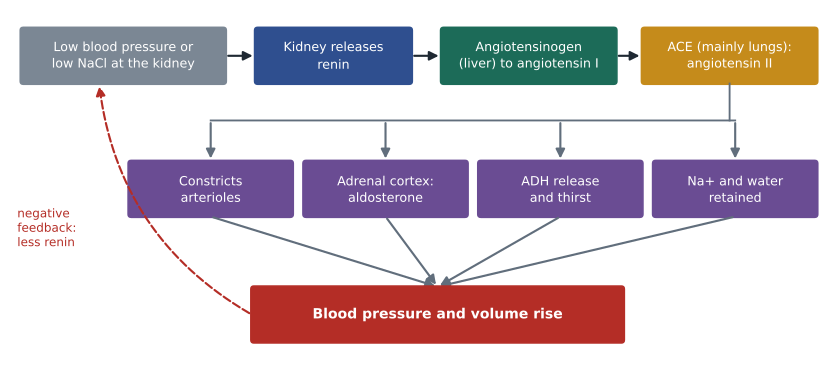
The renin-angiotensin-aldosterone system starts when specialized cells in the walls of the afferent arterioles, the juxtaglomerular cells, release the enzyme renin in response to low blood pressure in the kidney, low delivery of sodium chloride to the distal tubule, or sympathetic stimulation. Renin converts angiotensinogen, a plasma protein made by the liver, into angiotensin I. Angiotensin-converting enzyme, found mainly on the lining of blood vessels in the lungs, converts angiotensin I into angiotensin II, the active hormone. Many blood pressure medicines act on this pathway: ACE inhibitors block the converting enzyme, and other drugs block the angiotensin II receptor.
Diuretics as a test of understanding
Diuretics, drugs that increase urine output, make good passage material because each acts on one segment. Loop diuretics block the salt transporter in the thick ascending limb, which both causes large salt and water losses and weakens the medullary salt gradient, so the kidney cannot concentrate urine well. Thiazide diuretics block salt reabsorption in the distal convoluted tubule and have a milder effect. Both deliver more sodium to the collecting duct, where aldosterone-driven sodium reabsorption is accompanied by potassium secretion, so both tend to lower blood potassium. Potassium-sparing diuretics block aldosterone's receptor or the sodium channels in the collecting duct, so they lose less potassium.
Measuring kidney function
Clearance is the volume of plasma completely cleared of a substance per minute. It equals the urine concentration of the substance times the urine flow rate, divided by its plasma concentration. A substance that is freely filtered but neither reabsorbed nor secreted, such as the plant sugar inulin, has a clearance equal to the glomerular filtration rate. In practice, doctors estimate filtration from blood levels of creatinine, a waste product of muscle that is filtered and only slightly secreted. If kidney function falls, creatinine builds up in the blood. A substance with clearance lower than the filtration rate is being reabsorbed (glucose has a clearance near zero); a substance with clearance higher than the filtration rate is being secreted.
The kidney in acid-base balance and beyond
As lesson 5 described, the lungs control carbon dioxide and the kidneys control bicarbonate. The kidney reabsorbs nearly all filtered bicarbonate, mainly in the proximal tubule, and makes new bicarbonate when it secretes hydrogen ions, which are buffered in the urine by phosphate and by ammonia that the tubule cells produce. In metabolic acidosis, the kidney increases hydrogen ion secretion and ammonia production; in alkalosis, it excretes more bicarbonate. These adjustments take hours to days, which is why renal compensation is slower than respiratory compensation.
The kidney is also an endocrine organ. It makes erythropoietin when it senses low oxygen delivery, which drives red blood cell production; people with chronic kidney failure often develop anemia for this reason. It converts vitamin D to its active form, calcitriol, under the control of parathyroid hormone, so kidney failure can lead to low calcium and bone disease. And as the renin-angiotensin system shows, it is central to the long-term control of blood pressure.
Worked problem
Predicting the effect of a missing hormone
A patient has damage to the posterior pituitary and releases almost no antidiuretic hormone. Predict urine volume, urine concentration and plasma sodium if the patient cannot drink freely.
Show solution
- Without ADH, the collecting duct lacks aquaporins and stays impermeable to water.
- The dilute fluid leaving the loop of Henle is excreted, so urine is large in volume and very dilute.
- Water is lost faster than salt, so plasma osmolarity and plasma sodium rise.
- Thirst normally compensates; if the patient cannot drink, dehydration and high sodium develop.
Answer: Large volumes of dilute urine, with rising plasma sodium if water intake does not keep up. This condition is called diabetes insipidus.
Passage-style practice
Passage. Researchers gave healthy volunteers one of three drinks after an overnight fast and collected urine every 30 minutes for three hours. Drink 1 was 1 litre of water. Drink 2 was 1 litre of isotonic saline, with about the same osmolarity as plasma. Drink 3 was 1 litre of water taken together with a synthetic ADH drug. Data invented for this course.
| Drink | Total urine volume over 3 hours (millilitres) | Lowest urine osmolarity (milliosmoles per litre) |
|---|---|---|
| 1. Water | 850 | 60 |
| 2. Isotonic saline | 320 | 300 |
| 3. Water plus ADH drug | 150 | 700 |
Practice problems
Work each problem on paper first, then reveal the answer to check.
Why does water alone produce large volumes of dilute urine? (Skill 2: scientific reasoning)
Show answer
Water lowers plasma osmolarity, which suppresses ADH release, so the collecting duct stays impermeable to water.
Why is urine output smaller after isotonic saline, even though the volume drunk is the same? (Skill 2)
Show answer
Saline expands blood volume without lowering osmolarity, so ADH is not suppressed; the extra salt and water are excreted more slowly, partly through natriuretic peptide and lower aldosterone.
What does drink 3 show about the role of ADH? (Skill 4: data-based reasoning)
Show answer
With ADH present, the kidney retains water and makes concentrated urine even after a water load, so ADH is what allows water excretion to be controlled.
Which control group would show the urine output with no drink at all? (Skill 3: research design)
Show answer
A group that drinks nothing during the same three hours.
In drink 3, what might happen to plasma sodium if the volunteers kept drinking water while taking the ADH drug? (Skill 2)
Show answer
It would fall, because water would be retained without matching salt, diluting the plasma.
Common mistakes
MistakeAntidiuretic hormone increases sodium reabsorption.
InsteadADH increases water reabsorption through aquaporins; aldosterone increases sodium reabsorption.
MistakeThe descending limb of the loop of Henle pumps out salt.
InsteadThe descending limb lets water out; the thick ascending limb pumps salt out and is impermeable to water.
MistakeProteins are normally filtered and then reabsorbed.
InsteadPlasma proteins are largely kept out of the filtrate by the filtration barrier; protein in urine signals barrier damage.
MistakeGlucose in the urine means the kidney is damaged.
InsteadUsually it means blood glucose is so high that filtered glucose exceeds the transporters' capacity.
MistakeA substance with clearance above the filtration rate is being reabsorbed.
InsteadClearance above the filtration rate means the substance is also being secreted; below it means reabsorption.
Summary and key terms
- The nephron filters plasma in the glomerulus and then reabsorbs most of what it filtered along the tubule; secretion adds some substances.
- The proximal tubule reabsorbs about two-thirds of salt and water and nearly all glucose and amino acids; the thick ascending limb pumps salt into the medulla without water.
- The salty medulla, created by countercurrent multiplication, lets ADH concentrate urine by opening aquaporins in the collecting duct.
- ADH controls water and osmolarity; aldosterone controls sodium and volume; angiotensin II raises blood pressure; atrial natriuretic peptide lowers it.
- Clearance compares excretion with plasma concentration; inulin and, approximately, creatinine measure the filtration rate.
- The kidney adjusts bicarbonate and hydrogen ion excretion over days, makes erythropoietin and activates vitamin D.
- Nephron
- The functional unit of the kidney, made of a renal corpuscle and a renal tubule.
- Glomerular filtration rate
- The volume of filtrate formed per minute by both kidneys.
- Countercurrent multiplication
- The process by which the loop of Henle creates an increasing salt concentration deep in the medulla.
- Aquaporin
- A membrane channel protein that lets water cross a membrane.
- Renin
- An enzyme released by the kidney that starts the formation of angiotensin II.
- Clearance
- The volume of plasma completely cleared of a substance per minute.
- Diuretic
- A substance that increases urine output.
Lesson quiz · 5 questions
Score 60% or more to complete this lesson.
Create a free account to save your progress, take quizzes and earn a certificate.