
MCAT-112 · Lesson 11 of 12 · 21 min
Homeostasis and the integration of organ systems
▶ Video coming soon A video version of this lesson is on the way.
By the eleventh session, the Sunday Session had covered every organ system, and Thandiwe changed the format. She put a single scenario on the screen: a hiker lost overnight on a hot, dry trail with half a litre of water. 'Tell me what every organ does in the next twelve hours,' she said, 'and tell me which signal makes it do it.' Ezequiel started with sweating, Devika added the kidney and antidiuretic hormone, and Elliot connected falling blood volume to the baroreceptors and the heart. After twenty minutes, the shared screen was covered in arrows. 'That is what the MCAT means by integration,' she said. 'No organ acts alone.'
This lesson draws the course together around homeostasis, the maintenance of a stable internal environment. It covers the logic of feedback control, then works through four integrated examples that appear often in passages: blood glucose, body temperature, blood pressure and blood volume, and the response to exercise and stress. It closes with a method for reasoning through any multi-system scenario.
The logic of feedback control
Every homeostatic system has the same parts. A variable, such as blood glucose or core temperature, has a set point, a target value or range. Sensors detect the variable. An integrating centre, often in the brain or an endocrine gland, compares the sensed value with the set point. Effectors, such as muscles, glands or organs, act to change the variable. In negative feedback, the response opposes the change: if the variable rises, the response lowers it, and if it falls, the response raises it. Nearly all homeostatic systems work this way.
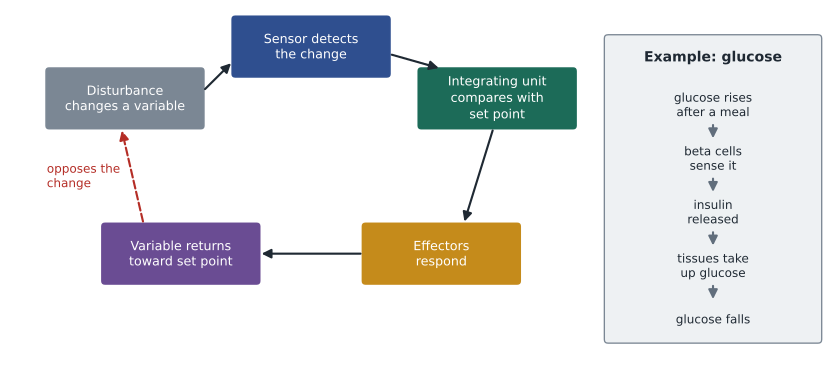
Positive feedback amplifies a change instead of opposing it, and it must be ended by an outside event. The examples you have met are the LH surge before ovulation, oxytocin during labour, the opening of sodium channels during the rising phase of an action potential, and the clotting cascade. Positive feedback is useful when the body needs to complete a process quickly and completely, not to hold a variable steady.
Feedforward control acts before a disturbance has changed the variable, in anticipation. The cephalic phase of digestion, in which the sight and smell of food start secretion, is an example, as is the rise in heart rate and breathing that begins before exercise starts.
Integration 1: blood glucose
Blood glucose is normally held between about 4 and 7 millimolar. The brain depends on glucose under most conditions, so low glucose is dangerous within minutes, while high glucose damages vessels, nerves and kidneys over years.
| After a meal (glucose rising) | Between meals and during fasting (glucose falling) |
|---|---|
| Beta cells of the pancreatic islets sense rising glucose and release insulin | Alpha cells sense falling glucose and release glucagon; insulin falls |
| Muscle and fat take up glucose through GLUT4 transporters moved to the cell surface | The liver breaks down glycogen and carries out gluconeogenesis, releasing glucose |
| The liver stores glucose as glycogen and makes fat | Fat tissue releases fatty acids, which muscle and other tissues burn, sparing glucose for the brain |
| Fat and protein synthesis increase | In prolonged fasting, the liver makes ketone bodies; cortisol supports gluconeogenesis |
| Glucose falls back toward the set point | Glucose rises back toward the set point |
Other hormones add to the falling-glucose response. Epinephrine, released during stress or when glucose drops sharply, rapidly increases glycogen breakdown in liver and muscle and fat breakdown in adipose tissue. Cortisol and growth hormone raise glucose more slowly. Because several hormones raise glucose and only insulin lowers it, the loss of insulin, as in type 1 diabetes, is especially severe. In type 2 diabetes, tissues respond poorly to insulin, so more is needed to control glucose; over time, beta cells may be unable to keep up.
Integration 2: body temperature
Core body temperature is held near 37 degrees Celsius by the hypothalamus, which receives information from thermoreceptors in the skin and from neurons that sense the temperature of blood flowing through the hypothalamus itself.
| Too warm | Too cold |
|---|---|
| Dermal arterioles dilate, carrying more blood to the skin to lose heat by radiation and convection | Dermal arterioles constrict, keeping warm blood in the core |
| Sweat glands secrete sweat; evaporation removes heat | Shivering: rapid involuntary muscle contractions produce heat |
| Behaviour: seeking shade, removing clothing | Behaviour: seeking warmth, adding clothing, curling up |
| Metabolic rate may fall slightly | Nonshivering thermogenesis: in infants and some adults, brown fat uses uncoupling protein 1 to release heat; thyroid hormone raises metabolic rate over time |
Fever is not a failure of temperature control but a raised set point. During infection, signalling molecules made by immune cells act on the hypothalamus, which raises the set point. The body then feels cold at normal temperature and responds by shivering and constricting skin vessels until the new, higher temperature is reached. When the infection resolves and the set point falls, the body feels too warm, so it sweats and flushes, the familiar "breaking" of a fever. Heat stroke, in contrast, is a failure of cooling, in which heat production or a hot environment overwhelms the body's ability to lose heat; it is especially likely in humid air, where sweat cannot evaporate effectively.
Integration 3: blood pressure and blood volume
Blood pressure is controlled on two time scales. In the short term, over seconds, the baroreceptor reflex adjusts the heart and blood vessels. Stretch receptors in the walls of the carotid sinuses and the aortic arch fire more when pressure rises. The medulla responds by increasing vagal output and decreasing sympathetic output, slowing the heart, reducing contractility and dilating arterioles, so pressure falls. When pressure falls, as when a person stands up suddenly and blood pools in the legs, firing decreases, the medulla increases sympathetic output, and the heart rate and arteriolar resistance rise.
In the long term, over hours to days, the kidney controls blood pressure by controlling blood volume, through the hormones covered in lesson 8. Low pressure or volume triggers renin release, the formation of angiotensin II and the release of aldosterone and antidiuretic hormone, all of which retain salt and water and constrict vessels. High volume stretches the atria, releasing atrial natriuretic peptide, which promotes salt and water excretion. Thirst, controlled by the hypothalamus in response to high osmolarity and low volume, adds water.
| Change | Fast response (seconds to minutes) | Slow response (hours to days) |
|---|---|---|
| Blood loss lowers volume and pressure | Baroreceptor reflex: higher heart rate, stronger contraction, constriction of arterioles and veins; fluid moves from tissues into capillaries because capillary pressure falls | Renin, angiotensin II and aldosterone retain sodium and water; ADH retains water; thirst; erythropoietin raises red cell production over days to weeks |
| Drinking a large volume of water lowers osmolarity | Little change in pressure | ADH falls, and the kidney excretes dilute urine |
| Eating a salty meal raises osmolarity | Thirst and ADH release | Retained water dilutes the salt; the kidney later excretes the excess salt and water as volume rises and renin falls |
The distinction between volume and osmolarity that lesson 8 introduced pays off here. Losing blood lowers volume without changing osmolarity, because whole blood is lost. Sweating loses more water than salt, so it lowers volume and raises osmolarity. Diarrhea loses a fluid similar to plasma but with extra bicarbonate, lowering volume and causing metabolic acidosis. Vomiting loses stomach acid, lowering volume and causing metabolic alkalosis. Each pattern triggers a predictable set of responses.
Integration 4: exercise and the stress response
During exercise, the sympathetic nervous system and epinephrine coordinate nearly every system. The heart rate and stroke volume rise, raising cardiac output; arterioles in working muscle dilate in response to local signals, while those in the gut and kidneys constrict; ventilation increases; the liver releases glucose and fat tissue releases fatty acids; the hemoglobin curve shifts right in warm, acidic muscle; and sweating and skin blood flow increase to remove the heat produced. Insulin falls and glucagon rises, even though muscle is using glucose rapidly, because contraction itself moves GLUT4 transporters to the muscle surface without needing insulin.
Longer-term stress engages the hypothalamic-pituitary-adrenal axis. The hypothalamus releases corticotropin-releasing hormone, the pituitary releases ACTH, and the adrenal cortex releases cortisol, which raises blood glucose, breaks down protein, and suppresses inflammation and the immune response. That is useful briefly, but chronic stress with prolonged high cortisol can raise blood glucose and blood pressure, weaken immune defences and contribute to bone loss and muscle wasting. MCAT-130 returns to the stress response from the psychological side.
A method for multi-system questions
When a passage describes a change and asks what will happen, work through it in a fixed order. First, identify the primary change: what variable moved first, and in which direction? Second, identify the sensors that detect it: baroreceptors, chemoreceptors, osmoreceptors, thermoreceptors or endocrine cells sensing a blood level. Third, identify the integrating centre and its output: the medulla, the hypothalamus, an endocrine gland. Fourth, list the effectors and what each does. Fifth, predict how the variable changes, and check whether the compensation is complete or partial, and whether it is fast (neural) or slow (hormonal).
This method also guards against the most common trap in physiology questions: confusing the cause with the compensation. A patient with a high heart rate after blood loss does not have a heart problem; the heart is compensating. A patient with low carbon dioxide and acidotic blood has a metabolic acidosis, and the low carbon dioxide is the lungs' compensation, not the cause.
Worked problem
Tracing a multi-system response
A person stands up quickly after lying down for an hour. About half a litre of blood pools in the leg veins. Trace the response that keeps them from fainting.
Show solution
- Primary change: venous return falls, so stroke volume, cardiac output and blood pressure fall.
- Sensors: baroreceptors in the carotid sinus and aortic arch fire less.
- Integrating centre: the medulla reduces vagal output and increases sympathetic output.
- Effectors: the heart rate and contractility rise; arterioles constrict, raising total peripheral resistance; veins constrict, pushing blood back toward the heart; the skeletal muscle pump helps when the person moves.
- Result: blood pressure is restored within seconds. If the reflex is impaired, for example by some blood pressure drugs, dehydration or autonomic disease, the person may feel dizzy or faint, a condition called orthostatic hypotension.
Answer: Reduced baroreceptor firing triggers a sympathetic response that raises heart rate and resistance and restores pressure within seconds.
Passage-style practice
Passage. Researchers measured several variables in healthy volunteers who exercised for 90 minutes in a warm room without drinking. Data invented for this course.
| Measurement | Rest | 45 minutes | 90 minutes |
|---|---|---|---|
| Core temperature (degrees Celsius) | 37.0 | 38.2 | 38.9 |
| Heart rate (beats per minute) | 65 | 145 | 168 |
| Plasma osmolarity (milliosmoles per litre) | 288 | 294 | 301 |
| Plasma ADH (relative units) | 1.0 | 2.8 | 5.5 |
| Sweat rate (litres per hour) | 0 | 1.1 | 0.9 |
Practice problems
Work each problem on paper first, then reveal the answer to check.
Why does plasma osmolarity rise? (Skill 2: scientific reasoning)
Show answer
Sweat contains less salt than plasma, so losing it removes more water than solute, concentrating the plasma.
What stimulus best explains the rise in ADH? (Skill 2)
Show answer
Rising plasma osmolarity sensed by hypothalamic osmoreceptors, along with falling blood volume.
Heart rate rises between 45 and 90 minutes although the exercise intensity is constant. Suggest why. (Skill 4: data-based reasoning)
Show answer
Blood volume falls as sweat is lost and more blood is sent to the skin, so stroke volume falls; heart rate must rise to maintain cardiac output.
Why might sweat rate fall slightly by 90 minutes despite the rising temperature? (Skill 2)
Show answer
The body begins to conserve water as dehydration worsens, which reduces cooling and lets temperature climb further.
What change to the protocol would test whether the rise in heart rate is due to fluid loss? (Skill 3: research design)
Show answer
Repeat the trial with the same exercise but with fluid replacement matching sweat loss; if the late rise in heart rate disappears, fluid loss caused it.
When control systems weaken
Homeostatic control becomes less precise with age and with chronic disease, and passages sometimes test this. Baroreceptor responses slow with age and with stiffening of the arteries, so older adults are more prone to dizziness on standing, especially when they are dehydrated or take drugs that lower blood pressure. Thirst becomes less sensitive, so older people can become dehydrated without feeling strongly thirsty. Temperature regulation weakens: sweating begins later and skin blood flow rises less, which raises the risk of heat illness during heat waves, while reduced shivering and muscle mass raise the risk of low body temperature in the cold. Kidney function declines gradually, so drugs that the kidney clears may build up at doses that are safe for younger adults. In each case the logic is the same as in this lesson: a weaker sensor, a slower integrating centre or a less capable effector makes the feedback loop correct disturbances more slowly or less completely.
Common mistakes
MistakeFever is a failure of the body's temperature control.
InsteadFever is a regulated rise in the hypothalamic set point; heat stroke is a failure of cooling.
MistakePositive feedback maintains homeostasis.
InsteadNegative feedback maintains homeostasis; positive feedback drives a process to completion and must be ended by an outside event.
MistakeA fast heart rate after blood loss shows heart disease.
InsteadIt is usually the baroreceptor reflex compensating for low blood pressure.
MistakeSweating lowers plasma osmolarity.
InsteadSweat is more dilute than plasma, so sweating raises plasma osmolarity.
MistakeMuscle needs insulin to take up glucose during exercise.
InsteadContraction moves GLUT4 to the surface independently of insulin, which is why insulin falls during exercise.
Summary and key terms
- Homeostasis relies mostly on negative feedback, with sensors, an integrating centre and effectors; positive feedback completes processes such as ovulation, labour and clotting.
- Insulin lowers blood glucose; glucagon, epinephrine, cortisol and growth hormone raise it.
- The hypothalamus controls temperature through skin blood flow, sweating, shivering and behaviour; fever is a raised set point.
- The baroreceptor reflex controls blood pressure in seconds; the kidney and its hormones control volume and pressure over hours to days.
- Exercise and stress engage the sympathetic system, epinephrine and cortisol across many organs.
- For any scenario, identify the primary change, sensors, integrating centre, effectors and result, and distinguish cause from compensation.
- Homeostasis
- The maintenance of a relatively stable internal environment.
- Set point
- The target value or range that a homeostatic system maintains.
- Integrating centre
- The part of a control system that compares a sensed value with the set point and directs a response.
- Feedforward control
- A response that begins in anticipation of a change, before the variable moves.
- Baroreceptor reflex
- The rapid neural reflex that adjusts heart rate and vessel tone in response to changes in arterial pressure.
- Nonshivering thermogenesis
- Heat production without muscle contraction, mainly by brown fat.
- Orthostatic hypotension
- A fall in blood pressure on standing that causes dizziness or fainting.
Lesson quiz · 5 questions
Score 60% or more to complete this lesson.
Create a free account to save your progress, take quizzes and earn a certificate.