
MCAT-112 · Lesson 12 of 12 · 20 min
Capstone: an organ systems passage set
▶ Video coming soon A video version of this lesson is on the way.
For the last organ systems session, Thandiwe kept the format the group now knew well: a short review, then a timed set of two passages and four independent questions, fourteen questions in twenty-two minutes, at the pace of the real Bio/Biochem section, followed by blind review and a debrief. Before the timer started, she put one slide on the screen. 'Every physiology passage gives you a system and breaks one piece of it. Find the broken piece, say what it normally does, and follow the consequences one step at a time. Do not jump to the end.'
This lesson has three parts. The first is a compact review that ties the course together by asking the same questions of every system: what it controls, how it is controlled, and what happens when a part fails. The second is the timed passage set, with an answer key. The third is the group's debrief, which shows how three different test-takers reviewed their errors.
Review: the systems side by side
| System | Main jobs | Main controls | A classic failure and its consequence |
|---|---|---|---|
| Nervous | Fast signalling, sensation, movement, coordination | Synaptic inputs; autonomic and somatic outputs | Demyelination slows or blocks conduction |
| Endocrine | Slow, sustained signalling; growth, metabolism, reproduction | Hypothalamic-pituitary axes; negative feedback | Primary hypothyroidism: low thyroid hormone, high TSH |
| Circulatory | Transport of gases, nutrients, wastes and heat | Baroreceptor reflex; local metabolic signals; kidney hormones | Heart failure: venous back-pressure and edema |
| Respiratory | Gas exchange; carbon dioxide and pH control | Medullary rhythm; central and peripheral chemoreceptors | Hypoventilation: high carbon dioxide and respiratory acidosis |
| Lymphatic and immune | Fluid return; defence against pathogens | Cytokines; antigen presentation; helper T cells | Loss of helper T cells weakens both antibody and cell-mediated responses |
| Digestive | Digestion and absorption of nutrients | Enteric nervous system; vagus nerve; gastrin, secretin, cholecystokinin | Pancreatic failure: fat malabsorption and vitamin deficiencies |
| Renal | Water, salt, acid-base and waste balance | ADH, aldosterone, angiotensin II, natriuretic peptide | Loss of ADH: large volumes of dilute urine |
| Reproductive | Gamete production; pregnancy | GnRH, LH, FSH; sex steroid feedback | Loss of ovarian hormones at menopause: high LH and FSH |
| Muscle and skeleton | Movement, support, mineral storage | Motor neurons; calcium; PTH, vitamin D, mechanical stress | Low estrogen speeds bone loss; ATP depletion causes rigor |
| Skin | Barrier, sensation, vitamin D, temperature | Hypothalamic thermoregulation; sympathetic outflow to vessels and sweat glands | Burns break the barrier and allow fluid loss and infection |
Three themes run through every row. First, structure explains function: the thin alveolar wall, the long loop of Henle, the folded intestinal lining and the overlap of filaments in a sarcomere each make a function possible. Second, control is layered: fast neural reflexes handle the next few seconds, and slower hormones adjust the set-up over hours and days. Third, compensation is not cure: when one system fails, others adjust, and the adjustments themselves produce many of the signs that passages describe.
The passage set
Set a timer for 22 minutes and answer all 14 questions before reading the answer key. Mark any question on which you guessed, so you can blind review it afterward, as lesson 11 of MCAT-101 described. All passages and data were written for this course.
Passage 1 (5 questions)
Passage 1. Researchers studied a strain of mice with a mutation in a gene expressed in the collecting duct of the kidney. Mutant and control mice were given free access to water, and then water was withheld for 12 hours. The researchers measured urine volume, urine osmolarity, plasma osmolarity and plasma ADH before and after water deprivation. In a second experiment, they injected a synthetic ADH drug into mice that had free access to water and measured urine osmolarity one hour later. Data invented for this course.
| Measurement | Control, free water | Control, 12 hours without water | Mutant, free water | Mutant, 12 hours without water |
|---|---|---|---|---|
| Urine volume (millilitres per hour) | 0.08 | 0.02 | 0.45 | 0.40 |
| Urine osmolarity (milliosmoles per litre) | 1,800 | 3,200 | 250 | 280 |
| Plasma osmolarity (milliosmoles per litre) | 300 | 310 | 305 | 345 |
| Plasma ADH (relative units) | 1.0 | 4.0 | 1.6 | 9.5 |
| Urine osmolarity 1 hour after ADH drug | 3,100 | Not measured | 260 | Not measured |
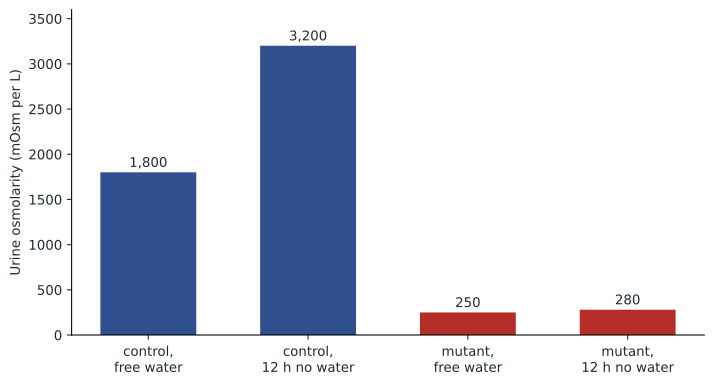
Q1. Which description best fits the mutant mice? (A) They cannot release ADH from the posterior pituitary; (B) their collecting ducts do not respond to ADH; (C) they make too much aldosterone; (D) their loop of Henle reabsorbs too much salt.
Q2. The most likely target of the mutation is: (A) the ADH receptor or the aquaporin channel in collecting duct cells; (B) the sodium-potassium pump in the proximal tubule; (C) renin in the juxtaglomerular cells; (D) the glucose transporter in the proximal tubule.
Q3. Why is plasma ADH higher in mutant mice than in control mice after water deprivation? (A) The mutation stimulates the pituitary directly; (B) the mutant mice's plasma osmolarity rises much more, which strongly stimulates hypothalamic osmoreceptors; (C) ADH is not broken down in mutant mice; (D) high urine volume stimulates ADH release.
Q4. If mutant mice are given free access to water, which behaviour would you most expect? (A) Reduced drinking; (B) greatly increased drinking; (C) refusal of water in favour of salt; (D) no change from control mice.
Q5. A loop diuretic is given to control mice that have been deprived of water. Compared with untreated deprived controls, urine osmolarity would most likely: (A) rise, because ADH rises; (B) fall, because the salt gradient in the medulla is weakened; (C) stay the same, because ADH controls osmolarity; (D) fall to zero.
Passage 2 (5 questions)
Passage 2. A 62-year-old man with a long history of smoking was studied during a stable period of chronic lung disease and again during a severe flare. During the flare, the researchers also measured his blood after he was given high-concentration oxygen for 30 minutes. Normal values: arterial pH 7.35 to 7.45; carbon dioxide 35 to 45 millimetres of mercury; oxygen 80 to 100 millimetres of mercury; bicarbonate 22 to 26 millimolar. Data invented for this course.
| Measurement | Stable period | Flare, breathing air | Flare, after 30 minutes of high-concentration oxygen |
|---|---|---|---|
| Arterial pH | 7.37 | 7.28 | 7.22 |
| Arterial carbon dioxide (millimetres of mercury) | 55 | 68 | 78 |
| Arterial oxygen (millimetres of mercury) | 62 | 48 | 140 |
| Arterial bicarbonate (millimolar) | 31 | 31 | 31 |
| Breathing rate (per minute) | 18 | 28 | 20 |
Q6. During the stable period, the patient's pH is nearly normal despite high carbon dioxide. This is best explained by: (A) respiratory compensation for a metabolic alkalosis; (B) renal retention of bicarbonate compensating for chronic respiratory acidosis; (C) a laboratory error; (D) increased ventilation lowering carbon dioxide.
Q7. During the flare, while breathing air, the patient's acid-base status is best described as: (A) acute respiratory acidosis on top of a compensated chronic respiratory acidosis; (B) metabolic alkalosis; (C) respiratory alkalosis; (D) metabolic acidosis with full respiratory compensation.
Q8. Bicarbonate does not change between the stable period and the flare. The best explanation is that: (A) the kidneys cannot respond to acid; (B) renal compensation takes days, and the flare developed over hours; (C) bicarbonate is not involved in buffering carbon dioxide; (D) the lungs control bicarbonate.
Q9. After high-concentration oxygen, the breathing rate falls and carbon dioxide rises. Which mechanism best explains this? (A) Oxygen directly blocks the medullary respiratory centres; (B) in this patient, low oxygen was contributing much of the drive to breathe through peripheral chemoreceptors, and relieving it reduced ventilation; (C) oxygen increases carbon dioxide production by the tissues; (D) oxygen causes the bronchioles to dilate.
Q10. Which other effect would the patient's chronic low oxygen be most likely to produce over months? (A) A low hematocrit; (B) a high hematocrit, because the kidney releases more erythropoietin; (C) a shift of the hemoglobin curve to the left; (D) reduced 2,3-bisphosphoglycerate.
Independent questions (4 questions)
Q11. A toxin blocks voltage-gated potassium channels in neurons. What is the most likely effect on the action potential? (A) It cannot start; (B) repolarization is slowed, so each action potential lasts longer; (C) the peak becomes more negative; (D) the resting potential becomes more negative.
Q12. Which cells present antigen on MHC class II molecules to helper T cells? (A) Red blood cells; (B) all nucleated cells; (C) dendritic cells, macrophages and B cells; (D) cytotoxic T cells.
Q13. A patient's stroke volume is 60 millilitres and heart rate is 90 beats per minute. Mean arterial pressure is 90 millimetres of mercury. What is the total peripheral resistance, in millimetres of mercury per litre per minute? (A) About 0.6; (B) about 1.7; (C) about 16.7; (D) about 486.
Q14. In a contracting skeletal muscle fibre, which region of the sarcomere shortens? (A) The A band; (B) the thick filaments; (C) the I band; (D) the thin filaments.
Answer key
| Question | Answer | Why |
|---|---|---|
| Q1 | B | ADH is present and even high, but urine stays dilute, and the ADH drug does not raise urine osmolarity, so the collecting ducts do not respond. (Skill 2) |
| Q2 | A | ADH acts through its receptor on collecting duct cells to insert aquaporins; a defect in either gives the pattern described. (Skill 2) |
| Q3 | B | The mutants keep losing water, so plasma osmolarity rises to 345, strongly stimulating osmoreceptors and ADH release; ADH cannot act, so it keeps rising. (Skill 4) |
| Q4 | B | Large urine losses raise plasma osmolarity and trigger thirst, so the mice drink heavily to keep up. (Skill 2) |
| Q5 | B | Loop diuretics block salt transport in the thick ascending limb, weakening the medullary gradient that ADH needs to concentrate urine. (Skill 2) |
| Q6 | B | High bicarbonate shows that the kidneys have retained bicarbonate over time to offset chronic carbon dioxide retention. (Skill 4) |
| Q7 | A | Carbon dioxide rose further and pH fell, with no time for more renal compensation, on top of an already compensated chronic state. (Skill 4) |
| Q8 | B | The kidneys adjust bicarbonate over days; an acute flare outpaces them. (Skill 1) |
| Q9 | B | With chronically high carbon dioxide, the drive from low oxygen through peripheral chemoreceptors becomes important; removing hypoxia reduces ventilation, and carbon dioxide rises. Mismatch of ventilation and blood flow also contributes. (Skill 2) |
| Q10 | B | Chronic low oxygen delivery stimulates erythropoietin release from the kidney, raising red cell production. (Skill 1) |
| Q11 | B | Voltage-gated potassium channels repolarize the membrane; blocking them prolongs the action potential. (Skill 1) |
| Q12 | C | MHC class II is found on professional antigen-presenting cells. (Skill 1) |
| Q13 | C | Cardiac output is 60 millilitres times 90, or 5.4 litres per minute; resistance is 90 divided by 5.4, about 16.7. (Skill 4) |
| Q14 | C | The I band contains only thin filaments and shortens as filaments slide; the A band and the filaments themselves do not change length. (Skill 1) |
The group's debrief
Each member scored differently on the timed set and improved in blind review, as in the earlier capstones. Their scores below are out of 14.
| Member | Passage 1 (of 5) | Passage 2 (of 5) | Independent (of 4) | Timed total | After blind review |
|---|---|---|---|---|---|
| Devika | 4 | 4 | 3 | 11 | 13 |
| Elliot | 5 | 3 | 4 | 12 | 13 |
| Ezequiel | 4 | 5 | 3 | 12 | 14 |
Ezequiel had his best set of the fall, and passage 2 was the reason. 'I have seen that patient,' he said. 'Chronic lung disease, a bad day, and someone turns the oxygen up too high. We were trained to watch for it.' His one timed miss in passage 1 was Q5. He had remembered that ADH concentrates urine and chose A, without noticing that the question was about a drug acting on the loop of Henle. In blind review, he named the mechanism in the margin, as his error-log rule from the biochemistry capstone told him to, and saw that the medullary gradient was the broken piece. His independent miss was Q13, where he divided millilitres by beats. 'Units first,' he wrote in his log.
Elliot finished passage 1 in under six minutes, a big change from the biochemistry capstone, where he had spent nine minutes rereading an easy table. His trouble came in passage 2. He chose D for Q6, reasoning that the high breathing rate meant the lungs were compensating, and then carried that wrong reading into Q7. He got Q8 right only because he remembered that the kidneys are slow. In blind review, he saw that the bicarbonate was the key number. Thandiwe's comment: 'Before you interpret an acid-base table, write down which value is abnormal first. The primary change is the one that explains the pH.' He added that line to the top of his error log.
Devika's two passage misses were Q3 and Q9. In Q3 she chose C, thinking ADH might pile up if it could not bind its receptor, which is plausible but not supported by the data, which showed plasma osmolarity rising dramatically. In Q9 she chose A. 'I knew carbon dioxide drives breathing,' she said. 'I forgot that the passage told me this patient had lived with high carbon dioxide for years.' Her independent miss was Q13, the resistance calculation, the same type of arithmetic that had cost her on the first diagnostic; this time, she had set up the equation correctly but multiplied 60 by 90 as 540 rather than 5,400 millilitres. She found the slip in blind review and noted that her mental math drill needed a section on powers of ten.
Thandiwe ended the session by asking each of them to update the content tags in their error logs and add one organ systems topic to the list of weak spots they would revisit before full-length practice. Devika chose acid-base calculations and the control of breathing. Elliot chose acid-base interpretation. Ezequiel chose cardiovascular calculations and the details of the immune system, where he had felt slowest all fall. The next block of the Sunday Session would move to general chemistry, where Devika's and Ezequiel's calculation habits would get a full workout.
How to review a physiology set
The debrief points to a review method that works for any passage set. For each miss, write down which system the passage was about, which part was broken, and what that part normally does. Then write the one step in the chain that you got wrong. Most physiology misses fall into one of four groups: a content gap (you did not know what the part does); a reading error (you missed a detail in the passage, such as a time course or a value); a reasoning error (you jumped from the broken part to a conclusion without following the steps, or confused compensation with cause); or a calculation slip. Each group needs a different fix: review of content, slower reading of tables, writing out the chain of steps, or arithmetic practice.
Common mistakes
MistakeA high hormone level means the hormone is working.
InsteadA hormone can be high because its target does not respond, as with ADH in passage 1, so feedback keeps driving it up.
MistakeIn acid-base problems, the value that changed most is always the primary problem.
InsteadThe primary change is the one that explains the direction of the pH; the other change is usually compensation.
MistakeGiving more oxygen can never reduce breathing.
InsteadIn people with chronic carbon dioxide retention, relieving low oxygen can reduce the drive to breathe and raise carbon dioxide.
MistakeConcentrating urine depends only on ADH.
InsteadADH needs the salty medulla created by the loop of Henle; disrupting the gradient limits concentration even with high ADH.
MistakeCompensation fully corrects a disturbance.
InsteadCompensation is usually partial, and renal compensation takes days, so acute changes appear before compensation catches up.
Summary and key terms
- Every organ system can be analysed by asking what it controls, how it is controlled and what happens when a part fails.
- Structure explains function, control is layered from fast neural to slow hormonal, and compensation is not the same as cure.
- In passage 1, high ADH with dilute urine and no response to an ADH drug points to collecting ducts that cannot respond to ADH.
- In passage 2, high bicarbonate with high carbon dioxide and near-normal pH shows chronic respiratory acidosis with renal compensation.
- Calculations such as cardiac output and resistance reward careful units and powers of ten.
- Review each miss by naming the broken part, its normal role and the step in the chain that went wrong.
- Primary disturbance
- The first change in a system, which explains the direction of the main abnormality.
- Compensation
- The response of another system that partly offsets a primary disturbance.
- Blind review
- Reworking marked questions before checking the answers, to separate guesses from knowledge.
- Nephrogenic diabetes insipidus
- A disorder in which the kidney does not respond to ADH, causing large volumes of dilute urine.
- Chronic respiratory acidosis
- A long-standing rise in carbon dioxide with renal retention of bicarbonate.
- Hypoxic drive
- Stimulation of breathing by low arterial oxygen through peripheral chemoreceptors.
Practice problems
Work each problem on paper first, then reveal the answer to check.
A patient has high aldosterone and low renin. Where is the problem most likely located?
Show answer
In the adrenal cortex, which is making aldosterone on its own; high blood pressure and sodium retention suppress renin.
Why does a person with severe diarrhea breathe faster?
Show answer
Loss of bicarbonate causes metabolic acidosis, and the lungs compensate by lowering carbon dioxide.
A drug blocks nicotinic acetylcholine receptors in autonomic ganglia. Which divisions of the autonomic system are affected?
Show answer
Both sympathetic and parasympathetic, because all preganglionic neurons release acetylcholine onto nicotinic receptors.
Why can a person with a removed thyroid gland still regulate blood calcium normally?
Show answer
Parathyroid hormone and vitamin D are the main regulators; calcitonin from the thyroid has only a minor role in adults, as long as the parathyroid glands are preserved.
Lesson quiz · 5 questions
Score 60% or more to complete this lesson.
Create a free account to save your progress, take quizzes and earn a certificate.