
MCAT-112 · Lesson 3 of 12 · 22 min
Nervous and endocrine systems
▶ Video coming soon A video version of this lesson is on the way.
Devika works shifts at a pharmacy, and she arrived at the third session with a question from the counter. A customer had asked why her thyroid pill had to be taken every day when her doctor said the gland was "only a little underactive", while her husband's asthma inhaler worked within minutes. 'One answer is pharmacology,' Thandiwe said. 'The better answer for the MCAT is that nerves and hormones are two different ways of sending a message. One is fast and private. The other is slow and public.'
The endocrine system uses hormones, chemical signals released into the blood that act on distant target cells with matching receptors. The AAMC outline splits it into two subtopics: hormones and their sources, and mechanisms of hormone action. This lesson covers both, along with the links between the nervous and endocrine systems through the hypothalamus and pituitary gland. Later lessons return to specific hormones in context: insulin and glucagon in lesson 11, the hormones of the kidney in lesson 8, and the reproductive hormones in lesson 9.
Nerves and hormones compared
| Feature | Nervous signalling | Endocrine signalling |
|---|---|---|
| Signal | Action potentials and neurotransmitters | Hormones in the blood |
| Speed of onset | Milliseconds | Seconds to days |
| Duration | Usually brief | Often prolonged |
| Targeting | Specific cells reached by the axon | Any cell with the right receptor, anywhere the blood goes |
| Typical uses | Rapid responses: movement, reflexes, sensation | Sustained processes: growth, metabolism, reproduction, fluid balance |
The line between them is blurred. Some neurons, called neurosecretory cells, release hormones into the blood; the hypothalamic neurons that make antidiuretic hormone and oxytocin are examples. Epinephrine is a hormone when the adrenal medulla releases it into the blood and closely related to a neurotransmitter, norepinephrine, released by sympathetic neurons. Many signals also act locally: paracrine signals act on nearby cells, and autocrine signals act on the cell that released them.
Classes of hormones and how they act
Hormones fall into three chemical classes, and the class predicts where the receptor is, how the hormone travels in the blood and how fast it acts.
| Class | Examples | Solubility and transport | Receptor location and mechanism | Speed |
|---|---|---|---|---|
| Peptide and protein hormones | Insulin, glucagon, antidiuretic hormone, oxytocin, growth hormone, prolactin, parathyroid hormone, the anterior pituitary tropic hormones | Water-soluble; dissolve freely in plasma; stored in vesicles and released by exocytosis | Cell-surface receptors (G protein-coupled or enzyme-linked); act through second messengers and changes in existing proteins | Fast, seconds to minutes |
| Steroid hormones | Cortisol, aldosterone, estrogens, progesterone, testosterone; the active form of vitamin D is closely related | Lipid-soluble; made from cholesterol on demand, not stored; carried in blood bound to proteins | Intracellular receptors in the cytoplasm or nucleus; the hormone-receptor complex binds DNA and changes gene transcription | Slow, hours to days, but long-lasting |
| Amino acid derivatives | Epinephrine and norepinephrine (from tyrosine); thyroid hormones T3 and T4 (from tyrosine and iodine); melatonin (from tryptophan) | Catecholamines are water-soluble; thyroid hormones are lipid-soluble and protein-bound | Catecholamines use cell-surface receptors; thyroid hormones use nuclear receptors | Catecholamines fast; thyroid hormones slow |
The thyroid hormones are the classic exception to the rule that amino acid derivatives act like peptides. Although they come from tyrosine, they are lipid-soluble, travel bound to carrier proteins, enter cells and bind nuclear receptors, so they act like steroids: slowly and over a long time. That is the answer to Devika's customer. Thyroid hormone works through gene expression and has a long half-life, so replacing it is a daily, steady process. The inhaler delivers a drug that acts on beta-2 adrenergic receptors on airway smooth muscle, cell-surface receptors that change existing proteins within seconds.
Binding to plasma proteins matters because only the free, unbound hormone can enter tissues and act. The bound fraction acts as a reservoir and slows clearance, so lipid-soluble hormones generally have longer half-lives in the blood than peptide hormones, which are filtered and broken down quickly.
The hypothalamus and the pituitary gland
The hypothalamus links the nervous and endocrine systems. It receives information about body temperature, blood osmolarity, nutrient levels, stress and light, and it controls the pituitary gland, which sits below it. The pituitary has two parts that work differently.
The posterior pituitary is an extension of the brain. Neurons whose cell bodies lie in the hypothalamus send axons down the pituitary stalk and release two hormones directly into the blood in the posterior pituitary: antidiuretic hormone, also called vasopressin, and oxytocin. The posterior pituitary stores and releases these hormones; it does not make them.
The anterior pituitary is true glandular tissue. The hypothalamus controls it through releasing and inhibiting hormones, which travel a short distance through a special set of blood vessels, the hypophyseal portal system, from the base of the hypothalamus to the anterior pituitary. Because the portal system carries the hormones directly, they arrive in high concentration without being diluted in the general circulation.
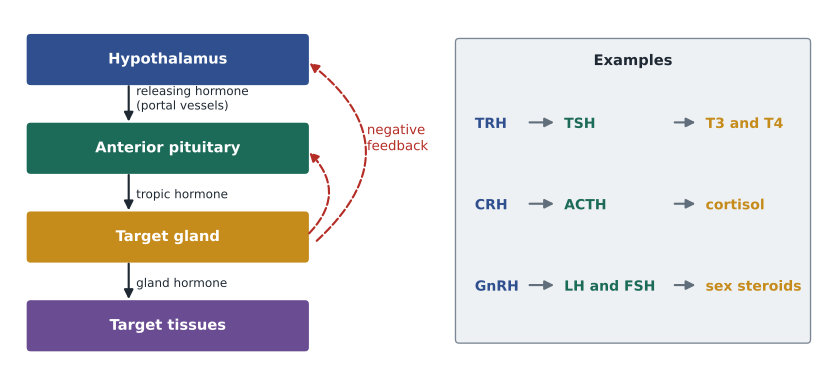
| Anterior pituitary hormone | Hypothalamic control | Target | Main effects |
|---|---|---|---|
| Thyroid-stimulating hormone (TSH) | Stimulated by thyrotropin-releasing hormone (TRH) | Thyroid gland | Production and release of T3 and T4 |
| Adrenocorticotropic hormone (ACTH) | Stimulated by corticotropin-releasing hormone (CRH) | Adrenal cortex | Production of cortisol and other glucocorticoids |
| Follicle-stimulating hormone (FSH) | Stimulated by gonadotropin-releasing hormone (GnRH) | Ovaries and testes | Follicle development; sperm production through Sertoli cells |
| Luteinizing hormone (LH) | Stimulated by GnRH | Ovaries and testes | Ovulation and corpus luteum formation; testosterone production by Leydig cells |
| Growth hormone (GH) | Stimulated by growth hormone-releasing hormone; inhibited by somatostatin | Liver, bone, muscle and most tissues | Growth, partly through insulin-like growth factor 1 made in the liver; raises blood glucose |
| Prolactin | Mainly inhibited by dopamine | Mammary glands | Milk production |
A mnemonic many students use for the six anterior pituitary hormones is FLAT PeG: FSH, LH, ACTH, TSH, prolactin and growth hormone. The first four are tropic hormones, meaning their main job is to stimulate another endocrine gland. Prolactin and growth hormone act mainly on non-endocrine tissues. Prolactin is unusual because its main hypothalamic control is inhibitory: dopamine from the hypothalamus holds prolactin release down, so damage to the pituitary stalk lowers most anterior pituitary hormones but raises prolactin.
Negative feedback and endocrine disorders
Most hormone systems are regulated by negative feedback: the final hormone inhibits the earlier steps that stimulated its release. Cortisol inhibits release of both CRH and ACTH; thyroid hormone inhibits TRH and TSH. Negative feedback keeps hormone levels within a range and explains the pattern of lab results in endocrine disease. The key reasoning tool is to ask where the problem is: in the target gland (primary disorder) or in the pituitary or hypothalamus (secondary or tertiary disorder).
| Condition | Thyroid hormone | TSH | Reasoning |
|---|---|---|---|
| Primary hypothyroidism (thyroid gland fails) | Low | High | Low thyroid hormone removes feedback, so the pituitary releases more TSH |
| Secondary hypothyroidism (pituitary fails) | Low | Low | The pituitary cannot make TSH, so the thyroid is not stimulated |
| Primary hyperthyroidism, for example Graves disease, in which antibodies stimulate the TSH receptor | High | Low | High thyroid hormone suppresses TSH through feedback |
| Pituitary tumour making TSH | High | High or inappropriately normal | The tumour ignores feedback |
The same logic applies to the adrenal axis. Cushing syndrome is the state of too much cortisol. If it comes from a pituitary tumour making ACTH, both ACTH and cortisol are high; if it comes from an adrenal tumour, cortisol is high and ACTH is suppressed. Giving steroid drugs such as prednisone for a long time suppresses ACTH, and the adrenal cortex shrinks; stopping the drug suddenly can leave the patient without enough cortisol, which is why such drugs are tapered.
Positive feedback is less common in hormone systems but appears in a few important places. Rising estrogen before ovulation triggers a surge of LH, covered in lesson 9. During childbirth, stretching of the cervix triggers oxytocin release, which strengthens uterine contractions, which stretch the cervix further, until the baby is delivered.
The major endocrine glands
| Gland | Hormone | Main effects |
|---|---|---|
| Hypothalamus | Releasing and inhibiting hormones; antidiuretic hormone and oxytocin (released from the posterior pituitary) | Controls the pituitary; ADH increases water reabsorption in the kidney; oxytocin causes uterine contraction and milk ejection |
| Pineal gland | Melatonin | Released in darkness; helps regulate circadian rhythms and sleep |
| Thyroid gland | T3 and T4 | Raise basal metabolic rate and heat production; needed for normal growth and brain development |
| Thyroid gland (C cells) | Calcitonin | Lowers blood calcium, mainly by inhibiting bone breakdown; a minor role in adult humans |
| Parathyroid glands | Parathyroid hormone (PTH) | Raises blood calcium by stimulating bone breakdown, increasing calcium reabsorption in the kidney and activating vitamin D |
| Adrenal cortex | Cortisol (glucocorticoid) | Raises blood glucose through gluconeogenesis; breaks down protein; suppresses inflammation and immune responses |
| Adrenal cortex | Aldosterone (mineralocorticoid) | Increases sodium reabsorption and potassium secretion in the kidney |
| Adrenal cortex | Androgens | Minor sex steroid effects; a significant source of androgens in females |
| Adrenal medulla | Epinephrine and norepinephrine | Fight-or-flight responses; raise heart rate, blood glucose and blood flow to muscle |
| Pancreas (islets) | Insulin (beta cells); glucagon (alpha cells); somatostatin (delta cells) | Insulin lowers blood glucose; glucagon raises it; somatostatin inhibits both and other digestive hormones |
| Ovaries | Estrogens and progesterone | Female reproductive development and the menstrual cycle; maintenance of pregnancy |
| Testes | Testosterone | Male reproductive development, sperm production and secondary sex characteristics |
| Kidneys | Erythropoietin; renin (an enzyme); active vitamin D (calcitriol) | Red blood cell production; activation of the angiotensin system; calcium absorption |
| Heart | Atrial natriuretic peptide | Released when the atria are stretched; increases sodium and water excretion and lowers blood pressure |
Calcium regulation: an example of opposing hormones
Blood calcium must stay within a narrow range, because calcium affects nerve and muscle excitability, blood clotting and the release of neurotransmitters. Low calcium makes neurons more excitable, because calcium normally stabilizes sodium channels; severe low calcium causes muscle spasms, called tetany.
When blood calcium falls, the parathyroid glands release parathyroid hormone. PTH raises calcium in three ways: it stimulates osteoclasts, indirectly through osteoblasts, to break down bone and release calcium and phosphate; it increases calcium reabsorption in the kidney and decreases phosphate reabsorption, so more phosphate is lost in urine; and it stimulates the kidney to convert vitamin D to its active form, calcitriol, which increases calcium absorption in the small intestine. When calcium rises, PTH falls. Calcitonin from the thyroid opposes PTH by inhibiting osteoclasts, but removing the thyroid does not cause noticeable calcium problems in adults, which shows that calcitonin is not essential.
Second messengers in hormone action
Peptide hormones and catecholamines change cell behaviour through the same signalling machinery described in MCAT-110. Many bind G protein-coupled receptors. Glucagon, epinephrine at beta receptors, TSH, ACTH, and antidiuretic hormone in the kidney raise cyclic AMP through Gs and activate protein kinase A. Epinephrine at alpha-1 receptors, and oxytocin, act through Gq, raising IP3, diacylglycerol and intracellular calcium. Insulin and growth factors act through receptor tyrosine kinases. Questions on these pathways often ask what happens when a step is blocked or when a cell lacks a receptor. A cell responds to a hormone only if it has the receptor; a tissue that lacks it is unaffected, however high the hormone level.
Worked problem
Reasoning about a hormone deficiency
A patient has a disease that destroys the adrenal cortex on both sides. Predict the levels of cortisol, ACTH and aldosterone, and one effect on blood potassium.
Show solution
- Cortisol is made in the adrenal cortex, so it falls.
- Low cortisol removes negative feedback on the hypothalamus and pituitary, so CRH and ACTH rise.
- Aldosterone is also made in the adrenal cortex, so it falls too.
- Aldosterone normally causes the kidney to secrete potassium; without it, potassium is retained, so blood potassium rises, and sodium and water are lost.
Answer: Cortisol low, ACTH high, aldosterone low, and blood potassium high. This pattern describes primary adrenal insufficiency.
Passage-style practice
Passage. Researchers measured blood levels of cortisol and ACTH in four groups of patients at 8 a.m. Group 1 had no endocrine disease. Group 2 had a tumour of the anterior pituitary. Group 3 had a tumour of one adrenal gland. Group 4 had taken a high dose of a synthetic glucocorticoid drug, which does not register on the cortisol test, every day for six months. Data invented for this course.
| Group | Cortisol (relative to normal) | ACTH (relative to normal) |
|---|---|---|
| 1 | Normal | Normal |
| 2 | High | High |
| 3 | High | Low |
| 4 | Low | Low |
Practice problems
Work each problem on paper first, then reveal the answer to check.
Which group shows the result of a hormone-secreting tumour that ignores negative feedback while driving another gland? (Skill 4: data-based reasoning)
Show answer
Group 2: the pituitary tumour makes ACTH despite high cortisol, and the ACTH drives the adrenal cortex.
Why is ACTH low in group 3? (Skill 2: scientific reasoning)
Show answer
The adrenal tumour makes cortisol on its own; high cortisol suppresses CRH and ACTH through negative feedback.
Why is measured cortisol low in group 4? (Skill 2)
Show answer
The synthetic drug suppresses ACTH by feedback, so the patient's own adrenal glands make little cortisol; the drug itself is not detected by the test.
What would happen if a group 4 patient stopped the drug suddenly? (Skill 2)
Show answer
The suppressed adrenal glands could not make enough cortisol quickly, so the patient could develop adrenal insufficiency.
Why measure all groups at the same time of day? (Skill 3: research design)
Show answer
Cortisol and ACTH follow a daily rhythm, highest in the early morning, so measuring at the same time controls for that variation.
Common mistakes
MistakeThe posterior pituitary makes antidiuretic hormone and oxytocin.
InsteadHypothalamic neurons make them; the posterior pituitary stores and releases them.
MistakeAll hormones made from amino acids act on surface receptors.
InsteadThyroid hormones are lipid-soluble and act on nuclear receptors, like steroids.
MistakeIn primary hypothyroidism, TSH is low.
InsteadIn primary hypothyroidism, low thyroid hormone removes feedback, so TSH is high.
MistakeSteroid hormones are stored in vesicles until needed.
InsteadSteroids are lipid-soluble and diffuse out as soon as they are made; they are synthesized on demand.
MistakeCalcitonin is the main hormone controlling blood calcium.
InsteadParathyroid hormone and active vitamin D are the main regulators; calcitonin has a minor role in adults.
Summary and key terms
- Nervous signals are fast, brief and targeted; hormones are slower, longer-lasting and reach any cell with the right receptor.
- Peptide hormones and catecholamines act on surface receptors through second messengers; steroids and thyroid hormones act on intracellular receptors and change gene expression.
- The hypothalamus controls the anterior pituitary through releasing hormones in the portal system and sends ADH and oxytocin to the posterior pituitary by axons.
- Negative feedback keeps hormone levels in range; primary disorders and pituitary disorders give opposite patterns of tropic hormone levels.
- Parathyroid hormone and vitamin D raise blood calcium; calcitonin has a minor opposing role.
- A tissue responds to a hormone only if it has the receptor.
- Hormone
- A chemical signal released into the blood that acts on distant target cells.
- Tropic hormone
- A hormone whose main target is another endocrine gland.
- Hypophyseal portal system
- Blood vessels that carry hypothalamic releasing hormones directly to the anterior pituitary.
- Negative feedback
- A process in which the output of a system reduces the signal that produced it.
- Primary disorder
- An endocrine disorder that starts in the target gland itself.
- Paracrine signal
- A chemical signal that acts on nearby cells without entering the general circulation.
- Calcitriol
- The active form of vitamin D, made in the kidney, which increases calcium absorption from the gut.
Lesson quiz · 5 questions
Score 60% or more to complete this lesson.
Create a free account to save your progress, take quizzes and earn a certificate.