
MBA-699 · Lesson 1 of 12 · 23 min
What consulting is: the capstone engagement and the client relationship
The last course of the program begins on a Friday evening in January with a question from Dr. Anjali Mehta, the faculty adviser for the capstone. She asks the cohort to think back to the first weekend of the program, when Dr. Achterberg handed them Cedarline's financial statements and asked what they saw. Two years later, she says, they can read a balance sheet, value a company, design a supply chain, build a people strategy and negotiate a union agreement. This term they will do something harder: use all of it at once, for someone else, under a deadline, with incomplete information and a client who has not yet decided whether to trust them.
Dr. Mehta spent sixteen years at a global strategy consulting firm, the last six as a partner in its consumer and retail practice, and then five years as chief strategy officer of a large Canadian insurer, where she hired consultants rather than being one. She tells the cohort that the second job taught her more about consulting than the first. As a client she learned which consultants made her organization better and which simply produced impressive documents, and the difference had little to do with intelligence. It had to do with whether they understood the real problem, whether they listened to the people who would have to carry out the answer, and whether they told her things she did not want to hear.
The capstone engagement
The capstone is a real engagement with a real client organization. Each team of students works for twelve weeks on a problem that matters to the client's senior leaders, produces a written report and a final presentation, and is assessed partly by the client. The work is unpaid, but it is not hypothetical: clients agree to provide data, staff time and a senior sponsor, and in return they expect advice they can use.
This year the cohort splits into two teams. Grace Mwangi, Hana Kowalski and Daniel Osei will work for Meadowlark Co-op, a member-owned retailer in southern Manitoba and eastern Saskatchewan, with its head office in Brandon. Leo Brandt and Owen Tremblay will work for Cedarline Outdoor, whose chief executive has asked for help turning the plans the cohort has studied for two years into one sequenced transformation program. Most of this course follows the Meadowlark team, with the Cedarline team appearing where its experience offers a useful contrast.
Meadowlark was founded in the 1930s by farm families who pooled their money to buy fuel and groceries at fair prices. Today it has 142,000 members, of whom 61 per cent bought something in the last year. It runs 22 grocery stores, 31 fuel and convenience sites and 9 farm supply stores, with revenue of 612 million dollars in fiscal 2026. Like most consumer co-ops, it returns part of its surplus to members each year as a patronage refund in proportion to what they spent. That refund has fallen from 9.5 million dollars in 2021 to 4.0 million, mainly because the grocery business, which accounts for 318 million of revenue, now earns an operating margin of only 1.1 per cent.
The co-op's chief executive, Colin Baptiste, will be the team's sponsor. The board chair, Agnes Wiebe, a grain farmer and former school principal, has told him that the board wants a plan for the grocery business that it can approve in the spring. The sponsor is the person who owns the engagement on the client side: he agreed to the scope, he will open doors, and he will decide whether the team's work is useful. Dr. Mehta tells the team to learn quickly who else matters, because a sponsor's support is necessary but rarely sufficient.
What consultants do
Management consulting is the business of helping organizations solve problems and make decisions by bringing expertise, analysis, an outside perspective or extra capacity that the organization lacks or cannot easily deploy. The industry includes strategy firms that advise chief executives and boards, large professional services firms that combine consulting with audit, tax and technology work, specialist firms focused on an industry or function, and thousands of independent consultants. Internal consulting groups inside large companies and governments do similar work for their own organizations.
Clients hire consultants for several different reasons, and Dr. Mehta argues that knowing which one applies is the first step in any engagement. Some want expertise they do not have, such as how to design a loyalty program or run a grocery ordering system. Some want analysis they have no time or skill to do. Some want an independent view, perhaps to test a plan before taking it to the board, or to settle a disagreement among executives. Some want capacity to carry out a project. And some, less openly, want the weight of an outside name to support a decision already made. That last reason is not always illegitimate, but a team that does not recognize it may spend weeks answering a question nobody is really asking.
Edgar Schein, whose work on culture the cohort met in MBA-503, distinguished three models of consulting. In the purchase-of-expertise model, the client defines the problem and buys a solution. In the doctor–patient model, the client describes symptoms and the consultant diagnoses and prescribes. In the process consultation model, the consultant helps the client see and solve the problem itself, building the client's own capability. Schein argued that the first two models fail more often than consultants admit, because the client's initial diagnosis may be wrong and because a solution imposed from outside is rarely carried out with conviction. Most good engagements mix the models: the team brings analysis and expertise, but works with the client so that the conclusions become the client's own.
The industry in 2026
Consulting is changing quickly, and the cohort's engagement sits in the middle of that change. Generative AI tools can now summarize documents, draft interview guides, analyse survey comments and produce first drafts of slides in minutes. In January 2026 McKinsey reported that it had about 25,000 AI agents working alongside roughly 40,000 human employees, and its internal assistant, Lilli, is used by most of its staff every month. Firms have begun to change how they charge as a result: McKinsey said in 2026 that about a quarter of its fees were now tied to outcomes rather than time, and large firms have held starting salaries flat for several years while reshaping the traditional pyramid of many junior analysts under a few partners.
Dr. Mehta draws a practical lesson from these changes. The parts of consulting that machines do well, such as gathering and summarizing information, are becoming cheap. The parts they do poorly are becoming more valuable: framing the right question, earning the trust of people who will not share the truth with a stranger, judging which evidence to believe, and persuading a board to act. The team may use AI tools for research and drafting, with the client's permission for any client data, but every fact in the final report must be checked against a source, and the judgement in it must be the team's own.
The client relationship
David Maister, Charles Green and Robert Galford argued in The Trusted Advisor that clients trust advisors who are credible, reliable and intimate, and who show low self-orientation. They summarized this as an equation: trust equals credibility plus reliability plus intimacy, divided by self-orientation. Credibility comes from expertise and accuracy; reliability from doing what you say you will do; intimacy from the client's sense that it is safe to share difficult things with you; and self-orientation from the impression that you care more about yourself, your fees or your ideas than about the client's problem. The equation is not meant to be calculated, but it is a useful reminder that a brilliant team that misses deadlines or keeps talking about its own frameworks will not be trusted.
For a student team, reliability is the quickest route to trust. Meadowlark's managers are busy and doubtful about business school students, Colin warns the team at their first call, because a previous student project produced a report full of national statistics that had nothing to do with small Prairie towns. The managers will judge you by whether you turn up when you said you would, whether you return their data in a usable form, and whether you understand that a grocery store in a town of 2,000 people is not a supermarket in Winnipeg.
Peter Block's Flawless Consulting, a standard guide for internal and external consultants since 1981, adds a point about authenticity: consultants should say plainly what they are experiencing in the relationship, including resistance, rather than pretending everything is fine. If a manager keeps delaying a data request, a good consultant names the pattern politely and asks what is behind it, rather than complaining to the sponsor. Resistance is usually information: the manager may fear what the data will show, or may doubt that the team understands the business.
Ethics and conflicts of interest
Consulting carries ethical duties that the cohort has met in other courses: confidentiality, honesty about findings, independence of judgement and avoidance of conflicts of interest. In the capstone they become concrete at once. Before the engagement begins, each student signs the client's confidentiality agreement and declares any interest that could affect the work.
Grace's declaration takes the longest. Until last year she was a category manager at Fairway Grocers, a regional supermarket chain, and she knows Fairway's supplier terms, margins and promotion plans in detail. Fairway does not operate in Meadowlark's region, so there is no direct competition, but Grace remains bound by her duty not to use Fairway's confidential information. She is also now chief executive of Second Ascent, the repair and resale venture spun out of Cedarline, which might one day want to sell through co-op stores. Dr. Mehta and Colin agree on three conditions: Grace may use her general knowledge of how grocery works, but no Fairway data or terms; she will not discuss Second Ascent with Meadowlark during the engagement; and if any recommendation touches on outdoor gear or repair, Hana and Daniel will lead that part. The conditions are recorded in the engagement letter.
Dr. Mehta tells the cohort that disclosure is the start of managing a conflict, not the end. A conflict is managed when the client understands it, agrees to the safeguards, and can see them working. Teams should also be honest about their own limits: if the team lacks expertise in an area that matters, such as the legal rules for closing a store with a long-term lease, it should say so and recommend that the client get proper advice.
How the course works
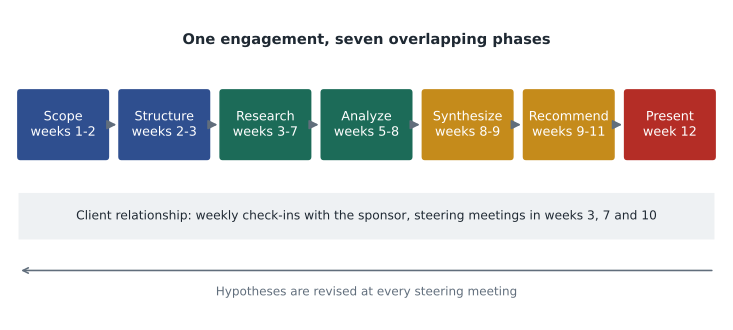
Each lesson in this course follows a stage of the engagement, from scoping in the first weeks to the final presentation in the twelfth. The figure shows the phases. They overlap: research begins before the problem is fully structured, analysis starts while interviews are still running, and the team will revise its hypotheses at each of three steering meetings with the client. Steering meetings are short formal reviews in which the sponsor and two or three senior managers hear what the team has found, challenge it and agree on next steps.
The assessment has three parts: the written report and presentation, graded by Dr. Mehta and a second faculty reader; the client's evaluation, which asks the sponsor whether the work was useful and how the team behaved; and a personal reflection on what each student learned. Dr. Mehta tells them that the client's evaluation is the hardest to earn and the most honest.
Before the team meets Meadowlark's managers, Daniel builds a rough estimate of what is at stake, so that everyone understands why the board cares. The calculation uses only figures from the co-op's annual report.
# Value at stake in the Meadowlark grocery business (millions of dollars)
grocery_sales = 318.0
margin_now = 0.011          # operating margin, fiscal 2026
margin_target = 0.025       # the board's three-year target
gap = (margin_target - margin_now) * grocery_sales
print(f"Operating profit now:      {margin_now * grocery_sales:6.2f}")
print(f"Operating profit at target:{margin_target * grocery_sales:6.2f}")
print(f"Annual gap to close:       {gap:6.2f}")
print(f"Value of one margin point: {0.01 * grocery_sales:6.2f}")
# Patronage refund: what payout of total savings restores 7.0 million?
savings_now, refund_now = 8.0, 4.0
savings_target = savings_now + gap
for payout in (0.50, 0.55):
    print(f"Refund at {payout:.0%} payout on {savings_target:.2f} of savings: {payout * savings_target:5.2f}")
# Fee perspective: the engagement costs the client nothing in fees,
# but staff time is real. Estimate client hours the team will use.
interviews, hours_each = 38, 1.25
workshops, people, hours_ws = 3, 8, 3
data_requests = 22 * 2.0
client_hours = interviews * hours_each + workshops * people * hours_ws + data_requests
print(f"Client staff hours needed: {client_hours:.0f}")Operating profit now: 3.50 Operating profit at target: 7.95 Annual gap to close: 4.45 Value of one margin point: 3.18 Refund at 50% payout on 12.45 of savings: 6.23 Refund at 55% payout on 12.45 of savings: 6.85 Client staff hours needed: 164
The output frames the engagement in two numbers. Each point of grocery margin is worth about 3.2 million dollars a year, and the gap between today's margin and the board's target is about 4.5 million. Hana notices something less obvious: even if grocery reaches exactly 2.5 per cent, the patronage refund would reach only 6.2 to 6.9 million at the co-op's usual payout ratios, short of the board's hope of 7.0 million. Either the grocery business must do somewhat better than the target, or the other divisions must contribute. That observation will matter when the team writes its problem statement in the next lesson. The last line is a reminder that the engagement is not free for the client: about 160 hours of managers' time, which Colin will have to protect.
Worked problem
Choosing what kind of help Meadowlark needs
In the first call, Colin says the board wants a plan for grocery. One director has suggested selling the stores to a national chain; another wants to open more stores. The managers believe the problem is competition from discount stores in larger towns. Using Schein's three models and the reasons clients hire consultants, decide what kind of engagement the team should propose.
Show solution
- The client's diagnosis is uncertain: the board is divided and managers have a single explanation that has not been tested. That argues against the purchase-of-expertise model, in which the team would simply answer the question as framed.
- The board needs an independent view it can trust, because directors disagree. That is a legitimate reason to hire outsiders, and it calls for transparent analysis that each director can follow.
- The managers will have to carry out whatever is decided, so the team should work with them on the diagnosis, in the spirit of process consultation, rather than presenting conclusions they have never seen.
- The team should therefore propose a diagnostic engagement that tests several explanations, including the managers' view about discounters, and builds options with the managers before recommending one to the board.
Answer: Propose a joint diagnosis and options engagement: independent enough to settle the board's disagreement, collaborative enough that managers own the answer.
Common mistakes
MistakeConsulting is mainly about producing a polished report.
InsteadThe report is a means; the goal is a decision the client makes and carries out, which depends on trust and ownership as much as analysis.
MistakeThe client's first description of the problem is the problem.
InsteadInitial diagnoses are often incomplete; test them, as Schein warned, before solving them.
MistakeDeclaring a conflict of interest is enough.
InsteadConflicts are managed by disclosure plus agreed safeguards that the client can see working.
MistakeAI tools make careful checking unnecessary.
InsteadThey make drafting and research faster, but every fact must still be checked and the judgement must remain the team's.
Summary and key terms
- Management consulting helps organizations solve problems by providing expertise, analysis, independence or capacity.
- Schein's purchase-of-expertise, doctor–patient and process consultation models describe different relationships; good engagements usually combine them.
- Trust depends on credibility, reliability and intimacy, and is reduced by self-orientation; reliability is a student team's quickest route to it.
- AI is making information gathering cheap and raising the value of framing, judgement and persuasion; firms are changing staffing and pricing in response.
- Confidentiality, honesty and conflict management are concrete obligations from the first day of an engagement.
- The Meadowlark engagement aims to close a grocery margin gap of about 4.5 million dollars a year and restore the patronage refund.
- Engagement
- A defined piece of consulting work for a client, with agreed scope, deliverables and timing.
- Sponsor
- The senior client executive who owns the engagement, opens doors and judges its usefulness.
- Steering meeting
- A short formal review in which client leaders hear findings, challenge them and agree next steps.
- Process consultation
- Schein's model in which the consultant helps the client diagnose and solve its own problem.
- Self-orientation
- In the trust equation, the degree to which an advisor seems focused on their own interests.
- Patronage refund
- A co-op's return of surplus to members in proportion to their purchases.
Practice problems
Work each problem on paper first, then reveal the answer to check.
Why might a board hire consultants when its own managers already have a view of the problem?
Show answer
To get an independent view that can settle disagreement among directors, or to test the managers' diagnosis before acting on it.
Using the trust equation, explain why a team that is brilliant but often late may still lose a client's trust.
Show answer
Lateness lowers reliability, one of the three terms in the numerator, and can signal self-orientation, which sits in the denominator.
Meadowlark's grocery sales are 318 million. What is one margin point worth, and how much profit is needed to move from 1.1 to 2.5 per cent?
Show answer
One point is worth 3.18 million; the gap is (0.025 − 0.011) × 318 = about 4.45 million a year.
Grace wants to mention how Fairway structures supplier rebates as an example in an interview. Should she?
Show answer
Not if the example draws on Fairway's confidential terms; she may use general industry knowledge but not her former employer's information.
Lesson quiz · 5 questions
Score 60% or more to complete this lesson.
Create a free account to save your progress, take quizzes and earn a certificate.