
MBA-602 · Lesson 9 of 12 · 24 min
Financing a venture: bootstrapping, angels, venture capital and government programs
Second Ascent's cash model from lesson 6 showed a J-curve with a low point of about 171,000 dollars on the lean plan, implying a first raise of perhaps 300,000 to 350,000 dollars with a cushion. Grace has 60,000 dollars of her own to commit. Dr. Marchetti opens the ninth session by asking the founders where the rest should come from, and then widens the question. The source of money is not just a matter of price, she says. Each kind of capital comes with expectations about growth, control, timing and exit, and choosing the wrong kind can push a venture into a strategy that does not suit it. A founder who wants to build a profitable regional business should be wary of money that needs a hundredfold return.
The financing ladder
Ventures typically raise money in stages, each sized to reach the next milestone that will reduce uncertainty and justify a higher valuation. At the bottom of the ladder are the founders' own savings and, often, money from friends and family. Next comes a pre-seed or seed stage, funded by angels, accelerators and seed funds, which pays for proving that customers want the product and that the unit economics can work. A Series A round, usually led by a venture capital firm, funds the building of a repeatable sales and delivery engine once the model is proven. Later rounds, Series B and beyond, fund rapid expansion. Alongside equity, ventures may use debt, customer prepayments and government programs that do not dilute ownership.
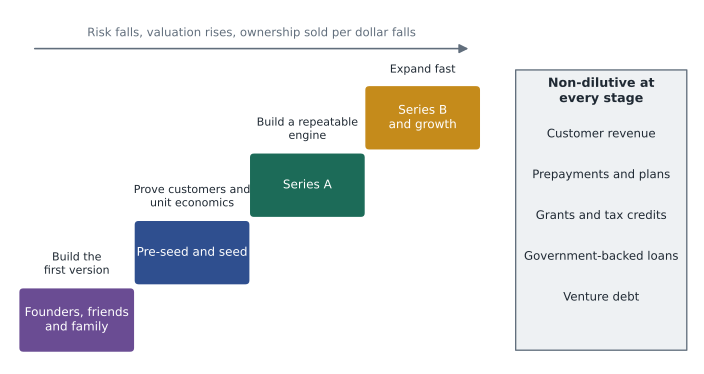
The logic of the ladder is that capital becomes cheaper as risk falls. Money raised before a venture has customers is very expensive in terms of ownership given up, because investors demand a large share to compensate for the chance of total loss. The same amount raised after the venture has shown strong unit economics costs much less ownership. Founders therefore try to raise just enough at each stage to reach a milestone that will change the venture's risk, plus a cushion, rather than raising as much as possible at the start. Dr. Marchetti adds that raising too little can be just as dangerous: a venture that runs out of money a month before reaching its milestone has to raise from a position of weakness.
Bootstrapping and customer funding
Bootstrapping means building a venture with the founders' own resources and the revenue it generates, without outside equity. It keeps full ownership and control and forces discipline, since every dollar spent must be earned. Some very large companies were largely bootstrapped: Mailchimp, the email marketing company, grew for two decades without venture capital before its founders sold it to Intuit in 2021 for about 12 billion US dollars. Bootstrapping works best for ventures with positive unit economics from the start, low capital needs and customers who pay quickly. It works poorly for ventures that need to spend heavily before they earn anything, such as those developing new drugs or hardware.
Customer funding is a powerful form of bootstrapping. John Mullins of the London Business School described several models in his 2014 book The Customer-Funded Business: pay-in-advance models, subscriptions, scarcity models in which customers buy before a limited run is made, and service-first models that start as consulting before becoming a product. Second Ascent has two customer-funding opportunities. Brand contracts could include a deposit or a monthly minimum paid in advance, and the annual repair plan from lesson 5 would collect a year's fee up front. Grace estimates that these could fund perhaps a quarter of the venture's first-year needs, which would reduce how much equity it must sell.
Friends, family and angels
Money from friends and family is the most common outside source of startup capital, and the most fraught. It is available because of trust rather than diligence, and it comes from people who often cannot afford to lose it. Dr. Marchetti's advice is to treat such investors exactly as one would treat professional ones, with proper documents and honest warnings about the likelihood of loss, and to accept money only from people who could lose all of it without lasting harm. Securities laws in both countries restrict who may invest in private companies without a prospectus, with exemptions for family and close friends, for accredited investors who meet tests of income or wealth, and for certain other categories; founders should take legal advice before accepting any outside money.
Angel investors are individuals, usually successful entrepreneurs or executives, who invest their own money in early-stage companies, typically in amounts from about 25,000 to a few hundred thousand dollars. Many invest through angel groups, which pool deal flow and diligence, and some through angel funds. In Canada, the National Angel Capital Organization represents angel groups and networks across the country. Good angels bring more than money: industry knowledge, introductions to customers and later investors, and the experience of having built companies. The best way to find them is through warm introductions, from founders they have backed, accountants and lawyers who work with startups, and accelerators.
Accelerators offer a short, intensive program of mentoring and introductions, usually ending in a demonstration day for investors, often in exchange for a small equity stake. Y Combinator, founded in 2005, made the model famous; its standard deal now provides about half a million US dollars through a combination of a fixed stake of about 7 per cent and a convertible instrument. Canadian programs include the Creative Destruction Lab, founded at the University of Toronto in 2012, which runs objective-based mentoring at several universities, and the DMZ at Toronto Metropolitan University. Programs vary widely in quality, and founders should talk to past participants before joining one.
Venture capital
Venture capital firms invest other people's money. A typical fund is a limited partnership in which pension funds, endowments, foundations, family offices and wealthy individuals are limited partners, committing capital for about ten years, and the venture firm is the general partner that chooses investments and manages them. The general partner usually earns an annual management fee of about 2 per cent of committed capital and a share, typically 20 per cent, of the fund's profits, known as carried interest. Because returns follow a power law, a fund must back companies that each have a credible chance of returning the whole fund. A 100-million-dollar fund that owns 15 per cent of a company at exit needs that company to be worth more than 600 million dollars just to return the fund once.
That arithmetic explains what venture capitalists look for: very large markets, products that can scale with little additional cost per customer, teams capable of building large companies, and a path to an exit through a sale or public listing within about seven to ten years. It also explains why most good businesses are not suitable for venture capital. A repair workshop that could grow to 20 million dollars of revenue with healthy profits is an excellent business, but it is unlikely to return a venture fund. Dr. Marchetti says the founders should be clear about this from the start. Second Ascent might become venture-scale if its brand portal and repair data became a platform used across the industry, but on its current plan it looks more like a business for angels, customers and lenders.
The venture market has been unusually concentrated. Canadian venture investment totalled about 8.0 billion dollars across 571 deals in 2025, down 6 per cent in value and 12 per cent in deal count from 2024, according to the Canadian Venture Capital and Private Equity Association, and investment in the first half of 2026 fell further, to about 2.5 billion dollars across 248 deals, with fewer international investors participating. In the United States, venture investment in the first half of 2026 reached a record of more than 400 billion US dollars, but about 86 per cent of it went to artificial intelligence companies and almost nine-tenths went into rounds of 100 million dollars or more. For a founder outside artificial intelligence seeking a few hundred thousand or a few million dollars, the market is far tighter than the headline totals suggest.
Corporate venture capital
Many large companies invest in startups through corporate venture arms, for strategic reasons as well as financial ones: to learn about new technologies, secure access to products, or position themselves to acquire a company later. Owen's company, Prairie Ridge Energy, is considering an investment in a battery-storage startup whose systems could stabilize the output of its wind and solar farms. Corporate investors can offer what financial investors cannot, such as a first large customer, technical validation and distribution, but their involvement carries risks for the startup. Competitors of the corporate investor may refuse to buy from the startup, and the corporation's strategy may change, leaving the startup with a disengaged shareholder. Owen's investment committee therefore wants a commercial pilot alongside the investment and is willing to accept a minority stake without special rights over a sale.
Debt
Debt does not dilute ownership, but it must be repaid regardless of how the venture performs, which makes it unsuitable for funding losses in a venture with uncertain revenue. Banks lend to young companies mainly against assets and personal guarantees from the founders. Government-backed loan programs reduce the bank's risk and make loans for equipment and premises easier to obtain. Venture debt, offered by specialist lenders to companies that have recently raised venture capital, extends runway between equity rounds, usually with warrants that give the lender a small equity upside. Revenue-based financing provides capital in exchange for a share of future revenue until a fixed multiple is repaid, which suits ventures with predictable recurring revenue.
In Canada, the Canada Small Business Financing Program shares the risk of loans that banks and credit unions make to small businesses for equipment, leasehold improvements and some working capital, and the Business Development Bank of Canada, a federal Crown corporation, lends to entrepreneurs and invests in venture funds and startups. Second Ascent's 85,000 dollars of equipment and workshop fit-out is a natural use for a government-backed term loan, which would leave equity for funding losses and growth.
Government programs and tax credits
Governments fund innovation through grants, tax credits and loans that do not dilute ownership. The National Research Council's Industrial Research Assistance Program, known as IRAP, provides advisory services and funding to small and medium-sized firms for technology projects. The SR&ED tax credit, described in lesson 8, refunds 35 per cent of qualifying research and development spending for CCPCs, up to an expenditure limit raised to 6 million dollars by Budget 2025, and the CRA introduced a pre-claim approval process in April 2026. Regional development agencies, such as FedDev Ontario, fund growth projects, and provincial programs add their own support. Second Ascent's software and its research into repair methods for new materials might qualify for SR&ED, but most of its workshop activity would not. Founders should be wary of distorting their plans to chase grants: non-dilutive money is valuable only if it funds work the venture needs anyway.
Crowdfunding
Crowdfunding raises small amounts from many people online. Reward crowdfunding, on platforms such as Kickstarter, collects pre-orders or perks rather than equity and works well for consumer products with a strong story; it is also a form of customer validation. Equity crowdfunding sells shares to the public through registered portals under special exemptions. Under the national start-up crowdfunding exemption that took effect in September 2021, an issuer can raise up to 1.5 million dollars in a 12-month period through a registered funding portal, with each investor limited to 2,500 dollars per offering, or 10,000 dollars if advised by a registered dealer. Equity crowdfunding can turn loyal customers into owners and advocates, but it adds many small shareholders to the cap table, which some later investors dislike.
Second Ascent's options
The founders compare three paths for the first 18 months. On the lean path, they combine Grace's 60,000 dollars, an 85,000-dollar government-backed equipment loan, customer deposits and plan fees of about 40,000 dollars and a 250,000-dollar convertible investment from a small group of angels, and they grow in one city on the plan from lesson 6. On the fast path, they raise a 2.5-million-dollar seed round now to open a second city in year two and build the brand portal. On the bootstrapped path, they take no outside equity, open more slowly with fewer technicians and rely on the loan, Grace's savings and customer funding. The code compares the cash available, the founders' ownership and a rough measure of what each path might be worth to them.
# Second Ascent: three financing paths for the first 18 months (dollars)
paths = {
    # name: (founder cash, loan, customer funding, outside equity, share of company sold, cash need)
    "Bootstrapped": (60_000, 85_000, 40_000, 0, 0.00, 230_000),
    "Lean":         (60_000, 85_000, 40_000, 250_000, 0.07, 255_000),
    "Fast":         (60_000, 85_000, 40_000, 2_500_000, 0.25, 1_900_000),
}
cedarline = 0.13            # Cedarline's stake for space, brand rights and referrals, in every path
for name, (own, loan, cust, eq, sold, need) in paths.items():
    cash = own + loan + cust + eq
    founders = (1 - cedarline) * (1 - sold)
    print(f"{name:<12} cash raised {cash:>9,.0f}  need {need:>9,.0f}  cushion {cash - need:>9,.0f}  founders own {founders:.0%}")

# A rough expected value of the founders' stake five years out, with subjective odds
outcomes = {
    "Bootstrapped": [(0.35, 0), (0.50, 6e6), (0.15, 14e6)],
    "Lean":         [(0.30, 0), (0.50, 9e6), (0.20, 25e6)],
    "Fast":         [(0.45, 0), (0.35, 12e6), (0.20, 70e6)],
}
for name, cases in outcomes.items():
    own = (1 - cedarline) * (1 - paths[name][4])
    if name == "Fast":
        own *= 0.75          # a later Series A would dilute the founders again
    ev = sum(p * v for p, v in cases) * own
    worst = cases[0][0]
print(f"{name:<12} chance of little or nothing {worst:.0%}, expected founders' value {ev / 1e6:5.2f} million")Bootstrapped cash raised 185,000 need 230,000 cushion -45,000 founders own 87% Lean cash raised 435,000 need 255,000 cushion 180,000 founders own 81% Fast cash raised 2,685,000 need 1,900,000 cushion 785,000 founders own 65% Bootstrapped chance of little or nothing 35%, expected founders' value 4.44 million Lean chance of little or nothing 30%, expected founders' value 7.69 million Fast chance of little or nothing 45%, expected founders' value 8.91 million
The bootstrapped path falls about 45,000 dollars short of its cash need, so it would have to hire more slowly than the plan assumes. The lean path leaves a cushion of about 180,000 dollars at a cost of about 7 per cent of the company, while the fast path raises far more money but sells a quarter of the company now and probably more later. The probabilities and values in the second part are judgements, not data, and Dr. Marchetti asks the cohort to change them and watch the result. With the founders' own estimates, the fast path has the highest expected value but also the highest chance of ending with nothing, and much of its value comes from a single optimistic outcome. Grace says the comparison clarifies her choice: she would rather have a good chance of a solid outcome than a smaller chance of a large one, at least until the first city proves the model. The founders choose the lean path, with the fast path as the plan for a seed round once they have twelve months of data.
Choosing investors
Investors differ as much as founders do, and founders should choose them deliberately. Useful questions include whether the investor has backed similar businesses and stood by them in difficult times; what other founders say about working with them; how much time and help they will actually provide; whether they can invest again in later rounds; and whether their expectations about growth and exit match the founders'. Dr. Marchetti suggests that founders call at least two founders from each investor's portfolio whose companies did not succeed, since how an investor behaves when things go badly reveals more than how they behave when things go well.
Worked problem
Sizing the first raise
On the lean plan, Second Ascent's cumulative cash low point is about 171,000 dollars in month 14, including 85,000 dollars of equipment. The founders will finance the equipment with a loan and expect 40,000 dollars of customer funding in the first year. Grace contributes 60,000 dollars. They want a cushion of six months of second-year fixed costs, about 28,000 dollars a month, in case the ramp is slower than planned. How much should they raise from angels?
Show solution
- Cash need before cushion: the low point of 171,000 dollars.
- Cushion: 6 × 28,000 = 168,000 dollars, so total need ≈ 339,000 dollars.
- Sources other than angels: loan 85,000 + customer funding 40,000 + Grace 60,000 = 185,000 dollars.
- Angel raise ≈ 339,000 − 185,000 = 154,000 dollars at a minimum. The founders round up to 250,000 dollars to allow for a slower ramp and the cost of raising, giving a little extra runway beyond the cushion.
Answer: Raise about 250,000 dollars from angels. That covers the low point, a six-month cushion and some margin, while selling only a small share of the company before the first city proves the model. Raising much more now would cost more ownership at the lowest valuation the venture will ever have.
Common mistakes
MistakeRaise as much money as possible at the start.
InsteadRaise enough to reach the next milestone plus a cushion; capital raised before risk falls costs the most ownership.
MistakeVenture capital is the normal way to fund a new business.
InsteadVenture capital suits only ventures that could return a fund; most good businesses are better funded by customers, angels, lenders and programs.
MistakeFriends and family money can be taken informally.
InsteadUse proper documents, comply with securities exemptions and accept only what investors can afford to lose.
MistakeGrants are free money and worth chasing.
InsteadNon-dilutive funding helps only when it pays for work the venture needs anyway.
Summary and key terms
- Ventures raise money in stages sized to reach milestones that reduce risk; capital gets cheaper as risk falls.
- Bootstrapping and customer funding keep ownership and enforce discipline when unit economics are positive.
- Angels and accelerators fund early stages and bring expertise; venture capital needs companies that can return a fund.
- The venture market is concentrated in large AI rounds, which makes small rounds outside AI harder to raise.
- Debt, government-backed loans, tax credits, grants and crowdfunding can complement equity.
- Choose investors whose expectations about growth, control and exit match the founders'.
- Bootstrapping
- Building a venture on the founders' resources and its own revenue, without outside equity.
- Angel investor
- An individual who invests personal money in early-stage companies.
- Accelerator
- A short, intensive program of mentoring and introductions, often in exchange for equity.
- Carried interest
- The general partner's share of a fund's profits, typically 20 per cent.
- Venture debt
- Loans to venture-backed companies, often with warrants, to extend runway.
- Non-dilutive funding
- Capital such as grants, tax credits and loans that does not reduce ownership.
- Equity crowdfunding
- Selling shares to many small investors online under a securities exemption.
Practice problems
Work each problem on paper first, then reveal the answer to check.
A 150-million-dollar fund expects to own 12 per cent of its best company at exit. How much must that company be worth to return the whole fund?
Show answer
150 / 0.12 = 1.25 billion dollars.
Why is debt poorly suited to funding a venture's early operating losses?
Show answer
It must be repaid whatever happens, while early revenue is uncertain; debt suits assets and predictable cash flows.
Name two kinds of customer funding a repair venture could use.
Show answer
Deposits or monthly minimums paid in advance on brand contracts, and annual plan fees collected up front.
What question would best reveal how an investor behaves in difficult times?
Show answer
Asking founders of the investor's unsuccessful portfolio companies how the investor acted when things went badly.
Lesson quiz · 5 questions
Score 60% or more to complete this lesson.
Create a free account to save your progress, take quizzes and earn a certificate.