
MBA-602 · Lesson 10 of 12 · 24 min
Valuation, term sheets and the cap table
Twelve months after the pre-seed financing, Second Ascent's first city is close to breakeven and two more brands have signed contracts. The founders want to open a second city and build the brand portal, and they begin talking to seed investors. Within a few weeks they have an offer: 1.5 million dollars at a pre-money valuation of 4.5 million, with an option pool of 10 per cent after the financing and a 1x non-participating liquidation preference. Grace brings the term sheet to the tenth session. Dr. Marchetti says that founders tend to focus on the valuation and skim the rest, and that the rest is often worth more. This lesson works through what the numbers and terms mean.
Pre-money and post-money
The pre-money valuation is the value the investor places on the company immediately before the new investment; the post-money valuation is the pre-money value plus the new money. If an investor puts in 1.5 million dollars at a pre-money valuation of 4.5 million, the post-money valuation is 6 million and the investor owns 1.5 / 6.0, or 25 per cent, of the company after the round. The price per share is the pre-money valuation divided by the number of shares outstanding before the investment, on a fully diluted basis, which counts not only issued shares but also options, the unissued option pool and securities that will convert, such as SAFEs. The definition of fully diluted is one of the most negotiated points in a financing, because it determines who bears the dilution from the option pool and converting securities.
How early-stage valuations are set
For an early-stage company, valuation is mostly a negotiated outcome rather than the result of a discounted cash flow analysis of the kind the cohort used in MBA-511. A seed-stage company has little revenue history, uncertain cash flows and a high chance of failure, so any forecast-based valuation is extremely sensitive to assumptions. In practice, valuations are set by the market for comparable rounds, by the amount the company needs and the share of the company investors want to own, typically 15 to 25 per cent in a seed round, and by competition among investors. A company with several interested investors can command a higher valuation than one with a single offer.
Investors nonetheless use rough methods to check whether a price makes sense. The venture capital method, developed by William Sahlman of Harvard, starts from a projected exit value several years ahead, divides it by the investor's target multiple of money, and adjusts for the dilution expected from later rounds. The target multiple reflects the risk of failure: a seed investor who expects most investments to fail might seek ten times its money from the ones that succeed, while an investor in a company with proven unit economics might accept five times. The method is crude, but it makes the investor's assumptions visible and lets founders argue about them.
The option pool shuffle
Term sheets usually require the company to create or enlarge an employee option pool before the investment, sized as a percentage of the post-money capitalization. Because the pool is created before the new money arrives, its dilution falls entirely on the existing shareholders, not on the new investor. Venture capitalists and founders sometimes call this the option pool shuffle. The effect is to lower the effective pre-money valuation: the founders are, in effect, selling the company for the stated pre-money valuation minus the value of the new pool. A founder offered 4.5 million pre-money with a 10 per cent post-money pool is really being valued at about 3.9 million for the existing shares.
There are legitimate reasons for a pool: the company will need to grant options to attract the people it plans to hire with the new money. The negotiating question is how big it needs to be. Founders should come to the negotiation with a hiring plan showing which roles will receive options in the next 18 to 24 months and roughly how much each will need, and argue for a pool sized to that plan rather than to a round number. Second Ascent plans to hire a workshop manager for the second city, a head of brand partnerships and four senior technicians, which by Dr. Marchetti's estimate needs a pool of 7 to 8 per cent, not 10.
SAFEs and convertible notes
Many early rounds use convertible instruments rather than priced equity, because they are quicker and cheaper to document and defer the valuation question. A convertible note is a loan that converts into shares at the next priced round, usually at a discount to the round price or at a price implied by a valuation cap, whichever is better for the holder; it carries interest and a maturity date. The simple agreement for future equity, or SAFE, introduced by Y Combinator in 2013, is not debt: it has no interest or maturity, and simply converts into shares at the next priced round on terms set by its cap or discount. In 2018 Y Combinator introduced the post-money SAFE, whose cap is a post-money valuation, which makes the holder's percentage ownership at conversion easy to calculate.
Second Ascent's pre-seed was a post-money SAFE of 250,000 dollars with a valuation cap of 3.6 million dollars and no discount. Because the cap is post-money, the angels know they will own 250,000 / 3,600,000, about 6.9 per cent, of the company's capitalization immediately before the seed round, before the new money and the enlarged option pool dilute everyone. When the seed round prices the company at 4.5 million pre-money, which is above the cap, the SAFE converts at the cap price, giving the angels a better price per share than the seed investors pay, as a reward for investing earlier.
The cap table
The capitalization table, or cap table, records who owns what: every class of shares, every option grant and every convertible security, with the number of shares and percentage ownership on a fully diluted basis. It is the most important spreadsheet in a startup, and errors in it cause serious problems in financings and sales. The following code builds Second Ascent's cap table through the founding, the Cedarline grant, the SAFE conversion and the seed round.
# Second Ascent cap table: founding, Cedarline grant, SAFE conversion and seed round
founders = {"Grace": 4_000_000, "Marta": 3_500_000, "Tariq": 2_500_000}
holders = dict(founders)
holders["Cedarline"] = 1_500_000
common = sum(holders.values())

# Post-money SAFE: 250,000 at a 3.6 million cap, no discount
safe_amt, safe_cap = 250_000, 3_600_000
safe_pct = safe_amt / safe_cap                       # ownership just before the seed round
safe_shares = common * safe_pct / (1 - safe_pct)
safe_price = safe_amt / safe_shares

# Seed round: 1.5 million at 4.5 million pre-money; option pool must be 10% post-money
pre, money, pool_pct = 4_500_000, 1_500_000, 0.10
post = pre + money
n_pre = (common + safe_shares) / (1 - pool_pct * post / pre)   # pool is inside the pre-money
pool = n_pre - common - safe_shares
price = pre / n_pre
seed_shares = money / price

holders["SAFE holders"] = safe_shares
holders["Option pool"] = pool
holders["Seed investors"] = seed_shares
total = sum(holders.values())
print(f"SAFE converts at {safe_price:.4f} a share; seed price {price:.4f} a share")
for name, n in holders.items():
    print(f"{name:<15} {n:>12,.0f} shares  {n / total:6.1%}")
print(f"Total fully diluted {total:,.0f}; post-money check {total * price:,.0f}")
print(f"Effective pre-money for existing holders: {(common + safe_shares) * price:,.0f}")SAFE converts at 0.2913 a share; seed price 0.3156 a share Grace 4,000,000 shares 21.0% Marta 3,500,000 shares 18.4% Tariq 2,500,000 shares 13.1% Cedarline 1,500,000 shares 7.9% SAFE holders 858,209 shares 4.5% Option pool 1,901,263 shares 10.0% Seed investors 4,753,157 shares 25.0% Total fully diluted 19,012,629; post-money check 6,000,000 Effective pre-money for existing holders: 3,900,000
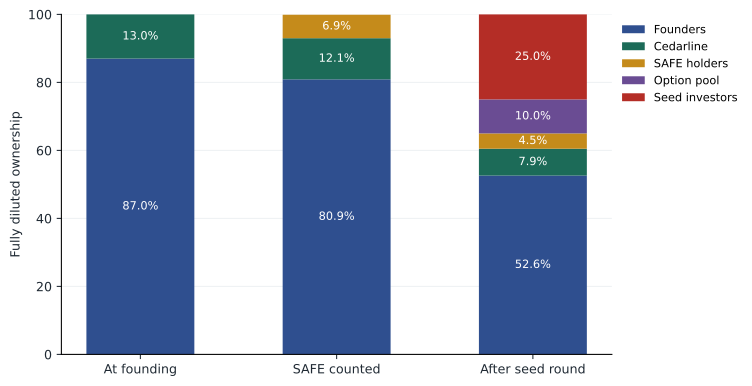
The output shows how ownership changes. Before any outside money, the founders owned 87 per cent and Cedarline 13 per cent. After the seed round, the founders together own about 53 per cent, Cedarline about 8, the SAFE holders about 4.5, the seed investors 25 and the option pool 10. The SAFE holders paid about 29 cents a share, the seed investors about 32 cents. The effective pre-money valuation for the existing holders, after the pool shuffle, is about 3.9 million dollars rather than the headline 4.5 million. Grace points out that if the founders could negotiate the pool down to 7 per cent, they would keep about two more points of the company at the same headline valuation.
Liquidation preferences
Investors in priced rounds usually buy preferred shares, which carry rights that common shares do not. The most important economic right is the liquidation preference, which determines how proceeds are divided when the company is sold or wound up. A 1x non-participating preference gives the investor the choice, on a sale, of either getting its money back first or converting to common shares and sharing pro rata, whichever is worth more. A participating preference gives the investor its money back and then a share of the remainder as well, sometimes up to a cap. Multiples above 1x, such as a 2x preference, give the investor twice its money back first. In weak markets, investors push for more aggressive preferences; in strong ones, founders can usually hold the standard 1x non-participating term.
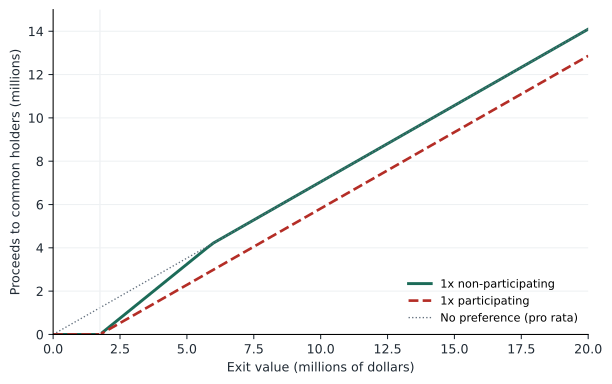
Preferences matter most in modest outcomes. In a very large sale, investors convert to common and the preference is irrelevant. In a sale for less than the total invested, the preference can leave common shareholders, including founders and employees, with little or nothing. In between, the difference between participating and non-participating preferences can shift millions of dollars. Founders should model the payout under several exit values before accepting any term sheet, as the following code does for Second Ascent.
# Liquidation waterfall at three exit values, fully diluted shares from the cap table
shares = {"Common holders": 11_500_000 + 1_901_263,   # founders, Cedarline and options (treated as exercised)
          "SAFE holders": 858_209, "Seed investors": 4_753_157}
pref = {"SAFE holders": 250_000, "Seed investors": 1_500_000}   # 1x preferences
total = sum(shares.values())

def waterfall(exit_value, participating=False):
    out = {k: 0.0 for k in shares}
    if participating:
        rest = exit_value
        for k, p in pref.items():
            out[k] = min(p, rest * p / sum(pref.values()))
        rest = max(0.0, exit_value - sum(out.values()))
        for k, n in shares.items():
            out[k] += rest * n / total
        return out
    # non-participating: each preferred class takes the better of its preference or converting
    converting = set()
    for _ in range(3):                          # iterate until the choices settle
        rest = exit_value - sum(min(pref[k], exit_value) for k in pref if k not in converting)
        pool = sum(n for k, n in shares.items() if k not in pref or k in converting)
        for k in pref:
            as_common = max(rest, 0) * shares[k] / (pool + (0 if k in converting else shares[k]))
            if as_common > pref[k]: converting.add(k)
    rest = exit_value
    for k in pref:
        if k not in converting:
            out[k] = min(pref[k], rest); rest -= out[k]
    pool = sum(n for k, n in shares.items() if k not in pref or k in converting)
    for k, n in shares.items():
        if k not in pref or k in converting:
            out[k] = max(rest, 0) * n / pool
    return out

for ev in (2_500_000, 8_000_000, 40_000_000):
    for part in (False, True):
        o = waterfall(ev, part)
        label = "participating" if part else "non-participating"
print(f"exit {ev / 1e6:4.1f}m {label:<18} " + " ".join(f"{k.split()[0]} {v / 1e6:5.2f}m" for k, v in o.items()))exit 2.5m non-participating Common 0.75m SAFE 0.25m Seed 1.50m exit 2.5m participating Common 0.53m SAFE 0.28m Seed 1.69m exit 8.0m non-participating Common 5.64m SAFE 0.36m Seed 2.00m exit 8.0m participating Common 4.41m SAFE 0.53m Seed 3.06m exit 40.0m non-participating Common 28.19m SAFE 1.81m Seed 10.00m exit 40.0m participating Common 26.96m SAFE 1.98m Seed 11.06m
At an exit of 2.5 million dollars, below the 6-million post-money valuation, the preferences take 1.75 million and the common holders share the remaining 750,000 dollars; without the preferences, common holders would have received about 70 per cent of the proceeds, or about 1.76 million dollars. At 8 million, non-participating investors convert, because their pro-rata share is worth more than their money back, and everyone shares in proportion to ownership; with a participating preference, the investors would take their 1.75 million and a share of the rest, moving more than 1.2 million dollars from common holders to investors. At 40 million, the difference between the two forms remains meaningful in dollars but small as a share of the total. Dr. Marchetti says that is why founders should fight hardest against participation and multiples in rounds where a modest exit is a realistic outcome.
Other key terms
A term sheet contains many other provisions, and each can matter. Anti-dilution protection adjusts the investor's conversion price if the company later sells shares at a lower price, a down round. The broad-based weighted average formula, which is standard, adjusts the price partly, taking into account how many shares are sold at the lower price; the full ratchet formula, which is rare and harsh, resets the investor's price to the new lower price. Pro rata rights let investors buy enough shares in future rounds to maintain their percentage ownership. Protective provisions require investor approval for certain actions, such as issuing senior shares, selling the company or changing the board. Information rights entitle investors to financial statements and budgets.
Board composition is one of the most important terms for control. A typical seed-stage board might have two founders and one investor; after a Series A, it might have two founders, two investors and one independent director agreed by both. Founders should think carefully about who will control the board after each round, because the board hires and fires the chief executive. Other common terms include a requirement that founders' shares vest, often restarting part of the vesting schedule; a no-shop clause preventing the company from negotiating with other investors for a period after signing; drag-along rights; and a statement of which costs the company pays, usually including the lead investor's legal fees up to a cap.
In Canada, venture financings are commonly documented using model forms published by the Canadian Venture Capital and Private Equity Association, adapted to Canadian corporate and securities law. Founders should also check that a large investment from a non-resident fund will not cause the company to lose its CCPC status, which would cost it the enhanced SR&ED credit and the small business deduction; deals are sometimes structured so that Canadian investors keep control, at least until the company is larger.
Negotiating the seed round
The founders and Dr. Marchetti go through the term sheet line by line. The valuation is in line with comparable seed rounds for capital-light service businesses with strong unit economics, though below what a software company might command. The 1x non-participating preference is standard. The broad-based weighted average anti-dilution is standard. The board would be two founders and one investor, which is acceptable. The two terms worth negotiating are the size of the option pool and a provision giving the lead investor a veto over any sale of the company for less than three times its investment. Grace decides to ask for a pool of 7.5 per cent, backed by the hiring plan, and to remove the sale veto in exchange for the investor's right to participate in future rounds.
Worked problem
Applying the venture capital method
The seed investor projects that, if Second Ascent succeeds, it will have revenue of about 20 million dollars in year six and could be sold at about 2 times revenue, a 40-million-dollar exit. The investor expects its stake to be diluted to about 75 per cent of its initial percentage by later rounds and targets 5 times its money on successful investments at this stage. What post-money valuation does the method suggest, and how does it compare with the offer?
Show solution
- Exit value: 20 million × 2 = 40 million dollars.
- Value of the investor's eventual stake per dollar of today's ownership: 40 million × 0.75 = 30 million dollars.
- Post-money valuation consistent with a 5x target: 30 million / 5 = 6 million dollars, so a 1.5-million investment should buy 1.5 / 6 = 25 per cent.
- That matches the offer: 4.5 million pre-money plus 1.5 million gives 6 million post-money. If the investor targeted 10x, the method would suggest a post-money of 3 million and 50 per cent ownership, which the founders would reject.
Answer: The offer is consistent with a 5x target on a 40-million exit with 25 per cent dilution. The founders' best arguments for a higher valuation are a larger exit, through more cities or the brand portal, or lower dilution, by reaching profitability without a Series A; their weakest is to dispute the investor's target multiple, which reflects its portfolio economics.
Common mistakes
MistakeThe headline pre-money valuation is what the founders' shares are worth.
InsteadThe option pool shuffle and the definition of fully diluted lower the effective pre-money; model it.
MistakeA SAFE is just a simple loan.
InsteadA SAFE is not debt: it has no interest or maturity and converts into shares at the next priced round on its cap or discount.
MistakeLiquidation preferences only matter if the company fails.
InsteadThey matter most in modest exits, where participation or multiples can move millions from common holders to investors.
MistakeFocus negotiation on valuation; the other terms are standard.
InsteadPool size, preferences, anti-dilution, board seats and vetoes can be worth more than a higher valuation.
Summary and key terms
- Post-money valuation equals pre-money plus new money; investor ownership is new money divided by post-money.
- Early-stage valuations are negotiated; the venture capital method checks them using exit value, dilution and a target multiple.
- An option pool created before the round dilutes only existing holders and lowers the effective pre-money valuation.
- SAFEs and convertible notes defer valuation; post-money SAFEs make conversion ownership easy to calculate.
- The cap table records fully diluted ownership through every round and must be kept accurate.
- Liquidation preferences, anti-dilution, pro rata rights, protective provisions and board composition shape economics and control.
- Pre-money valuation
- The value placed on a company immediately before a new investment.
- Fully diluted
- Counting all issued shares, options, the unissued pool and converting securities.
- Option pool shuffle
- Creating or enlarging the option pool inside the pre-money valuation, so existing holders bear the dilution.
- SAFE
- A simple agreement for future equity that converts into shares at a later priced round.
- Liquidation preference
- The right of preferred holders to receive a set amount before common holders on a sale.
- Broad-based weighted average
- The standard anti-dilution formula that partly adjusts the conversion price in a down round.
- Cap table
- The record of a company's ownership on a fully diluted basis.
Practice problems
Work each problem on paper first, then reveal the answer to check.
An investor puts 2 million dollars into a company at a pre-money valuation of 6 million. What is the post-money valuation and the investor's ownership?
Show answer
Post-money = 8 million; ownership = 2 / 8 = 25 per cent.
A post-money SAFE of 300,000 dollars has a cap of 5 million. What percentage of the company's pre-round capitalization will it convert into, if the round price is above the cap?
Show answer
300,000 / 5,000,000 = 6 per cent.
A company with a 1x non-participating preference of 3 million owned 30 per cent by the investor is sold for 6 million. Does the investor convert?
Show answer
As common it would get 30 per cent of 6 million = 1.8 million, less than 3 million, so it takes the 3 million preference and common holders share the other 3 million.
Why might founders accept a lower valuation to avoid a participating preference?
Show answer
Because in modest exits participation can transfer far more value to investors than a slightly higher valuation saves.
Lesson quiz · 5 questions
Score 60% or more to complete this lesson.
Create a free account to save your progress, take quizzes and earn a certificate.