
MBA-602 · Lesson 1 of 12 · 26 min
What entrepreneurship is: opportunity, uncertainty and the entrepreneurial method
The second-year cohort of the weekend EMBA at the Lakeshore School of Business in Toronto begins the fall term with Entrepreneurship and New Ventures, a course that draws on almost everything the managers studied in their first year. Dr. Elena Marchetti teaches it. She founded a freight-scheduling software company with two classmates, ran it for nine years through two near-death experiences and one lucky contract, and sold it to a larger logistics firm. Since then she has invested in about forty young companies as an angel and runs the school's venture lab, where students and alumni test ideas before they quit their jobs. She opens the first session by putting two numbers on the board: the share of her own angel investments that returned less than she put in, and the share of her total gains that came from just two of them.
The first number is a little over sixty per cent; the second is about seventy per cent. Leo Brandt, co-founder and chief financial officer of Kestrel Analytics, nods: that is the arithmetic his own investors explained to him when Kestrel raised its first venture round. Daniel Osei, plant controller at Northfield Components, says it sounds more like a lottery than a business. Dr. Marchetti says that is the question the course will answer. Entrepreneurship is not a lottery, because founders and investors can tilt the odds through what they choose to pursue, how they test it and how they finance it. But it is not a plan executed against a known forecast either. It is a method for acting when the future cannot be forecast, and the course is about learning that method well enough to use it, whether in a new company, inside a large one, or as an investor.
Defining entrepreneurship
Definitions of entrepreneurship fill shelves, but the one Dr. Marchetti uses comes from Howard Stevenson of Harvard Business School: entrepreneurship is the pursuit of opportunity beyond the resources you currently control. The definition has three useful features. First, it is about behaviour rather than personality. It does not ask whether someone is a born risk-taker; it asks what they do. Second, it applies inside existing organizations as well as to new firms. A product manager who builds a new business line with borrowed people and a small budget is acting entrepreneurially. Third, it puts resources at the centre. The entrepreneur's characteristic problem is that the opportunity needs money, people, partners and credibility that the entrepreneur does not yet have, and must persuade others to commit them before the outcome is known.
Economists have described the entrepreneur's role in several ways. Richard Cantillon, writing in the 1730s, described the entrepreneur as someone who buys at a known price to sell at an uncertain one. Joseph Schumpeter, in work from 1911 to his 1942 book Capitalism, Socialism and Democracy, cast the entrepreneur as an innovator who introduces new products, methods, markets or forms of organization, and called the resulting churn creative destruction: new combinations displace old ones, and the process drives long-run growth. Israel Kirzner offered a quieter view, in which entrepreneurs are alert to profit opportunities that others have overlooked and, by acting on them, move markets toward balance. The two views are compatible. Some ventures, like a new medical device, create something that did not exist; many more, like a better repair shop or a new route for an existing service, notice and close a gap.
Risk and uncertainty
Frank Knight's 1921 book Risk, Uncertainty and Profit drew a distinction that sits at the heart of this course. Risk, in Knight's sense, describes situations in which the possible outcomes and their probabilities can be known, from data or from the structure of the problem: the chance that a given machine fails this year, or the expected default rate on a large pool of car loans. Uncertainty describes situations in which the probabilities cannot be known in advance, because the event is new and there is no history to estimate from. Knight argued that profit, as distinct from a normal return on capital, is the reward for bearing uncertainty, since a measurable risk can be insured or priced away.
Most of the first year of the MBA dealt with risk. Corporate finance discounted cash flows at a rate that reflected measurable risk; operations set safety stock from a known distribution of demand. A new venture faces uncertainty. Nobody knows how many people will pay for a service that does not yet exist, at what price, or how a market will respond when competitors notice. Dr. Marchetti says the classic mistake of experienced managers who start companies is to treat uncertainty as if it were risk: to build a detailed five-year forecast, treat it as knowledge, and then spend heavily to execute it. The forecast is not useless, she says, but its job is to expose assumptions, not to predict the future.
Causation and effectuation
Saras Sarasvathy, now at the University of Virginia, studied how expert entrepreneurs actually make decisions. In a study published in 2001 she gave experienced founders, each of whom had started several companies and taken at least one public, a detailed problem about a hypothetical product and asked them to think aloud. Most did not begin with market research and a forecast. They began with who they were, what they knew and whom they knew, and asked what they could do with those means. She called this effectuation, in contrast to causation, the logic taught in most business schools, in which a manager starts with a goal, such as a target market share, and selects the best means to reach it.
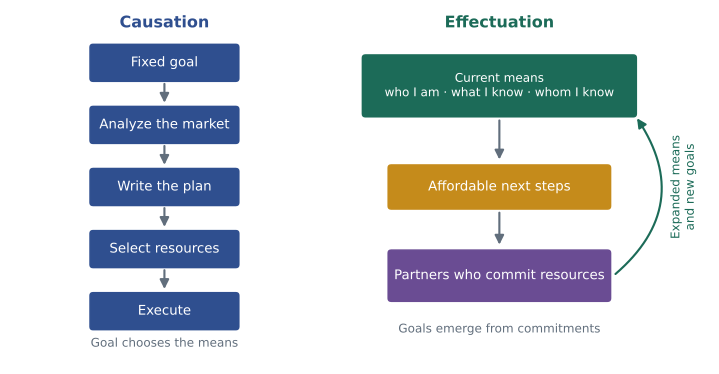
Sarasvathy summarized effectuation in five principles. The bird-in-hand principle says to start with your means rather than a predetermined goal. The affordable-loss principle says to decide how much you are willing to lose on the next step, rather than how much you expect to gain. The crazy-quilt principle says to form partnerships with people who will commit resources early, letting those partners help shape what the venture becomes. The lemonade principle says to treat surprises as information and possibly opportunities rather than deviations to be corrected. The pilot-in-the-plane principle says that the future is not something to be predicted but something to be shaped by the actions of the entrepreneur and partners. Effectuation is not a rejection of planning. It is the right logic early, when uncertainty is high; causal planning becomes more useful as a venture learns and the future becomes more predictable.
The cohort's first discussion shows how this works. Hana Kowalski, director of operations at Lakeview Health, says the idea most like a venture in her job is a scheduling service that would bring nurse practitioners to rural patients through mobile clinics. A causal approach would start by estimating the number of rural patients, choosing a target share and building a business plan to raise funds. An effectual approach would start with what Hana already has: her knowledge of clinic operations, relationships with two rural municipalities and a clinic van that Lakeview no longer uses. The affordable first step might be a two-month pilot in one town, using the van on Saturdays, with the town paying for fuel and a room. If the pilot works, the town's commitment becomes evidence for the next partner.
Kinds of entrepreneurial ventures
Entrepreneurship takes many forms, and the right methods differ among them. Most new businesses are small businesses meant to provide a good living for their owners: a restaurant, a contractor, a dental practice. They usually serve known markets with known methods, are financed by savings and bank loans, and aim for profitability within a year or two. Scalable startups are designed to grow very large, usually by finding a repeatable and profitable business model in a new or poorly served market; they often lose money for years and rely on outside equity, typically from angels and venture capital. Corporate ventures are new businesses started inside established firms, with access to the parent's customers, brands and balance sheet but also its politics and its tolerance for failure.
Two other forms matter to this cohort. Social ventures pursue a social or environmental mission and may be not-for-profit, for-profit, or a hybrid; Hana's mobile clinic idea could be any of the three, and lesson 8 will show how the choice affects funding. Entrepreneurship through acquisition means buying an existing small company rather than starting one. The search fund model, developed at Stanford in the 1980s, has an aspiring chief executive raise money from investors to spend up to two years finding a profitable small firm, typically one whose founder is retiring, and then buy and run it. Daniel says he has thought about this: one of Northfield's suppliers, a small fabricating shop, has an owner in his late sixties and no successor. Dr. Marchetti says the same disciplines of opportunity screening, customer discovery and deal structuring will apply.
| Type | Typical goal | Typical financing | Main uncertainty |
|---|---|---|---|
| Small business | Owner income, steady profit | Savings, bank loans, family | Execution and local demand |
| Scalable startup | Very large growth and an exit | Angels, venture capital | Whether a repeatable business model exists |
| Corporate venture | New growth for the parent | Parent company budget | Fit with the parent and its patience |
| Social venture | Mission with financial sustainability | Grants, impact investors, earned revenue | Model that sustains the mission |
| Acquisition (search fund) | Buy, run and grow a profitable firm | Search investors, senior debt, seller notes | Price paid and operator skill |
Why most new ventures fail, and why some succeed
Survival statistics are sobering but often misquoted. Government data in Canada and the United States show that a substantial minority of new employer businesses close within their first few years and roughly half are gone within five to ten years, with wide differences across industries. Closure is not always failure: some owners sell, retire or move to better opportunities. For venture-backed startups, the relevant measure is not survival but return. Studies of venture portfolios consistently find that most investments return less than the capital put in, a small share return a few times their cost, and a very small share produce returns so large that they pay for everything else. Returns in venture capital follow something close to a power law rather than a bell curve.
Dr. Marchetti draws three lessons. First, the high failure rate means that the biggest risk for most ventures is building something nobody wants. Post-mortems of failed startups, such as those collected by the research firm CB Insights, regularly list lack of market need and running out of cash as the most common causes, well ahead of competition or technology. Second, because cash is finite, the founder's job early on is to learn as much as possible about what works for as little money and time as possible. Third, the power law shapes what venture investors want. A fund that needs one or two very large outcomes to succeed will push the companies it backs to aim very big, which is not always in the interest of a founder who would be happy with a profitable, mid-sized company. Choosing the right kind of money is part of choosing the right kind of venture.
# Why venture returns follow a power law: a seeded simulation of a 40-company angel portfolio
import random
random.seed(602)

def outcome():
    # multiple of money returned by one investment
    r = random.random()
    if r < 0.55: return 0.0                      # company fails
    if r < 0.80: return random.uniform(0.2, 1.5)  # modest outcome
    if r < 0.95: return random.uniform(1.5, 6.0)  # good outcome
    return random.paretovariate(1.1) * 8          # rare large outcome

stake = 25_000
mults = sorted((outcome() for _ in range(40)), reverse=True)
total_in = stake * len(mults)
total_out = stake * sum(mults)
below_cost = sum(1 for m in mults if m < 1.0)
print(f"Invested {total_in:,.0f}; returned {total_out:,.0f}; portfolio multiple {total_out / total_in:.2f}x")
print(f"Investments returning less than cost: {below_cost} of {len(mults)}")
top2 = sum(mults[:2]) / sum(mults)
print(f"Share of all money returned that came from the best two: {top2:.0%}")
print("Top five multiples:", ", ".join(f"{m:.1f}x" for m in mults[:5]))Invested 1,000,000; returned 1,421,294; portfolio multiple 1.42x Investments returning less than cost: 29 of 40 Share of all money returned that came from the best two: 58% Top five multiples: 21.2x, 11.9x, 4.9x, 4.3x, 1.7x
The simulation is a stylized version of Dr. Marchetti's own portfolio, not a forecast. With the seed used here, most of the forty investments return less than they cost and the best two produce most of the gains. Running it with other seeds gives different totals, sometimes a loss and sometimes a large gain, which is itself the point: a portfolio of a few dozen early-stage investments has a very wide range of outcomes. Owen Tremblay, finance manager at Prairie Ridge Energy, says this explains why his company's small venture fund insists on investing in at least twenty companies. Dr. Marchetti adds that angels who make only two or three investments are not really diversified at all.
The entrepreneurial method
If uncertainty cannot be forecast away, what can founders do? The answer this course develops has four parts. First, choose opportunities where your means give you an edge and the potential reward justifies the uncertainty, which lesson 2 covers. Second, treat the business idea as a set of hypotheses about customers, value and economics, and test the riskiest ones first with conversations and cheap experiments before building much, which lessons 3 and 4 cover. Third, design a business model whose unit economics can work, and understand what it will take to reach them, in lessons 5 and 6. Fourth, assemble the team, legal structure and capital that the venture needs, on terms that preserve the founders' ability to keep going, in lessons 7 to 11.
Dr. Marchetti calls the overall approach evidence-based entrepreneurship. Steve Blank, a Silicon Valley founder turned teacher, argued in his 2005 book The Four Steps to the Epiphany that a startup is not a small version of a large company. A large company executes a known business model; a startup searches for one. Eric Ries built on Blank's ideas in his 2011 book The Lean Startup, popularizing the minimum viable product and the cycle of building, measuring and learning. Research has begun to test these ideas. A field experiment by Arnaldo Camuffo and colleagues, published in 2020, trained some early-stage founders in Italy to treat their ideas as scientific hypotheses and test them; those founders were more likely to pivot or to stop weak ideas early, and those who continued earned more revenue. The evidence is still accumulating, but it suggests the method can be taught.
The cohort's ventures
Each manager will carry a venture through the course. Grace Mwangi, category manager at Fairway Grocers, has the most developed idea. In MBA-512 the cohort helped design Cedarline Outdoor's lifetime repair service, and Grace kept in touch with Marta Silva, who runs Cedarline's repair workshop. Customers keep bringing Marta jackets, tents and packs from other brands, and she has to turn them away. Grace and Marta think there is a business in repairing, refurbishing and reselling outdoor gear of every brand, and in doing repairs for smaller brands that have no workshop of their own. They call it Second Ascent. Cedarline's leadership is open to a spin-off: it would gain a partner for its repair promise without running a business it does not understand.
The other managers' ventures will appear as contrasts. Leo will draw on Kestrel's experience of raising seed and venture money, including mistakes in its early cap table. Hana will develop the mobile clinic as a possible social venture. Daniel will evaluate buying the fabricating shop as an acquisition. Owen will look at entrepreneurship from the investor's side, as Prairie Ridge considers investing in a battery-storage startup through its corporate venture fund. Dr. Marchetti says that by December each of them should be able to answer the three questions every serious investor asks: why this, why now, and why you.
Worked problem
Affordable loss for Second Ascent
Grace and Marta are deciding on a first step. Option A is to lease a 2,000-square-foot workshop, buy two industrial sewing machines and a seam-taping machine, hire two technicians and open in three months, at a committed cost of about 210,000 dollars for the first year. Option B is to run Saturday repair days in Cedarline's existing workshop for eight weeks, with Marta and one paid technician, taking repairs on any brand and advertising only through a landing page and two outdoor clubs, at a cost of about 9,000 dollars. Grace has 60,000 dollars of savings she is willing to put at risk this year. Apply causal and effectual reasoning to the choice.
Show solution
- A causal approach would ask which option best achieves a goal, such as reaching 1 million dollars of revenue in two years, and would favour Option A as the faster route if the forecast of demand is believed.
- But demand for multi-brand repair at Second Ascent's prices is unknown: there is no history to estimate it from. That is uncertainty in Knight's sense, so the forecast behind Option A is a guess.
- Under the affordable-loss principle, the founders ask what they can afford to lose on the next step. Option A commits more than three times Grace's affordable loss; Option B commits about 15 per cent of it.
- Option B also tests the riskiest assumptions directly: whether owners of other brands will bring gear, what they will pay, how long repairs take, and whether Cedarline's workshop can share space. It builds a partnership, with Cedarline, under the crazy-quilt principle.
Answer: Option B is the better first step. It keeps the possible loss within what the founders can afford, generates evidence on demand, price and repair times, and deepens the partnership with Cedarline. If the Saturday repair days fill up, that evidence will make Option A, or something better, far easier to finance.
Common mistakes
MistakeEntrepreneurs are a personality type: born risk-lovers.
InsteadEntrepreneurship is a set of behaviours, pursuing opportunity beyond resources controlled, that can be learned; expert founders often work hard to limit their risk.
MistakeA detailed five-year forecast reduces the uncertainty of a new venture.
InsteadUnder true uncertainty the forecast is a set of assumptions; its value is in showing which ones to test first.
MistakeVenture returns are roughly normal, so the average company is a good guide.
InsteadReturns follow a power law: most investments lose money and a few produce most of the gains.
MistakeEffectuation means not planning.
InsteadEffectuation is the right logic when uncertainty is high; planning becomes more useful as the venture learns.
Summary and key terms
- Entrepreneurship is the pursuit of opportunity beyond the resources you currently control, in new firms or inside existing ones.
- Knight distinguished measurable risk from uncertainty; new ventures face uncertainty, so forecasts expose assumptions rather than predict outcomes.
- Expert entrepreneurs often reason effectually: start with means, limit losses to what is affordable, build partnerships and use surprises.
- Ventures differ in goal, financing and main uncertainty: small businesses, scalable startups, corporate and social ventures, and acquisitions.
- Most new ventures fail for lack of market need or cash; venture returns follow a power law, which shapes investors' demands.
- Entrepreneurship
- The pursuit of opportunity beyond the resources currently controlled.
- Creative destruction
- Schumpeter's term for the displacement of old products and firms by new combinations.
- Knightian uncertainty
- A situation whose outcomes cannot be assigned probabilities in advance.
- Effectuation
- Decision logic that starts from available means and affordable loss rather than a fixed goal.
- Affordable loss
- The amount a founder is willing to lose on a step, used in place of expected return.
- Search fund
- An investor-backed vehicle through which an aspiring chief executive finds, buys and runs an existing firm.
- Power law
- A distribution in which a few outcomes are vastly larger than the rest.
Practice problems
Work each problem on paper first, then reveal the answer to check.
Why does Stevenson's definition of entrepreneurship apply to a manager in a large company?
Show answer
Because it defines entrepreneurship as pursuing opportunity beyond resources currently controlled, which a manager does when building a new line with borrowed people and budget.
Give one example of risk and one of uncertainty for Second Ascent.
Show answer
Risk: the chance that a sewing machine breaks down this year, estimable from maintenance data. Uncertainty: how many owners of other brands will pay for repairs at Second Ascent's prices, since no history exists.
An angel invests 25,000 dollars in each of 20 companies. Twelve fail, six return their money, one returns 5 times and one returns 30 times. What is the portfolio multiple, and what share of the money returned came from the best company?
Show answer
Returned = 6 × 25,000 + 5 × 25,000 + 30 × 25,000 = 1,025,000 on 500,000 invested, a multiple of 2.05; the best company supplied 750,000 / 1,025,000 ≈ 73 per cent.
Which effectuation principle does a founder apply by agreeing with a town that it will pay the fuel costs for a pilot clinic?
Show answer
The crazy-quilt principle: securing early commitments from a partner, who thereby helps shape the venture.
Lesson quiz · 5 questions
Score 60% or more to complete this lesson.
Create a free account to save your progress, take quizzes and earn a certificate.