
MBA-512 · Lesson 8 of 12 · 21 min
Channels and distribution, including e-commerce
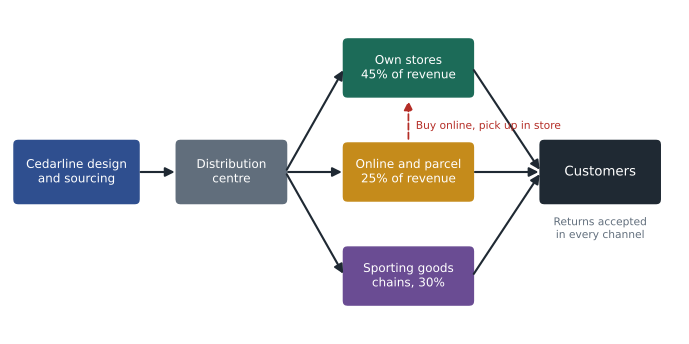
The fifth weekend opens with a letter. The largest sporting goods chain that carries Cedarline has written to say that it will reduce Cedarline's shelf space by a third next season unless Cedarline matches the allowances of a competing brand, stops undercutting the chain's prices on its own website, and gives the chain exclusive versions of its best-selling jackets. Wholesale is 30 per cent of Cedarline's revenue, and this chain is the largest part of it. Cedarline's head of e-commerce, meanwhile, argues that the chains are a declining channel and that the company should sell more directly. Dr. Lindqvist asks the cohort to set the argument aside until it has answered a prior question: what does each channel actually do for Cedarline's customers, and what does it cost?
A marketing channel, or distribution channel, is the set of organizations and routes through which a product moves from producer to customer: wholesalers, distributors, retailers, agents, marketplaces, the firm's own stores and websites, and the logistics providers that connect them. Channel decisions are among the most consequential in marketing because they are slow and costly to change, they determine which customers can find and buy the product, and they share the value created between the firm and its partners.
What channels do
Intermediaries exist because they perform functions more efficiently than producers or customers could alone. They gather information about customers and competitors, promote the product, negotiate and take orders, hold inventory and bear the risk that it will not sell, finance purchases, transport goods, handle payment and returns, and provide after-sale service. A simple calculation shows the economy they create. If five producers each sold directly to ten retailers, fifty separate relationships would be needed; through a single wholesaler, fifteen suffice. The functions themselves cannot be eliminated; they can only be shifted. When Cedarline sells directly online, it takes on the functions of selection, display, fulfilment, delivery and returns that the chain performs in its stores, along with their costs.
Channel design starts from customers' service needs, which Louis Stern and Adel El-Ansary described as service outputs: how much customers want to buy at once (lot size), how long they will wait (waiting time), how far they will travel (spatial convenience), how much choice they want in one place (assortment) and how much help they need (customer service). An expedition enthusiast buying a technical shell wants expert advice and the chance to try it on; a family replacing a child's outgrown snowsuit wants convenience and a reasonable price. The channel mix should match the service outputs that target segments value, at the lowest cost to deliver them.
Channel structure
Firms choose the length and breadth of their channels. A direct channel sells to customers without intermediaries, through the firm's own sales force, stores or website. An indirect channel uses one or more intermediaries. Breadth, or intensity, describes how many outlets carry the product. Intensive distribution places it in as many outlets as possible, appropriate for convenience goods bought by habit. Selective distribution uses a limited number of outlets chosen for their fit and capability, common for brands like Cedarline that need knowledgeable staff and a suitable setting. Exclusive distribution gives one outlet the right to sell in an area, used for luxury goods and complex products that need heavy dealer investment.
Most firms now sell through several channels at once. A multichannel firm operates them side by side, each with its own systems and often its own customers. An omnichannel firm integrates them, so customers can research online and buy in a store, buy online and pick up in a store, return anywhere, and see the same inventory and prices wherever they look. Integration is costly, requiring shared inventory data and systems and changes to how stores and staff are measured, but customers increasingly expect it, and research has found that customers who buy in several channels tend to spend more than single-channel customers, although part of that reflects who they are rather than what the channels do.
Channel economics
Each channel has a different profit structure. Wholesale has a lower gross margin, because the chain buys at wholesale prices net of the allowances shown in the price waterfall of lesson 7, but the chain bears the costs of stores, staff, display and most marketing. Cedarline's own stores earn the full retail margin but bear rent and staff costs. Online sales earn a retail margin too, but carry fulfilment, shipping, payment fees, the cost of returns and a heavy marketing cost to attract visitors. The cohort builds an illustrative channel profit and loss for Cedarline from the company's cost data.
# Contribution per 100 dollars of Cedarline revenue, by channel (illustrative unit economics)
channels = {
    #            gross margin, selling and occupancy, warehouse handling, shipping, payments, returns, marketing
    'Own stores': (0.53, 0.24, 0.00, 0.00, 0.02, 0.01, 0.04),
    'Online':     (0.56, 0.00, 0.10, 0.07, 0.03, 0.06, 0.12),
    'Wholesale':  (0.40, 0.00, 0.03, 0.02, 0.00, 0.01, 0.02),
}
rev = {'Own stores': 210.6, 'Online': 117.0, 'Wholesale': 140.4}     # fiscal 2026, millions
print(f"{'Channel':12}{'Gross':>7}{'Costs':>7}{'Contrib.':>10}{'Revenue':>9}{'Contrib. (m)':>14}")
for ch, (gm, *costs) in channels.items():
    c = gm - sum(costs)
    print(f"{ch:12}{gm * 100:>7.0f}{sum(costs) * 100:>7.0f}{c * 100:>10.0f}{rev[ch]:>9.1f}{c * rev[ch]:>14.1f}")

# Online order economics: the free-shipping threshold and returns change each order's contribution
def order(value, ship_free, ret_rate):
    gm = 0.56 * value
    ship = 9.0 if ship_free else 0.0
    returns = ret_rate * (0.56 * value + 7.5)      # lost margin plus reverse logistics
    return gm - 0.10 * value - ship - 0.03 * value - returns
for v, free, r in ((96, False, 0.10), (104, True, 0.10), (131, True, 0.14), (131, True, 0.25)):
print(f"Order {v:>3} dollars, free shipping {str(free):5}, returns {r:.0%}: contribution {order(v, free, r):6.2f}")Channel Gross Costs Contrib. Revenue Contrib. (m) Own stores 53 31 22 210.6 46.3 Online 56 38 18 117.0 21.1 Wholesale 40 8 32 140.4 44.9 Order 96 dollars, free shipping False, returns 10%: contribution 35.15 Order 104 dollars, free shipping True , returns 10%: contribution 29.15 Order 131 dollars, free shipping True , returns 14%: contribution 36.01 Order 131 dollars, free shipping True , returns 25%: contribution 27.12
The results surprise the head of e-commerce. Per 100 dollars of revenue, wholesale contributes about 32 dollars, own stores about 22 and online about 18, because online carries fulfilment, shipping, returns and a marketing cost of about 12 per cent of revenue to attract visitors who might otherwise have found Cedarline in a chain's store. The figures are averages: some online customers are highly profitable and some stores are not. The second part of the code shows why. An order of 96 dollars that pays for shipping earns about 35 dollars; an order of 104 dollars that just crosses the new free-shipping threshold of 100 dollars, which the cohort recommended in MBA-504, earns about 29, because Cedarline now pays the 9 dollars of shipping. A large order with a 14 per cent chance of return earns 36 dollars, but the same order from a customer who returns a quarter of what they buy earns only 27.
The cohort draws three conclusions. Online is valuable but not the cheap channel it appears to be; its costs are spread across several departments. Returns are a channel cost that marketing creates, for instance by encouraging customers to order several sizes, and better size guidance and fit information can reduce them. And the chains, for all their demands, perform functions that Cedarline would find expensive to replace, especially for weekend trail families who buy several brands in one trip.
Conflict and power
Channel members depend on one another but their interests diverge. Vertical conflict arises between levels, as between Cedarline and the chain, over margins, allowances, assortment and the firm's own direct sales. Horizontal conflict arises between members at the same level, as between two chains in one city. Multichannel conflict arises when a firm's channels compete for the same customers, as when the chain sees Cedarline's website undercutting its prices. Some conflict is healthy, pushing partners to perform; too much damages the relationship and the brand.
The balance of power depends on mutual dependence. The chain depends on Cedarline less than Cedarline depends on the chain, because Cedarline is one of many brands in its stores while the chain is Cedarline's largest wholesale customer. Cedarline's power rests on its brand: if customers would leave the chain to find Cedarline, the chain needs Cedarline. The brand-building of lesson 5 is therefore also a channel strategy. Practical tools for managing conflict include differentiated assortments, such as chain-exclusive versions of a jacket, consistent pricing policies across channels, clear rules about which channel serves which customers, and performance-based allowances that reward partners for selling well rather than for buying in volume.
Firms that want consistent prices across retailers often publish a minimum advertised price policy, a unilateral statement that the supplier will stop supplying or will withdraw allowances from retailers that advertise below a stated price. Such policies are common, but they sit close to the line drawn by the competition laws discussed in lesson 7, so they should be designed with legal advice, applied unilaterally and limited to advertised prices rather than actual selling prices.
E-commerce and marketplaces
Online sales have become a substantial and still growing part of retail. In Canada, Statistics Canada reported that e-commerce accounted for about 7.7 per cent of retail trade in June 2026, a figure that understates the share in categories such as apparel and electronics and excludes sales by many online-only and foreign sellers. Canadian shoppers also buy heavily from foreign websites, which means Canadian brands compete online with international rivals that may have lower costs and wider selections.
Marketplaces such as Amazon, and the marketplaces run by large retailers, offer brands immediate access to enormous traffic and efficient fulfilment, at the cost of referral fees, intense price competition, limited control over how the brand is presented and limited access to customer data. Many marketplaces also run retail media businesses, selling advertising on their sites that lets brands appear in search results and product pages, and these have become one of the fastest-growing forms of advertising. For a brand like Cedarline, marketplaces can serve as a controlled outlet for part of the range, especially end-of-season goods, but rarely as the main home of the brand, because they turn the experience into a comparison of price and delivery speed.
Direct-to-consumer brands, which sell mainly through their own websites, attracted much investment in the 2010s on the promise of higher margins and closer customer relationships. Many found that the cost of acquiring customers through online advertising rose steeply as competition for attention grew, that returns and shipping were expensive, and that physical stores and wholesale partners remained important for reaching most customers. Several well-known direct brands later opened stores or began selling through retailers. The lesson for Cedarline is not that direct channels are bad but that each channel must earn its place on the economics and the service outputs it delivers.
Business-to-business channels
Daniel's channel question is different. Northfield sells directly to its two automotive customers through account managers and engineers. Small equipment makers, the segment it now wants to enter, order in small lots, need quick delivery and often buy standard parts from industrial distributors who carry thousands of products from many manufacturers. Manufacturers' representatives, independent agents who sell several non-competing lines on commission, offer another route to small customers without the cost of a full sales force.
Worked problem
Northfield's route to small equipment makers
Northfield estimates that small equipment makers in its region buy about 6 million dollars a year of brackets it could supply. Selling directly would need two additional sales engineers at a combined cost of about 320,000 dollars a year plus 80,000 of travel and samples, and Northfield expects to win 15 per cent of the market within three years. An industrial distributor would buy at a 22 per cent discount from Northfield's direct price, handle small orders from its own stock and could reach 25 per cent of the market. Northfield's contribution margin before selling costs is 24 per cent at the direct price. Which route is better in year three?
Show solution
- Direct route: revenue 0.15 × 6.0 = 0.90 million; contribution 0.24 × 0.90 = 0.216 million, minus selling costs of 0.40 million, a loss of about 0.18 million a year.
- Distributor route: Northfield's revenue is 0.25 × 6.0 × 0.78 = 1.17 million at the lower price; contribution margin at the distributor price is (0.24 - 0.22) / 0.78, about 2.6 per cent, so contribution is only about 0.03 million.
- Neither route is attractive at the current cost structure: the distributor's discount consumes almost all of Northfield's margin.
- A hybrid: sell directly to the few larger equipment makers who design custom brackets, where Northfield's engineering is valued, and offer a smaller range of standard brackets through a distributor only if Northfield can lower their cost through longer production runs.
Answer: The analysis shows that Northfield's cost structure, built for large automotive orders, does not suit small customers through any channel. Daniel recommends targeting the mid-sized equipment makers who design their own components directly, using engineering support as the point of difference, and revisiting distribution once a standard product line exists.
Selling in Canada raises a further channel question for international brands and for Canadian firms selling across the border. Cross-border shipping adds duties, taxes and brokerage fees that customers often discover only at delivery, and the drip pricing rules discussed in lesson 1 apply to how these charges are presented. Products and packaging sold in Quebec must meet the French-language requirements discussed in lesson 5, including on websites that sell to Quebec customers.
Common mistakes
MistakeSelling direct eliminates the middleman's margin.
InsteadThe functions remain; the firm takes on their costs, which may exceed the margin saved.
MistakeOnline is the most profitable channel because there is no rent.
InsteadFulfilment, shipping, returns and customer acquisition often make online contribution lower than stores or wholesale.
MistakeA retailer's demands should be met to keep shelf space.
InsteadPower depends on mutual dependence; brand strength and differentiated assortments improve the firm's position.
MistakeFree shipping always raises profit.
InsteadIt raises conversion but shifts shipping cost to the firm; measure contribution per visitor.
Summary and key terms
- Channels perform functions such as information, promotion, inventory, financing, delivery and service; the functions can be shifted but not eliminated.
- Channel design should match the service outputs target customers value at the lowest cost.
- Distribution can be intensive, selective or exclusive; omnichannel integrates channels around the customer.
- Channel economics differ: wholesale trades lower gross margin for lower costs; online carries fulfilment, returns and acquisition costs.
- Conflict and power reflect mutual dependence; a strong brand is also a channel asset.
- Marketplaces offer reach at the cost of control and price pressure.
- Marketing channel
- The organizations and routes through which a product moves from producer to customer.
- Service outputs
- The service levels customers want from a channel, such as lot size, waiting time, convenience, assortment and help.
- Selective distribution
- Using a limited number of outlets chosen for fit and capability.
- Omnichannel
- Integrating channels so customers can research, buy, receive and return across them seamlessly.
- Minimum advertised price policy
- A supplier's unilateral policy on the lowest price at which resellers may advertise its products.
- Retail media
- Advertising sold by retailers and marketplaces on their own sites and apps.
Practice problems
Work each problem on paper first, then reveal the answer to check.
Four producers each sell to eight retailers. How many contacts are needed directly and through one wholesaler?
Show answer
Directly 32; through a wholesaler 4 + 8 = 12.
Which type of distribution suits a premium watch brand that needs trained staff?
Show answer
Selective or exclusive distribution.
An online order of 120 dollars has a gross margin of 55 per cent, fulfilment and payment costs of 13 per cent of value, 9 dollars of shipping and no returns. What is its contribution?
Show answer
66 - 15.60 - 9 = 41.40 dollars.
Give two ways to reduce conflict between a brand's website and its retail partners.
Show answer
Channel-exclusive products, consistent pricing, performance-based allowances or sharing online orders with stores for pickup.
Lesson quiz · 5 questions
Score 60% or more to complete this lesson.
Create a free account to save your progress, take quizzes and earn a certificate.