
MBA-512 · Lesson 1 of 12 · 23 min
What marketing management is: creating and capturing customer value
The second-year cohort of the weekend EMBA at the Lakeshore School of Business in Toronto meets its marketing professor on a grey Saturday morning in February, in the same winter term in which it is taking Corporate Finance. Dr. Sofia Lindqvist spent twelve years in brand management at a consumer packaged goods company and then six as chief marketing officer of a regional bank before she began teaching. She opens by holding up two plain white T-shirts. One costs a few dollars to make and sells for twelve at a discount store. The other, nearly identical, carries the logo of a fashion house and sells for two hundred and forty. She asks the five managers in the front row which shirt is the better business, and what, exactly, the extra two hundred and twenty-eight dollars is paying for.
The answers come quickly and they differ. Daniel Osei of Northfield Components says the logo shirt is a better business only if enough people buy it, and that in his world of metal brackets customers pay for specifications, not logos. Grace Mwangi of Fairway Grocers says the discount store sells many more shirts and that volume is a strategy too. Leo Brandt of Kestrel Analytics says the extra money pays for status and a story. Hana Kowalski of Lakeview Health asks whether the buyer of the expensive shirt is any better off. Owen Tremblay of Prairie Ridge Energy, who sells electricity and gas processing services, says his customers cannot tell one kilowatt-hour from another, so he wonders whether marketing matters to him at all. Dr. Lindqvist writes every answer on the board and says that each touches one of the questions this course will answer: what customers value, how a firm creates that value, how much of it the firm can capture in its price, and how it can keep doing so when competitors try to copy it.
A definition worth taking seriously
Many managers think of marketing as advertising and promotion, the department that makes brochures and buys media. That is a small part of it. The American Marketing Association defines marketing as the activity, set of institutions and processes for creating, communicating, delivering and exchanging offerings that have value for customers, clients, partners and society at large. Peter Drucker put it more sharply in 1973: the aim of marketing is to know and understand the customer so well that the product or service fits and sells itself. On this view, marketing is not a function that starts after the product is made. It is the discipline of deciding which customers to serve, what to offer them, how to price and deliver it, and how to tell them about it, all organized around value.
Marketing management is the practical work of making those decisions and carrying them out. It has an analytical side, which studies customers, competitors and markets; a strategic side, which chooses where to compete and how to win; and an operational side, which designs products, sets prices, manages channels and runs communications. Dr. Lindqvist insists that the three sides be connected. A beautiful advertising campaign for the wrong customer, or a clever price for a product nobody needs, is not good marketing however well it is executed.
Value created and value captured
The central idea of the course is a simple piece of arithmetic that Adam Brandenburger and Harborne Stuart called the value stick. For any product and any customer, there is a maximum amount the customer would be willing to pay, set by how much the product is worth to them compared with their next best alternative. There is also the cost of supplying it, which at its lowest is set by what suppliers and employees need to be paid to provide their inputs. The difference between willingness to pay and cost is the value created by the transaction. The price divides that value into two parts: the customer keeps willingness to pay minus price, called consumer surplus, and the firm keeps price minus cost, its margin.
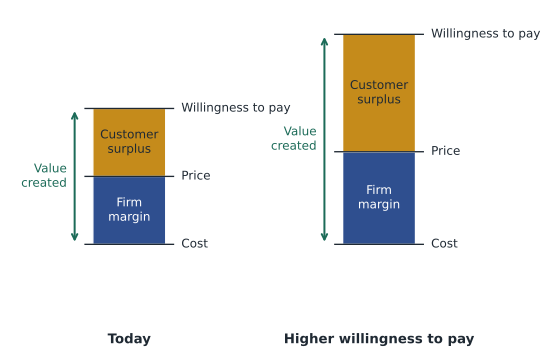
The value stick explains Dr. Lindqvist's two shirts. The fashion house has not lowered its cost much; it has raised the willingness to pay of a particular group of customers, through design, exclusivity and the meaning the brand carries for them. The discount retailer has done the opposite: it keeps cost very low and passes most of the saving to customers through a low price, so its margin per shirt is thin but its customers buy because they keep a large surplus. Both can be excellent businesses. What neither can do is succeed for long by capturing more value than it creates. A firm that raises price without raising willingness to pay simply hands the customer a reason to switch.
The framework also gives marketing three distinct levers. It can increase willingness to pay by making the product better or more relevant, by building trust and meaning in a brand, or by reaching customers who value the product more. It can reduce the cost of serving customers by finding efficient channels and messages. And it can change how value is shared, through price, which is why lesson 7 is among the most important in the course. Grace, whose supermarket competes on thin margins, notes that most of her category managers spend their time on the third lever, negotiating promotional prices with suppliers, and very little on the first.
From production to marketing orientation
Theodore Levitt's 1960 article Marketing Myopia argued that firms decline when they define themselves by their products instead of by the customer needs they serve. His famous example was the American railways, which thought they were in the railroad business rather than the transportation business and let cars, trucks and aircraft take their customers. Dr. Lindqvist uses Levitt to describe three orientations that firms move between. A production orientation assumes customers want whatever is cheap and available and focuses on efficiency. A selling orientation assumes customers will not buy enough unless pushed and focuses on persuasion and promotion. A marketing orientation starts with customer needs and works backwards to the product, the price and the message.
Owen recognizes Prairie Ridge in the first orientation. For decades a gas processor needed only reliable plants and long-term contracts. But its new retail business, selling community solar subscriptions and fixed-price electricity plans to households and small businesses, faces customers who compare offers on websites, read reviews and can switch. The kilowatt-hour may be identical, but the offer is not: contract length, price certainty, the source of the power, the quality of billing and service, and the trust customers place in the company all differ. Commodities are rarely as undifferentiated as their sellers believe.
The marketing management process
The course follows a standard sequence that Dr. Lindqvist presents as a loop rather than a ladder. Analysis comes first: understanding customers, the company's own capabilities, competitors, collaborators such as retailers and partners, and the wider context of technology, regulation and the economy. These are often called the five Cs. Strategy comes next: segmenting the market, choosing which segments to target and deciding how to position the offering in their minds. Then come the tactical decisions, the traditional four Ps of product, price, place and promotion, extended for services by people, process and physical evidence. Finally there is implementation and control, measuring results against plans and adjusting. Each lesson of the course sits somewhere in this loop.
| Stage | Key questions | Lessons |
|---|---|---|
| Analysis | What do customers value and how do they decide? What do the data say? | 2, 3 |
| Strategy | Which customers do we serve, and how do we want them to see us? | 4, 5 |
| Offering | What do we sell, and how do we innovate? | 6 |
| Value capture | What do we charge, and how do we structure prices? | 7 |
| Delivery | Through which channels do customers buy and receive it? | 8 |
| Communication | How do we reach and persuade customers? | 9 |
| Measurement | What is a customer worth, and what is working? | 10 |
| Execution | How do we launch and run the plan? | 11, 12 |
Two cautions accompany the framework. First, the stages interact. A positioning that promises premium quality constrains price and channel choices, and a channel such as a discount retailer can undermine a premium position no matter what the advertising says. Second, the sequence is iterative. Data from a launch feed back into the segmentation; a pricing test may reveal that the target segment was wrong. Leo says that at Kestrel every one of these decisions was made at once, in a single meeting, by two founders and an engineer, and Dr. Lindqvist replies that this is exactly why the framework is useful: it lists the decisions that are being made whether or not anyone notices.
Marketing and the value of the firm
The cohort learned in MBA-511 that a decision is good if it increases the present value of the firm's future cash flows. Marketing decisions are no exception, and Dr. Lindqvist asks the cohort to hold them to that standard. A promotion that lifts sales this quarter but trains customers to wait for discounts may reduce value. A brand-building campaign whose effect on sales appears only over several years may increase it. Customers themselves can be thought of as assets: each one is expected to generate a stream of margins over time, and the total present value of those streams, often called customer equity, is a large part of the value of many companies. Lesson 10 shows how to estimate it.
Cedarline Outdoor, the apparel and equipment company the cohort has followed since MBA-501, illustrates the point. Its revenue grew from 312 million dollars in fiscal 2022 to 468 million in fiscal 2026, but much of the growth came from deeper and more frequent promotions, gross margin fell from 54.0 to 49.8 per cent, and inventory more than doubled as the company bought for sales targets that discounting alone could not meet. Return on invested capital fell to about 8 per cent, below the 9 per cent cost of capital the cohort estimated in MBA-511. Dr. Lindqvist puts it bluntly: Cedarline grew by giving away value it had created, through price, rather than by creating more. The course capstone will ask the cohort to write a marketing plan that reverses this.
Responsibility and the law
Marketing works by influencing what people believe and choose, so it carries particular responsibilities. Customers rely on claims about products being true, on prices being complete and on their personal information being handled fairly. Most firms find that honesty is also good business, because the value of a brand rests on trust that is slow to build and quick to lose. But the law also sets limits, and managers need to know where they are.
In Canada, the Competition Act prohibits false or misleading representations to the public, including claims about performance that are not based on adequate and proper testing, and it treats drip pricing, advertising a price that cannot be obtained because of mandatory extra fees, as a misleading representation. The Competition Bureau enforces these provisions and can seek large administrative monetary penalties. Ad Standards administers the industry's self-regulatory Canadian Code of Advertising Standards. Privacy is governed by PIPEDA and provincial laws such as Quebec's Law 25, and commercial email by Canada's anti-spam legislation, CASL. Lessons 2, 5, 7 and 9 return to these rules where they bear on particular decisions.
The cohort and the course
Dr. Lindqvist asks each manager to bring a live marketing problem from work, which the course will revisit. Daniel's is Northfield's dependence on two automotive customers and its first attempt to sell to equipment makers, a business-to-business marketing problem in which buyers are engineers and purchasing managers. Grace's is Fairway's private-label range, which sells well but which shoppers see as the cheap option rather than a brand in its own right. Leo's is Kestrel's move from selling to small retailers to selling to mid-sized chains, which requires a different sales model and different pricing. Hana's is Lakeview's new evening and weekend clinics, a service that patients can use only if they know it exists and trust it. Owen's is Prairie Ridge's community solar subscriptions, a new product that most households do not yet understand. And all five will work together on Cedarline.
# The value stick for three versions of Cedarline's Ridgeline jacket
# WTP = average willingness to pay of the target buyer, P = price, C = unit cost (dollars)
versions = {
    'Ridgeline Light':      {'WTP': 236, 'P': 199, 'C': 118},
    'Ridgeline':            {'WTP': 302, 'P': 249, 'C': 147},
    'Ridgeline Expedition': {'WTP': 405, 'P': 329, 'C': 196},
}
print(f"{'Version':22}{'Created':>9}{'Customer':>10}{'Firm':>7}{'Firm share':>12}")
for name, v in versions.items():
    created = v['WTP'] - v['C']
    surplus = v['WTP'] - v['P']
    margin = v['P'] - v['C']
    print(f"{name:22}{created:>9}{surplus:>10}{margin:>7}{margin / created:>11.0%}")

# What happens if a deep promotion cuts the Ridgeline price to 199?
v = versions['Ridgeline']
print(f"Ridgeline at 199: firm margin falls from {v['P'] - v['C']} to {199 - v['C']} dollars a jacket,")
print(f"so sales must rise by {(v['P'] - v['C']) / (199 - v['C']) - 1:.0%} just to keep the same total margin.")Version Created Customer Firm Firm share Ridgeline Light 118 37 81 69% Ridgeline 155 53 102 66% Ridgeline Expedition 209 76 133 64% Ridgeline at 199: firm margin falls from 102 to 52 dollars a jacket, so sales must rise by 96% just to keep the same total margin.
The code shows how the three versions of the Ridgeline, which the cohort priced in MBA-502, divide value between Cedarline and its customers. The expedition version creates the most value and Cedarline captures a similar share of it as with the standard jacket. The last line shows why Cedarline's promotions were so costly: cutting the standard jacket from 249 to 199 dollars cuts the margin per jacket from 102 to 52 dollars, so sales would have to almost double to keep total margin unchanged, and only very price-sensitive demand responds that much.
Worked problem
Kestrel's software for a mid-sized chain
Leo estimates that Kestrel's forecasting software would save a mid-sized retail chain about 180,000 dollars a year in lost sales and excess inventory, compared with its current spreadsheets. Serving the chain, including cloud computing, onboarding and support, costs Kestrel about 40,000 dollars a year. Kestrel proposes a price of 90,000 dollars a year. A rival offers software the chain values at 150,000 dollars a year for 70,000. How is value created and shared, and which offer should the chain prefer?
Show solution
- Value created by Kestrel is willingness to pay minus cost: 180,000 - 40,000 = 140,000 dollars a year.
- The chain keeps 180,000 - 90,000 = 90,000 dollars of surplus; Kestrel keeps a margin of 90,000 - 40,000 = 50,000 dollars, about 36 per cent of the value created.
- The rival offers a surplus of 150,000 - 70,000 = 80,000 dollars, less than Kestrel's 90,000, so a well-informed chain should prefer Kestrel even though its price is higher.
- Kestrel could raise its price by up to about 10,000 dollars before the rival offered more surplus, but only if the chain believes the 180,000-dollar estimate.
Answer: Customers compare surplus, not price. Kestrel wins at a higher price because it creates more value, but its advantage exists only if the chain is convinced of the savings, which is why Leo's sales team needs credible evidence from existing customers. That task of making value visible and believable is a large part of business-to-business marketing.
Common mistakes
MistakeMarketing means advertising and promotion.
InsteadMarketing covers which customers to serve, what to offer, how to price, deliver and communicate it, all organized around value.
MistakeA higher price always means more value captured.
InsteadA price above willingness to pay captures nothing; value captured depends on value created and on competition.
MistakeRevenue growth shows that marketing is working.
InsteadGrowth bought with discounts can destroy value; marketing should raise the present value of cash flows.
MistakeCommodity products cannot be marketed.
InsteadThe full offer, including terms, service, trust and convenience, can almost always be differentiated.
Summary and key terms
- Marketing management is the work of choosing customers, designing offers and capturing value, organized around what customers value.
- Value created is willingness to pay minus cost; price divides it into customer surplus and firm margin.
- Marketing can raise willingness to pay, reduce the cost to serve, or change the division of value through price.
- A marketing orientation starts with customer needs; marketing myopia defines a business by its products.
- Marketing decisions should be judged by their effect on the present value of the firm, including the value of its customers.
- Value stick
- A diagram showing willingness to pay, price and cost, and how value is created and shared.
- Willingness to pay
- The maximum a customer would pay for an offer, compared with the next best alternative.
- Consumer surplus
- The value a customer keeps: willingness to pay minus price.
- Marketing myopia
- Defining a business by its products rather than the customer needs it serves.
- Customer equity
- The present value of the expected margins from a firm's current and future customers.
- Drip pricing
- Advertising a price that cannot be obtained because mandatory fees are added later; a misleading representation under the Competition Act.
Practice problems
Work each problem on paper first, then reveal the answer to check.
A product costs 40 dollars to supply, sells for 70 and is worth 100 to its typical buyer. What are value created, customer surplus and firm margin?
Show answer
Value created 60; customer surplus 30; firm margin 30.
A competitor launches a product the same buyer values at 95, priced at 60. What happens to the first firm?
Show answer
The rival offers a surplus of 35 against 30, so buyers switch unless the first firm cuts price to about 65 or raises willingness to pay.
Name three ways marketing can increase value created rather than just value captured.
Show answer
Improve the product or its relevance, build trust and meaning in the brand, reach customers who value it more, or lower the cost of serving customers.
Why might a promotion that raises this quarter's sales reduce the value of the firm?
Show answer
It cuts margins and may train customers to wait for discounts, lowering future prices and margins.
Lesson quiz · 5 questions
Score 60% or more to complete this lesson.
Create a free account to save your progress, take quizzes and earn a certificate.