
MBA-512 · Lesson 2 of 12 · 24 min
Understanding customers: behaviour and decision journeys
Hana Kowalski arrives at the second weekend with a puzzle. Six months ago Lakeview Health opened evening and weekend clinics at two of its community sites, staffed by family physicians and nurse practitioners, to treat minor illnesses and injuries that do not need a hospital. The clinics have spare capacity most evenings. Meanwhile, the emergency department at Lakeview's hospital still sees dozens of patients each weekend with sprained ankles, ear infections and minor cuts, who wait four or five hours and cost far more to treat. Lakeview mailed a leaflet to every household in its area and posted the clinic hours on its website. Hana wants to know why patients are not doing what seems obvious.
Dr. Lindqvist answers with a question: what is the patient trying to get done at nine o'clock on a Saturday night, with a feverish child? The answer is not merely treatment. It is reassurance that the problem is not serious, certainty that the place will be open and will see them, confidence that if it is serious they are in the right place, and an end to the worry as quickly as possible. A hospital emergency department, for all its waiting, offers certainty on every count. A clinic that patients have never visited offers none of it. Understanding customer behaviour means understanding the whole of what customers are trying to achieve, and how they actually decide.
Needs, wants and jobs to be done
Marketers distinguish needs, the basic requirements such as health, safety, belonging or esteem, from wants, the particular forms those needs take given a person's culture and circumstances, and demand, wants backed by the ability and willingness to pay. Clayton Christensen and his colleagues reframed the question in a practical way: customers hire products to do jobs. A job to be done has functional dimensions, such as treating an ear infection; emotional dimensions, such as relieving a parent's anxiety; and social dimensions, such as being seen as a responsible parent. Christensen's well-known example was a fast-food chain that discovered many of its milkshakes were bought early in the morning by commuters who wanted something filling and slow to consume on a long, dull drive. The competition was not other milkshakes but bananas, bagels and boredom.
The jobs lens is useful because it widens the set of competitors and points to what really matters to customers. Cedarline's customers do not buy a waterproof jacket for its own sake. Some are hiring it to stay dry and safe on a multi-day hike, a functional job where performance and reliability matter most. Others are hiring it to look like the kind of person who goes on multi-day hikes, a social job where style and the brand's meaning matter more. The same jacket may be hired for both jobs, but the two groups respond to different messages, shop in different places and accept different prices. Lesson 4 turns this observation into segmentation.
How customers decide
The classic model describes five stages. Need recognition occurs when a customer notices a gap between their actual and desired state, triggered internally, by a fever, or externally, by an advertisement or a friend's new tent. Information search draws on memory, friends, reviews, retailers and search engines. Evaluation of alternatives compares options on the attributes the customer cares about. The purchase decision may still be altered by others' opinions, by the availability of the product or by an unexpected price. Post-purchase behaviour includes satisfaction or regret, use, repeat purchase and word of mouth, which in turn shape other customers' searches.
How much effort customers put into these stages depends on their involvement. A high-involvement purchase, such as a first expedition tent or the choice of a family doctor, is expensive, risky or personally meaningful, and customers search widely and compare carefully. A low-involvement purchase, such as a pair of socks or a bag of ice, is made quickly, often by habit or with a simple rule. The distinction matters for marketing: detailed comparisons and expert reviews help in high-involvement categories, while availability, visibility and defaults dominate in low-involvement ones. The same customer can be highly involved in one category and indifferent in another.
The customer decision journey
In 2009, consultants at McKinsey argued that the traditional funnel, in which customers start with many brands and narrow them down to one, no longer described how people buy. Their research described a circular journey. Customers begin with an initial consideration set of brands formed from past experience and exposure. During active evaluation, they often add brands as well as removing them, as reviews, search results and conversations introduce new options. At the moment of purchase, they choose. After purchase, their experience shapes whether they enter a loyalty loop, in which they return without considering alternatives, or reopen the journey next time. Brands that were not in the initial set could still win during evaluation, and brands that won the purchase could still lose the customer after it.
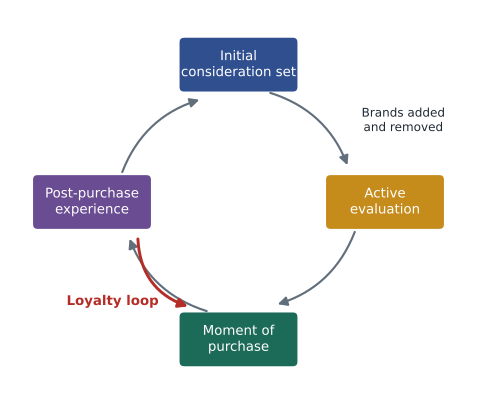
The journey view changes where marketing effort goes. If most customers add brands during active evaluation, being found and well reviewed at that stage matters as much as broad awareness. If loyal customers skip evaluation, then the post-purchase experience, delivery, service, returns and the product's actual performance, is itself marketing. For Lakeview, the analysis is sobering. The emergency department is in almost every family's initial consideration set; it is the default. The new clinics are in almost nobody's. A leaflet that arrives on an ordinary Tuesday, when nobody is sick, does not put the clinic in the consideration set at the moment it matters, nine o'clock on a Saturday night.
How people really choose
Economic models often assume that customers weigh all attributes carefully and choose the option with the highest value. Research in psychology and behavioural economics shows systematic departures from this ideal, which marketers ignore at their peril and should exploit only with care. Daniel Kahneman and Amos Tversky's prospect theory, published in 1979, showed that people evaluate outcomes as gains or losses relative to a reference point, and that losses loom larger than equivalent gains. In their later estimates, a loss weighed about twice as heavily as a gain of the same size. The value function is also concave for gains and convex for losses, so people tend to be risk-averse when choosing among gains and risk-seeking when choosing among losses.
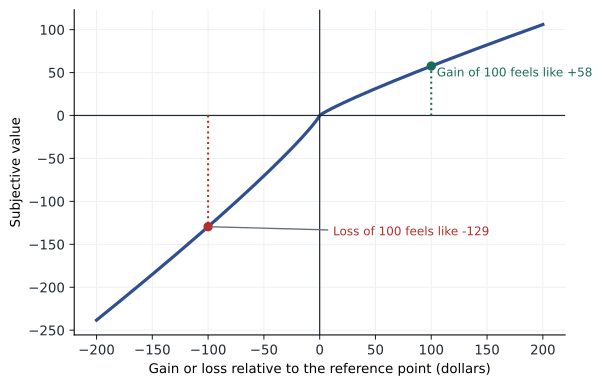
Several practical effects follow. Reference prices matter: customers judge a price against what they expect to pay, so a jacket that was 349 dollars and is now 249 feels like a gain, while the same 249 after a period at 199 feels like a loss. Framing matters: a 5 dollar surcharge for paying by card feels worse than a 5 dollar discount for paying cash, although the prices are identical. Anchoring matters: the first number customers see, such as a high list price or the most expensive option on a menu, pulls their estimates towards it. Defaults matter enormously, because many people accept whatever option requires no action, which is why enrolment in pension plans is far higher when employees must opt out rather than opt in.
Two other effects are widely cited and should be treated with some caution. Choice overload, the idea that too many options reduce purchases, comes from a famous 2000 study in which shoppers offered 24 jams were less likely to buy than those offered 6. Later reviews of many studies found the effect real in some conditions but absent or reversed in others, depending on how familiar customers were with the category and how easy the options were to compare. The decoy effect, first documented by Joel Huber, John Payne and Christopher Puto in 1982, occurs when adding an option that is clearly worse than one existing option, but not another, increases the share choosing the option it resembles. It appears often in subscription menus and product lines, and lesson 7 returns to it. Dr. Lindqvist's rule is that a behavioural effect is a hypothesis to test in your own market, not a law.
Business customers
Daniel points out that Northfield's customers are not households but purchasing departments at automakers and equipment manufacturers. Business buying differs in several ways. Decisions are usually made by a group, the buying centre, which Frederick Webster and Yoram Wind described as including users, who work with the product; influencers, such as engineers who write specifications; buyers, who negotiate terms; deciders, who have final authority; and gatekeepers, who control the flow of information. Each has different concerns: the engineer cares about tolerances and test results, the buyer about price and delivery terms, the plant manager about whether a supplier problem will stop the line.
The type of purchase also matters. Patrick Robinson, Charles Faris and Yoram Wind distinguished a straight rebuy, a routine reorder from an approved supplier; a modified rebuy, in which the buyer reconsiders specifications, price or supplier; and a new task, a first purchase with high uncertainty and extensive search. Northfield is an approved supplier in straight rebuys with its two automotive customers, which is comfortable but makes it hard to win new business. To sell to equipment makers it must enter new-task and modified-rebuy situations, where it needs to reach engineers early, while specifications are being written, and to reduce the perceived risk of switching through samples, test data, references and trial orders.
Mapping the journey
A customer journey map lays out every step a customer takes to get a job done, the touchpoints with the organization at each step, what the customer is thinking and feeling, and where things go wrong. Good maps are built from evidence: interviews, observation, complaints, call recordings and data on where customers drop out. Dr. Lindqvist asks Hana to map the journey of a parent with a sick child on a weekend evening. The map shows that most parents search on a phone for the nearest open clinic, that Lakeview's clinics do not appear in map searches because their listings show weekday hours only, that the website does not say whether walk-in patients will be seen or what conditions the clinic treats, and that nothing tells parents how long the wait will be. Each is a reason to drive to the emergency department instead.
The fixes are not advertising in the usual sense. They include correct listings with evening hours, a page that says plainly what the clinic treats and when to go to the emergency department instead, a live wait-time display, online check-in, and a nurse advice line that can direct callers to the clinic. Lakeview also decides to ask emergency department triage nurses to hand eligible low-acuity patients a card about the clinics, so that the next time the job arises, the clinic is in the consideration set.
Understanding customers responsibly
Much of what firms now know about customers comes from data: transactions, website behaviour, location, loyalty programs and data bought from others. That knowledge is valuable, but it raises legal and ethical obligations that marketers must understand before they design a campaign, not after.
In Canada, private-sector organizations are governed federally by PIPEDA, which requires meaningful consent for the collection, use and disclosure of personal information, limits collection to what is needed for identified purposes, and gives individuals rights of access. Quebec's Law 25, fully in force since 2024, adds stricter requirements, including privacy impact assessments, privacy settings at the highest level by default, and explicit consent for sensitive information. In June 2026, the federal government tabled Bill C-36, the Protecting Privacy and Consumer Data Act, its third attempt to replace PIPEDA after earlier bills died when Parliament was dissolved in 2021 and prorogued in 2025; as introduced it would raise penalties to as much as 3 per cent of global revenue for administrative penalties and give a new commission order-making powers. Health information, which Hana handles, is also governed by provincial health privacy laws such as Ontario's PHIPA, which allow its use for marketing only with express consent.
Dr. Lindqvist adds a test that goes beyond legality: would the customer be surprised, and would they mind, if they knew how their data was being used? A parent who receives a reminder about flu shots from the clinic they use is unlikely to object. A parent who sees advertisements for children's cough medicine on social media because their child visited an emergency department would rightly feel their trust had been betrayed. Lesson 9 returns to these questions for advertising technology.
# Lakeview's weekend clinic journey: where do eligible patients drop out?
# Each stage: share of the previous stage that continues (estimates from survey and visit data)
stages = [('Eligible minor-illness episodes', 1.00),
          ('Aware that clinic exists',         0.38),
          ('Know it is open evenings',         0.45),
          ('Trust it for this problem',        0.70),
          ('Find it in a phone search',        0.55),
          ('Visit the clinic',                 0.80)]
episodes = 12000                      # weekend-evening episodes a year in the area
n = episodes
for name, rate in stages:
    n *= rate
    print(f"{name:34}{n:>8,.0f}")
base = n
# Which single improvement adds the most visits? Raise each rate by 0.15 (capped at 0.95)
print("Visits added by raising one stage's rate by 15 points:")
for i, (name, rate) in enumerate(stages[1:], start=1):
    m = episodes
    for j, (_, r) in enumerate(stages):
        if j == i: r = min(0.95, r + 0.15)
        m *= r
    print(f"  {name:32}{m - base:>+7,.0f}")

# Prospect theory: how a surcharge and a discount of the same size feel
def value(x, a=0.88, lam=2.25):
    return x ** a if x >= 0 else -lam * (-x) ** a
print(f"Feel of a 5 dollar discount: {value(5):+.2f}; of a 5 dollar surcharge: {value(-5):+.2f}")Eligible minor-illness episodes 12,000 Aware that clinic exists 4,560 Know it is open evenings 2,052 Trust it for this problem 1,436 Find it in a phone search 790 Visit the clinic 632 Visits added by raising one stage's rate by 15 points: Aware that clinic exists +249 Know it is open evenings +211 Trust it for this problem +135 Find it in a phone search +172 Visit the clinic +119 Feel of a 5 dollar discount: +4.12; of a 5 dollar surcharge: -9.27
The code multiplies the stage conversion rates to estimate how many of about 12,000 eligible weekend episodes a year end in a clinic visit: roughly 630. It then raises each stage's rate in turn by 15 points. The largest gains come from the stages with the lowest rates, awareness and knowing that the clinic is open in the evenings, but fixing the phone listings is also worth a great deal and costs almost nothing. The last line uses Tversky and Kahneman's 1992 parameters to show why a surcharge provokes more resistance than an equal discount: the loss is felt more than twice as strongly.
Worked problem
Daniel's first equipment customer
Northfield wants to supply welded brackets to a farm equipment maker that currently buys from a single long-standing supplier. The purchasing manager says the company is satisfied and sees no reason to change. How should Northfield approach the buying centre?
Show solution
- Classify the purchase: for the equipment maker this is at best a modified rebuy, and Northfield is trying to turn a straight rebuy into one.
- Identify the members of the buying centre and their concerns: design engineers (performance, tolerances, ease of assembly), quality engineers (defect rates, audits), purchasing (price, terms, supply security), plant managers (delivery reliability) and the executive who approves a new supplier (risk).
- Find a trigger for reconsideration: a new tractor model whose brackets are still being designed, a capacity problem at the incumbent, or the buyer's policy of having a second source for critical parts.
- Reduce the perceived risk of switching: offer engineering support early in the design, samples with full inspection reports, references from automotive customers and a trial order for a single model.
Answer: Northfield should not lead with price to the purchasing manager, who has no reason to change. It should reach the engineers designing the next model and offer itself as a qualified second source, which addresses the buyer's own interest in supply security. The goal of the first year is to be in the consideration set when the next modified rebuy occurs.
Common mistakes
MistakeCustomers buy products.
InsteadCustomers hire products to do functional, emotional and social jobs; competitors are whatever else could do the job.
MistakeAwareness is enough to win the sale.
InsteadBrands must be in the consideration set at the moment of need and survive active evaluation and the post-purchase experience.
MistakeA behavioural effect seen in one study will work in my market.
InsteadEffects such as choice overload vary by context; test them before relying on them.
MistakeIf data use is legal, customers will accept it.
InsteadAsk whether customers would be surprised and would mind; trust is easily lost.
Summary and key terms
- Customers hire products to do jobs with functional, emotional and social dimensions.
- Involvement shapes how much customers search and compare.
- The decision journey is circular: brands can enter during evaluation, and the post-purchase experience drives loyalty.
- Loss aversion, reference prices, framing, anchoring and defaults shape choices, but effects should be tested in context.
- Business purchases involve a buying centre and differ between straight rebuys, modified rebuys and new tasks.
- Using customer data requires meeting privacy law and customers' reasonable expectations.
- Job to be done
- The progress a customer is trying to make in a particular circumstance, for which they hire a product.
- Consideration set
- The brands a customer actively considers when making a purchase.
- Loss aversion
- The tendency to weigh losses more heavily than gains of the same size.
- Buying centre
- The group of people involved in a business purchasing decision.
- Customer journey map
- A representation of the steps, touchpoints, thoughts and pain points in getting a job done.
- Meaningful consent
- Consent under PIPEDA based on information the individual can reasonably understand about how their data will be used.
Practice problems
Work each problem on paper first, then reveal the answer to check.
Give the functional, emotional and social jobs a family might hire a minivan to do.
Show answer
Functional: carry children and gear safely; emotional: feel secure and organized; social: be seen as a responsible parent.
Why might a brand that is not in the initial consideration set still win a sale?
Show answer
Customers add brands during active evaluation through search, reviews and conversations.
A retailer can frame a 3 dollar difference as a discount for using its app or as a fee for not using it. Which is likely to cause more resistance, and why?
Show answer
The fee, because it is framed as a loss, which people weigh more heavily than an equal gain.
Which member of a buying centre controls what information reaches the decision makers?
Show answer
The gatekeeper, often a purchasing assistant or technical staff member.
Lesson quiz · 5 questions
Score 60% or more to complete this lesson.
Create a free account to save your progress, take quizzes and earn a certificate.