
MATH-430 · Lesson 4 of 12 · 24 min
Global properties of plane curves: rotation index, four-vertex theorem, isoperimetric inequality
Lessons 2 and 3 were local: curvature at a point depends only on the curve near that point. This lesson asks what is forced by the global shape of a closed plane curve. Three classical theorems answer in different ways. The total curvature of a closed curve is a whole number of full turns, and for a simple closed curve exactly one turn. A simple closed convex curve has at least four vertices, points where the curvature is stationary. And of all closed curves with a given length, the circle encloses the greatest area. Each proof combines the local calculus of curves with a global idea: continuity of an integer, an integration by parts around a closed loop, or Fourier series.
Closed curves and the tangent angle
A closed curve is a regular curve \(\alpha : \mathbb{R} \to \mathbb{R}^2\) that is periodic, \(\alpha(s + L) = \alpha(s)\) for all \(s\), with \(L > 0\) the smallest such period; parametrized by arc length, \(L\) is the length. It is simple if it does not cross itself: \(\alpha(s_1) = \alpha(s_2)\) only when \(s_1 - s_2\) is a multiple of \(L\). A circle is simple; a figure eight is not.
The unit tangent \(T(s) = (\cos\theta(s), \sin\theta(s))\) defines an angle that is determined only up to multiples of \(2\pi\) at each point, but we can choose it continuously along the curve.
Lemma (lifting). If \(T : [0, L] \to S^1\) is smooth, there is a smooth function \(\theta : [0, L] \to \mathbb{R}\) with \(T = (\cos\theta, \sin\theta)\), unique once \(\theta(0)\) is chosen.
Proof. Write \(T = (a, b)\) with \(a^2 + b^2 = 1\), so that \(aa' + bb' = 0\). Choose \(\theta_0\) with \(T(0) = (\cos\theta_0, \sin\theta_0)\) and define \(\theta(s) = \theta_0 + \int_0^s (ab' - ba')\,du\). Using complex numbers, consider \(g(s) = (a - ib)e^{i\theta}\). Its derivative is \(e^{i\theta}\big[(a' - ib') + i\theta'(a - ib)\big]\). Substituting \(\theta' = ab' - ba'\), the real part of the bracket is \(a' + (ab' - ba')b = a'(1 - b^2) + abb' = a(aa' + bb') = 0\), and the imaginary part is \(-b' + (ab' - ba')a = -b'(1 - a^2) - aba' = -b(aa' + bb') = 0\). So \(g\) is constant, and \(g(0) = (a_0 - ib_0)(a_0 + ib_0) = 1\). Hence \(e^{i\theta} = a + ib\), that is \(T = (\cos\theta, \sin\theta)\). Uniqueness holds because two lifts differ by a continuous function with values in \(2\pi\mathbb{Z}\), which must be constant. \(\blacksquare\)
Since \(T\) is periodic, \(\theta(L) - \theta(0)\) is a multiple of \(2\pi\). The integer
is the rotation index of the closed curve: the number of full turns the tangent makes. The second expression follows from \(k = \theta'\) (lesson 3), so the rotation index is the total signed curvature divided by \(2\pi\). A circle traversed counterclockwise has \(n = 1\), and clockwise \(n = -1\). A figure eight has \(n = 0\): the tangent turns once left on one lobe and once right on the other. The limaçon \(r = 1 + 2\cos t\), which has a small loop inside a larger one, has \(n = 2\).
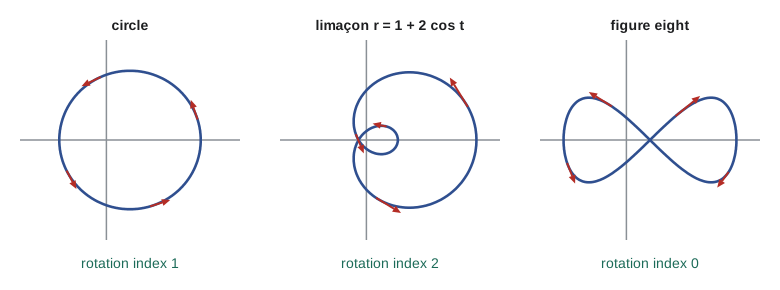
Because it is an integer that depends continuously on the curve, the rotation index cannot change under a regular homotopy, a continuous deformation through closed regular curves. Hassler Whitney proved in 1937, with credit to William Graustein, that the converse holds: two closed regular plane curves can be deformed into each other through regular curves exactly when they have the same rotation index. So a figure eight cannot be deformed into a circle without at some moment creating a cusp.
Hopf's theorem on turning tangents
Theorem (Hopf, 1935). The rotation index of a simple closed plane curve is \(\pm 1\).
The sign depends only on orientation; traversed with the enclosed region on the left, the index is \(+1\). The theorem is intuitively obvious and surprisingly delicate to prove. Here is Heinz Hopf's argument.
Proof. Choose a line touching the curve with the whole curve on one side, for instance the lowest horizontal line meeting it, and start the arc-length parameter at a point of contact \(p = \alpha(0)\), so that the curve lies in the half-plane above the tangent line at \(p\). Orient the curve so that \(T(0) = (1, 0)\). Consider the triangle \(\Delta = \{(s_1, s_2) : 0 \le s_1 \le s_2 \le L\}\) and the secant map \(\psi : \Delta \to S^1\),
Simplicity guarantees that the denominator never vanishes off the diagonal and the corner, and regularity makes \(\psi\) continuous on the diagonal (the secant direction tends to the tangent direction). At the corner, chords from points just after \(p\) to points just before \(p\) point backward along the tangent, so \(\psi\) is continuous there too. The triangle is simply connected, so \(\psi\) has a continuous angle function \(\Theta\) on all of \(\Delta\), by the same lifting argument applied along segments from a base vertex.
Along the diagonal from \((0, 0)\) to \((L, L)\), \(\psi = T\), so the change of \(\Theta\) is \(2\pi n\). The diagonal can be deformed within \(\Delta\) to the path along the two legs, from \((0, 0)\) to \((0, L)\) and then to \((L, L)\), so the change of \(\Theta\) is the same along that path. On the first leg, \(\psi(0, s_2)\) is the direction from \(p\) to \(\alpha(s_2)\); since the curve lies above the tangent line at \(p\), this direction stays in the closed upper half-circle, starting at \(T(0) = (1, 0)\) and ending at \(-T(0) = (-1, 0)\). So \(\Theta\) increases by exactly \(\pi\). On the second leg, \(\psi(s_1, L)\) is the direction from \(\alpha(s_1)\) to \(p\), the negative of the previous direction, which stays in the closed lower half-circle and goes from \((-1, 0)\) to \((1, 0)\): another \(\pi\). The total is \(2\pi\), so \(n = 1\). \(\blacksquare\)
Hopf's theorem has a satisfying consequence. For a simple closed curve, total absolute curvature satisfies \(\int_0^L |k|\,ds \ge |\int_0^L k\,ds| = 2\pi\), with equality exactly when \(k\) does not change sign. One can show that a simple closed curve with \(k \ge 0\) is convex, meaning it bounds a convex region, and Fenchel proved in 1929 that every closed space curve has total curvature at least \(2\pi\), with equality only for convex plane curves.
The four-vertex theorem
A vertex of a plane curve is a point where \(k'(s) = 0\), a local extremum or stationary point of the curvature. Every closed curve has at least two vertices, where \(k\) attains its maximum and minimum over the compact curve. An ellipse with distinct axes has exactly four: the ends of both axes. The four-vertex theorem says that two is never the whole story for convex curves.
Theorem (Mukhopadhyaya, 1909). A simple closed strictly convex curve that is not a circle has at least four vertices.
Here strictly convex means that every line meets the curve in at most two points, or is tangent to it. Adolf Kneser extended the theorem in 1912 to all simple closed plane curves, and the converse, that any function with two maxima and two minima is the curvature of some simple closed curve, was proved by Herman Gluck in 1971 for positive functions and by Dennis DeTurck, Herman Gluck, Daniel Pomerleano and David Shea Vela-Vick in 2007 in general.
Proof. Parametrize by arc length with period \(L\). The key identity is that for any constant vector \(a\) and constant \(c\),
Indeed, integrating by parts around the closed curve, where boundary terms cancel by periodicity, \(\int_0^L k'\alpha\,ds = -\int_0^L kT\,ds = -\int_0^L \theta'(\cos\theta, \sin\theta)\,ds = -\big[(\sin\theta, -\cos\theta)\big]_0^L = 0\), and \(\int_0^L k'\,ds = k(L) - k(0) = 0\). Now let \(p = \alpha(s_1)\) and \(q = \alpha(s_2)\) be points where \(k\) attains its maximum and minimum. Since the curve is not a circle, \(k\) is not constant, so \(p \ne q\), and they split the curve into two arcs. Suppose \(k'\) changed sign only at \(p\) and \(q\). Then \(k' \ge 0\) on one arc and \(k' \le 0\) on the other, and \(k'\) is not identically zero on either arc, since \(k\) climbs from its minimum to its maximum along each. Let \(a \cdot x + c = 0\) be the line through \(p\) and \(q\). By strict convexity the curve meets this line only at \(p\) and \(q\), so \(a \cdot \alpha + c\) is positive on one arc and negative on the other; replacing \(a, c\) by \(-a, -c\) if needed, the signs match those of \(k'\). Then the integrand \(k'(a \cdot \alpha + c)\) is nonnegative everywhere and positive on an open set, so the integral is positive, contradicting the identity. Hence \(k'\) changes sign at some third point. But a continuous periodic function changes sign an even number of times around a period, so \(k'\) changes sign at least four times, and each sign change is a vertex. \(\blacksquare\)
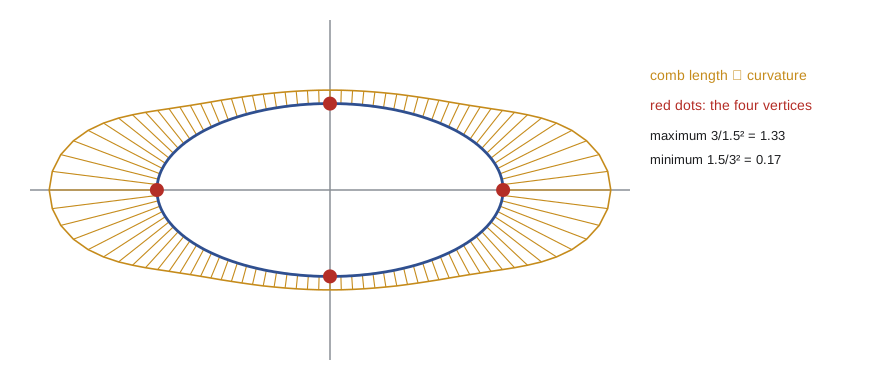
Designers of car bodies and typefaces draw curvature combs like the one in the figure to check that a curve is fair, meaning that its curvature varies smoothly with as few vertices as possible. The four-vertex theorem says that a closed convex outline must have at least four places where the comb is locally longest or shortest.
The isoperimetric inequality
Among all regions with a given perimeter, which has the largest area? Legend credits Queen Dido of Carthage with the answer, a semicircle along the coast, and Zenodorus proved around 150 BCE that the circle beats any polygon of the same perimeter. Jakob Steiner gave several ingenious geometric arguments in 1838, but each assumed that a maximizer exists, a gap filled later by Weierstrass. The proof below, by Adolf Hurwitz in 1902, uses Fourier series and gives both the inequality and the equality case.
First we need the area. If a simple closed curve \(\alpha(t) = (x(t), y(t))\), \(0 \le t \le 2\pi\), is positively oriented and bounds a region of area \(A\), Green's theorem gives
Theorem. A simple closed curve of length \(L\) bounding a region of area \(A\) satisfies \(L^2 \ge 4\pi A\), with equality if and only if it is a circle.
Proof. Rescale so that \(L = 2\pi\) and parametrize by arc length, so \(x'^2 + y'^2 = 1\) and both functions are \(2\pi\)-periodic. Translate so that \(\int_0^{2\pi} x\,dt = 0\). Expand in Fourier series: \(x(t) = \sum_{n \ge 1} (a_n\cos nt + b_n\sin nt)\), with no constant term, and \(y(t) = c_0 + \sum_{n \ge 1} (c_n\cos nt + d_n\sin nt)\). By Parseval's identity,
and, since \(y' = \sum n(d_n\cos nt - c_n\sin nt)\), the area is \(A = \int x y' = \pi\sum_{n \ge 1} n(a_n d_n - b_n c_n)\). Therefore
as one checks by expanding the squares: the right side is \(\pi\sum\big[n^2(a_n^2 + b_n^2 + c_n^2 + d_n^2) - 2n(a_n d_n - b_n c_n)\big]\). So \(A \le \pi\), that is \(L^2 = 4\pi^2 \ge 4\pi A\). Equality forces every term to vanish: \(a_n = b_n = c_n = d_n = 0\) for \(n \ge 2\), and \(a_1 = d_1\), \(b_1 = -c_1\). Then \(x = a_1\cos t + b_1\sin t\) and \(y = c_0 - b_1\cos t + a_1\sin t\), a circle of radius \(\sqrt{a_1^2 + b_1^2}\). \(\blacksquare\)
The ratio \(Q = 4\pi A/L^2\), the isoperimetric quotient, is 1 for circles and smaller for every other shape: about 0.785 for a square, 0.605 for an equilateral triangle, and close to zero for long thin shapes. Soap films, cell membranes and drops of liquid all trade area against perimeter or surface area, and the three-dimensional version, that the sphere encloses the most volume for a given surface area, explains why bubbles are round.
Computing global invariants
The program checks the three theorems on concrete curves. It computes rotation indices by integrating the signed curvature \(k = (x'y'' - y'x'')/(x'^2 + y'^2)^{3/2}\) numerically, counts vertices of an ellipse and of a smooth convex curve with three-fold symmetry by counting sign changes of \(k\) sampled around the curve, and evaluates the isoperimetric quotient of several shapes using the area formula from Green's theorem.
import math

def curve_data(f, n=4000):
    """Sample a 2 pi periodic curve: signed curvature, length and area (Green's theorem)."""
    h = 2 * math.pi / n
    ks, L, A = [], 0.0, 0.0
    for i in range(n):
        t = i * h
        (x0, y0), (x1, y1), (x2, y2) = f(t - h), f(t), f(t + h)
        dx, dy = (x2 - x0) / (2 * h), (y2 - y0) / (2 * h)
        ddx, ddy = (x2 - 2 * x1 + x0) / h**2, (y2 - 2 * y1 + y0) / h**2
        v = math.hypot(dx, dy)
        ks.append((dx * ddy - dy * ddx) / v**3)
        L += v * h
        A += 0.5 * (x1 * dy - y1 * dx) * h
    return ks, L, A, h

curves = {
    "circle r=2":      lambda t: (2 * math.cos(t), 2 * math.sin(t)),
    "limacon":         lambda t: ((1 + 2 * math.cos(t)) * math.cos(t), (1 + 2 * math.cos(t)) * math.sin(t)),
    "figure eight":    lambda t: (math.sin(t), math.sin(t) * math.cos(t)),
    "ellipse 3 x 1.5": lambda t: (3 * math.cos(t), 1.5 * math.sin(t)),
    "trefoil oval":    lambda t: ((1 + 0.1 * math.cos(3 * t)) * math.cos(t), (1 + 0.1 * math.cos(3 * t)) * math.sin(t)),
}
for name, f in curves.items():
    ks, L, A, h = curve_data(f)
    # total curvature: integrate k ds with ds = speed dt
    tot = 0.0
    for i in range(len(ks)):
        t = i * h
        (x0, y0), (x2, y2) = f(t - h), f(t + h)
        tot += ks[i] * math.hypot(x2 - x0, y2 - y0) / (2 * h) * h
    n = len(ks)
    vertices = sum(1 for i in range(n) if (ks[i] - ks[i - 1]) * (ks[(i + 1) % n] - ks[i]) < 0)
    line = f"{name:16s} rotation index {tot / (2 * math.pi) + 0.0:+.4f}"
    if name in ("ellipse 3 x 1.5", "trefoil oval"):     # the simple convex, non-circular curves
        line += f"  vertices {vertices}  Q = 4 pi A / L^2 = {4 * math.pi * A / L**2:.4f}"
    print(line)

# isoperimetric quotient of polygons (exact formulas)
for m in (3, 4, 6, 12, 100):
    side = 1.0
    area = m * side**2 / (4 * math.tan(math.pi / m))
print(f"regular {m:3d}-gon: Q = {4 * math.pi * area / (m * side)**2:.4f}")circle r=2 rotation index +1.0000 limacon rotation index +2.0000 figure eight rotation index -0.0000 ellipse 3 x 1.5 rotation index +1.0000 vertices 4 Q = 4 pi A / L^2 = 0.8412 trefoil oval rotation index +1.0000 vertices 6 Q = 4 pi A / L^2 = 0.9618 regular 3-gon: Q = 0.6046 regular 4-gon: Q = 0.7854 regular 6-gon: Q = 0.9069 regular 12-gon: Q = 0.9770 regular 100-gon: Q = 0.9997
The circle, the ellipse and the oval have rotation index 1, the limaçon 2 and the figure eight 0, to four decimal places (the tiny negative sign on the figure eight's zero is rounding). The ellipse has exactly four vertices, the minimum the theorem allows. The oval \(r = 1 + 0.1\cos 3t\) has six: its curvature has three maxima and three minima, matching its three-fold symmetry, so the four-vertex theorem is a lower bound and not an exact count. Both convex curves have isoperimetric quotient below 1, the nearly round oval much closer to 1 than the ellipse, and the regular polygons approach the circle's value 1 from below as the number of sides grows, just as Zenodorus would have predicted. Limaçons and figure eights are left out of the last two tests because they are not simple curves, so the area formula counts some regions twice or with opposite signs.
Common mistakes
MistakeAssuming the angle of the tangent is a well-defined function on a closed curve.
InsteadThe angle is defined only up to multiples of \(2\pi\); the lifting lemma gives a continuous choice along \([0, L]\), and its total change is \(2\pi\) times the rotation index.
MistakeExpecting every closed curve to have rotation index \(\pm 1\).
InsteadHopf's theorem needs the curve to be simple; a figure eight has index 0 and a limaçon with an inner loop has index 2.
MistakeCounting only the maximum and minimum of curvature as vertices.
InsteadAny point where \(k' = 0\) is a vertex; the four-vertex theorem says there are at least four for a simple closed convex curve.
MistakeThinking the four-vertex theorem says there are exactly four vertices.
InsteadIt is a lower bound; ovals with \(m\)-fold symmetry can have \(2m\) vertices.
MistakeForgetting orientation in the area formula.
Instead\(\frac12\int(xy' - yx')\,dt\) is the area for a counterclockwise curve and its negative for a clockwise one.
Summary and key terms
- A continuous tangent angle \(\theta(s)\) exists along any closed curve, and its total change \(\int k\,ds\) is \(2\pi\) times an integer, the rotation index.
- Hopf's Umlaufsatz: a simple closed curve has rotation index \(\pm 1\). The proof uses the secant map on a triangle.
- The Whitney–Graustein theorem: regular homotopy classes of closed plane curves are classified by rotation index.
- The four-vertex theorem: a simple closed strictly convex curve that is not a circle has at least four vertices; the proof integrates \(k'\) against a linear function.
- The isoperimetric inequality \(L^2 \ge 4\pi A\), with equality only for circles, follows from Fourier series and Parseval's identity.
- closed curve
- A periodic regular curve.
- simple curve
- A closed curve that does not cross itself.
- rotation index
- The number of full turns made by the unit tangent of a closed curve.
- vertex
- A point of a plane curve where the derivative of the curvature vanishes.
- strictly convex curve
- A closed curve met by every line in at most two points or along a tangent.
- isoperimetric quotient
- The ratio 4 pi A over L squared, equal to 1 exactly for circles.
Practice problems
Work each problem on paper first, then reveal the answer to check.
Compute the total signed curvature of the ellipse \((a\cos t, b\sin t)\) directly.
Show answer
\(k\,ds = \frac{ab}{a^2\sin^2 t + b^2\cos^2 t}\,dt\), and \(\int_0^{2\pi} \frac{ab\,dt}{a^2\sin^2 t + b^2\cos^2 t} = 2\pi\), a standard integral; so the index is 1, as Hopf's theorem requires.
What is the rotation index of the curve \((\cos t, \sin t)\) traversed for \(0 \le t \le 6\pi\), viewed as a closed curve of period \(6\pi\)?
Show answer
3: the tangent turns three times. The curve is not simple as a closed curve of that period, since it repeats its points.
Find all vertices of the parabola \(y = x^2\).
Show answer
\(k = 2/(1 + 4x^2)^{3/2}\) has \(k' = 0\) only at \(x = 0\). An open curve can have a single vertex.
Use the isoperimetric inequality to show a rectangle of perimeter 4 has area less than 1.27.
Show answer
\(A \le L^2/(4\pi) = 16/(4\pi) \approx 1.273\). In fact the best rectangle, the unit square, has area 1.
Show that for a closed curve \(\int_0^L k\,T\,ds = 0\).
Show answer
\(kT = \theta'(\cos\theta, \sin\theta) = \frac{d}{ds}(\sin\theta, -\cos\theta)\), which integrates to zero around a closed curve.
Why does the four-vertex proof fail for a curve that is not convex, and what extra work did Kneser need?
Show answer
A line through the points of maximum and minimum curvature may cross the curve elsewhere, so \(a \cdot \alpha + c\) need not have one sign on each arc. Kneser and later authors used a more careful choice of arcs.
Lesson quiz · 5 questions
Score 60% or more to complete this lesson.
Create a free account to save your progress, take quizzes and earn a certificate.