
MATH-241 · Lesson 2 of 12 · 21 min
The real numbers: ordered fields and the completeness axiom
What is a real number? In school, real numbers are points on a line, or infinite decimals. Both pictures are useful but neither is a definition you can prove theorems from. Analysis takes a different approach. It lists the properties the real numbers have, as axioms, and proves everything else from them. The axioms come in three groups: the field axioms, which govern addition and multiplication; the order axioms, which govern inequalities; and a single completeness axiom, which says the number line has no gaps. The first two groups are also satisfied by the rational numbers. The completeness axiom is what makes the reals special, and it is the foundation of the whole course.
The field axioms
A field is a set \(F\) with two operations, addition and multiplication, satisfying the following for all \(a, b, c \in F\).
- Addition is associative and commutative, there is an element 0 with \(a + 0 = a\), and every \(a\) has a negative \(-a\) with \(a + (-a) = 0\).
- Multiplication is associative and commutative, there is an element \(1 \ne 0\) with \(a \cdot 1 = a\), and every \(a \ne 0\) has an inverse \(a^{-1}\) with \(a a^{-1} = 1\).
- Multiplication distributes over addition: \(a(b + c) = ab + ac\).
The rationals \(\mathbb{Q}\), the reals \(\mathbb{R}\) and the complex numbers \(\mathbb{C}\) are fields. So is the set \(\{0, 1\}\) with arithmetic modulo 2, and more generally the integers modulo a prime, which you will meet in MATH-351 Number Theory. The integers are not a field, because 2 has no integer inverse.
All the familiar rules of algebra follow from these axioms. For example, \(a \cdot 0 = 0\) for every \(a\). Proof: \(a \cdot 0 = a(0 + 0) = a \cdot 0 + a \cdot 0\), and adding \(-(a \cdot 0)\) to both sides gives \(0 = a \cdot 0\). \(\blacksquare\) Similar short arguments show that \((-1)a = -a\), that \((-a)(-b) = ab\), and that \(ab = 0\) implies \(a = 0\) or \(b = 0\). We will use these freely.
The order axioms
An ordered field is a field with a relation \(<\) such that, for all \(a, b, c\):
- (trichotomy) exactly one of \(a < b\), \(a = b\), \(b < a\) holds;
- (transitivity) if \(a < b\) and \(b < c\) then \(a < c\);
- (addition) if \(a < b\) then \(a + c < b + c\);
- (multiplication) if \(a < b\) and \(0 < c\) then \(ac < bc\).
Both \(\mathbb{Q}\) and \(\mathbb{R}\) are ordered fields. The complex numbers are a field but cannot be ordered: in any ordered field, squares of non-zero elements are positive, so \(i^2 = -1\) would have to be positive, and then \(0 = 1 + (-1) = 1^2 + i^2\) would be a sum of positives.
From the order axioms we can derive the usual rules for inequalities. Here are three that matter.
Lemma. In an ordered field: (a) if \(a < b\) and \(c < 0\) then \(ac > bc\); (b) \(a^2 > 0\) for every \(a \ne 0\), and in particular \(1 > 0\); (c) if \(0 < a < b\) then \(0 < \frac{1}{b} < \frac{1}{a}\).
Proof. (a) From \(c < 0\), adding \(-c\) gives \(0 < -c\). Multiplying \(a < b\) by \(-c\) gives \(-ac < -bc\); adding \(ac + bc\) gives \(bc < ac\). (b) If \(a > 0\), multiply \(0 < a\) by \(a\) to get \(0 < a^2\). If \(a < 0\), part (a) applied to \(a < 0\) with \(c = a\) gives \(a^2 > 0\). Since \(1 = 1^2\) and \(1 \ne 0\), \(1 > 0\). (c) If \(a > 0\) then \(\frac{1}{a} > 0\), since otherwise \(1 = a \cdot \frac{1}{a} \le 0\). Multiplying \(a < b\) by the positive number \(\frac{1}{ab}\) gives \(\frac{1}{b} < \frac{1}{a}\). \(\blacksquare\)
The absolute value is defined by \(|a| = a\) if \(a \ge 0\) and \(|a| = -a\) if \(a < 0\). The triangle inequality from lesson 1 holds in every ordered field, as does \(|ab| = |a|\,|b|\).
The rationals have gaps
An ordered field can still have holes. The classic example is the gap in \(\mathbb{Q}\) where \(\sqrt{2}\) should be.
Theorem. There is no rational number \(r\) with \(r^2 = 2\).
Proof. Suppose \(r = \frac{p}{q}\) with integers \(p, q\), \(q > 0\), in lowest terms, and \(r^2 = 2\). Then \(p^2 = 2q^2\), so \(p^2\) is even and hence \(p\) is even, say \(p = 2m\). Then \(4m^2 = 2q^2\), so \(q^2 = 2m^2\) is even and \(q\) is even. This contradicts lowest terms. \(\blacksquare\)
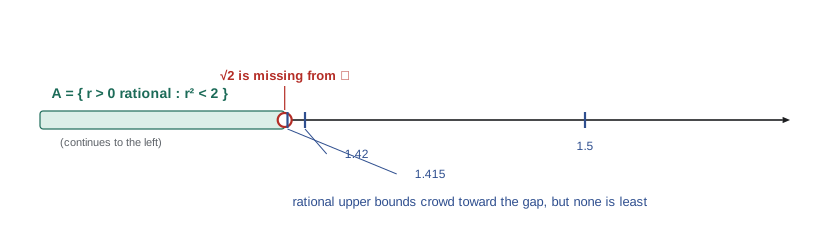
You saw this proof in MATH-228. Here is what it means for analysis. Let \(A = \{r \in \mathbb{Q} : r > 0, \; r^2 < 2\}\). The set \(A\) is non-empty (it contains 1) and bounded above (every element is less than 2). In \(\mathbb{Q}\), \(A\) has many upper bounds, such as 2, 1.5, 1.42 and 1.415. But it has no least upper bound in \(\mathbb{Q}\): for any rational upper bound \(u\) we can find a smaller rational upper bound. The point where the least upper bound should be is missing.
Worked problem
Shrinking a rational upper bound
Let \(u > 0\) be rational with \(u^2 > 2\). Show that \(v = \frac{u}{2} + \frac{1}{u}\) is rational, \(v < u\), and \(v^2 > 2\).
Show solution
- \(v\) is rational because \(u\) is. Also \(u - v = \frac{u}{2} - \frac{1}{u} = \frac{u^2 - 2}{2u} > 0\), so \(v < u\).
- Compute \(v^2 - 2 = \frac{u^2}{4} + 1 + \frac{1}{u^2} - 2 = \frac{u^2}{4} - 1 + \frac{1}{u^2} = \big(\frac{u}{2} - \frac{1}{u}\big)^2\).
- This square is positive because \(\frac{u}{2} \ne \frac{1}{u}\) (otherwise \(u^2 = 2\)). So \(v^2 > 2\).
Answer: Every rational upper bound \(u\) of \(A\) can be replaced by a smaller one, \(v\). This is the Babylonian (Newton) step for \(\sqrt{2}\), and it shows that \(A\) has no least upper bound in \(\mathbb{Q}\).
Upper bounds and suprema
To state completeness we need precise language.
Definition. Let \(S\) be a subset of an ordered field. A number \(u\) is an upper bound of \(S\) if \(s \le u\) for every \(s \in S\). If \(S\) has an upper bound, it is bounded above. A number \(u\) is a least upper bound, or supremum, of \(S\) if (i) \(u\) is an upper bound of \(S\), and (ii) \(u \le v\) for every upper bound \(v\) of \(S\). We write \(u = \sup S\).
Lower bounds, bounded below, and the greatest lower bound or infimum \(\inf S\) are defined in the same way with the inequalities reversed. A set is bounded if it is bounded above and below.
A set has at most one supremum: if \(u\) and \(u'\) are both suprema, then \(u \le u'\) (because \(u'\) is an upper bound and \(u\) is least) and \(u' \le u\), so \(u = u'\).
The supremum need not belong to the set. For \(S = (0, 1) = \{x : 0 < x < 1\}\), \(\sup S = 1\) but \(1 \notin S\). When \(\sup S \in S\), it is called the maximum of \(S\). The interval \((0, 1)\) has a supremum but no maximum; the interval \([0, 1]\) has both.
The completeness axiom
Completeness axiom (least upper bound property). Every non-empty subset of \(\mathbb{R}\) that is bounded above has a least upper bound in \(\mathbb{R}\).
We now define the real numbers as a complete ordered field: an ordered field in which the completeness axiom holds. Two facts justify this definition. First, a complete ordered field exists; it can be constructed from the rationals, for example by Dedekind cuts. Second, it is unique up to isomorphism: any two complete ordered fields are the same in every respect that matters, with addition, multiplication and order matching under a bijection. We will not prove these facts here, but the construction is sketched below.
The completeness axiom has a mirror image for lower bounds.
Theorem. Every non-empty subset of \(\mathbb{R}\) that is bounded below has a greatest lower bound.
Proof. Let \(S\) be non-empty and bounded below, and let \(-S = \{-s : s \in S\}\). If \(m\) is a lower bound of \(S\), then \(-m\) is an upper bound of \(-S\), so \(-S\) is non-empty and bounded above. By completeness it has a supremum \(u\). We claim \(-u = \inf S\). For \(s \in S\), \(-s \le u\), so \(s \ge -u\): thus \(-u\) is a lower bound. If \(m\) is any lower bound of \(S\), then \(-m\) is an upper bound of \(-S\), so \(u \le -m\), that is, \(m \le -u\). So \(-u\) is the greatest lower bound. \(\blacksquare\)
Square roots exist
As a first use of completeness, we prove that 2 has a real square root, so the gap in \(\mathbb{Q}\) is filled in \(\mathbb{R}\).
Theorem. There is a real number \(x > 0\) with \(x^2 = 2\).
Proof. Let \(A = \{t \in \mathbb{R} : t > 0, \; t^2 < 2\}\). Then \(1 \in A\), and every \(t \in A\) satisfies \(t < 2\) (if \(t \ge 2\) then \(t^2 \ge 4\)). By completeness, \(x = \sup A\) exists, and \(x \ge 1\). We show that \(x^2 < 2\) and \(x^2 > 2\) are both impossible.
Suppose \(x^2 < 2\). We find a small \(h\) with \(0 < h < 1\) and \((x + h)^2 < 2\). Since \((x + h)^2 = x^2 + 2xh + h^2 < x^2 + h(2x + 1)\) for \(0 < h < 1\), it is enough to take \(h < \frac{2 - x^2}{2x + 1}\). Then \(x + h \in A\) and \(x + h > x\), contradicting that \(x\) is an upper bound.
Suppose \(x^2 > 2\). Let \(h = \frac{x^2 - 2}{2x}\), which is positive, and note \(h < x\). Then \((x - h)^2 = x^2 - 2xh + h^2 > x^2 - 2xh = 2\). So \(x - h\) is positive and \((x - h)^2 > 2\). For any \(t \in A\), \(t^2 < 2 < (x - h)^2\), so \(t < x - h\). Thus \(x - h\) is an upper bound of \(A\) smaller than \(x\), contradicting that \(x\) is the least upper bound.
By trichotomy, \(x^2 = 2\). \(\blacksquare\)
The same argument, with more algebra, shows that every positive real number has a unique positive \(n\)th root for each natural number \(n\). The structure of the proof, supposing the supremum is 'too small' or 'too big' and contradicting one of the two parts of the definition, is a pattern we will use repeatedly.
Bisection: computing a supremum
Completeness is an existence statement, but it has a constructive shadow. To find \(\sup A\) for the set above, start with a lower point \(a = 1\) that is in \(A\) and an upper bound \(b = 2\). Test the midpoint: if it is in \(A\), move \(a\) up to it; otherwise move \(b\) down. After \(k\) steps the supremum is trapped in an interval of length \(2^{-k}\). This is the bisection method, and in lesson 8 the same idea proves the intermediate value theorem.
from fractions import Fraction

def in_A(t):
    return t > 0 and t * t < 2

a, b = Fraction(1), Fraction(2)        # a is in A, b is an upper bound
for k in range(1, 31):
    m = (a + b) / 2
    if in_A(m):
        a = m
    else:
        b = m
    if k in (1, 2, 3, 5, 10, 20, 30):
        print(f"step {k:2d}: {float(a):.10f} <= sup A <= {float(b):.10f}   width = {float(b - a):.2e}")

print("b*b - 2 =", float(b * b - 2), "  a*a - 2 =", float(a * a - 2))
print("a and b are rational at every step; their common limit is not.")step 1: 1.0000000000 <= sup A <= 1.5000000000 width = 5.00e-01 step 2: 1.2500000000 <= sup A <= 1.5000000000 width = 2.50e-01 step 3: 1.3750000000 <= sup A <= 1.5000000000 width = 1.25e-01 step 5: 1.4062500000 <= sup A <= 1.4375000000 width = 3.12e-02 step 10: 1.4140625000 <= sup A <= 1.4150390625 width = 9.77e-04 step 20: 1.4142131805 <= sup A <= 1.4142141342 width = 9.54e-07 step 30: 1.4142135615 <= sup A <= 1.4142135624 width = 9.31e-10 b*b - 2 = 3.154468700139468e-11 a*a - 2 = -2.602633344082894e-09 a and b are rational at every step; their common limit is not.
Constructing the reals: Dedekind cuts
Where do real numbers come from, if we start with the rationals? Dedekind's idea, published in 1872 in his essay Stetigkeit und irrationale Zahlen, was to identify each real number with the set of rationals below it. A cut is a subset \(\alpha \subset \mathbb{Q}\) that is non-empty, not all of \(\mathbb{Q}\), closed downward (if \(p \in \alpha\) and \(q < p\) then \(q \in \alpha\)), and has no largest element. For example, the rational number 3 corresponds to the cut \(\{q \in \mathbb{Q} : q < 3\}\), and \(\sqrt{2}\) corresponds to the cut \(\{q \in \mathbb{Q} : q \le 0 \text{ or } q^2 < 2\}\).
Cuts are ordered by inclusion, and the least upper bound of a bounded set of cuts is simply their union. So completeness is almost free in this construction. Defining addition is easy (add elements), and multiplication takes more care because of signs. Verifying all the field and order axioms is long but routine, and it is often done in detail in a course such as MATH-341. The upshot is that the real numbers can be built from the rationals, which can be built from the integers, which can be built from sets, as you saw in MATH-228.
Cantor's alternative, also from 1872, defines a real number as an equivalence class of Cauchy sequences of rationals; we will meet Cauchy sequences in lesson 6. Decimals give a third description: every real number has a decimal expansion, unique except that a terminating decimal such as 0.5 also equals 0.4999.... All three constructions produce the same complete ordered field.
Common mistakes
MistakeAssuming \(\sup S\) belongs to \(S\).
Instead\(\sup (0, 1) = 1 \notin (0, 1)\); a supremum in the set is a maximum.
MistakeProving only that \(u\) is an upper bound.
InsteadA supremum also needs condition (ii): no smaller number is an upper bound.
MistakeUsing completeness for unbounded or empty sets.
Instead\(\mathbb{N}\) has no upper bound and \(\emptyset\) has no least upper bound; both hypotheses are needed.
MistakeThinking completeness holds in \(\mathbb{Q}\).
Instead\(\{r \in \mathbb{Q} : r^2 < 2\}\) is bounded with no rational supremum.
MistakeMultiplying an inequality by a quantity of unknown sign.
InsteadMultiplying by a negative number reverses the inequality; check the sign first.
Summary and key terms
- The real numbers form an ordered field: the usual algebra holds, and inequalities follow the order axioms.
- The rationals are also an ordered field but have gaps, for example where \(\sqrt{2}\) should be.
- A supremum is a least upper bound: an upper bound no larger than any other upper bound. It is unique when it exists.
- The completeness axiom says every non-empty set of reals that is bounded above has a supremum; the infimum version follows.
- Completeness proves that square roots exist, and bisection approximates suprema numerically.
- The reals can be constructed from the rationals by Dedekind cuts or Cauchy sequences.
- Field
- A set with addition and multiplication satisfying associativity, commutativity, identities, inverses and distributivity.
- Ordered field
- A field with an order relation compatible with addition and with multiplication by positive elements.
- Upper bound
- A number \(u\) with \(s \le u\) for all \(s \in S\).
- Supremum
- The least upper bound of a set, written \(\sup S\).
- Infimum
- The greatest lower bound of a set, written \(\inf S\).
- Completeness axiom
- Every non-empty subset of \(\mathbb{R}\) bounded above has a supremum in \(\mathbb{R}\).
- Dedekind cut
- A non-empty, proper, downward-closed subset of \(\mathbb{Q}\) with no largest element.
Practice problems
Work each problem on paper first, then reveal the answer to check.
Prove from the field axioms that \((-1) \cdot a = -a\).
Show answer
\(a + (-1)a = (1 + (-1))a = 0 \cdot a = 0\), so \((-1)a\) is the additive inverse of \(a\).
Find \(\sup S\) and \(\inf S\) for \(S = \{1 - \frac{1}{n} : n \in \mathbb{N}\}\), and decide whether each belongs to \(S\).
Show answer
\(\inf S = 0\), attained at \(n = 1\), so it is a minimum. \(\sup S = 1\), not attained: every element is below 1, and any \(v < 1\) is exceeded by \(1 - \frac{1}{n}\) once \(\frac{1}{n} < 1 - v\).
Prove that if \(S \subseteq T\) are non-empty and \(T\) is bounded above, then \(\sup S \le \sup T\).
Show answer
\(\sup T\) is an upper bound of \(T\), hence of \(S\); the least upper bound of \(S\) is at most any upper bound.
Show that \(\mathbb{C}\) cannot be ordered.
Show answer
In an ordered field non-zero squares are positive, so \(1 > 0\) and \(i^2 = -1 > 0\), giving \(0 = 1 + (-1) > 0\), a contradiction.
Let \(S\) be non-empty and bounded above, and \(c > 0\). Prove \(\sup (cS) = c \sup S\), where \(cS = \{cs : s \in S\}\).
Show answer
\(c \sup S\) bounds \(cS\). If \(v\) bounds \(cS\) then \(\frac{v}{c}\) bounds \(S\), so \(\sup S \le \frac{v}{c}\) and \(c \sup S \le v\).
Lesson quiz · 5 questions
Score 60% or more to complete this lesson.
Create a free account to save your progress, take quizzes and earn a certificate.