
MATH-241 · Lesson 10 of 12 · 24 min
The derivative and the mean value theorem
The derivative is a limit, so everything in lessons 7 to 9 now applies to it. This lesson defines the derivative precisely, proves that differentiable functions are continuous, and proves the product, quotient and chain rules. It then proves the mean value theorem, the result that connects the derivative at single points to the behaviour of a function over an interval. Most of the facts about derivatives used in calculus, such as that a function with positive derivative is increasing, are consequences of this theorem. The lesson ends with derivatives that behave strangely: a derivative that exists everywhere but is discontinuous, and Weierstrass's continuous function that has no derivative anywhere.
The definition
Definition. Let \(I\) be an interval, \(f: I \to \mathbb{R}\) and \(c \in I\). Then \(f\) is differentiable at \(c\) if the limit
\[f'(c) = \lim_{x \to c} \frac{f(x) - f(c)}{x - c}\]
exists. The difference quotient is not defined at \(x = c\), which is why the limit must be taken in the sense of lesson 7, ignoring the point itself. At an endpoint of \(I\) the limit is one-sided.
Equivalently, with \(x = c + h\), \(f'(c) = \lim_{h \to 0} \frac{f(c + h) - f(c)}{h}\). Geometrically \(f'(c)\) is the slope of the tangent line, the limit of slopes of secant lines through \((c, f(c))\).
Worked problem
Two derivatives from the definition
Compute \(f'(c)\) for \(f(x) = x^n\) with \(n \ge 1\), and show that \(|x|\) is not differentiable at 0.
Show solution
- For \(x \ne c\), \(\frac{x^n - c^n}{x - c} = x^{n-1} + x^{n-2}c + \dots + c^{n-1}\), a polynomial in \(x\) with \(n\) terms.
- Letting \(x \to c\), each term tends to \(c^{n-1}\), so \(f'(c) = nc^{n-1}\).
- For \(|x|\) at 0, \(\frac{|x| - 0}{x - 0}\) equals 1 for \(x > 0\) and \(-1\) for \(x < 0\). The one-sided limits differ, so the limit does not exist.
Answer: \((x^n)' = nx^{n-1}\), while \(|x|\) is continuous at 0 but not differentiable there: its graph has a corner.
Theorem. If \(f\) is differentiable at \(c\), then \(f\) is continuous at \(c\).
Proof. For \(x \ne c\), \(f(x) - f(c) = \frac{f(x) - f(c)}{x - c} \cdot (x - c)\). As \(x \to c\) the first factor tends to \(f'(c)\) and the second to 0, so \(f(x) \to f(c)\). \(\blacksquare\)
The converse fails, as \(|x|\) shows. It fails very badly, as we see at the end of the lesson.
The rules of differentiation
Theorem. If \(f\) and \(g\) are differentiable at \(c\), then so are \(f + g\), \(fg\) and, if \(g(c) \ne 0\), \(\frac{f}{g}\), with
\[(fg)'(c) = f'(c)g(c) + f(c)g'(c), \qquad \Big(\frac{f}{g}\Big)'(c) = \frac{f'(c)g(c) - f(c)g'(c)}{g(c)^2}.\]
Proof of the product rule. Add and subtract \(f(c)g(x)\):
\[\frac{f(x)g(x) - f(c)g(c)}{x - c} = \frac{f(x) - f(c)}{x - c}\, g(x) + f(c)\, \frac{g(x) - g(c)}{x - c}.\]
As \(x \to c\), \(g(x) \to g(c)\) because \(g\) is continuous at \(c\), and the two quotients tend to \(f'(c)\) and \(g'(c)\). \(\blacksquare\) The quotient rule is proved the same way, using \(g(x) \ne 0\) for \(x\) near \(c\).
Theorem (chain rule). If \(g\) is differentiable at \(c\) and \(f\) is differentiable at \(g(c)\), then \(f \circ g\) is differentiable at \(c\) with \((f \circ g)'(c) = f'(g(c))\, g'(c)\).
The tempting proof writes \(\frac{f(g(x)) - f(g(c))}{x - c} = \frac{f(g(x)) - f(g(c))}{g(x) - g(c)} \cdot \frac{g(x) - g(c)}{x - c}\), but \(g(x) - g(c)\) may be zero for \(x\) arbitrarily close to \(c\), so the first fraction can be undefined. The fix, due in this form to Carathéodory, is to package the difference quotient of \(f\) as a continuous function.
Proof. Let \(d = g(c)\) and define \(\varphi(y) = \frac{f(y) - f(d)}{y - d}\) for \(y \ne d\) and \(\varphi(d) = f'(d)\). Then \(\varphi\) is continuous at \(d\), and \(f(y) - f(d) = \varphi(y)(y - d)\) for every \(y\), including \(y = d\). Substituting \(y = g(x)\) and dividing by \(x - c\):
\[\frac{f(g(x)) - f(g(c))}{x - c} = \varphi(g(x)) \cdot \frac{g(x) - g(c)}{x - c}.\]
As \(x \to c\), \(g(x) \to d\) by continuity of \(g\), so \(\varphi(g(x)) \to \varphi(d) = f'(d)\) by continuity of \(\varphi\) at \(d\), and the second factor tends to \(g'(c)\). \(\blacksquare\)
Interior extrema and Rolle's theorem
Theorem (interior extremum). If \(f\) is differentiable at an interior point \(c\) of \(I\) and has a local maximum or minimum at \(c\), then \(f'(c) = 0\).
Proof. Suppose \(f(x) \le f(c)\) for \(x\) near \(c\). For \(x > c\) near \(c\), \(\frac{f(x) - f(c)}{x - c} \le 0\), so the right-hand limit gives \(f'(c) \le 0\). For \(x < c\) the quotient is \(\ge 0\), giving \(f'(c) \ge 0\). Hence \(f'(c) = 0\). \(\blacksquare\) This result is due to Fermat in spirit, from his method of maxima of the 1630s.
Theorem (Rolle). If \(f\) is continuous on \([a, b]\), differentiable on \((a, b)\), and \(f(a) = f(b)\), then \(f'(c) = 0\) for some \(c \in (a, b)\).
Proof. By the extreme value theorem, \(f\) attains a maximum and a minimum on \([a, b]\). If both occur at the endpoints, then since \(f(a) = f(b)\), \(f\) is constant and \(f' = 0\) everywhere. Otherwise one of them occurs at an interior point \(c\), and \(f'(c) = 0\) by the interior extremum theorem. \(\blacksquare\)
Michel Rolle stated the result for polynomials in 1691. Its proof here rests on the extreme value theorem and hence on compactness and completeness: over \(\mathbb{Q}\), the function \(x^3 - x\) vanishes at 0 and at 1 but has no rational critical point at all, since \(3x^2 = 1\) has no rational solution.
The mean value theorem
Theorem (mean value theorem). If \(f\) is continuous on \([a, b]\) and differentiable on \((a, b)\), there is \(c \in (a, b)\) with
\[f'(c) = \frac{f(b) - f(a)}{b - a}.\]
Proof. Subtract the secant line: let \(h(x) = f(x) - f(a) - \frac{f(b) - f(a)}{b - a}(x - a)\). Then \(h\) is continuous on \([a, b]\), differentiable on \((a, b)\), and \(h(a) = h(b) = 0\). By Rolle there is \(c\) with \(0 = h'(c) = f'(c) - \frac{f(b) - f(a)}{b - a}\). \(\blacksquare\)
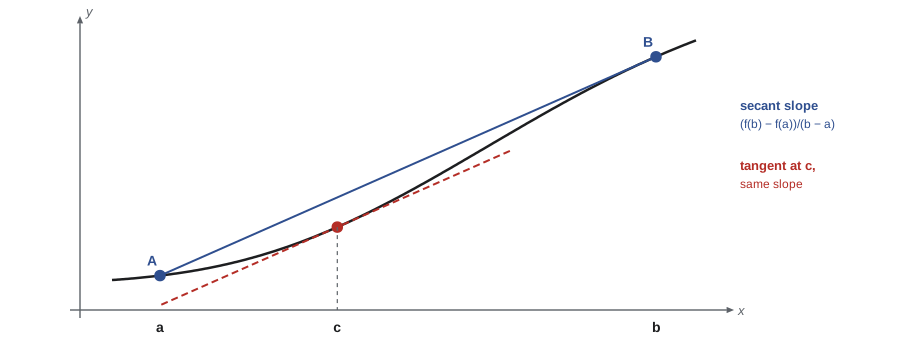
The theorem is due to Lagrange in 1797 and was given a careful proof by Cauchy in 1823, who also proved the generalized form: if \(f\) and \(g\) are continuous on \([a, b]\) and differentiable on \((a, b)\), there is \(c\) with \((f(b) - f(a))g'(c) = (g(b) - g(a))f'(c)\). The proof applies Rolle to \(h(x) = (f(b) - f(a))g(x) - (g(b) - g(a))f(x)\). Lesson 11 uses this form to prove L'Hôpital's rule.
Consequences
Corollary 1. If \(f'(x) = 0\) for every \(x \in (a, b)\), then \(f\) is constant on \((a, b)\). Proof: for \(x < y\) in \((a, b)\), \(f(y) - f(x) = f'(c)(y - x) = 0\). \(\blacksquare\)
Corollary 2. If \(f' = g'\) on an interval, then \(f - g\) is constant. This is why antiderivatives are unique up to a constant, the fact behind the \(+ C\) of calculus. On a set that is not an interval it fails: \(\operatorname{sgn}(x)\) has derivative 0 on \(\mathbb{R} \setminus \{0\}\) but is not constant.
Corollary 3. If \(f' > 0\) on an interval, \(f\) is strictly increasing there; if \(f' \ge 0\), it is increasing. Proof: \(f(y) - f(x) = f'(c)(y - x)\) has the sign of \(f'(c)\). \(\blacksquare\) The converse of the strict version fails: \(x^3\) is strictly increasing with \(f'(0) = 0\).
Corollary 4. If \(|f'(x)| \le K\) on an interval, then \(|f(x) - f(y)| \le K|x - y|\), so \(f\) is Lipschitz and hence uniformly continuous. For example \(|\sin x - \sin y| \le |x - y|\).
Worked problem
An inequality from the mean value theorem
Prove that \(\sqrt{1 + x} < 1 + \frac{x}{2}\) for every \(x > 0\).
Show solution
- Let \(f(t) = \sqrt{1 + t}\) on \([0, x]\). By the mean value theorem, \(\sqrt{1 + x} - 1 = f'(c)\,x = \frac{x}{2\sqrt{1 + c}}\) for some \(c \in (0, x)\).
- Since \(c > 0\), \(\sqrt{1 + c} > 1\), so \(\frac{x}{2\sqrt{1 + c}} < \frac{x}{2}\).
- Hence \(\sqrt{1 + x} < 1 + \frac{x}{2}\).
Answer: The mean value theorem converts bounds on \(f'\) into bounds on \(f\). The same method gives \(\ln(1 + x) < x\) and \(e^x > 1 + x\) for \(x > 0\).
Strange derivatives
A derivative need not be continuous. Let \(f(x) = x^2 \sin\frac{1}{x}\) for \(x \ne 0\) and \(f(0) = 0\). At 0, \(\big|\frac{f(h) - f(0)}{h}\big| = |h \sin\frac{1}{h}| \le |h| \to 0\), so \(f'(0) = 0\). For \(x \ne 0\), the rules give \(f'(x) = 2x\sin\frac{1}{x} - \cos\frac{1}{x}\). As \(x \to 0\) the first term tends to 0 while \(\cos\frac{1}{x}\) oscillates between \(-1\) and 1, so \(f'\) has no limit at 0. The function is differentiable everywhere, but its derivative is discontinuous at 0.
Even so, derivatives cannot jump. Darboux's theorem (1875) says that if \(f\) is differentiable on \([a, b]\) and \(y\) lies strictly between \(f'(a)\) and \(f'(b)\), then \(f'(c) = y\) for some \(c \in (a, b)\). Proof sketch: assume \(f'(a) < y < f'(b)\) and let \(g(x) = f(x) - yx\), so \(g'(a) < 0 < g'(b)\). Then \(g\) takes values below \(g(a)\) just to the right of \(a\) and below \(g(b)\) just to the left of \(b\), so its minimum on \([a, b]\) is at an interior point \(c\), where \(g'(c) = 0\). Consequently a function with a jump discontinuity, such as \(\operatorname{sgn}\), is not the derivative of anything.
A continuous function need not be differentiable anywhere. In 1872 Weierstrass presented to the Berlin Academy the function
\[W(x) = \sum_{n=0}^{\infty} a^n \cos(b^n \pi x), \qquad 0 < a < 1,\ b \text{ an odd integer},\ ab > 1 + \tfrac{3\pi}{2},\]
and proved it is continuous everywhere and differentiable nowhere. The series converges uniformly by comparison with \(\sum a^n\), which gives continuity (MATH-341 proves that uniform limits of continuous functions are continuous). The partial sums are smooth, but each new term adds oscillations that are \(b\) times faster and only \(a\) times smaller, so the slopes they contribute grow like \((ab)^n\). Bolzano had constructed a similar function in the 1830s, but his work was not published until 1922. Weierstrass's example ended the belief, common among earlier analysts, that a continuous function must be differentiable except at isolated points.
import math

a, b = 0.5, 13            # ab = 6.5 > 1 + 3*pi/2, about 5.71
def W(x, terms):
    return sum(a**n * math.cos(b**n * math.pi * x) for n in range(terms))

def slope(f, x, h):
    return (f(x + h) - f(x)) / h

x0 = 0.3
print("difference quotients of the partial sums at x = 0.3 (terms = number of terms kept):")
for h in (1e-2, 1e-3, 1e-4, 1e-5):
    row = "  ".join(f"{slope(lambda t: W(t, k), x0, h):11.2f}" for k in (1, 2, 3, 4, 6))
    print(f"h = {h:.0e}:", row)
print("columns: terms = 1, 2, 3, 4, 6")difference quotients of the partial sums at x = 0.3 (terms = number of terms kept): h = 1e-02: -2.57 -0.34 22.82 22.51 19.17 h = 1e-03: -2.54 3.37 -78.81 -34.35 -183.12 h = 1e-04: -2.54 3.73 -101.53 416.51 -1110.58 h = 1e-05: -2.54 3.76 -103.41 191.29 -7029.60 columns: terms = 1, 2, 3, 4, 6
For a single smooth partial sum the difference quotients settle down once \(h\) is small. For more terms they settle only at smaller and smaller \(h\), and at much larger values. In the limit there is no scale at which the function looks like a straight line, which is what nowhere differentiable means.
Derivatives of inverse functions
Theorem. Let \(f\) be continuous and strictly monotone on an interval, with inverse \(g\). If \(f\) is differentiable at \(c\) with \(f'(c) \ne 0\), then \(g\) is differentiable at \(d = f(c)\) and \(g'(d) = \frac{1}{f'(c)}\).
Proof. By lesson 8, \(g\) is continuous. For \(y \ne d\) in the domain of \(g\), put \(x = g(y)\); then \(x \ne c\) because \(g\) is injective, and \(\frac{g(y) - g(d)}{y - d} = \frac{x - c}{f(x) - f(c)}\). As \(y \to d\), continuity of \(g\) gives \(x \to c\), so the quotient tends to \(\frac{1}{f'(c)}\). \(\blacksquare\)
For example, \(\sqrt[n]{y}\) is the inverse of \(x^n\) on \((0, \infty)\), so its derivative at \(y = x^n\) is \(\frac{1}{nx^{n-1}} = \frac{1}{n} y^{\frac{1}{n} - 1}\), the expected power rule. The condition \(f'(c) \ne 0\) is necessary: \(x^3\) has \(f'(0) = 0\), and its inverse \(\sqrt[3]{y}\) has a vertical tangent at 0, where it is not differentiable.
Common mistakes
MistakeAssuming continuity implies differentiability.
Instead\(|x|\) at 0, and Weierstrass's function everywhere, are counterexamples.
MistakeProving the chain rule by multiplying and dividing by \(g(x) - g(c)\).
InsteadThat quantity can be 0 near \(c\); use Carathéodory's continuous quotient \(\varphi\).
MistakeApplying the mean value theorem without continuity at the endpoints.
InsteadThe hypotheses are continuity on \([a, b]\) and differentiability on \((a, b)\).
MistakeConcluding \(f\) is constant from \(f' = 0\) on a non-interval.
InsteadThe sign function has derivative 0 on \(\mathbb{R} \setminus \{0\}\).
MistakeAssuming a derivative that exists everywhere is continuous.
Instead\(x^2 \sin\frac{1}{x}\) has a discontinuous derivative at 0.
Summary and key terms
- \(f'(c) = \lim_{x \to c} \frac{f(x) - f(c)}{x - c}\); differentiability implies continuity, not conversely.
- The product, quotient and chain rules follow from limit laws; the chain rule needs Carathéodory's trick.
- At an interior extremum \(f' = 0\); Rolle's theorem follows from the extreme value theorem.
- Mean value theorem: \(f'(c) = \frac{f(b) - f(a)}{b - a}\) for some \(c \in (a, b)\).
- Consequences: \(f' = 0\) gives constants; the sign of \(f'\) gives monotonicity; bounds on \(f'\) give Lipschitz bounds.
- Derivatives have the intermediate value property (Darboux) but may be discontinuous; Weierstrass's function is continuous and nowhere differentiable.
- Derivative
- The limit of difference quotients at a point.
- Rolle's theorem
- Equal endpoint values force a critical point inside.
- Mean value theorem
- Some tangent is parallel to the secant.
- Darboux's theorem
- Derivatives have the intermediate value property.
- Nowhere differentiable function
- A continuous function with no derivative at any point.
Practice problems
Work each problem on paper first, then reveal the answer to check.
Use the definition to find \(f'(c)\) for \(f(x) = \frac{1}{x}\), \(c \ne 0\).
Show answer
\(\frac{1/x - 1/c}{x - c} = -\frac{1}{xc} \to -\frac{1}{c^2}\).
Is \(f(x) = x|x|\) differentiable at 0?
Show answer
Yes: \(\frac{h|h|}{h} = |h| \to 0\), so \(f'(0) = 0\).
Prove \(|\cos x - \cos y| \le |x - y|\).
Show answer
Mean value theorem with \(|\sin c| \le 1\).
Show that \(x^3 + x + 1 = 0\) has exactly one real root.
Show answer
At least one by the intermediate value theorem (odd degree). Two roots would give, by Rolle, a zero of \(3x^2 + 1 > 0\).
Prove \(e^x \ge 1 + x\) for all \(x\), assuming \((e^x)' = e^x\).
Show answer
For \(x > 0\), \(e^x - 1 = e^c x \ge x\); for \(x < 0\), \(e^x - 1 = e^c x\) with \(e^c < 1\) and \(x < 0\) gives \(e^x - 1 > x\).
Lesson quiz · 5 questions
Score 60% or more to complete this lesson.
Create a free account to save your progress, take quizzes and earn a certificate.