
LVT-210 · Lesson 4 of 12 · 20 min
Installing fibre cable: pulling, bend radius and pathways
Fibre cable is stronger than it looks and weaker than people treat it. The glass itself has a very high tensile strength, but only as long as its surface is unscratched; a fibre that is overstretched, crushed or bent too tightly may not break at once but can develop microscopic cracks that grow over months until it fails. The damage is often invisible at the time of installation and may not show on the acceptance test. That is why the installation limits in this lesson are treated as absolute, not as targets to approach.
This lesson follows two installations. At the Hartwell warehouse, the crew pulls a 12-strand singlemode cable through 140 m (460 ft) of conduit along the building's north wall to a new wall enclosure at the far end, where copper would have been too long. At Riverside, they pull the 24-strand singlemode and the 12-strand OM4 through 320 m (1,050 ft) of underground conduit between the school's main building and the gymnasium.
The installation limits: tension and bend radius
Every fibre cable has two tension ratings on its data sheet. The maximum installation load is the highest tension the cable may see during the pull. The long-term load, which is much lower, is what it may carry permanently once installed, for example hanging in a riser. Indoor tight-buffered cables with a few strands may be rated for only a few hundred newtons; outdoor loose-tube cables are commonly rated at 2,670 N (600 lbf) for installation. The rating applies to the strength members, which is why the pull is always made on them.
Bend radius has two values too. TIA-568.3 sets general minimums that the manufacturer may tighten: for most cables, ten times the cable's outside diameter when it is not under tension, and twenty times while it is being pulled. The larger radius during the pull is there because tension and bending together put far more stress on the glass than either alone. Small cables with two or four fibres have fixed minimums, smaller than for larger cables, and the manufacturer's data sheet always governs.
| Cable | Outside diameter | Installation load | Bend radius, no load | Bend radius, under load |
|---|---|---|---|---|
| Hartwell 12F singlemode, tight-buffered | 7.0 mm (0.28 in) | 1,300 N (300 lbf) | 70 mm (2.8 in) | 140 mm (5.5 in) |
| Riverside 24F OS2, loose tube | 11.0 mm (0.43 in) | 2,670 N (600 lbf) | 110 mm (4.3 in) | 220 mm (8.7 in) |
| Riverside 12F OM4, loose tube | 10.0 mm (0.39 in) | 2,670 N (600 lbf) | 100 mm (3.9 in) | 200 mm (7.9 in) |
Planning the pull: tension through bends
Tension builds along a pull. Friction on straight conduit adds a little; every bend multiplies the tension already in the cable. The relationship is the capstan equation that LVT-130 used for copper: the tension leaving a bend equals the tension entering it multiplied by e raised to the friction coefficient times the bend angle in radians. A pull with several bends near the far end is much harder than the same bends near the feed end, because the multiplication works on whatever tension has built up. Pulling lubricant made for fibre cable lowers the friction coefficient and is used on any long or bendy run.
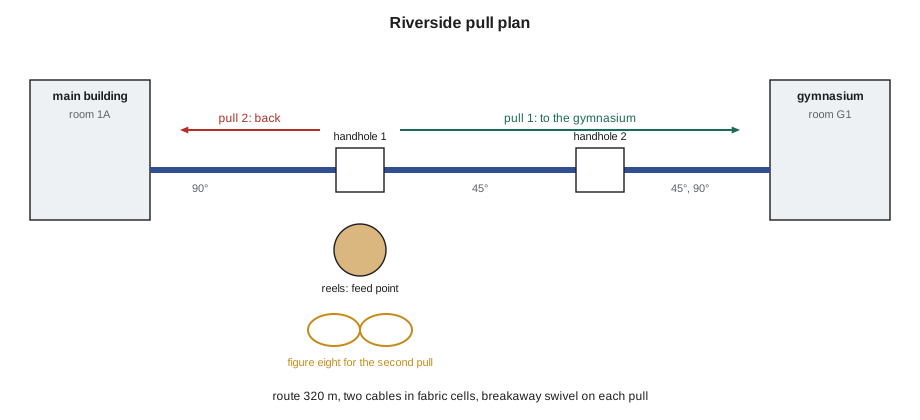
Hollis plans long pulls with a simple calculation run section by section, and the code below follows it for the Riverside route. The conduit leaves the main building's entrance room, runs under the parking lot with two handholes, and enters the gymnasium. The friction coefficient with lubricant is taken as 0.35, and the weight of the cable is included because it presses the cable against the conduit floor on the straight sections.
import math
# Tension along the Riverside campus pull, section by section
MU = 0.35                      # friction coefficient with lubricant
W = 1.0                        # cable weight, N per m
LIMIT = 2670                  # installation load from the data sheet, N
route = [("straight", 95), ("bend", 90), ("straight", 110), ("bend", 45),
         ("straight", 80), ("bend", 45), ("straight", 35), ("bend", 90)]
def pull(sections, start=50):
    t = start
    for kind, val in sections:
        if kind == "straight":
            t += MU * W * val
        else:
            t *= math.exp(MU * math.radians(val))
    return t
whole = pull(route)
print(f"pull from the main building: {whole:.0f} N ({100 * whole / LIMIT:.0f} % of the limit)")
# Pulling in two halves from the middle handhole, feeding the cable each way
first, second = route[:4], route[4:]
t1, t2 = pull(first), pull(second)
print(f"first half {t1:.0f} N, second half {t2:.0f} N (each {100 * max(t1, t2) / LIMIT:.0f} % or less)")pull from the main building: 634 N (24 % of the limit) first half 241 N, second half 199 N (each 9 % or less)
A single pull from the main building would reach about a quarter of the cable's rating, which looks comfortable. But Hollis plans to pull the two cables together, which roughly doubles the weight and the friction, the lubricant is never spread perfectly, and the friction coefficient on old conduit can be well above the value in the calculation. A margin of four to one on paper can shrink quickly on site. So she decides to pull from the middle handhole in both directions: the cable is fed from the reel at the middle handhole, pulled to the gymnasium first, then the rest of the reel is laid out on the ground in a figure eight and pulled back toward the main building. Each half sees far less tension than the whole pull would.
The figure eight
When a cable must be pulled in two directions from a midpoint, the cable for the second direction is taken off the reel and laid on the ground or a clean tarp in a large figure eight. The figure eight is used instead of a coil because it adds no twist: each loop of the eight twists the cable one way and the next loop twists it back. A plain coil would put one full twist into the cable for every loop, and pulling it out later would kink it. The loops are made large, several times the bend radius, and the figure eight is protected from traffic and kept clean.
Pulling equipment and attachments
Short indoor pulls are made by hand. Longer pulls use a winch or a capstan puller with a tension meter or a breakaway swivel. A breakaway swivel is a link between the pull rope and the cable grip that separates at a set load, below the cable's rating, so the cable cannot be overloaded even if the winch operator does not stop in time. The swivel also lets the cable rotate freely, so twist in the pull rope is not passed into the cable.
The attachment is made to the strength members. For loose-tube cable, the jacket is cut back, the aramid yarn is gathered and tied or clamped into a pulling eye, the central strength member is clamped, and the tubes are cut short and taped inside the grip so they carry no load. Many manufacturers sell outdoor cables with factory pulling eyes. For tight-buffered indoor cable, the aramid yarn is tied in a knot around the pull line and the end is taped smooth so it does not catch on couplings or fittings.
- Pull smoothly and continuously; stopping and starting adds tension as the cable comes off the conduit wall.
- Station a person at every handhole and at both ends with radios, to feed, guide and watch for snags.
- Feed the cable straight into the conduit; a guide or a large-radius pulley at the entry keeps the bend radius under load.
- Never let the cable be stepped on, driven over or kinked while it is laid out.
- Leave enough slack at each end for the enclosure, the splice trays and future re-termination.
Inner duct, conduit and other pathways
Underground conduit between buildings is usually 100 mm (4 in) trade size or larger, too large for a single small fibre cable to be pulled efficiently and too valuable to fill with one cable. It is subdivided with inner duct, smaller flexible tubes installed inside it, or with fabric inner duct, a set of woven sleeves that holds each cable in its own cell. Each cell carries one cable and keeps a pull rope for the next one. The Riverside conduit has three fabric cells: one for the singlemode, one for the OM4, and one spare with a pull tape.
Indoors, fibre runs in tray, in innerduct inside tray, in conduit, or on the same J-hooks as copper where the specification allows. Many specifications require fibre in tray to be in its own innerduct, so it cannot be crushed by copper bundles laid on top later. Fibre should never be the bottom cable in a tray of copper. Where fibre and copper share a pathway, the fibre is pulled last or protected. The Hartwell route is entirely in conduit along the warehouse wall, with pull boxes at each bend so no section has more than two right-angle bends.
In risers, fibre is supported at each floor or at the interval the manufacturer specifies, so the cable carries only the weight of one section. Riser cables are usually lowered from the top floor rather than pulled up from the bottom, with a person at each floor feeding and securing the cable. Riser and plenum ratings, firestopping at each floor and the rules for cables leaving one fire compartment for another are code questions for LVT-330; on site, the crew checks that the cable's FT rating matches the space it runs through.
import math
# Fill check: Riverside fabric cells and the Hartwell conduit
cables = {"24F OS2": 11.0, "12F OM4": 10.0, "12F Hartwell": 7.0}
CELL = 32        # inside width of one fabric cell, mm
CONDUIT_ID = 26.6   # inside diameter of the Hartwell conduit, mm
for name in ("24F OS2", "12F OM4"):
    d = cables[name]
    print(f"{name}: diameter {d} mm, cell {CELL} mm, ratio {d / CELL:.2f}")
area = math.pi * cables["12F Hartwell"] ** 2 / 4
fill = 100 * area / (math.pi * CONDUIT_ID ** 2 / 4)
print(f"Hartwell conduit fill with one cable: {fill:.1f} % (one-cable limit 53 %)")
print(f"room for {int(0.40 * (math.pi * CONDUIT_ID ** 2 / 4) / area)} cables of this size at 40 % fill")24F OS2: diameter 11.0 mm, cell 32 mm, ratio 0.34 12F OM4: diameter 10.0 mm, cell 32 mm, ratio 0.31 Hartwell conduit fill with one cable: 6.9 % (one-cable limit 53 %) room for 5 cables of this size at 40 % fill
Slack, storage loops and protecting the ends
Fibre installations leave slack at each end and at intermediate points. At each enclosure, enough cable is left to bring the cable end to a splicing table or vehicle, usually several metres, and then to store the excess neatly in the enclosure or on a slack storage bracket. Outdoors, a service loop is often left in a handhole, coiled on a bracket at more than the minimum bend radius, so the cable can be re-spliced later after a repair. At Riverside, Sanjay's design calls for a 10 m (33 ft) loop in each handhole.
The cable ends are sealed as soon as the pull is finished. Water that enters the end of a loose-tube cable can travel along the tubes, and gel-filled cables can lose gel if the end is left open in the sun. The crew caps each end with a heat-shrink end cap or tape, tags it with the cable number, and coils it out of the way until splicing. The length marks at each end are recorded, and the difference becomes the as-built length of the cable.
Worked problem
Did the Hartwell pull stay within its limits?
The Hartwell cable is rated for 1,300 N (300 lbf). Hollis used a breakaway swivel set at 900 N (200 lbf), and the pull finished without the swivel parting. The tightest point on the route is a pull box where the cable turns 90 degrees around a guide of 150 mm (6 in) radius. The cable diameter is 7.0 mm (0.28 in). Were the tension and radius limits respected?
Show solution
- Tension: the swivel parts at 900 N (200 lbf), below the rating, and it did not part, so the tension never exceeded 900 N (200 lbf).
- Bend radius under load is twenty times the diameter: 20 × 7.0 = 140 mm (20 × 0.28 = 5.6 in).
- The guide radius of 150 mm (6 in) is larger than 140 mm (5.6 in), so the bend under load was within the limit.
Answer: Both limits were respected; Hollis records the swivel setting and the guide radius in the pull record.
Common mistakes
MistakePulling a fibre cable by its jacket.
InsteadPull by the aramid yarn or central strength member, through a swivel.
MistakeCoiling cable in a plain loop for a two-direction pull.
InsteadLay it out in a figure eight so no twist is added.
MistakeUsing the no-load bend radius during the pull.
InsteadUse the larger radius, typically twenty times the diameter, while the cable is under tension.
MistakeLaying fibre at the bottom of a tray full of copper.
InsteadUse innerduct or pull fibre last, so it is never crushed.
MistakeLeaving cable ends open after the pull.
InsteadSeal and tag each end at once.
Summary and key terms
- Overstretching, crushing or tight bends can damage fibre invisibly and cause later failure.
- Cables have a maximum installation load and a lower long-term load; the data sheet governs.
- Bend radius is typically ten times the diameter at rest and twenty times under tension.
- Tension grows with friction and multiplies at bends; long or bendy routes are pulled from the middle in two directions.
- A figure eight stores cable for a second pull without adding twist.
- Breakaway swivels protect the cable from overload; the grip is attached to the strength members.
- Inner duct divides large conduit; fibre in tray is protected from copper bundles.
- Slack is left at ends and handholes, and cable ends are sealed and tagged after the pull.
- Installation load
- The maximum tension a fibre cable may see during the pull.
- Long-term load
- The much lower tension a cable may carry permanently once installed.
- Breakaway swivel
- A link that lets the cable rotate and separates at a set load below the cable rating.
- Figure eight
- A way of laying out cable on the ground that adds no twist.
- Inner duct
- Smaller ducts or fabric cells installed inside a conduit to carry individual cables.
- Service loop
- A coil of spare cable left for future repairs or re-termination.
Practice problems
Work each problem on paper first, then reveal the answer to check.
A cable is 9 mm in diameter. What are its typical bend radius limits?
Show answer
90 mm at rest and 180 mm under tension.
A pull reaches 1,200 N before a 90° bend with a friction coefficient of 0.35. What leaves the bend?
Show answer
1,200 × e^(0.35 × 1.571) ≈ 2,080 N.
Why is a long route pulled from the middle?
Show answer
Each half sees much less tension than a single end-to-end pull.
What protects the cable if the winch operator does not stop in time?
Show answer
A breakaway swivel set below the cable rating.
Lesson quiz · 5 questions
Score 60% or more to complete this lesson.
Create a free account to save your progress, take quizzes and earn a certificate.