
LVT-210 · Lesson 3 of 12 · 19 min
Fibre safety: light, glass shards and chemicals
The fibre crew's first job of the season is not a new installation. At the Juniper Point condominium, the property manager has asked Cobalt Line to replace two old wall-mounted fibre enclosures on the riser and move the building's 12-strand OM3 into new ones, while the residents' internet, the security cameras and the access control system stay in service on the other strands. That means working beside live fibres, in a small room, with cleavers, solvents and glass. Greta Lindqvist, Cobalt Line's safety coordinator, meets the crew in the parking garage before the first day and walks through the hazards with them.
Fibre work has fewer hazards than many trades, but they are particular to it: invisible light that can damage eyes, slivers of glass small enough to disappear into skin, flammable cleaning solvents, and the ordinary risks of the places where fibre runs, from ladders and ceiling spaces to manholes and live equipment rooms. LVT-110 covered the general hazards of the low-voltage trade; this lesson covers the ones that come with glass and light.
Invisible light and the eye
The light in a fibre system is infrared, at 850 nm, 1310 nm or 1550 nm. The eye cannot see it, so there is no blink reflex and no warning. Light leaving the end of a fibre or connector spreads out in a cone, so the intensity falls quickly with distance, and for most building systems the power is low. But looking into an energised fibre end at close range, or through a magnifier or a microscope, concentrates the light onto the retina. Damage can happen without pain and without anything being seen.
Laser products are classified under IEC 60825-1, which Canada applies through its radiation-emitting devices rules and the US through the FDA's laser product requirements. Communication systems have their own part of the standard, IEC 60825-2, which sets hazard levels at the places where a person could reach the light, such as an open connector. Most building transceivers are Class 1, safe under all reasonable conditions of use, or Class 1M, which is safe to the naked eye but not when viewed through magnifying optics. Higher-power systems used on long links and in some video and amplified systems are more hazardous, and the equipment labels say so.
| Class | Meaning | What it means for the crew |
|---|---|---|
| 1 | Safe under all reasonably foreseeable conditions | Still never looked into deliberately |
| 1M | Safe to the naked eye; hazardous with magnifiers or microscopes | Never use an optical microscope on a fibre that may be live |
| 2 and 2M | Visible light, protected by the blink reflex | Visual fault locators; do not stare into them |
| 3R | Low risk, but more than Class 2 | Some test sources; avoid direct exposure |
| 3B and 4 | Hazardous to the eye, and Class 4 to the skin | Long-haul and amplified systems; follow the owner's lockout and the labels |
The practical rules follow from the table. Treat every fibre as live until it is proven dark. Never look into the end of a fibre or a connector, and never point one at someone. Inspect end faces only with a video microscope, which shows the image on a screen and keeps the eye away from the light, and never with an optical eyepiece microscope on a fibre that could be connected to a transmitter. Cap every connector and adapter port that is not in use. At Juniper Point, the crew uses an optical power meter to confirm that each strand they work on is dark before they open it.
import math
# Converting power meter readings: dBm to microwatts, and a dark-strand check
readings = {"strand 1 (cameras)": -6.8, "strand 2 (cameras)": -7.1,
            "strand 5 (spare)": -62.0, "strand 6 (spare)": -61.4,
            "strand 9 (internet)": -4.9, "strand 10 (internet)": -5.3}
DARK = -50.0        # below this the meter reads only its own noise floor
for name, dbm in readings.items():
    uw = 1000 * 10 ** (dbm / 10)
    state = "dark" if dbm < DARK else "LIVE"
    print(f"{name:22s} {dbm:7.1f} dBm = {uw:10.4f} microwatts  {state}")
live = [n for n, d in readings.items() if d >= DARK]
print(f"{len(live)} live strands: do not disconnect or inspect them optically")strand 1 (cameras) -6.8 dBm = 208.9296 microwatts LIVE strand 2 (cameras) -7.1 dBm = 194.9845 microwatts LIVE strand 5 (spare) -62.0 dBm = 0.0006 microwatts dark strand 6 (spare) -61.4 dBm = 0.0007 microwatts dark strand 9 (internet) -4.9 dBm = 323.5937 microwatts LIVE strand 10 (internet) -5.3 dBm = 295.1209 microwatts LIVE 4 live strands: do not disconnect or inspect them optically
The meter confirms what the building's records say: strands 1, 2, 9 and 10 carry traffic, and 5 and 6 are dark. The live strands are at a few microwatts each at the meter, which is not a hazard at the distance a person would normally be from an open connector, but that is a judgement nobody on the crew makes. Live strands are flagged with a red tag in the enclosure, and their connectors are not unplugged until the cut-over, which the property manager has scheduled for two in the morning on the last day.
Glass shards
Cleaving and stripping fibre produces small pieces of bare glass, typically a few millimetres to a few centimetres long and as thin as a hair. They are sharp, nearly invisible, and they do not show up on an X-ray. A shard that enters the skin can work its way in and cause infection; one that is rubbed into an eye or swallowed is a serious injury. Shards are the main injury risk in fibre work, and the precautions are simple and absolute.
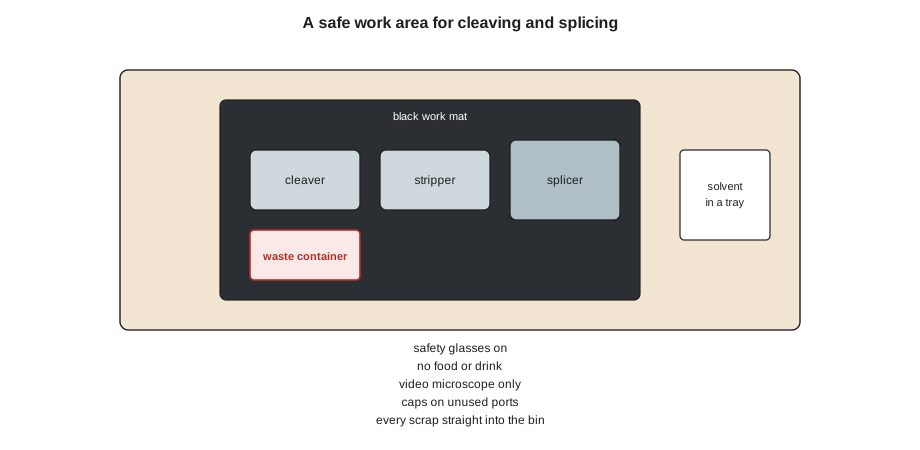
- Collect every scrap of fibre at once in a marked, sealed disposal container: a commercial fibre waste bin, or a lidded container with a strip of tape inside to catch the pieces.
- Work on a dark mat, so the glass is visible, and never on a surface where people eat or put down their hands.
- Wear safety glasses at all times while cleaving, stripping and handling bare fibre.
- Do not eat, drink or smoke in the work area, and wash hands before doing so elsewhere.
- Never brush scraps away with bare hands or blow them off a surface; pick them up with tape.
- Do not rub your eyes while working, and check clothing for shards before leaving the work area.
Hollis's splicing kit has a fibre waste container clipped to the work tray, a black mat, and a roll of tape. When a cleaver's scrap collector fills, it is emptied into the container, not the garbage. At the end of the day, the container is sealed, labelled and taken back to the shop for disposal, so that cleaning staff in the building never handle a bag with fibre in it.
Cleaning chemicals and gels
Fibre work uses several chemicals. Isopropyl alcohol, usually at 99 percent, is used on lint-free wipes to clean bare fibre before cleaving and to wipe down tools. Specialised optical cleaning fluids are used for connectors. Gel cleaners remove the water-blocking gel from loose-tube cables. Some adhesives used in connector termination are two-part epoxies, and some cleaning sprays contain propellants.
Isopropyl alcohol and many solvents are flammable, and their vapours are heavier than air. In a small riser room, a manhole or a ceiling space, vapour can build up. The safety data sheet for each product, under WHMIS in Canada and the hazard communication standard in the US, gives its flash point, health hazards, required ventilation and protective equipment. Hollis keeps the sheets for the crew's products in the truck and in the job binder. The rules are to use the smallest quantity that does the job, keep containers closed, ventilate small spaces, keep solvents away from the fusion splicer's electrode arc and from hot work, and wear nitrile gloves when using gel cleaners or epoxies.
At Juniper Point, the riser room is about 2 by 3 m (6.5 by 10 ft) and has no mechanical ventilation. Greta's plan has the crew prop the door open with a fan blowing in from the corridor while they clean, keep only one small dispenser bottle of alcohol in the room, and store the rest in the truck. The plan is short, but it is written down, and every crew member signs it before work starts, as Ontario's occupational health and safety rules expect for a hazard assessment on a job site.
Working beside live systems
Most fibre work in existing buildings happens beside live systems: other strands in the same cable, other cables in the same enclosure, and active equipment in the same rack. A single unplugged connector, a pinched cord or a bumped patch can take down a whole building's internet or a hospital's imaging network. Live-system work is controlled by planning rather than by personal protective equipment.
Before any work, the crew confirms which strands are live, using the records, the equipment labels and the power meter. Live strands and connectors are tagged. The work is planned so that the live strands are not handled at all, or are moved only during a scheduled cut-over window with the owner's representative present. Patch cords are not removed to make room. Any change to a live circuit is written into a method of procedure: a numbered list of steps, the person who does each one, the check that confirms it worked, and how to go back if it does not.
| Step | Action | Check | Back-out |
|---|---|---|---|
| 1 | Owner confirms the window has started; cameras switched to local recording | Owner's message logged | Stop; reschedule |
| 2 | Disconnect strands 1 and 2 at the old enclosure, connect to new panel ports 1 and 2 | Power meter at the camera switch reads within 0.5 dB of the earlier value | Reconnect to the old enclosure |
| 3 | Repeat for strands 9 and 10 to new ports 9 and 10 | Building internet link light on; owner confirms service | Reconnect to the old enclosure |
| 4 | Remove the old enclosure; label new ports | Labels match the records | Not applicable |
Where fibre goes: the site hazards
Fibre runs through risers, ceilings, data rooms, underground conduit, handholes and manholes. The site hazards are the same ones other low-voltage work faces, and LVT-110 covered them: ladders and lifts, falling objects, live electrical equipment, dust and noise. Two deserve repeating for fibre crews. Splicing outdoors is often done in a vehicle or a tent beside an open handhole, which needs traffic protection and guarding. And manholes and vaults are confined spaces, with the atmospheric testing, ventilation, permits and attendants those require. Riverside's route uses handholes shallow enough to work from the surface, and Greta has confirmed that none of them will be entered.
Outdoor work also brings ground disturbance. Before the Riverside crew opens any handhole lid or digs to expose a conduit, the locate request must be made through Ontario One Call, and the marked utilities respected. Hollis has seen a contractor's backhoe cut a 144-strand cable on another campus; the repair took two days of splicing in a hole in the rain.
Worked problem
A dark-strand check before opening a connector
At Juniper Point, Teo is about to clean the connector on strand 6, which the records show as spare. The power meter, connected at the other end of the riser, reads −61.4 dBm. The meter's noise floor is about −60 dBm. Is the strand dark?
Show solution
- A reading at or below the meter's noise floor means no measurable light is reaching it.
- −61.4 dBm is below the floor, so the meter is reading only its own noise.
- The strand is dark at the far end; Teo also checks that no equipment is connected at the near end before opening the connector.
Answer: Strand 6 is dark. Teo still inspects it with the video microscope, never an eyepiece.
Common mistakes
MistakeAssuming a fibre is dark because the records say so.
InsteadConfirm with a power meter and look for connected equipment at both ends.
MistakeUsing an eyepiece microscope on a connector that might be live.
InsteadUse a video microscope, which keeps the eye away from the light.
MistakeBrushing fibre scraps off the table.
InsteadPick them up with tape and put them in the disposal container.
MistakeKeeping a large bottle of alcohol open in a small room.
InsteadUse a small dispenser, keep it closed and ventilate the space.
MistakeUnplugging a cord to make room in a live enclosure.
InsteadPlan the work around live connections, or change them only in a scheduled window.
Summary and key terms
- Fibre light is invisible infrared; there is no blink reflex and no warning.
- Laser classes under IEC 60825-1 describe the hazard; never look into a fibre end and never use an eyepiece microscope on a fibre that may be live.
- A power meter confirms whether a strand is dark before it is opened.
- Glass shards are the main injury risk; collect every scrap in a sealed container and wear safety glasses.
- Solvents are flammable and their vapours collect in small spaces; use small quantities, keep them closed and ventilate.
- Live-system work is controlled by records, tags and a written method of procedure.
- Site hazards include ladders, live rooms, traffic, confined spaces and buried utilities.
- Class 1M
- A laser product safe to the naked eye but hazardous when viewed through magnifying optics.
- Video microscope
- An inspection scope that displays the end face on a screen, keeping the eye away from the light.
- Dark strand
- A fibre carrying no light, confirmed with a power meter.
- Fibre waste container
- A sealed, labelled container used to collect every scrap of bare glass.
- Method of procedure
- A written, step-by-step plan for a change to a live system, with checks and back-out steps.
- Safety data sheet
- The supplier document giving a chemical product's hazards and precautions.
Practice problems
Work each problem on paper first, then reveal the answer to check.
A meter reads −7 dBm on a strand. Is it live?
Show answer
Yes; that is about 200 microwatts, a working signal.
Why are fibre shards dangerous even though they are tiny?
Show answer
They are sharp, hard to see, can work into the skin and do not show on X-rays.
What makes Class 1M different from Class 1?
Show answer
It becomes hazardous when viewed through magnifying optics.
What three things does each step of a method of procedure include?
Show answer
The action, the check that confirms it worked, and how to back out.
Lesson quiz · 5 questions
Score 60% or more to complete this lesson.
Create a free account to save your progress, take quizzes and earn a certificate.