
LVT-120 · Lesson 6 of 12 · 20 min
Copper cable categories and performance
Twisted-pair copper is still the most common cable in any building. It carries Ethernet to desks and devices, power to cameras, access points and lights through Power over Ethernet, and voice and alarm circuits on the backbone. A spool of Category 6A cable looks simple: four pairs of insulated copper wire in a jacket. Its performance depends on details that are invisible from the outside: the gauge of the copper, the twist rate of each pair, the separator between pairs, the shield if there is one and the consistency of all of these along hundreds of metres. This lesson explains how twisted pair works, what the categories mean, which electrical parameters define them and how to choose a category for a job.
How twisted pair works
Each pair carries a signal as a difference in voltage between its two conductors, a method called balanced transmission. Noise that couples into the cable from outside, such as interference from a motor or a fluorescent ballast, tends to affect both conductors of a pair equally. Because the receiver looks only at the difference between them, the noise largely cancels out. Twisting the two conductors around each other keeps them at the same average distance from any noise source, which makes the cancellation work, and it also makes the pair's own magnetic field cancel at a distance, so the pair radiates less into its neighbours.
The four pairs in a cable are twisted at slightly different rates, so that no two pairs line up along the cable, which reduces crosstalk between them. Higher categories use tighter, more carefully controlled twists, and many add a plastic separator, often called a spline or cross-filler, that holds the pairs apart. The characteristic impedance of the cable, set by the conductor size, the insulation and the twist, is 100 ohms for all the recognized categories. Keeping that impedance uniform along the cable and through every connector is what keeps reflections low.
The balanced design is also why installation matters so much. Untwisting a pair too far at a termination, kinking a cable, crushing it under a cable tie or bending it too tightly changes the pair geometry at that point, and the cable's performance falls there. LVT-130 covers the installation practices that preserve the geometry.
Categories and classes
TIA groups twisted-pair components and cabling into categories by the highest frequency to which their performance is specified. ISO/IEC 11801 uses classes for the installed channel and categories for components. The higher the frequency, the more data the cabling can carry, because faster Ethernet uses higher-frequency signalling.
| TIA category | ISO class | Specified to | Typical applications |
|---|---|---|---|
| Category 5e | Class D | 100 MHz | 1 Gb/s Ethernet; 2.5 and 5 Gb/s over 100 m in most installations |
| Category 6 | Class E | 250 MHz | 1 Gb/s; 10 Gb/s only over shorter distances, about 37 to 55 m |
| Category 6A | Class EA | 500 MHz | 10 Gb/s over the full 100 m channel; high-power PoE |
| (not TIA) | Class F / FA | 600 / 1,000 MHz | ISO only, with fully shielded cable and non-RJ45 connectors |
| Category 8 | Class I / II | 2,000 MHz | 25 and 40 Gb/s over a 30 m channel in data centres |
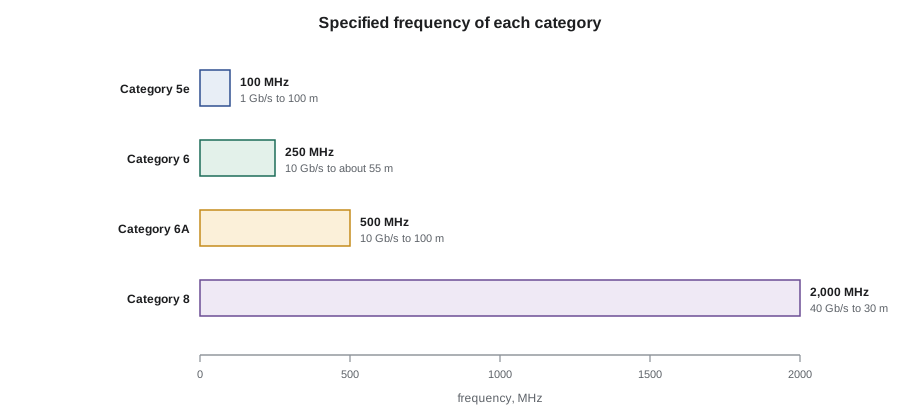
Older categories still appear in existing buildings. Category 3, specified to 16 MHz, survives in voice backbone and in old horizontal cable that should be replaced. Category 5, without the e, is no longer recognized. Categories 7 and 7A are ISO component categories, not TIA categories, and use connectors other than the familiar RJ45 style. Cable sold as Category 7 for ordinary office use, terminated on standard jacks, cannot deliver Category 7 performance, since the channel is only as good as its weakest component.
Category 6A has become the default for new horizontal cabling, and most owner standards require it. The reasons are 10 gigabit Ethernet over the full 100 m, better performance for wireless access points that now use multi-gigabit uplinks, and better handling of the heat produced when high-power PoE runs through large cable bundles, covered in Lesson 11. The trade-offs are size and cost: a Category 6A cable is typically 7 to 8 mm (0.28 to 0.31 in) in diameter, against about 5 to 6 mm (0.20 to 0.24 in) for Category 5e, so it fills pathways faster and is stiffer to work with.
Shielded and unshielded cable
Most North American cabling is unshielded twisted pair, abbreviated UTP, which relies entirely on balance and twisting to reject noise. Shielded cables add a foil or braid that blocks external interference and reduces alien crosstalk between neighbouring cables. ISO/IEC 11801 names the constructions with two letters before TP: the first describes the overall shield and the second the shield around each pair, with U for unshielded, F for foil and S for braid.
- U/UTP: no overall shield and no pair shields. The common North American cable.
- F/UTP: an overall foil shield around unshielded pairs. Common in Europe and in North American installations near strong noise sources.
- U/FTP: foil around each pair, no overall shield. Used for high-performance Category 6A and some Category 8 cable.
- S/FTP: an overall braid with foil around each pair. Required for ISO Class F and FA and used in Category 8.
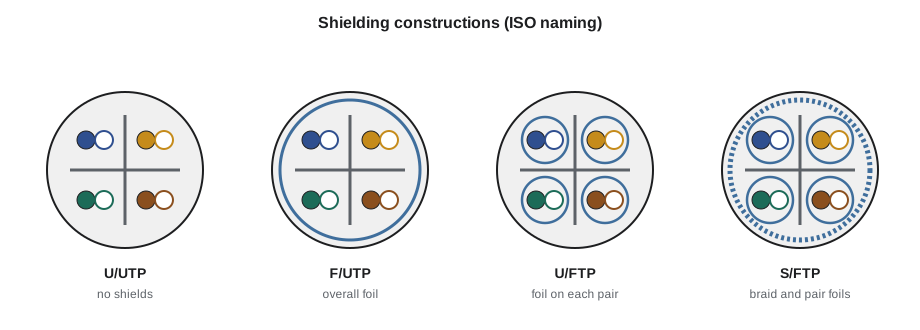
A shield only works if it is continuous and bonded. Shielded cable must be terminated on shielded jacks and panels, with the shield connected all the way through every connection, and the panels bonded to the telecommunications bonding system at the telecommunications room. A shield that is broken, or bonded at neither end, can act as an antenna and make performance worse than unshielded cable. LVT-130 covers shielded termination and LVT-330 the bonding.
The parameters that define a category
A certification tester, covered in LVT-130, measures each link against limits set in TIA-568.2 across the whole frequency range of its category. Every installer should understand what the main parameters mean, because they point to what went wrong when a link fails.
- Insertion loss is the loss of signal strength along the link, in decibels. It rises with frequency and with length, and with temperature as Lesson 5 explained. Too much insertion loss usually means the link is too long or the cable is wrong.
- Near-end crosstalk, NEXT, is signal from one pair coupling into another pair at the same end of the cable. Power sum NEXT adds the coupling from all three other pairs. Poor NEXT usually points to untwisted pairs at a termination or a mismatched connector.
- Far-end crosstalk, measured as the attenuation to crosstalk ratio far-end, ACRF, is the coupling measured at the far end, compared with the signal that arrives there.
- Return loss measures the signal reflected back toward the transmitter by changes in impedance. Kinks, crushed sections, tight bends and poorly made terminations all cause reflections.
- Alien crosstalk is coupling between pairs in different cables bundled together. It limits 10 gigabit Ethernet on Category 6 and is the reason Category 6A cables are designed with larger diameters or shields.
- Propagation delay and delay skew are the time a signal takes to travel the link and the difference between the fastest and slowest pairs. Ethernet sends data on all four pairs at once, so excessive skew can corrupt it.
- DC loop resistance and resistance unbalance matter for PoE: unbalance between the two conductors of a pair, or between pairs, can saturate the transformers in network equipment.
Decibels can be confusing at first. Insertion loss is reported as a positive number of decibels lost; for crosstalk and return loss, a larger number is better, because it means the unwanted signal is weaker. The difference between a measured value and the limit is called the margin or headroom, and manufacturers' warranty programs and some owners require a minimum margin on every link.
# Approximate insertion loss of a 100 m Category 6A channel (illustrative model)
from math import sqrt
def channel_loss(f_mhz, length_m=100, connectors=4):
    cable = (1.82 * sqrt(f_mhz) + 0.0091 * f_mhz + 0.25 / sqrt(f_mhz)) * length_m / 100
    conn = connectors * 0.02 * sqrt(f_mhz)
    return cable + conn

for f in (1, 10, 100, 250, 500):
    il = channel_loss(f)
    short = channel_loss(f, length_m=40, connectors=2)
print(f"{f:4d} MHz: 100 m channel {il:5.1f} dB, 40 m link {short:5.1f} dB")1 MHz: 100 m channel 2.2 dB, 40 m link 0.9 dB 10 MHz: 100 m channel 6.2 dB, 40 m link 2.5 dB 100 MHz: 100 m channel 19.9 dB, 40 m link 8.1 dB 250 MHz: 100 m channel 32.3 dB, 40 m link 13.1 dB 500 MHz: 100 m channel 47.0 dB, 40 m link 19.0 dB
The model shows two things that the standard's limit lines also show: loss rises steeply with frequency, roughly with its square root, and it scales almost directly with length. A 40 m link has well under half the loss of a full channel, which is why short links almost always pass insertion loss with large margins, and why the hard part of a short link is usually return loss and crosstalk at the closely spaced connections.
Single-pair Ethernet
One newer development will appear on Maya's jobs in building automation and industrial work. Single-pair Ethernet uses one twisted pair instead of four, with its own connectors, and is covered by TIA-568.5. Its long-reach version, 10BASE-T1L, carries 10 megabits per second over as much as 1,000 m, with power over the same pair. It is intended for sensors, controllers, valves and meters that today use older field buses, and it lets those devices join the building network without a gateway. BICSI's 2024 manual added single-pair cabling for the same reason. It does not replace four-pair cable at the desk.
Choosing a category
For new horizontal cabling, Sanjay starts from Category 6A unless the owner's standard says otherwise. He chooses unshielded cable for most offices and schools, and shielded cable where there are strong noise sources, such as near variable-frequency drives in a mechanical room, in industrial spaces or where an owner's standard asks for it. Category 8 belongs in data centres, between servers and switches in the same row. For an existing building, the decision is often whether to reuse old cable. Category 5e may be kept for 1 gigabit devices if it tests well, but cable that will feed new wireless access points is usually replaced with Category 6A.
Worked problem
Reusing cable in the Kellerman Building
The sixth-floor tenant's IT manager asks whether the Category 5e cabling left by the previous tenant can be reused for the new layout. It is fifteen years old, unlabelled, and terminated on a mixture of jacks. The new tenant wants 2.5 gigabit uplinks to its wireless access points and 1 gigabit to desks. What does Dev advise?
Show solution
- Category 5e can carry 1 gigabit to desks and, in most installations, 2.5 gigabit, so performance alone does not rule it out.
- But the cable is undocumented, so nobody knows its routes, lengths or condition, and the mixed jacks suggest repairs and changes over the years.
- The new layout will move most outlets, and the access points will need new locations on a grid, so much of the old cable will not reach where it is needed.
- Testing every old link to Category 5e limits and tracing its route would cost a large share of new cabling, with no warranty at the end.
Answer: Dev recommends removing the abandoned cable, as the code requires for cable that will not be reused, and installing new, warranted Category 6A to the new layout.
Every cable jacket carries a print legend that repeats along its length: the manufacturer, the category, the fire rating, the conductor gauge and a length marking every metre or foot. The legend is the cable's identification on site, and Maya checks it on every box before a pull, because a box of Category 6 delivered in place of Category 6A looks almost the same.
Common mistakes
MistakeBuying Category 7 cable for an office with standard jacks.
InsteadThe channel is only as good as its connectors; specify Category 6A components.
MistakeTreating a shield as automatically better.
InsteadA shield helps only when continuous and bonded; a broken shield can make things worse.
MistakeReading a crosstalk value of 40 dB as worse than 30 dB.
InsteadFor crosstalk and return loss, larger numbers are better.
MistakeAssuming Category 6 carries 10 gigabit to 100 m.
InsteadCategory 6 carries 10 gigabit only to about 37 to 55 m; Category 6A carries it to 100 m.
MistakeMixing categories in one channel.
InsteadA channel performs to the lowest category of any component in it.
Summary and key terms
- Twisted pair uses balanced transmission; twisting cancels external noise and reduces crosstalk.
- Categories are defined by the frequency to which their performance is specified: Category 5e to 100 MHz, 6 to 250 MHz, 6A to 500 MHz, 8 to 2,000 MHz.
- Category 6A carries 10 gigabit Ethernet over 100 m and is the usual choice for new horizontal cabling.
- Shielding is named by the ISO convention, such as F/UTP, and works only when continuous and bonded.
- Insertion loss, NEXT, ACRF, return loss, alien crosstalk, delay skew and resistance unbalance define a category's performance.
- Single-pair Ethernet, covered by TIA-568.5, extends Ethernet to sensors and controllers over long distances.
- Balanced transmission
- Sending a signal as the voltage difference between the two conductors of a pair, so that common noise cancels.
- Category
- A TIA performance grade for twisted-pair components and cabling, defined by frequency.
- Insertion loss
- The loss of signal strength along a link, in decibels.
- NEXT
- Near-end crosstalk: coupling between pairs measured at the transmitting end.
- Return loss
- A measure of signal reflected by impedance changes along a link; larger is better.
- Alien crosstalk
- Crosstalk between pairs in different cables.
- Delay skew
- The difference in propagation delay between the fastest and slowest pairs of a link.
- F/UTP
- Cable with an overall foil shield around unshielded pairs.
Practice problems
Work each problem on paper first, then reveal the answer to check.
Why does twisting the two conductors of a pair reduce noise?
Show answer
It keeps both conductors equally exposed to external noise, so the noise cancels in the balanced receiver, and it makes the pair's own field cancel.
To what frequency is Category 6A specified, and what is its ISO class?
Show answer
500 MHz; Class EA.
What does U/FTP mean?
Show answer
No overall shield, with foil around each pair.
A link fails NEXT near one end. What is the likely cause?
Show answer
Pairs untwisted too far at a termination, or a damaged or mismatched connector.
Why does resistance unbalance matter for PoE?
Show answer
Unbalanced currents can saturate the transformers in the network equipment and disrupt data.
Lesson quiz · 5 questions
Score 60% or more to complete this lesson.
Create a free account to save your progress, take quizzes and earn a certificate.