
LVT-120 · Lesson 4 of 12 · 20 min
Backbone cabling
Backbone cabling ties the system together. It connects the entrance facility to the equipment room, the equipment room to each telecommunications room, and on a campus each building to the main cross-connect. There are far fewer backbone cables than horizontal cables, but each one carries the traffic of a whole floor or a whole building, so a backbone failure affects hundreds of users at once. Backbone design is about capacity, distance and resilience: enough fibre strands and copper pairs for today and for growth, media that will carry the applications over the distances involved, and routes that are protected and, where the owner needs it, duplicated.
Intrabuilding and campus backbone
Within a building, the backbone usually runs vertically through a riser: a stack of telecommunications rooms connected by sleeves or slots through each floor slab. Where rooms are not stacked, or a building is spread out horizontally, backbone cables also run horizontally through ceiling pathways or conduit between rooms. On a campus, backbone cables run between buildings through underground conduit and maintenance holes, through utility tunnels, by direct burial in rugged cable, or occasionally overhead. TIA-568.1 calls the first intrabuilding backbone and the second interbuilding or campus backbone, and the generic standard calls them Cabling Subsystems 2 and 3.
Every backbone cable follows the hierarchical star from Lesson 2: from the main cross-connect to each horizontal cross-connect, or through one intermediate cross-connect. Two practical consequences follow. First, each telecommunications room gets its own backbone cables from above in the hierarchy; Maya will never see a fibre cable that runs from room 2B to room 3A as the only feed for 3A. Second, the main cross-connect should be placed so that the longest backbone runs stay within the distances the chosen media can carry.
Backbone media
Three types of cable carry backbone traffic. Each has a role.
- Optical fibre carries almost all backbone data. Multimode fibre, with a 50 µm core, is the traditional choice inside a building because its transceivers are less expensive; singlemode fibre, with a core of about 9 µm, carries much higher speeds over much longer distances and is now common in every backbone because its cost has fallen. Most owners specify both: a multimode cable and a singlemode cable to each room, or a hybrid cable containing both.
- Multipair twisted-pair copper, in cables of 25, 50, 100 or more pairs, carries analog voice, alarm and elevator telephone circuits, and other low-speed services from the main cross-connect to the floors. Its importance has fallen with voice over IP, but most buildings still need some.
- Four-pair balanced twisted-pair cable, such as Category 6A, can also serve as backbone between rooms that are within the 90 m and 100 m channel limits, for example to connect a switch in an equipment room to a small panel on the same floor.
Distance is the deciding factor. Older editions of TIA-568 gave fixed backbone distance limits, such as a few kilometres for singlemode and 800 m for copper voice backbone. Current editions recognize that what a backbone can carry depends on the application: the same fibre that carries 10 gigabit Ethernet over a few hundred metres may carry 100 gigabit Ethernet over only about a hundred. The designer chooses the media from the distance and the fastest application expected over the life of the cable.
| Application | OM3 multimode | OM4 multimode | OS2 singlemode |
|---|---|---|---|
| 1000BASE-SX (1 Gb/s, 850 nm) | about 1,000 m | about 1,100 m | uses LX: 5,000 m or more |
| 10GBASE-SR / LR (10 Gb/s) | 300 m | 400 m | LR: 10,000 m |
| 40GBASE-SR4 (40 Gb/s, parallel) | 100 m | 150 m | LR4: 10,000 m |
| 100GBASE-SR4 (100 Gb/s, parallel) | 70 m | 100 m | LR4: 10,000 m |
Category 6A copper is limited to the 100 m channel whatever the application, and multipair voice cable carries analog voice and low-speed circuits over much longer distances but cannot carry Ethernet backbone.
The riser
In a building with stacked telecommunications rooms, the backbone runs through sleeves or slots in each floor. A common design provides several 100 mm (4 in) sleeves per floor, with at least one spare beyond what the initial backbone needs. Each sleeve is a penetration of a fire-rated floor and must be firestopped with a listed system after the cables are installed and every time cables are added; LVT-330 covers firestopping in detail. Sleeves should rise a short distance above the floor to keep spilled water from running down the riser.
Vertical cables need support. A long vertical run of heavy multipair copper or fibre cable puts its weight on the topmost support, and without intermediate support the cable can stretch, and the fibres or conductors can be damaged. Cables in a riser are secured at each floor with cable supports, split-mesh grips or straps on a vertical ladder rack, following the manufacturer's maximum vertical rise between supports. Fibre cables in particular have a maximum vertical rise and a minimum bend radius under load.
Cables in a riser must also carry the right fire rating. In Canada, riser cables between floors are rated FT4 under the Canadian Electrical Code, the same rating as cables in general building spaces; cables in air-handling plenums need the higher FT6 rating. The building code may require riser cables to be enclosed in some buildings. LVT-330 covers the ratings in detail.
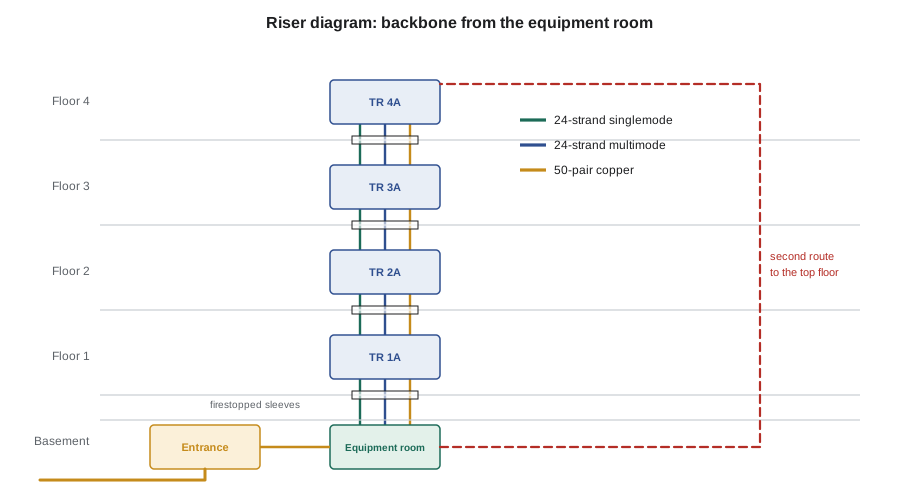
Sizing the backbone
Backbone capacity is counted in fibre strands and copper pairs. On the fibre side, each switch stack in a telecommunications room needs a pair of strands per uplink, and most networks use two uplinks for resilience, often on different fibre cables. Other systems may need their own strands: a separate security network, building automation, a service provider's circuit carried to a tenant floor. Designers then add generous spare capacity because a fibre cable, once installed in a riser, is expensive to supplement. Common practice is to install fibre in cable sizes of 12, 24, 48 or more strands, terminated in full, so that spare strands are ready to patch when needed.
On the copper side, older designs provided a fixed number of voice pairs for each work area. Most buildings now need far fewer, but owners usually require a minimum, such as 25 or 50 pairs per room for analog lines, alarm communicators, fax lines, emergency telephones and elevator telephones, with spare capacity.
# Backbone fibre and copper for each telecommunications room
import math
rooms = {"1A": 260, "2B": 380, "3A": 310}   # outlets served by each room
CABLE_SIZES = [12, 24, 48, 72, 96]

def optic_strands(outlets):
    stacks = math.ceil(outlets / 192)       # up to four 48-port switches per stack
    uplinks = stacks * 2 * 2               # two uplinks per stack, two strands each
    other = 4                                # security network and building systems
    needed = (uplinks + other) * 2           # 100 % spare
    return needed, next(s for s in CABLE_SIZES if s >= needed)

for room, n in rooms.items():
    need, size = optic_strands(n)
    pairs = max(25, math.ceil(n * 0.1 / 25) * 25)    # owner minimum 25 pairs
    print(f"room {room}: {n} outlets -> {need} strands needed, install {size}-strand cable "
f"(singlemode) plus {size}-strand multimode; {pairs}-pair copper")room 1A: 260 outlets -> 24 strands needed, install 24-strand cable (singlemode) plus 24-strand multimode; 50-pair copper room 2B: 380 outlets -> 24 strands needed, install 24-strand cable (singlemode) plus 24-strand multimode; 50-pair copper room 3A: 310 outlets -> 24 strands needed, install 24-strand cable (singlemode) plus 24-strand multimode; 50-pair copper
The example follows Riverside school's board standard, which requires both a singlemode and a multimode cable to every room, each sized for twice the strands the network needs today, and at least 25 copper pairs. A different owner might choose singlemode only, or hybrid cables, but the method is the same: count the uplinks and services, add spare, round up to a cable size.
Resilience and diverse routes
A single riser is a single point of failure. A fire, a flood or a careless drill through one shaft can cut every backbone cable in the building. Owners who cannot tolerate that, such as hospitals, emergency centres and many data-intensive offices, specify diverse routing: a second set of backbone cables, following a physically separate route, often to a second equipment room or entrance. On a campus, critical buildings may have two entrance conduits from different directions and two service providers entering through different entrances. Diverse routes only help if they are truly separate; two cables in the same sleeve, or in separate sleeves that share one corridor ceiling, are not diverse.
St. Brendan's is the strongest case among Cobalt Line's jobs. The hospital's standard requires every telecommunications room in a clinical area to have backbone from both of its two equipment rooms, by routes that share no floor slab penetration, no shaft and no corridor, and the drawings show the two routes in different colours so that nobody combines them during construction.
Worked problem
Choosing fibre for Riverside's gymnasium
Riverside's separate gymnasium building is fed from the main cross-connect by a campus backbone through underground conduit. The cable route, including vertical rises at both ends and slack loops, is 320 m (1,050 ft). The board wants the gymnasium to have 10 gigabit uplinks now and the option of 40 gigabit later. Which fibre should be installed?
Show solution
- For 10 gigabit today, both OM3 (300 m) and OM4 (400 m) were candidates; OM3 falls short at 320 m (1,050 ft), so OM4 or singlemode is needed.
- For 40 gigabit later, OM4 reaches only about 150 m with SR4 optics, well short of the route length.
- Singlemode reaches several kilometres at 10, 40 and 100 gigabit with LR optics, so its reach is limited by the transceivers, not the fibre.
- The underground route must use outdoor-rated cable, or indoor/outdoor cable, with water-blocking, and the cable must be terminated or transitioned within the code's distance after it enters each building.
Answer: Sanjay specifies a 24-strand singlemode indoor/outdoor cable, plus a 12-strand OM4 cable as the owner's standard requires, so that the gymnasium can be upgraded by changing optics alone.
Backbone in renovations
In existing buildings, the backbone is often the hardest part of a project. Old risers may be full of abandoned cable, which the electrical code requires to be removed when it is not tagged for future use, and the firestopping around it may be missing or damaged. Before Cobalt Line adds a new fibre cable to an existing riser, Maya and Dev survey every floor: which sleeves have room, which old cables can be identified and removed, and which penetrations need their firestopping restored. At St. Brendan's, the survey found three sleeves packed with unlabelled copper from a telephone system retired years earlier. Removing it, with the hospital's approval and under its infection control rules, freed enough space for the new backbone and a spare sleeve on every floor.
Backbone cables also need room to be worked on later. Each cable is left with a service loop in the equipment room and in each telecommunications room, coiled neatly on the ladder rack or in a slack storage bracket, so that a damaged end can be re-terminated or a panel moved without splicing. Fibre slack is stored within its minimum bend radius, never in tight coils tied off with cable ties.
Testing completes the backbone work. Every fibre strand is tested for loss after termination, as LVT-210 describes, and every copper pair for continuity and correct pairing. The results go into the records along with the strand assignments, so that the network team knows which strands are in use and which are spare from the first day.
Common mistakes
MistakeFeeding one telecommunications room from another to save backbone.
InsteadRun each room's backbone from the main or an intermediate cross-connect.
MistakeChoosing multimode fibre only for today's speed and distance.
InsteadCheck the reach at the fastest application expected over the cable's life; singlemode is often the safer choice.
MistakeHanging a long vertical cable from the top floor only.
InsteadSupport it at each floor within the manufacturer's maximum vertical rise.
MistakeCalling two cables in the same shaft a diverse route.
InsteadDiverse routes share no penetration, shaft or ceiling pathway.
MistakeLeaving a riser sleeve open after pulling cable.
InsteadFirestop every penetration with a listed system each time cables are added.
Summary and key terms
- Backbone cabling connects the entrance facility, the equipment room and the telecommunications rooms, and on a campus the buildings.
- Optical fibre carries backbone data; multipair copper carries voice and low-speed circuits; four-pair cable can serve short backbone runs within 100 m.
- Multimode reach falls sharply at higher speeds; singlemode reach is limited by the transceivers, not by campus distances.
- Riser cables run in sleeves or slots that are firestopped, are supported at each floor and carry the code's riser fire rating.
- Backbone is sized from uplinks and services, with generous spare, rounded up to a standard cable size.
- Critical buildings use physically diverse backbone routes.
- Backbone cabling
- Cabling between the entrance facility, equipment room and telecommunications rooms, and between buildings.
- Riser
- A vertical pathway, usually stacked rooms connected by floor sleeves or slots, that carries backbone cables between floors.
- Multimode fibre
- Optical fibre with a larger core, usually 50 µm, used for shorter, lower-cost links.
- Singlemode fibre
- Optical fibre with a core of about 9 µm, used for high speeds over long distances.
- Multipair cable
- Twisted-pair copper cable with many pairs, such as 25 or 100, used for voice and low-speed backbone.
- Diverse routing
- Backbone cables following physically separate routes so that one event cannot cut them all.
- Uplink
- The connection from a floor switch to the network core, carried on backbone cabling.
Practice problems
Work each problem on paper first, then reveal the answer to check.
What fire rating does riser cable need?
Show answer
FT4 in Canada, the rating for cables between floors; FT6 where the cable passes through a plenum.
A room needs four uplinks of two strands each and four strands for other systems. With 100 % spare, what cable size?
Show answer
(8 + 4) × 2 = 24 strands, so a 24-strand cable.
Why do many owners now specify singlemode in the building backbone?
Show answer
Its reach covers any future speed over building and campus distances, and its cost has fallen.
What does a split-mesh grip do in a riser?
Show answer
It supports the weight of a vertical cable at a floor so the cable does not hang from the top.
Name two things that defeat diverse routing.
Show answer
Sharing a sleeve, shaft or corridor ceiling pathway; or both routes ending in the same room.
Lesson quiz · 5 questions
Score 60% or more to complete this lesson.
Create a free account to save your progress, take quizzes and earn a certificate.