
LVT-110 · Lesson 7 of 12 · 19 min
Safety around power systems and arc flash awareness
Low-voltage technicians do not work on power circuits, but they work close to them every day. Data cable shares ceilings with lighting circuits; telecommunications rooms contain panelboards; access control power supplies are fed from 120 V circuits; cameras are mounted on poles beside parking lot lighting; and in renovations, old cables of unknown purpose lie in the ceiling beside live conductors. This lesson covers the hazards of electrical power, how the safety standards control them, and the practices a low-voltage technician uses to stay clear of them. It does not qualify anyone to work on energized power equipment, which requires electrical training and authorization well beyond this course.
Electric shock
An electric shock happens when current passes through the body. The harm depends on the current, the path and the duration, and the current depends on the voltage and the resistance of the body and its contact. Dry skin has a high resistance, thousands of ohms; wet skin, sweat, cuts and a firm grip on a conductor lower it sharply, and once the skin is broken the body's internal resistance is only a few hundred ohms. Approximate effects of 60 Hz current through the trunk are well established: about 1 mA can be felt, around 10 to 20 mA can cause muscles to clamp so the person cannot let go, and from about 50 to 100 mA the heart can go into ventricular fibrillation, which is fatal without prompt defibrillation. At 120 V, a hand-to-hand path through wet skin can easily pass that much.
Class 2 circuits are designed to keep the voltage low enough that shock is unlikely in normal conditions, which is why their limits are lower in wet locations. A 24 V circuit can still give a noticeable shock to wet hands. A 57 V PoE pair or a 70 V paging line can be felt and can startle someone on a ladder into a fall, which is a more common outcome than electrocution in this trade.
Arc flash and arc blast
An arc flash is an electrical explosion. When a fault creates a path through the air between conductors of a power system, for example when a tool slips across bus bars or a conductor's insulation fails, the current flows through an arc of ionized gas. The arc can reach temperatures of several thousand degrees, vaporizes copper, and releases an intense flash of heat and light, a pressure wave and molten metal. The energy depends on the fault current available from the system and on how long the arc lasts before a breaker or fuse clears it. At the panelboards and switchboards of a commercial building, an arc flash can cause severe burns several metres away and the pressure wave can throw a worker across a room.
Arc flash hazards are greatest where power equipment is open: when panel covers are off, when breakers are racked in or out, or when electricians test or work inside equipment. A closed, properly maintained panel presents little arc flash hazard under normal operation. That is why the main rule for a low-voltage technician is simple: never open power equipment, and keep clear of open power equipment that others are working on.
The safety standards
In Canada, CSA Z462, Workplace electrical safety, sets out the requirements for protecting workers from shock and arc flash; its current edition is CSA Z462:24. Ontario's Occupational Health and Safety Act and its construction regulation, O. Reg. 213/91, require electrical equipment to be de-energized and locked out before work unless specific conditions are met, and require workers to be competent for the work they do. The standard divides the space around exposed energized conductors into boundaries.
- The limited approach boundary is the distance from exposed energized conductors within which a shock hazard exists. Unqualified persons may not cross it unless escorted and advised by a qualified person. For systems from about 151 to 750 V, it is 1.0 m from exposed fixed conductors.
- The restricted approach boundary is closer, 0.3 m for 151 to 750 V; only qualified persons with shock protection may cross it.
- The arc flash boundary is the distance at which the incident energy of an arc flash would fall to the level that causes a second-degree burn on bare skin, 1.2 cal/cm² (5 J/cm²). It depends on the equipment and is shown on the arc flash label that equipment owners are required to apply to panels and switchboards.
A low-voltage technician is an unqualified person under the standard for power equipment. She may work near closed equipment, but she must not cross the limited approach boundary of exposed energized parts, and she must stay outside the arc flash boundary of any equipment that is open or being worked on.
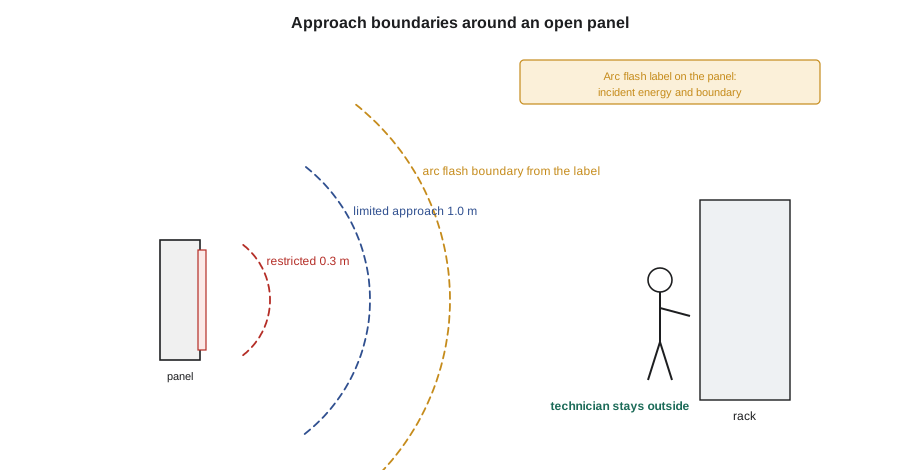
# Approach boundaries for exposed fixed energized conductors (values from the standard's table, illustrative)
# nominal system voltage range (V): (limited approach, restricted approach)
TABLE = [((50, 150), ("1.0 m", "avoid contact")),
         ((151, 750), ("1.0 m", "0.3 m"))]
def boundaries(volts):
    for (lo, hi), b in TABLE:
        if lo <= volts <= hi:
            return b
    return None
for name, v in (("receptacle circuit", 120), ("panelboard bus, 600 V", 600), ("PoE pair", 57), ("Class 2 lock supply", 24)):
    b = boundaries(v)
    if v < 50:
        print(f"{name:<28} {v:>4} V: below the 50 V threshold; no shock approach boundary")
    else:
        print(f"{name:<28} {v:>4} V: limited {b[0]}, restricted {b[1]}")
print("arc flash boundary: read it from the equipment's arc flash label")receptacle circuit 120 V: limited 1.0 m, restricted avoid contact panelboard bus, 600 V 600 V: limited 1.0 m, restricted 0.3 m PoE pair 57 V: limited 1.0 m, restricted avoid contact Class 2 lock supply 24 V: below the 50 V threshold; no shock approach boundary arc flash boundary: read it from the equipment's arc flash label
The listing shows why the standard has a 50 V threshold: most Class 2 and communication circuits are below it, while PoE at 57 V sits just above, although its source is limited. The standard's tables give the boundaries for exposed conductors; covered conductors in a closed panel are a different matter.
Treat every unknown conductor as live
The most dangerous moments for a low-voltage technician come in existing buildings. Cables of unknown purpose lie in old ceilings; a junction box above a tile may contain splices of a lighting circuit; an abandoned telephone backboard may have a 120 V receptacle wired behind it; a previous contractor may have run a 24 V circuit in the same box as 120 V wiring. Dev's rules for unknown conductors are blunt.
- Assume an unknown conductor is live until it has been proven dead by a qualified person or with an appropriate tester.
- Never cut a cable whose purpose and source are not confirmed. Trace it, label it, and ask.
- Do not open junction boxes, panelboards, luminaires or other power enclosures. If a low-voltage cable must pass through or near one, the electrical contractor provides the opening or sleeve.
- Use a non-contact voltage tester as a warning device, not as proof that a conductor is dead. Test it on a known live source before and after use.
- Report damaged power wiring, missing covers and exposed conductors to the supervisor and keep others away until they are fixed.
A non-contact voltage tester detects the electric field around an AC conductor and beeps or lights when it senses one. It is useful for warning a technician that a cable in a ceiling is energized, but it can miss a live conductor that is shielded, in metal conduit or carrying DC, and it can respond to a dead conductor coupled to a live one nearby. Proving a power conductor dead requires a properly rated voltage tester, a test on a known source, and a qualified person.
Lockout and the low-voltage technician
When power must be removed from equipment so that work can be done safely, the equipment is locked out: its disconnecting means is opened, each worker applies a personal lock and tag, and the absence of voltage is verified before work starts. A low-voltage technician participates in lockout when her work requires power to be off, for example when an electrician disconnects the 120 V feed to an access control supply so that it can be replaced, or when a camera is installed beside a parking lot luminaire. The electrician performs the isolation and the voltage test; Maya applies her own personal lock to the lockout point or the group lockout box, and removes only her own lock when her work is finished. No one else's lock may ever be removed by her, and her lock is never removed by anyone else except under the employer's documented procedure for an absent worker.
Lockout also applies to low-voltage systems with stored or hazardous energy that is not electrical: an automatic door operator, a motorized projection screen, an overhead coiling door with a card reader, or a gate operator. Their motors are power circuits, and their mechanisms can move and crush. They are isolated and locked out before a technician works on the door hardware, and the motion is tested to confirm it cannot start.
# Test-before-touch sequence for proving a conductor dead (performed by the qualified person)
steps = ["confirm the tester is rated for the voltage and category (CAT III 600 V or higher)",
         "test the tester on a known live source",
         "test each conductor to each other conductor and to ground",
         "test the tester again on the known live source",
         "only then treat the circuit as dead; keep the lock on until work is done"]
for n, s in enumerate(steps, 1):
    print(f"{n}. {s}")
print("a non-contact tester alone does not prove a conductor dead")1. confirm the tester is rated for the voltage and category (CAT III 600 V or higher) 2. test the tester on a known live source 3. test each conductor to each other conductor and to ground 4. test the tester again on the known live source 5. only then treat the circuit as dead; keep the lock on until work is done a non-contact tester alone does not prove a conductor dead
Telecommunications rooms and shared spaces
In a well-designed telecommunications room, power and low-voltage systems are separated: the panelboard, if there is one, sits in its own area with clear working space in front of it, and the racks and backboards are elsewhere. Clear working space in front of power equipment is required by the electrical code, about 1 m in depth, and must never be used to store cable reels, ladders or boxes. Maya keeps that space clear and never stands in it to work on a rack. If the room was not designed that way, Dev raises it with Colette before the crew moves in, because a crowded room with a panel beside the rack is where a technician is most likely to be near open power equipment when an electrician is working.
Worked problem
An unknown cable in the hospital ceiling
In the east wing renovation at St. Brendan's, Maya finds an old grey cable with three conductors running across the ceiling in the path of her new cable tray. It is not on the drawings. A non-contact tester shows no response. Can she cut it?
Show solution
- No. The non-contact tester cannot prove the cable dead: it may carry DC, be shielded, or be fed from an emergency circuit that is off now and on later.
- Maya stops, marks the cable, and reports it to Dev.
- Dev asks the electrical contractor's foreman to trace it. It turns out to be a 120 V circuit to an old nurse call annunciator, fed from the emergency power panel, which was out of service for testing that morning.
- The electrician disconnects and removes it under lockout, and Cobalt Line's tray goes in afterwards.
Answer: No; she stops and reports it. The cable proved to be a live emergency circuit that was temporarily off.
Common mistakes
MistakeUsing a non-contact tester to prove a cable dead.
InsteadIt only warns; proving dead needs a rated tester and a qualified person.
MistakeOpening a junction box to route low-voltage cable through it.
InsteadNever open power enclosures; ask the electrical contractor.
MistakeStoring reels in the working space in front of a panel.
InsteadKeep the required working space clear at all times.
MistakeRemoving someone else's lock because the work looks finished.
InsteadOnly the person who applied a lock removes it, except under the employer's formal procedure.
MistakeAssuming a PoE or paging circuit cannot cause harm.
InsteadIt can startle a worker on a ladder into a fall; work carefully on all circuits.
Summary and key terms
- Shock harm depends on current, path and time; tens of milliamperes through the chest can be fatal.
- Arc flash is an electrical explosion at open power equipment; its energy depends on fault current and clearing time.
- CSA Z462 and provincial regulations set limited and restricted approach boundaries and arc flash boundaries.
- Low-voltage technicians are unqualified persons for power equipment: they stay outside the boundaries and never open power enclosures.
- Unknown conductors are treated as live; non-contact testers only warn; lockout uses each worker's personal lock.
- Arc flash
- The heat and light released by an electrical arc fault in power equipment.
- Limited approach boundary
- The distance from exposed energized parts within which a shock hazard exists.
- Restricted approach boundary
- The closer distance that only qualified, protected persons may cross.
- Arc flash boundary
- The distance at which arc flash energy falls to the threshold for a second-degree burn.
- Qualified person
- A person trained and authorized to work on or near the specific energized equipment.
- Lockout
- Isolating equipment from energy sources and securing the isolation with personal locks and tags.
- Non-contact voltage tester
- A pen-style detector that warns of an AC electric field without touching the conductor.
Practice problems
Work each problem on paper first, then reveal the answer to check.
At about what current through the chest can 60 Hz current cause ventricular fibrillation?
Show answer
From roughly 50 to 100 mA.
Why can a non-contact tester miss a live conductor?
Show answer
It cannot sense DC, and shielding or metal conduit can block the field.
Where does a low-voltage technician find the arc flash boundary for a panel?
Show answer
On the arc flash label applied to the equipment.
Who removes a worker's personal lock at the end of the job?
Show answer
The worker who applied it.
Lesson quiz · 5 questions
Score 60% or more to complete this lesson.
Create a free account to save your progress, take quizzes and earn a certificate.